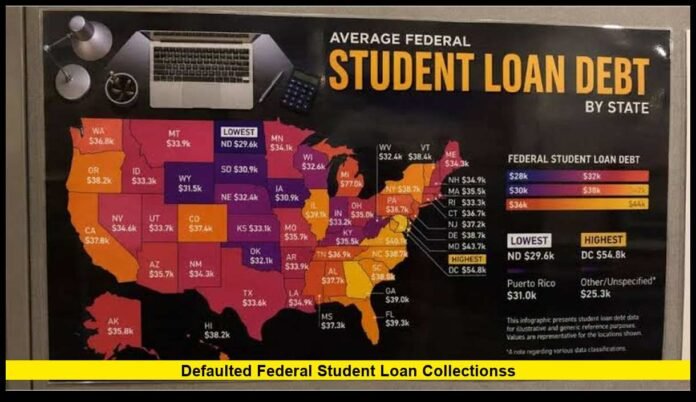

Defaulted federal student loan collections remain a major financial concern for Americans who have fallen behind on education debt, particularly as federal repayment programs and collection policies change. Borrowers facing default need to understand the current collection procedures, the temporary delay in certain involuntary collection activities announced in January 2026, and the steps available to restore their loans to good standing.
A federal student loan default can affect far more than a monthly budget. It may damage a borrower’s credit history, restrict access to additional federal student aid, and expose eligible wages or federal payments to collection. Although a temporary delay can provide time to review available options, it does not forgive outstanding debt or automatically resolve a default.
The most effective response starts with identifying the loan holder, checking the current account status, and determining which resolution option fits the borrower’s circumstances. Rehabilitation, consolidation, and repayment arrangements may offer paths forward, but each has different requirements and consequences.
Understanding the Latest Federal Collection Developments
Federal student loan collection policies have changed as the government works through repayment-system adjustments and implementation of new legislation. On January 16, 2026, the U.S. Department of Education announced a temporary delay in involuntary collection activities, including administrative wage garnishment and the Treasury Offset Program.
These collection methods allow the government to recover qualifying debts without relying solely on voluntary monthly payments. Wage garnishment directs an employer to withhold part of a borrower’s disposable earnings, while a Treasury offset can redirect eligible federal payments toward a debt.
The announced delay gives affected borrowers an opportunity to review their accounts and investigate available resolution options. However, borrowers should not interpret it as a cancellation of the debt or a permanent suspension of the government’s collection authority.
A pause in certain enforcement activities also does not necessarily stop interest from accruing, remove negative credit information, or restore federal student aid eligibility. Those consequences depend on the applicable loan terms, federal rules, and the borrower’s account status.
Borrowers should therefore monitor official notices and verify current instructions before making financial decisions based on the delay. A collection policy announcement is not a substitute for an individual determination of eligibility or account status.
When a Federal Student Loan Becomes Defaulted
For most federal student loans that require monthly payments, default generally occurs after 270 days of missed payments. The borrower first becomes delinquent after missing a scheduled payment, but the account does not immediately enter default.
During delinquency, the loan servicer may send reminders, request payment, or explain available repayment arrangements. If the borrower continues to miss payments and reaches the applicable default threshold, the consequences become more serious.
Some federal loan types follow different rules. Federal Perkins Loans, for example, may have different default provisions, so borrowers should confirm the requirements that apply to their specific loans.
Once a loan enters default, the government may demand the outstanding balance under applicable loan terms. The account may move to the Department of Education’s Default Resolution Group or, in certain cases involving commercially held Federal Family Education Loan Program loans, a guaranty agency.
Borrowers should not assume that a loan is current simply because they have stopped receiving statements from their previous servicer. Checking StudentAid.gov and contacting the organization responsible for the defaulted account can help establish the correct status.
How Federal Student Loan Collections Affect Borrowers
Federal collection procedures can create several financial pressures at the same time. The consequences depend on the loan, the collection method, and whether the borrower has entered an approved resolution arrangement.
Administrative wage garnishment is one of the most significant concerns. Under the general federal process, qualifying student loan debt can result in withholding of up to 15% of disposable pay without a court judgment. Applicable legal protections and procedures still govern the process.
The Treasury Offset Program works differently. Rather than withholding earnings through an employer, it can intercept eligible federal payments, including federal tax refunds, to recover qualifying debts.
Other consequences may include negative credit reporting, collection notices, and restrictions on receiving additional federal student aid while the default remains unresolved.
The total amount owed may also change over time. Interest can continue to accrue under the applicable loan terms, and authorized collection costs may affect the balance.
Borrowers who receive official collection notices should read them carefully, verify the amount claimed, and identify any response deadlines. Prompt action can help prevent avoidable mistakes and preserve the opportunity to challenge an inaccurate debt or collection action.
Loan Rehabilitation Offers a Structured Way Out of Default
Loan rehabilitation is a federal program that can help eligible borrowers return a defaulted student loan to good standing. It requires the borrower to make an agreed series of qualifying payments under the applicable rehabilitation rules.
For most eligible loans, rehabilitation requires nine voluntary, reasonable, and affordable payments within a 10-month period. The precise payment calculation depends on the borrower’s circumstances and the program’s requirements.
Income and expenses may influence the amount. In some circumstances, an eligible borrower may qualify for payments as low as $5 per month. Borrowers should obtain an individualized calculation rather than assume that the minimum amount will apply to their account.
Successful rehabilitation can offer important benefits. The loan comes out of default, the borrower may regain access to federal student aid, and the default notation is generally removed from the borrower’s credit history.
However, rehabilitation does not erase every negative credit entry associated with the loan. Late payments previously reported may remain, and the borrower’s credit score may not improve immediately.
Rehabilitation also takes time. Borrowers should ask the organization managing the loan how payments will be calculated, when the agreement begins, which payments qualify, and when the account will officially leave default.
Federal Loan Consolidation Can Provide Another Resolution Option
Direct Consolidation Loans allow eligible borrowers to combine qualifying federal student loans into a new federal loan. For certain borrowers in default, consolidation can provide a route out of default without completing the full rehabilitation payment sequence.
Eligibility requirements apply. A borrower may need to agree to repay the new loan under an eligible repayment plan or meet other conditions established by federal rules. The available route depends on the loan type and the borrower’s circumstances.
Consolidation can be useful for people seeking to simplify several loan accounts or restore eligibility for repayment benefits. Nevertheless, it is not automatically the best option for every borrower.
The original default notation generally does not disappear from a credit report simply because a borrower consolidates. Consolidation may also capitalize unpaid interest, increasing the principal balance on which future interest accrues.
Before proceeding, borrowers should compare the expected payment, total repayment cost, credit-reporting consequences, and eligibility requirements with those of rehabilitation. The organization handling the default can explain which options remain available.
What Borrowers Should Know About Wage Garnishment
Administrative wage garnishment can be particularly disruptive because it reduces the money a borrower receives from each paycheck. Federal law generally allows the government to withhold up to 15% of disposable earnings for qualifying defaulted student loan debt.
Disposable earnings are not necessarily the same as take-home pay. The calculation follows applicable legal rules concerning earnings and required deductions.
Before a garnishment begins, the government generally provides notice and an opportunity for the borrower to respond. Depending on the circumstances, a borrower may request a hearing, dispute the debt, challenge the proposed amount, or raise a qualifying financial-hardship argument.
Deadlines matter. A borrower who receives a notice should follow the instructions carefully and preserve copies of all correspondence.
If the borrower believes the loan has already been paid, the balance is wrong, or the debt does not belong to them, supporting documents can help establish the issue. Payment confirmations, account statements, and relevant correspondence may be useful.
Because collection policies can change, borrowers should confirm whether any announced delay applies to their specific situation rather than assume that every garnishment notice has been canceled.
Tax Refund Offsets and Federal Payments
A defaulted federal student loan may also be subject to collection through the Treasury Offset Program when applicable rules permit. This program can redirect eligible federal payments to satisfy qualifying debts.
Federal tax refunds are a common concern for borrowers who expect to use the money for rent, household bills, or other essential expenses. An offset can reduce or eliminate the refund available to the borrower.
Before an offset, borrowers generally receive a notice explaining the debt and the process for challenging the proposed action. Anyone who disputes the amount or believes the debt has been resolved should follow the notice’s instructions.
Borrowers should keep proof of payments and any documentation that supports a dispute. They should also verify the account status before relying on an expected refund to cover essential expenses.
The temporary delay announced in January 2026 included the Treasury Offset Program, but borrowers should check the latest official guidance for changes to the policy and its implementation.
Credit Reporting and Long-Term Financial Effects
A federal student loan default can make it harder to obtain credit on favorable terms. Lenders may consider the default when evaluating applications for credit cards, vehicle financing, mortgages, and other borrowing.
The impact depends on the borrower’s overall credit history and the lender’s evaluation process. A default does not guarantee that every credit application will be rejected, but it can create an additional obstacle.
Successful rehabilitation generally removes the default notation from the borrower’s credit history. However, accurate late-payment information reported before rehabilitation may remain.
Consolidation generally does not provide the same removal of the original default notation. Depending on applicable reporting rules, a default can remain on a credit report for up to seven years, although specific federal student loan reporting circumstances may differ.
Borrowers should review their credit reports for accuracy and dispute information that is incorrect. They should not pay a company that promises to erase accurate credit history through a special shortcut.
Resolving the underlying loan is the essential step. Credit recovery may take time and depends on several factors beyond the loan account itself.
Federal Repayment Changes and Future Options
Federal student loan repayment rules are changing under legislation enacted in 2025. The new framework introduces changes to repayment options, including the Repayment Assistance Plan, which became available beginning July 1, 2026, for eligible borrowers.
A borrower with a loan still in default generally cannot simply enroll in an income-driven repayment plan and treat the default as resolved. The borrower must first qualify for an applicable route out of default, such as rehabilitation or consolidation.
The legislation also provides for a second opportunity to rehabilitate an eligible defaulted loan beginning July 1, 2027. This future provision may help some borrowers who previously used their rehabilitation opportunity.
That second opportunity is not the same as an option already available to every borrower in October 2026. Eligibility, implementation details, and applicable program rules must be checked before making a repayment decision.
Borrowers should review their current choices rather than delay action solely because additional provisions may become available later. Waiting can allow financial and credit consequences to continue.
Steps to Take When a Loan Is in Default
Borrowers can make progress by following a practical sequence:
- Check the loan status: Sign in to StudentAid.gov and review the federal loans listed in the account.
- Identify the responsible organization: Determine whether the loan is handled by the Default Resolution Group, a guaranty agency, or another authorized organization.
- Review notices and deadlines: Read collection letters carefully and respond within the stated time limits.
- Compare rehabilitation and consolidation: Request details about payment requirements, eligibility, credit reporting, and the time needed to resolve the default.
- Keep documentation: Save payment records, written agreements, notices, and confirmation numbers.
- Protect personal information: Use verified federal channels and avoid companies that promise guaranteed forgiveness in exchange for upfront fees.
Borrowers who cannot afford a proposed payment should explain their financial circumstances and ask which options are available. Ignoring notices rarely improves the situation, while a documented conversation can help clarify the next steps.
Frequently Asked Questions
Can federal student loan collections be stopped?
Certain involuntary collection activities were subject to a delay announced in January 2026. Whether a specific action is paused depends on current federal policy and the borrower’s circumstances. Resolving the default remains important.
How much can be taken from wages?
Administrative wage garnishment can generally reach up to 15% of disposable pay for qualifying federal student loan debt, subject to applicable protections and procedures.
Does rehabilitation remove a default?
Successful rehabilitation generally brings the eligible loan out of default and removes the default notation from the credit history. Earlier late-payment entries may remain.
Is consolidation faster than rehabilitation?
Consolidation can provide a quicker route out of default for eligible borrowers, but it has different credit-reporting and financial consequences. Borrowers should compare both options before deciding.
What is the first step after receiving a collection notice?
Verify the debt, read the notice for deadlines, and contact the organization responsible for the loan. If the debt or collection amount is incorrect, follow the stated dispute process.
Conclusion
Defaulted federal student loan collections can create serious financial pressure, but borrowers may have several ways to regain control of their accounts. Understanding the latest collection policies, checking official loan records, and comparing available resolution programs can help borrowers make informed decisions. A temporary delay should be treated as an opportunity to act, not a reason to ignore the debt.
Have you experienced challenges with federal student loan repayment or found a way to resolve a default? Share your thoughts in the comments and keep checking for the latest confirmed changes to federal student loan policies.