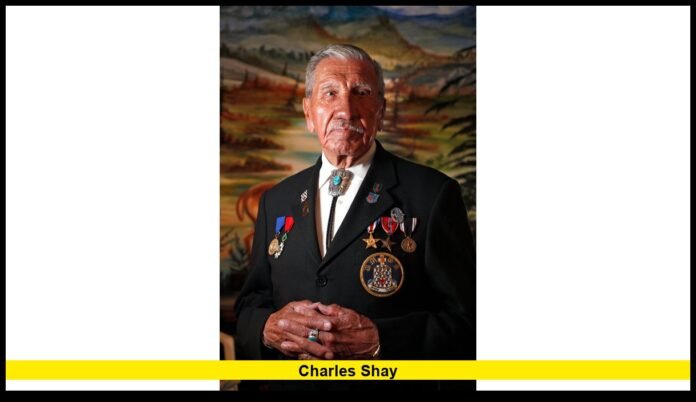

Charles Shay, the renowned Native American U.S. Army medic who became one of the most recognized heroes of D-Day, died on December 3, 2025, at the age of 101. His death in Normandy, France, marks the passing of one of the last surviving first-wave Omaha Beach veterans and a deeply respected figure in American military history.
A Life Marked by Extraordinary Service
Born on June 27, 1924, in Bristol, Connecticut, Shay was raised on the Penobscot Nation’s reservation on Indian Island, Maine. His upbringing strongly shaped his sense of duty and identity, both of which guided him through two major wars and decades of service that followed.
Drafted in 1943, Shay joined the 1st Infantry Division and headed to Europe the following year. On June 6, 1944, he took part in the first wave of the D-Day assault on Omaha Beach. Machine-gun fire, explosions, and rising tides created deadly conditions, yet Shay repeatedly ran into the surf to pull wounded soldiers to safety. His life-saving actions earned him the Silver Star and placed him among the most celebrated American medics of the Second World War.
Beyond D-Day, Shay also served in the battles of Aachen, Huertgen Forest, and the Battle of the Bulge. Later in the war, he was briefly held as a prisoner of war before being liberated. His bravery and resilience became defining parts of his legacy.
After WWII, Shay reenlisted and served as a medic in the Korean War. He later worked internationally during the early years of the Cold War, demonstrating a continued commitment to global service and diplomacy.
Honors and Lasting Recognition
Throughout his life, Shay received numerous prestigious honors for his military service. His awards include the Silver Star, multiple Bronze Star Medals, and France’s Legion of Honour. His home state of Maine honored him in 2024 by naming a Penobscot Bay ferry after him, ensuring future generations would see and recognize his name.
Shay also dedicated years to documenting and preserving Native American military history. He was instrumental in republishing historical works by his grandfather and wrote his own memoir detailing his wartime experiences. Through his writing and public appearances, he helped raise awareness about the sacrifices made by Native American service members.
A Life in Normandy and a Mission to Remember
In his later years, Shay chose to live permanently in Normandy, a place indelibly linked to his youth and his heroism. He lived near Omaha Beach, where he regularly participated in memorial events and greeted visitors who traveled from around the world to learn about D-Day.
Even during the global pandemic, Shay continued his role as a symbolic representative at remembrance ceremonies when many veterans could not travel. He saw his presence as a responsibility—one that connected the modern world to the sacrifices of 1944.
In his final years, Shay passed symbolic leadership of remembrance efforts to another Native American veteran, ensuring the continuation of the legacy he had built. He remained a steadfast advocate for peace and historical memory, expressing deep concern over the return of conflict in Europe.
Tributes and National Remembrance
Tributes poured in following his passing. Leaders in Maine and across the veteran community honored his lifelong service, his bravery under fire, and the significance of his role as a Native American soldier who fought for freedoms his own community did not fully enjoy at the time.
Veteran organizations highlighted Shay’s efforts to preserve history and support fellow service members. Advocates for Native American heritage praised his role in elevating long-overlooked stories of Indigenous bravery in the U.S. Armed Forces.
Shay leaves behind a memorial in Normandy dedicated to nearly 500 Native American service members who landed on the beaches during the D-Day invasion. His presence there brought comfort, inspiration, and historical clarity to thousands of visitors each year.
Why Charles Shay’s Legacy Matters
Charles Shay represents courage, sacrifice, and unwavering devotion to country. His story underscores several lasting themes:
- Native American contributions to American military history deserve wide recognition.
- Heroism on D-Day was not defined only by victory, but by the selflessness of individuals like Shay.
- Preserving memory is a vital service, one Shay carried out long after leaving the battlefield.
- His life bridges the past and the present, reminding America that freedom is built on countless acts of bravery.
Shay’s journey—from the Penobscot reservation to Omaha Beach and back to Normandy—has left a profound imprint on American and world history.
Charles Shay’s remarkable life stands as a testament to courage, compassion, and the enduring importance of honoring those who served.