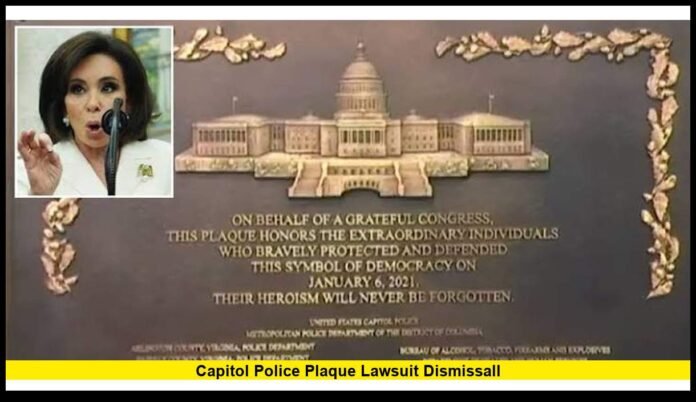

The capitol police plaque lawsuit dismissal has ended a closely watched federal court dispute involving two law enforcement officers who defended the U.S. Capitol during the January 6, 2021, attack. U.S. District Judge Dabney L. Friedrich dismissed the case after determining that former Capitol Police officer Harry Dunn and Metropolitan Police Department officer Daniel Hodges had not demonstrated the type of concrete legal injury required to bring their claims in federal court.
The ruling came after months of disagreement over a memorial plaque that Congress ordered to recognize law enforcement officers who responded to the Capitol attack. Although the plaque was eventually installed in 2026, its location and design became the center of a new dispute.
The decision is important because the judge’s ruling was based primarily on the constitutional requirement of standing. It did not simply declare that the officers’ concerns about the memorial were unfounded. Instead, the court concluded that the plaintiffs had not established that they personally suffered a legally recognizable injury that would allow the federal court to provide the relief they requested.
Why Congress Ordered the Capitol Police Memorial Plaque
The dispute traces back to legislation enacted in 2022.
Congress included a provision in the Consolidated Appropriations Act of 2022 recognizing the law enforcement personnel who protected the Capitol, lawmakers and staff during the January 6 attack. The legislation directed the Architect of the Capitol to obtain an honorific plaque listing the names of the officers involved.
The law also specified that the plaque was to be placed at a permanent location on the western front of the U.S. Capitol.
The requirement created an obligation for the Architect of the Capitol to complete the memorial within a specific period. However, the plaque was not installed by the deadline established by Congress.
The delay eventually became a source of increasing controversy among lawmakers and law enforcement officers who had participated in the response to January 6.
Harry Dunn and Daniel Hodges Take the Dispute to Court
Former Capitol Police officer Harry Dunn and Metropolitan Police Department officer Daniel Hodges filed their lawsuit in June 2025.
Both men had been involved in the response to the Capitol attack. Dunn, who served with the Capitol Police, became one of the most publicly recognized officers associated with the events of January 6. Hodges, a Metropolitan Police officer who assisted at the Capitol, was also among the officers who confronted rioters during the attack.
Their lawsuit sought to compel the federal government to comply with the congressional requirement concerning the memorial.
At the heart of their argument was the contention that the government had failed to carry out an obligation Congress had specifically established in law.
The lawsuit therefore was not initially about the wording or physical location of an existing plaque. When the case was filed, the central issue was the failure to install the memorial as required.
The Plaque Was Eventually Installed
The situation changed significantly in March 2026.
After years of delay, the memorial plaque was finally installed inside the Capitol. The installation was not accompanied by the kind of major public ceremony that might normally be associated with a memorial recognizing hundreds or thousands of law enforcement personnel.
The location also immediately became controversial.
Rather than being positioned in an area through which ordinary Capitol visitors would routinely pass, the plaque was installed in a restricted interior area near the western side of the building. The location was not part of the standard public tour route.
That distinction became central to the continuing legal dispute.
Dunn and Hodges argued that the installation did not satisfy the underlying congressional requirement because the memorial was supposed to have a permanent location on the Capitol’s western front.
Their position was that merely installing the plaque somewhere inside the Capitol did not resolve the government’s obligations under the 2022 legislation.
Why the Plaque’s Location Became Controversial
The disagreement over the location involved more than the physical position of a piece of bronze.
Supporters of the officers’ position argued that a memorial is intended to be publicly visible. If ordinary visitors cannot see it, they contended, the purpose of a public memorial is substantially diminished.
The plaintiffs therefore maintained that placing the plaque in a restricted area did not provide the public recognition contemplated by Congress.
The dispute was further complicated by the way individual officers were identified.
Rather than displaying the names of all responding officers directly on the physical plaque, the installation included a QR code that could provide access to a list of names.
That approach became another point of disagreement because the 2022 law specifically referred to a plaque listing the names of the officers.
As a result, the controversy evolved from a question about whether a plaque existed into a broader legal dispute over whether the government’s eventual installation satisfied the specific requirements established by Congress.
The Government’s Position
The federal government challenged the lawsuit on legal grounds, including questions about whether Dunn and Hodges had standing to pursue their claims.
Standing is a fundamental requirement in federal court. A plaintiff generally must demonstrate a concrete and particularized injury that is connected to the challenged conduct and can be addressed through the requested judicial relief.
The government’s position was that the officers’ interests in how the memorial was displayed did not automatically give them a constitutional right to bring the case.
That argument became increasingly important after the plaque was installed.
Once the government had placed the memorial inside the Capitol, the original demand to force an installation became more complicated. The plaintiffs continued to argue that the government’s actions did not satisfy the law, but the court still had to determine whether the officers themselves had suffered a legally sufficient injury.
What Judge Dabney Friedrich Decided
Judge Dabney L. Friedrich ultimately dismissed the case.
The September 30, 2026, ruling focused on Article III standing rather than ordering the government to move the memorial or redesign it.
The judge concluded that Dunn and Hodges had not demonstrated the type of concrete injury necessary for federal jurisdiction.
One issue addressed by the court involved what the plaintiffs described as personal or psychological harm resulting from the way the government had handled the memorial.
The ruling determined that those alleged injuries did not establish the required legal basis for standing.
In practical terms, the court drew a distinction between having a powerful personal interest in a government action and suffering a legally cognizable injury.
The officers had a direct connection to the events being commemorated. They had personally participated in the defense of the Capitol and had a significant interest in how their service and that of their colleagues was remembered.
But the court concluded that this connection alone was insufficient to satisfy the constitutional requirements for federal standing.
The Ruling Does Not Mean the Court Approved Every Detail of the Plaque
An important point for anyone following the case is what the ruling did not decide.
The dismissal does not amount to an order declaring that the plaque’s location perfectly satisfies every provision of the 2022 law.
It also does not require the officers to accept the current placement.
The court’s decision was instead about whether Dunn and Hodges had the legal standing necessary to pursue their claims in federal court.
That distinction matters because a dismissal based on standing can leave broader disagreements about government compliance unresolved.
The court did not issue an order requiring the plaque to remain permanently in its current location, nor did it direct Congress or the Architect of the Capitol to change the memorial.
The Difference Between the Original Lawsuit and the Current Dispute
The legal dispute changed considerably between 2025 and 2026.
When Dunn and Hodges filed the case, the plaque had not been installed despite the congressional mandate.
Their objective was therefore straightforward: obtain a court order requiring the government to install the memorial.
After the plaque was finally put in place, however, the government’s action altered the circumstances surrounding the lawsuit.
The plaintiffs argued that the installation did not comply with the law because of its location and the way officers’ names were presented.
The government, meanwhile, had a stronger argument that the principal action demanded by the original lawsuit had already occurred.
The resulting litigation became a question of whether the plaintiffs could continue challenging the government’s implementation after the physical plaque had been installed.
Why the Case Matters Beyond the Plaque
The dispute has broader implications for how federal courts handle lawsuits involving government obligations and memorials.
At one level, the case concerns a relatively specific congressional requirement.
At another, it illustrates the limits of federal judicial power.
Federal courts cannot automatically decide every dispute involving an alleged failure by the government to follow a statute. Plaintiffs must meet constitutional requirements before a court can reach the underlying merits.
The ruling therefore highlights the difference between an argument that government officials have failed to comply with a law and a legal claim that a particular plaintiff has suffered an injury that a federal court can remedy.
That distinction was decisive in this case.
What the Decision Means for the Memorial
The plaque remains installed inside the Capitol.
The memorial recognizes the law enforcement response to January 6, while additional information about individual officers is available through the QR-code system.
For the moment, the federal court has not ordered the plaque to be relocated to another part of the Capitol.
The ruling also does not automatically resolve congressional questions surrounding the memorial. Members of Congress could continue discussing whether the installation reflects the intent of the 2022 legislation.
The Architect of the Capitol and congressional leaders could also face continuing questions about the location, accessibility and presentation of the memorial.
Could the Lawsuit Continue in Another Form?
The district court’s dismissal does not necessarily mean that every possible legal avenue has disappeared.
Dunn and Hodges may have options available under federal appellate procedure, depending on the final judgment and the decisions made by their legal team.
An appeal would present another opportunity to challenge the district court’s interpretation of standing.
At the same time, any future litigation would have to overcome the same fundamental constitutional questions that played a central role in the district court’s decision.
Other forms of congressional or administrative action could also address the underlying disagreement without relying on the same lawsuit.
A Dispute That Began With a Missing Memorial
The story of the Capitol memorial has unfolded over several years.
Congress approved legislation calling for recognition of the officers who defended the Capitol in 2022. The required installation did not occur by the statutory deadline. Dunn and Hodges eventually went to federal court in 2025.
The plaque was finally installed in 2026, but its location and presentation immediately generated another dispute.
The officers maintained that the government’s solution did not fully satisfy Congress’s instructions. The government challenged whether the officers had a sufficient legal basis to pursue those objections in federal court.
Judge Friedrich ultimately sided with the standing argument and dismissed the case.
The capitol police plaque lawsuit dismissal therefore represents a procedural resolution rather than a comprehensive judicial determination of every question surrounding the memorial.
Key Facts to Know
- Harry Dunn and Daniel Hodges filed the federal lawsuit in 2025.
- Both officers participated in the law enforcement response to January 6, 2021.
- Congress had directed the Architect of the Capitol to establish a memorial plaque.
- The congressional deadline passed without the plaque being installed.
- The plaque was eventually installed inside the Capitol in March 2026.
- The location was not part of the normal public tour route.
- The physical memorial does not display the complete list of individual officers directly; a QR code provides access to additional names.
- Dunn and Hodges argued that the installation did not fully comply with Congress’s instructions.
- Judge Dabney L. Friedrich dismissed the case on September 30, 2026.
- The court concluded that the plaintiffs had not demonstrated a sufficiently concrete injury to establish Article III standing.
- The ruling did not order the plaque moved or declare that every aspect of the installation complied with the underlying law.
- Further congressional, administrative or appellate developments could affect the memorial’s future.
What Comes Next for the Capitol Memorial
The next stage of the dispute will depend on whether the plaintiffs pursue further legal action and whether Congress takes additional steps concerning the memorial.
For now, the plaque remains in the Capitol, ending one part of a lengthy effort to establish a permanent memorial for the officers who responded to the January 6 attack.
The court’s decision provides a clear answer on the immediate lawsuit: Dunn and Hodges cannot continue their claims in the district court based on the injury they alleged.
But questions surrounding the memorial itself remain part of the broader debate over how the Capitol’s January 6 history should be documented and publicly presented.
As developments continue, attention is likely to remain focused on whether the plaque stays in its current location, whether lawmakers seek changes to its presentation, and whether the plaintiffs challenge the dismissal through the appellate courts.
Stay tuned for the latest verified developments surrounding the Capitol memorial and share your thoughts on what should happen next.