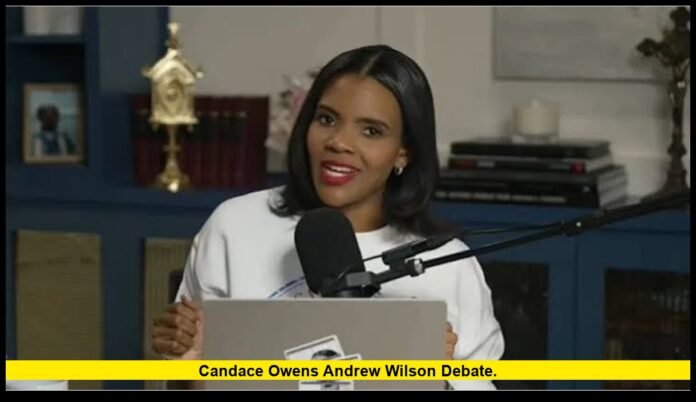

Candace Owens Andrew Wilson debate preparations have reached their final stage, with the highly anticipated confrontation scheduled for Friday, August 14, 2026. The event is centered on Owens’ claims and questions surrounding the death of Charlie Kirk and the case involving Tyler Robinson. Andrew Wilson has challenged Owens to defend her position in a direct debate, turning a long-running online dispute into a formal public confrontation.
The debate has attracted significant attention because the two commentators have spent days publicly challenging each other over the evidence, the interpretation of the case and the standards that should be used to evaluate competing claims. The event is set to be moderated by Patrick Bet-David, adding a structured format to what has largely been an online dispute.
Why the Debate Has Become Such a Major Story
The confrontation did not emerge overnight.
Owens and Wilson had already been arguing publicly about the Charlie Kirk case before the debate was arranged. Wilson repeatedly challenged Owens to defend her claims in a direct discussion. Owens eventually agreed to the confrontation after negotiations over the financial stake, venue and format.
The proposed event quickly became larger than an ordinary online debate.
A $300,000 amount became part of the agreement, while Owens pushed for additional conditions surrounding the production. The discussions also included questions about moderation and fact-checking.
Those negotiations gave the event an unusually high profile before the two participants even appeared together.
The attention has grown further because Owens recently postponed one of her scheduled shows. She said she wanted to address a newly filed defense document directly during the debate instead of responding to it immediately on her regular program.
That decision has increased expectations for the Friday confrontation.
The $300,000 Challenge
The money attached to the debate has been one of its most discussed features.
Wilson initially put forward a $300,000 challenge for Owens to debate the issues surrounding Kirk’s death and the related criminal case. Owens initially sought a higher amount during negotiations, reportedly proposing $500,000 along with several conditions.
The discussions eventually returned to the $300,000 figure.
The amount is important because it helped transform an online argument into a high-stakes event. However, the money itself is not the subject that viewers will ultimately be judging.
The central issue remains the evidence.
Both participants have strong and established audiences. Their supporters are likely to approach the discussion with different expectations. That makes the actual arguments more important than the size of the financial stake.
Patrick Bet-David Is Set to Moderate
Patrick Bet-David has been selected to moderate the event.
His role is especially important because the discussion involves several complicated and disputed claims. A moderator can help keep the conversation focused, prevent the participants from talking past each other and move the discussion back to specific evidence.
Bet-David is also familiar with long-form political and cultural discussions through his Valuetainment platform.
His involvement gives the event a more structured appearance than the social-media exchanges that led to it.
Michael Knowles had previously been discussed as a possible moderator but declined the role. He argued that the serious issues surrounding Kirk’s death should be handled through the legal system rather than turned into a public spectacle.
Bet-David’s acceptance ultimately provided the event with a confirmed moderator.
The Central Issue Involving Tyler Robinson
One of the most important areas of disagreement concerns Tyler Robinson, the man accused in connection with Kirk’s killing.
Owens has publicly questioned the case against Robinson and has described him as a possible patsy. Wilson has challenged that position and has pressed Owens to explain the evidence supporting it.
That disagreement is expected to receive major attention during the debate.
The distinction between questioning a prosecution case and establishing that someone was framed will be particularly important.
A person can challenge evidence without proving an alternative explanation. Likewise, an unresolved question does not automatically establish that a particular theory is correct.
The debate will therefore test how both sides handle that difference.
Owens’ Position Has Become More Direct
Owens has become increasingly direct in her public comments about the case.
Her recent statements have included challenges to the official narrative and questions about how investigators and other people connected to the case have handled key information.
She has also indicated that she is prepared to defend her position publicly rather than retreat from the claims that Wilson has challenged.
That makes the debate a significant moment for Owens.
Instead of addressing critics through separate broadcasts, she will have to respond to Wilson’s questions in real time.
That could make the discussion particularly revealing.
If Owens introduces evidence that has not previously received significant attention, the debate could generate new discussion about the case. If she repeats arguments already made publicly, Wilson will have an opportunity to challenge them point by point.
Wilson Has Been Preparing for the Confrontation
Wilson has spent considerable time criticizing Owens’ interpretation of the case.
His approach has focused heavily on evidence and standards of proof. He has argued that inconsistencies, unanswered questions or unusual circumstances do not automatically establish a conspiracy or alternative explanation.
That position is likely to shape his strategy during the debate.
Wilson can be expected to press Owens on individual claims rather than allowing the conversation to remain at a broad level.
For example, if Owens raises a discrepancy, Wilson can ask what that discrepancy proves. If she presents a witness statement, he can ask whether the statement independently establishes the conclusion she draws from it.
This approach could force the discussion into a series of specific factual disputes.
The Debate Is More Than a Social Media Argument
The format changes the nature of the dispute.
Social-media arguments allow participants to choose which points they address. They can also publish responses hours or days after another person makes a claim.
A live debate removes much of that flexibility.
Owens will be able to challenge Wilson directly. Wilson will have the same opportunity.
That creates a different standard for both participants.
Neither side can simply rely on supporters to interpret an argument afterward. Viewers will be able to hear the questions, answers and rebuttals as they happen.
For that reason, the complete discussion may provide more useful information than short clips shared after the event.
Why Fact-Checking Could Become Important
The volume of claims involved in the dispute makes fact-checking especially important.
The negotiations reportedly included discussion of live fact-checking. That request reflects the difficulty of handling a case involving legal proceedings, witness accounts, investigative claims and competing interpretations.
A fact-checking process can help separate established information from disputed assertions.
However, viewers should still pay attention to the precise wording used by both speakers.
There is a major difference between saying that a detail has not been explained and saying that investigators deliberately concealed it.
There is also a difference between questioning the strength of a prosecution case and proving that an accused person was framed.
Those distinctions could determine which arguments appear strongest during the exchange.
The Postponed Owens Show Added More Suspense
Owens recently postponed a scheduled program shortly before the debate.
She said a newly filed defense document deserved a careful response and that addressing it immediately would not be the right move. Instead, she indicated that she wanted to deal with the matter during the face-to-face confrontation.
The decision created another layer of anticipation.
Viewers now have a specific reason to watch for Owens’ response to the filing.
Wilson, meanwhile, has continued to challenge Owens publicly and has made it clear that he expects her to defend the claims she has made.
That sets up one of the most closely watched exchanges of the event.
What Viewers Should Pay Attention To
The debate is likely to generate countless clips and reactions. However, viewers who want to understand the substance should focus on several specific elements.
- Evidence: What documents, testimony or verified information does each participant present?
- Specific claims: Does either side clearly define what it is trying to prove?
- Direct answers: Do the participants respond to the questions they receive?
- Standards of proof: Does a disputed detail actually support the conclusion being drawn from it?
- New information: Does either participant introduce evidence that was not previously discussed?
- Corrections: Does either side acknowledge an error or revise an earlier claim?
These points offer a better way to evaluate the event than simply counting online reactions.
The Importance of the Full Discussion
A short video clip can make almost any debate appear decisive.
A participant may deliver a strong one-line response, while the surrounding discussion provides important context. That is why the full event matters.
The most meaningful developments could come from extended exchanges rather than viral moments.
A claim may initially sound convincing until the other participant asks for supporting evidence. Conversely, a seemingly minor detail may become important after additional information is presented.
The full discussion will give viewers a better opportunity to make that judgment.
Why the Event Has Attracted Such Strong Interest
The confrontation brings together two very different styles of political commentary.
Owens has built a large audience through commentary, interviews, investigations and long-form discussions. Wilson is strongly associated with debate-focused content and confrontational exchanges.
Their disagreement therefore combines two different approaches.
Owens has emphasized questions surrounding the case and challenged parts of the established narrative.
Wilson has emphasized the need for direct evidence and has challenged the conclusions Owens has drawn.
That difference makes the event more than a simple disagreement between two commentators.
It becomes a test of how competing methods of argument perform when placed under sustained questioning.
The Turning Point USA Connection
Turning Point USA also remains relevant to the wider dispute because Kirk founded the organization.
Questions about Wilson’s relationship with the organization became part of the debate negotiations. Owens wanted clarity over whether Wilson was speaking for himself or representing the organization.
That distinction matters.
A person’s personal argument should not automatically be treated as the official position of an organization unless that organization has formally adopted it.
The debate should therefore be judged on the claims made by the two participants themselves.
What Could Happen During the Debate
The event is scheduled for Friday, August 14, and promotional material confirms that Bet-David will moderate the discussion.
The exact impact of the confrontation will depend on what happens once the participants begin addressing the evidence.
Owens may focus on gaps she believes remain unanswered. Wilson may attempt to narrow those arguments and demand proof for each conclusion.
That could create a fast-moving exchange.
The most important moments may occur when one participant asks the other to establish a direct connection between evidence and conclusion.
Those moments can reveal whether the disagreement is actually about facts or about how those facts should be interpreted.
There Is No Reason to Declare a Winner Before the Exchange
Online audiences have already begun choosing sides.
Some supporters believe Owens will use the debate to expose weaknesses in the case. Others believe Wilson’s debate experience will allow him to dismantle her arguments.
Neither expectation establishes the outcome.
There is also no universally accepted scoring system for a public online debate of this type.
A person can win an exchange rhetorically without proving every factual claim. Another participant can make a strong factual point without producing the most memorable moment.
That is why the evidence should remain the primary focus.
The Latest Status
The latest confirmed information is that the debate is scheduled for August 14, 2026, with Patrick Bet-David serving as moderator. The event follows a public negotiation that settled around a $300,000 financial stake.
The confrontation is expected to focus heavily on Owens’ claims about the Charlie Kirk case, including her position concerning Tyler Robinson and her broader questions about the circumstances surrounding Kirk’s death.
Owens has indicated that she intends to address issues directly during the debate. Wilson has repeatedly challenged her to provide evidence for the conclusions she has promoted publicly.
The event therefore represents the culmination of a dispute that has developed through online posts, videos and public challenges.
As of the latest available update, the debate itself remains the central development, and claims about a winner should not be treated as established fact before the complete exchange has been reviewed.
What Comes Next After the Debate
The discussion is unlikely to end when the cameras stop.
Both participants have large online audiences, and any major exchange will likely produce extensive reaction afterward.
Clips will circulate. Supporters will highlight favorable moments. Critics will identify statements they believe were weak.
The more important question will be whether either side introduces information that changes the broader understanding of the case.
If new evidence emerges, it can be examined separately from the personalities involved.
If the debate largely repeats arguments that have already circulated, the event may still become a major moment in the ongoing public dispute, but it will not necessarily resolve the underlying questions.
That distinction should remain clear.
Why the Debate Matters for Viewers
The event provides an opportunity to watch two prominent commentators defend competing interpretations in the same discussion.
That alone makes it significant.
But the real value will depend on whether the conversation remains focused on evidence rather than personality clashes.
For viewers, the best approach is to listen carefully, distinguish confirmed information from allegations and avoid treating social-media reactions as proof.
The debate may produce a dramatic moment. It may produce several.
Yet the strongest argument will ultimately be the one that survives scrutiny after the excitement fades.
The Bottom Line
The long-running dispute between Owens and Wilson has now reached a formal stage. A $300,000 financial stake, a confirmed moderator and a scheduled August 14 event have turned their online confrontation into a major digital debate.
The central questions remain serious. They involve the evidence surrounding Kirk’s death, the case against Robinson and the competing interpretations that Owens and Wilson have presented publicly.
The debate gives both participants an opportunity to defend their positions directly.
For viewers, the most useful response will be to look beyond viral clips and focus on what can actually be established.
What do you think about the upcoming showdown between Candace Owens and Andrew Wilson? Share your thoughts in the comments and stay tuned for the latest verified developments.