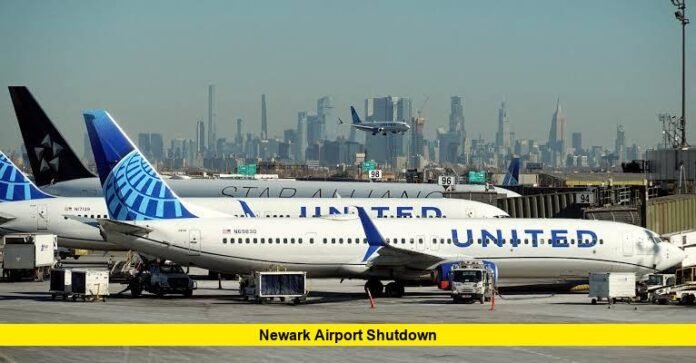

The Newark airport shutdown that disrupted travel across the Northeast on Monday was caused by an air traffic control communications problem at the Philadelphia Terminal Radar Approach Control facility, prompting the Federal Aviation Administration to temporarily halt flights and triggering widespread delays and diversions.
What Happened at Newark Airport?
Newark Liberty International Airport experienced a major operational disruption on September 21 after the FAA ordered a ground stop because of problems affecting communications used by air traffic controllers.
The disruption was not a permanent closure of Newark Liberty International Airport. Instead, the FAA temporarily restricted flights because an equipment and communications problem affected the Philadelphia TRACON facility, which handles air traffic in the region, including aircraft operating to and from Newark.
The initial restriction focused on flights heading into Newark. As the situation developed, delays also affected departing flights, leaving aircraft and passengers waiting at the airport while the FAA worked to restore normal traffic flows.
The FAA said the issue involved certain frequencies at Philadelphia TRACON. TRACON, short for Terminal Radar Approach Control, is responsible for managing aircraft as they approach and depart airports within its area of responsibility.
Why Was Newark Airport Shut Down?
The term “shutdown” describes the disruption, but Newark airport itself was not permanently shut down.
The FAA imposed a temporary ground stop because controllers were experiencing problems with some communications frequencies at Philadelphia TRACON. The facility manages air traffic serving both Philadelphia International Airport and Newark Liberty International Airport, along with Teterboro Airport.
Because reliable communication between controllers and pilots is essential for safe aircraft movements, the FAA temporarily restricted traffic rather than allowing normal flight volumes to continue while the problem was unresolved.
The disruption illustrates why a technical problem at an air traffic control facility can affect multiple airports even when the equipment problem is not physically located at the airport itself.
FAA Ground Stop Affected Newark Arrivals and Departures
The first FAA restriction affected aircraft traveling toward Newark. The agency subsequently extended the disruption, while Newark departures experienced increasing delays.
An early FAA advisory indicated that flights departing other airports for Newark were being held on the ground, with the possibility that the restriction could be extended. Newark departures were also experiencing significant delays.
Later reporting showed that the effects spread beyond Newark and Philadelphia. The FAA also issued ground stops affecting airports in the New York region, including John F. Kennedy International Airport and LaGuardia Airport, as the communications problem created broader congestion across the Northeast airspace.
This meant that passengers who were not flying directly to or from Newark could still encounter delays because aircraft and crews were displaced by the disruption.
Hundreds of Flights Were Delayed
The Newark disruption quickly produced a substantial number of delays.
Reuters reported that FlightAware was showing more than 600 delayed flights at Newark and Philadelphia, representing more than 20% of traffic associated with the affected operation. Flightradar24 reported average Newark delays of about 112 minutes during the disruption.
Other reporting indicated that approximately 250 Newark flights had been delayed and that dozens of aircraft originally bound for Newark were diverted to other airports.
The number of affected flights changed throughout the day as the FAA adjusted restrictions and airlines worked through the resulting backlog.
Flights Were Diverted From Newark
One of the most visible effects of the disruption was the diversion of flights that could not safely continue toward Newark while the air traffic control problem was being addressed.
According to reporting based on flight-tracking data, 67 flights bound for Newark had been diverted as of approximately 1 p.m. ET. The diverted flights included international aircraft returning from destinations such as Iceland, Greece and Spain.
Diversions can create additional complications for passengers because an aircraft may land at an airport other than the scheduled destination. Airlines then have to coordinate onward transportation, aircraft positioning, crew schedules and airport operations.
For travelers waiting at Newark, this also meant that the arrival of their aircraft could be delayed even after the FAA lifted the initial restrictions.
Philadelphia TRACON Was at the Center of the Problem
The key facility involved in Monday’s disruption was Philadelphia TRACON.
Philadelphia TRACON does not simply manage aircraft operating directly around Philadelphia International Airport. Its responsibilities extend into airspace serving other airports, including Newark and Teterboro.
That is why a communications problem at the facility could produce consequences at Newark Liberty International Airport.
The FAA confirmed that the temporary flight restrictions were related to problems with certain frequencies at Philadelphia TRACON.
The agency did not initially provide all technical details about the equipment problem. Later reports attributed the broader disruption to damage involving an air traffic control communications fiber line during construction work. FAA Administrator Bryan Bedford said the problem involved the loss of communications capability and a backup fiber connection that had also been affected.
The Disruption Spread to Other Major Airports
Newark was not the only airport affected.
The FAA temporarily restricted flights involving Philadelphia International Airport and Teterboro, while disruptions later extended to major New York-area airports.
Reports also identified ground stops or significant restrictions involving JFK, LaGuardia and Westchester County Airport. The resulting congestion affected air traffic across a much wider portion of the Northeast.
The situation was particularly disruptive because Newark, JFK and LaGuardia collectively serve one of the country’s busiest air travel markets.
When aircraft cannot move normally through one part of that airspace, delays can quickly propagate to flights operating hundreds or even thousands of miles away.
Why the Newark Disruption Caused a Ripple Effect
Airline schedules are highly interconnected.
A single aircraft may operate several flights during one day. If the aircraft is delayed arriving at Newark, its next departure can also be delayed. The same applies to flight crews and connecting passengers.
For airlines with large operations at Newark, the impact can therefore continue even after the FAA lifts a ground stop.
Newark is a major hub for United Airlines, meaning the disruption had particular significance for United passengers. Reuters reported that United was among the carriers affected and that the airline offered flexibility for travelers impacted by the air traffic control disruption.
What Newark Passengers Should Do
Travelers scheduled to fly through Newark should check their individual flight status rather than assuming that every flight is canceled or delayed by the same amount.
Airport-wide disruptions can produce different results depending on the aircraft’s location, route, crew availability and the airline’s recovery schedule.
Passengers should:
- Check the airline’s app or website before leaving for the airport.
- Confirm the latest departure and arrival time.
- Check whether the aircraft operating their flight has arrived.
- Allow additional time at Newark if their flight is operating.
- Contact the airline if a rebooking or rerouting option is needed.
- Check for airline travel waivers if their itinerary was affected.
The FAA has also advised travelers to obtain individual flight information directly from their airlines because operational conditions can change quickly during an air traffic control disruption.
Is Newark Airport Permanently Closed?
No.
The Monday disruption should not be interpreted as a permanent Newark airport closure.
The FAA imposed temporary flight restrictions because of an air traffic control communications problem. Newark Liberty International Airport continues to operate as an active commercial airport, although passengers affected by Monday’s disruption can continue to experience delays as airlines work through the backlog.
The distinction between an airport closure and an FAA ground stop is important. A ground stop is a temporary air traffic management measure that prevents or restricts certain aircraft from departing toward an affected airport or airspace.
It does not necessarily mean that the airport terminal itself is closed or that every flight has been canceled.
Newark Already Had Existing Flight Restrictions
Monday’s disruption occurred against a separate background of FAA operational limits at Newark.
The FAA has previously imposed limits on the number of scheduled aircraft operations at Newark because of congestion, staffing and equipment challenges. A 2026 Federal Register notice extended the FAA’s Newark operating limitation order through October 30, 2027, with the extension taking effect later in October 2026.
Those longer-term operational limits are separate from Monday’s temporary ground stop.
In other words, the September 21 disruption was not caused by the existing Newark flight-volume limits. The immediate trigger was the air traffic control communications problem affecting Philadelphia TRACON.
FAA Has Been Upgrading Newark’s Air Traffic Infrastructure
The latest disruption also comes after the FAA has undertaken several modernization projects involving Newark and the surrounding air traffic control system.
The FAA previously said it had transitioned to a new fiber-optic communications network connecting New York and Philadelphia TRACON facilities and had deployed backup systems intended to provide additional redundancy.
The agency has also announced additional technology upgrades at Newark, including new surface movement radar and other planned improvements to communications, radar and controller information systems.
The recurrence of communications-related disruptions nevertheless demonstrates how problems affecting regional air traffic control infrastructure can have immediate consequences for passengers.
Newark Airport Shutdown and the Broader Air Travel Impact
Monday’s disruption was particularly significant because it occurred while the New York region was receiving international visitors for the United Nations General Assembly.
That timing added pressure to an already busy Northeast aviation network. Multiple airports were dealing with restrictions, diversions and delays at the same time.
For passengers, the most important point is that a flight showing as delayed does not necessarily mean it will be canceled. Airlines can resume operations once the FAA restores sufficient air traffic capacity, but the resulting backlog can continue affecting schedules for hours afterward.
What Travelers Should Know About the Newark Airport Shutdown
The latest Newark disruption was a temporary FAA ground stop rather than a permanent airport closure.
The immediate cause was an air traffic control communications problem involving certain frequencies at Philadelphia TRACON. Newark, Philadelphia and Teterboro were among the airports directly affected, while the disruption subsequently contributed to wider restrictions and delays across the New York and Northeast airspace.
More than 600 flights involving Newark and Philadelphia were reported delayed during the disruption, while dozens of Newark-bound flights were diverted. Newark delays averaged more than 100 minutes at one point, according to flight-tracking data cited by Reuters.
Passengers should therefore rely on their airline’s latest flight status rather than treating the term “shutdown” as meaning that Newark airport is completely closed.
Stay tuned for the latest Newark airport updates, and share your experience in the comments if Monday’s disruption affected your flight.