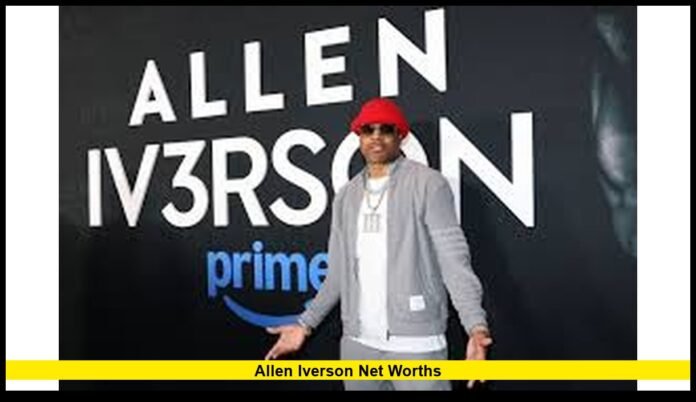

Allen Iverson net worth is estimated at around $1 million in 2026, a striking figure for a basketball superstar who earned roughly $154.5 million in NBA salary alone and generated tens of millions more through endorsements. His financial story is far more complicated than his current estimated wealth suggests, with massive contracts, major brand deals, financial difficulties, and a potentially valuable Reebok trust fund all playing a role in his long-term financial picture.
Iverson remains one of the most recognizable players in NBA history. His impact extended well beyond statistics and championships. He became an icon of basketball culture, changed the perception of smaller guards, built one of the sport’s most memorable sneaker lines and helped shape the visual identity of an entire generation of NBA players.
As of 2026, the former Philadelphia 76ers superstar is also approaching an important financial milestone connected to his long-running relationship with Reebok.
Allen Iverson’s Estimated Net Worth in 2026
Current public estimates generally place Iverson’s wealth at approximately $1 million. Because Iverson does not publicly release a complete personal balance sheet, however, no outside figure can be considered an official valuation.
The estimate becomes more interesting when compared with his career earnings.
During his NBA career, Iverson earned approximately $154.5 million in salary. He also collected substantial endorsement income, particularly through Reebok. At the height of his career, he was among the most commercially recognizable athletes in American sports.
That creates an important distinction between career earnings and net worth.
A player’s career earnings represent money generated over many years. Net worth reflects what remains after expenses, taxes, debts, financial obligations, investments and assets are considered. An athlete can therefore earn hundreds of millions of dollars without retaining anything close to that amount decades later.
Iverson’s financial history is one of the clearest examples of that difference.
How Much Money Did Allen Iverson Make in the NBA?
Iverson entered the NBA in 1996 after a standout career at Georgetown University. The Philadelphia 76ers selected him with the first overall pick, immediately making him one of the most closely watched young players in basketball.
He quickly justified the attention.
Iverson won NBA Rookie of the Year in his first season and eventually developed into one of the league’s most dominant scoring guards. His career earnings grew as his role and popularity increased.
His major contracts included lucrative extensions with Philadelphia, followed by significant deals after his move to Denver and later Detroit.
By the end of his NBA career, Iverson had reportedly earned approximately $154.5 million in salary.
His highest reported single-season salary came during the 2008-09 season with the Detroit Pistons, when he earned roughly $20.8 million.
Estimated NBA Career Earnings
| Category | Approximate Amount |
|---|---|
| NBA salary | $154.5 million |
| Major endorsement income | Tens of millions |
| Reebok-related income | Significant long-term earnings |
| Highest reported NBA salary | About $20.8 million |
| NBA career | 1996–2010 |
These numbers demonstrate how extraordinary Iverson’s earning power became during his prime.
But his financial story did not end when his NBA career ended.
Reebok Became the Most Important Part of His Financial Legacy
Few athlete-brand relationships have been as closely associated with a basketball player as Iverson and Reebok.
The partnership began when Iverson was establishing himself as one of the NBA’s most marketable young stars. His personality, playing style and cultural influence made him an ideal fit for a company attempting to compete with larger sportswear brands.
The relationship became much more valuable over time.
Iverson’s Reebok sneakers, particularly the Question and Answer lines, became closely associated with his playing career. The shoes remain recognizable among basketball fans and sneaker collectors, with retro releases continuing to keep his brand visible.
The relationship eventually evolved into a lifetime arrangement that reportedly included two particularly important financial components: ongoing annual income and a future trust fund.
The $32 Million Reebok Trust Fund
One of the most unusual elements of Iverson’s financial story is a reported $32 million Reebok trust fund.
According to widely reported details surrounding the agreement, the trust was structured to become accessible when Iverson reaches age 55.
Iverson was born on June 7, 1975, meaning he turns 55 on June 7, 2030.
That makes 2030 a potentially transformative year for his finances.
Reports have described the arrangement as including a substantial trust intended to provide long-term financial security. The reported structure is particularly notable because the money was not simply handed over during Iverson’s highest-spending years.
Instead, it was designed to provide a financial safety net later in life.
Why the Reebok Trust Matters
The trust is important because Iverson’s post-playing career financial history has been marked by challenges.
A large amount of money available immediately can disappear quickly when expenses remain high. By placing a significant portion of the value into a long-term arrangement, the Reebok deal effectively created a future source of financial security.
However, it is important not to assume that Iverson will necessarily receive exactly $32 million in unrestricted cash in 2030.
Taxes, legal obligations and the specific terms governing the trust could affect the amount ultimately available to him.
Therefore, the $32 million figure should be understood as the reported value of the trust rather than a guaranteed prediction of his 2030 take-home wealth.
Iverson Also Reportedly Receives Lifetime Reebok Income
The trust fund is only one part of the reported Reebok arrangement.
Iverson has also been associated with a lifetime annual payment of approximately $800,000 under the agreement.
That recurring income is especially significant because it provides a long-term source of money even after the end of his professional basketball career.
For a retired athlete, predictable annual income can be more valuable than a large one-time payment because it creates a continuing financial foundation.
Iverson’s Reebok relationship therefore represents much more than a traditional sneaker endorsement.
It became an important part of his long-term financial planning.
How Did Iverson Go From More Than $150 Million in NBA Salary to a Much Smaller Fortune?
The biggest question surrounding Iverson’s finances is how someone who earned more than $150 million from NBA contracts could eventually have a reported net worth of only around $1 million.
The answer involves a combination of lifestyle expenses, financial obligations and the challenges that can accompany sudden wealth.
During his playing career, Iverson was known for maintaining a large circle of friends and associates. He also developed a reputation for spending heavily on luxury items, entertainment, travel, jewelry, clothing and other lifestyle expenses.
Reports from his divorce proceedings provided an especially revealing look at the gap between his income and expenses.
At one point, court documents reportedly showed monthly expenses that were dramatically higher than his monthly income.
That kind of financial imbalance can become extremely difficult to sustain once a professional athlete stops receiving a large NBA salary.
Retirement Changed Iverson’s Income Structure
For NBA stars, retirement creates a fundamental financial transition.
During their playing years, athletes can earn millions of dollars annually from contracts, bonuses and endorsements. After retirement, that salary disappears almost immediately.
Iverson’s final NBA season came in 2009-10, although he briefly pursued opportunities outside the NBA afterward.
Without his previous NBA salary, maintaining the same level of spending became considerably more difficult.
This is one reason why the financial position of retired athletes can change so dramatically. The income that supported an expensive lifestyle during a player’s peak may no longer exist once the athlete leaves professional sports.
His Financial Difficulties Became Public
Iverson’s financial problems eventually became widely reported.
His divorce proceedings brought attention to his income, expenses and financial obligations. The situation generated headlines because it contrasted sharply with the enormous amounts he had earned during his career.
However, describing Iverson simply as a former athlete who “lost everything” oversimplifies the situation.
He continued to have commercial value after retirement, retained his relationship with Reebok and remained one of the most recognizable basketball personalities in the world.
His story is better understood as a dramatic transition from extraordinarily high active-athlete income to a much more complicated post-career financial structure.
Allen Iverson’s Basketball Career Remains His Biggest Legacy
Money is only one part of Iverson’s story.
On the court, he established himself as one of the most influential guards in NBA history.
He won the 2001 NBA MVP award, was selected to 11 All-Star teams, won four scoring titles, led the league in steals three times and earned multiple All-NBA selections.
He was inducted into the Naismith Basketball Hall of Fame in 2016.
His 2000-01 campaign remains particularly memorable.
Iverson averaged more than 31 points per game, won the scoring title and carried Philadelphia to the NBA Finals. The Sixers ultimately lost the championship series to the Los Angeles Lakers, but Iverson’s performance throughout that postseason cemented his reputation as one of the era’s toughest competitors.
The Crossover That Became an Icon
Iverson’s influence was not limited to scoring.
His crossover dribble became one of the defining moves of the late 1990s and early 2000s. His famous move against Michael Jordan became one of the most replayed moments of that era.
More importantly, Iverson showed that a smaller guard could dominate physically imposing opponents through speed, creativity and confidence.
His influence can still be seen in modern NBA basketball.
Today’s league is filled with undersized guards who use quickness, ball handling and perimeter shooting to attack larger defenders. Iverson was one of the stars who helped establish that style as a central part of the modern game.
Iverson’s Cultural Influence Made Him More Than an Athlete
Iverson also became an important cultural figure.
His tattoos, cornrows, jewelry, clothing and expressive personality challenged the traditional image of what a professional basketball superstar was expected to look like.
At the time, those choices generated controversy.
Today, many of those same elements are deeply connected to NBA culture.
Players now have greater freedom to express themselves through fashion and personal style, and Iverson is frequently recognized as one of the athletes who helped push that transformation forward.
His influence is one reason his brand remains valuable years after his final NBA game.
The Reebok Question Remains a Major Part of His Brand
Iverson’s sneaker legacy has also endured.
The Reebok Question became one of the most recognizable basketball shoes of its era. Its association with Iverson’s early NBA career and his 2001 MVP season helped make the model a major part of basketball sneaker culture.
Retro releases have introduced the shoes to younger generations who never watched Iverson play live.
That continuing demand gives Iverson something that many retired athletes no longer possess: a highly recognizable commercial identity.
Iverson Returned to Reebok in a Leadership Role
Iverson’s relationship with Reebok has also evolved beyond his role as a signature athlete.
In 2023, Reebok announced a basketball leadership structure involving Shaquille O’Neal as president of basketball and Allen Iverson as vice president of basketball.
The move gave Iverson a formal role in helping shape the brand’s basketball strategy.
It also represented a full-circle moment.
The company that helped build his identity as a young NBA superstar eventually brought him into a leadership position where he could help influence its next generation of basketball products and athletes.
That role adds another dimension to Iverson’s post-playing career.
What Could Happen to His Wealth in 2030?
The most important future financial milestone remains his 55th birthday.
If the reported Reebok trust is distributed according to the terms that have been publicly described, Iverson could gain access to a significant amount of money in June 2030.
That could substantially alter his financial position.
But projections should remain cautious.
The eventual value available to Iverson could depend on taxes, legal arrangements and other obligations. Public reports also do not provide enough information to calculate his complete future balance sheet.
What can be said with greater confidence is that the trust provides a potentially important financial cushion.
Why Iverson’s Financial Story Still Matters
Iverson’s experience offers an important lesson about professional sports wealth.
Making millions does not automatically create lasting financial security.
Athletes often receive enormous salaries during relatively short careers. Their earning windows can last only a decade or two, while their financial needs continue for the rest of their lives.
Iverson’s career demonstrates both sides of that reality.
He reached extraordinary financial heights, became one of the most commercially successful players of his generation and then faced serious financial challenges after retirement.
At the same time, the long-term Reebok arrangement provided a financial safety net that could become especially important later in his life.
Final Outlook for Allen Iverson’s Finances
In 2026, Iverson’s financial position remains one of the more intriguing stories connected to an NBA legend.
The commonly reported estimate of approximately $1 million is dramatically lower than the more than $150 million he earned in NBA salary, but it does not tell the entire story.
His ongoing relationship with Reebok, reported annual income, continued commercial relevance and future trust fund all remain important pieces of the bigger picture.
Meanwhile, his basketball legacy remains essentially untouchable.
Iverson was an MVP, an 11-time All-Star, a four-time scoring champion and a Hall of Famer. His influence on basketball culture continues through his sneakers, style and the generations of guards who grew up watching him.
The financial story is complicated, but the legacy is much clearer: Allen Iverson changed basketball in ways that continue to be visible more than a decade after his playing career ended.
What do you think about Allen Iverson’s remarkable financial journey and lasting impact on basketball? Share your thoughts and stay tuned for more updates on NBA legends.