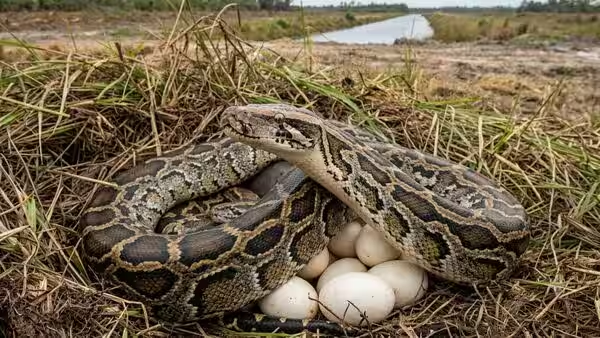

The Burmese python Florida spread has become one of the most closely watched wildlife issues in the state, as new evidence confirms these invasive snakes are no longer confined to their traditional stronghold in the Everglades. Wildlife officials, researchers, and conservationists have spent decades tracking the reptile’s expansion across South Florida, but recent findings show the snakes are pushing into new counties, adapting to fresh habitats, and continuing to reshape local ecosystems. For residents, hunters, and nature enthusiasts alike, understanding how and why this spread is happening has never been more relevant.
A Growing Problem Beyond the Everglades
For years, Burmese pythons were considered a problem largely isolated to the Everglades ecosystem. Historically, Burmese python populations in South Florida were centered in Everglades National Park in Miami-Dade County, but they eventually became established from Lake Okeechobee to Key Largo and from western Broward County west to Collier County. That range, while already massive, is no longer the full picture.
Florida wildlife officials have confirmed new breeding populations of Burmese pythons in Charlotte County, marking a new area of expansion in Southwest Florida beyond the snakes’ longtime stronghold in the Greater Everglades. This discovery is significant because it shows the species establishing itself in a location separate from the core invasion zone, rather than simply drifting outward along a continuous front.
Reports of pythons in this region began increasing from 2020 onward, with sightings coming from communities such as Rotonda West, Placida, Englewood East, and South Gulf Cove. According to tracking data, 78 pythons have been captured, found dead, or sighted in Charlotte County, with 61% of those reports occurring since 2024. That concentration of recent activity suggests the population is not just present but actively growing.
How the Snakes Are Reaching New Territory
One of the more important findings from wildlife officials is that this new Southwest Florida population did not form through the snakes gradually migrating overland from the Everglades. Officials have confirmed that this expansion is not due to natural migration from the Everglades. Instead, the new population is believed to have originated from captive pythons that either escaped or were intentionally released, and which subsequently began reproducing in the wild.
This distinction matters for how experts think about future risk. A population that starts from a release event, rather than a slow expansion of an existing range, can appear suddenly in a location far from established populations, making early detection and containment far more difficult.
Beyond intentional or accidental releases, researchers point to the snake’s biology and behavior as key drivers of its ability to spread naturally once established. According to University of Florida wildlife ecology researchers involved in ongoing python removal projects, the animals rely heavily on Florida’s extensive network of waterways. Pythons can remain in the water for extended periods and often use waterways and canals to travel, since the species spends the vast majority of its life in water. Given how thoroughly interconnected Florida’s canal systems and wetlands are, this water-based mobility gives the snakes a practical highway system for moving between regions.
Researchers have also proposed a resource-driven theory for the northern movement of pythons. One leading explanation is that the snakes are running out of available prey in South Florida, where they have already caused steep declines in small mammal populations, pushing them to search for food elsewhere. In other words, the python’s own success at consuming native wildlife in the Everglades may be part of what is now pushing individual snakes to explore new territory.
Individual pythons have also been found well outside any established breeding zone, underscoring how far a single snake can travel or be transported. One Burmese python was discovered in 2024 at Four Creeks Wildlife Management Area north of Jacksonville, far beyond the species’ known established range. While an isolated sighting like this does not necessarily indicate a breeding population, it illustrates how unpredictable the snake’s presence can be across the state.
Impact on Florida’s Ecosystem
The ecological consequences of the Burmese python Florida spread extend well beyond the simple presence of a new species. Researchers tracking long-term population trends have documented dramatic effects on native wildlife in areas where pythons have become established. Wildlife ecology experts involved in ongoing removal and monitoring programs describe the situation in stark terms, noting that the snakes’ impact zone is expanding even faster than their physical range. Researchers have observed that it is not simply that the snakes are spreading geographically, but that their ecological impacts are spreading, with documented losses of mammal populations extending toward the northern edge of the python’s range near Loxahatchee and the Big Cypress area.
Some of the clearest evidence of this impact comes from mammal population studies conducted within core python territory. Researchers estimate that roughly 95% of small mammals in parts of South Florida have already been consumed by the invasive snakes. That scale of predation has cascading effects throughout the food web, since many native predators and prey species depend on a healthy population of rabbits, raccoons, opossums, and other small mammals to maintain ecological balance.
Scientists studying the broader invasion history describe Burmese pythons as one of the most difficult invasive species challenges in the world. A peer-reviewed analysis compiled by federal researchers characterized decades of python control efforts as an especially stubborn management problem, citing the animal’s ability to hide effectively within Florida’s dense, subtropical terrain. The python’s native range in Southeast Asia shares strong similarities with the Everglades’ climate and vegetation, which has allowed the species to thrive with few natural checks on its population.
Detection remains one of the biggest obstacles to controlling the spread. Wildlife experts have not been able to precisely estimate how many Burmese pythons currently exist in Florida due to the species’ extremely low detectability in the wild. Survey success rates for spotting pythons are estimated at only 1% to 3%, meaning that out of 100 snakes present in a given search area, researchers might expect to find only one to three individuals. This low detection rate helps explain why a breeding population can go unnoticed for years before it is formally confirmed, as appears to have happened in Charlotte County.
The scale of the original introduction also helps explain why the species has proven so resilient. An estimated 180,000 Burmese pythons were imported into the United States between 1975 and 2018, many of which entered the wild through accidental or intentional releases, according to federal wildlife data. By the year 2000, the species had already established a self-sustaining breeding population within the South Florida ecosystem.
Public Interest and Efforts to Control the Spread
Public concern over the Burmese python Florida spread has translated into direct action, most visibly through the state’s annual python removal competition. The Florida Python Challenge is an annual conservation event organized by the Florida Fish and Wildlife Conservation Commission and the South Florida Water Management District, designed to remove invasive snakes from the wild while raising public awareness of the ecological threat they pose. The 2026 edition of the challenge ran from July 10 through July 19, with participants searching designated public lands within the Everglades ecosystem to humanely remove pythons, after completing a required registration and training process. This year’s competition offered a total prize pool of $25,000.
Participation and results have varied considerably since the event began. The first three Python Challenge competitions, held in January between 2013 and 2020, removed a combined 254 pythons. After the event moved to a July schedule in 2021, hunters captured 223 snakes that year despite a shorter competition window, and the 2025 challenge set a new record with 294 pythons removed. Officials also noted that this year’s hunt took place under extreme heat, with heat index values forecast to reach between 105 and 110 degrees in parts of Florida, adding an additional layer of difficulty for competitors working in the field.
Notably, the newly confirmed Charlotte County population sits outside the official hunting boundaries of the statewide challenge. Despite the discovery of an established breeding population there, Charlotte County is not currently included among the competition’s designated hunting areas. This gap illustrates one of the practical challenges facing wildlife managers: response strategies and public hunting programs must continually be reassessed as the snake’s range shifts, since areas without formal removal programs can allow a new population to grow with little organized pushback.
To address emerging hot spots directly, state agencies have expanded staffing focused specifically on new population zones. Starting in June 2024, the Nonnative Fish and Wildlife Program hired two part-time python technicians dedicated to conducting surveys and removing snakes three times per week in the areas of highest concentration. Researchers say that the greatest priority going forward is intercepting new populations while they remain small. Wildlife ecology experts have emphasized that early detection in border counties, such as Palm Beach, may offer far better returns than continuing to fight fully entrenched populations at the heart of the existing infestation, since drawing a firm containment line before a population becomes self-sustaining is significantly more achievable than reversing one that already is.
Final Thoughts
The Burmese python Florida spread illustrates how a single invasive species, introduced decades ago through the exotic pet trade, can permanently alter an entire regional ecosystem. What began as isolated sightings near Everglades National Park in the late 1970s has grown into a self-sustaining, wide-ranging population that continues to expand into new counties, most recently confirmed in Charlotte County. Whether driven by intentional releases, the snake’s own search for food, or its ability to travel undetected through Florida’s waterways, the pattern is consistent: pythons are moving, adapting, and establishing footholds well beyond the boundaries wildlife managers once considered their limit.
While programs like the Florida Python Challenge continue to raise awareness and remove snakes from the wild each year, experts caution that eradication may not be a realistic outcome given the animal’s low detectability and rapid reproductive rate. The more immediate goal for researchers and state agencies is containment — identifying new populations early, dedicating resources to emerging hot spots, and preventing further movement into untouched parts of the state. As monitoring efforts continue, the coming years will likely reveal whether these containment strategies can keep pace with a species that has already proven remarkably difficult to stop.
Stay tuned for more updates on Florida’s invasive wildlife challenges, and share your thoughts or local sightings in the comments below.