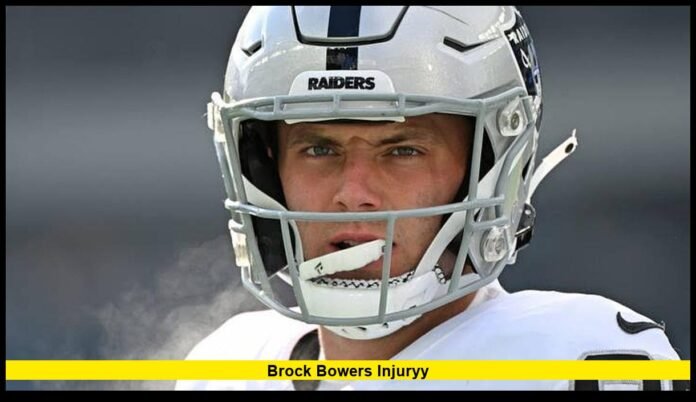

The Las Vegas Raiders opened the 2026 season looking like a completely different team than the one fans watched a year earlier, jumping out to a surprising 2-0 record. But there’s been an obvious hole in the lineup the entire time, and it belongs to the team’s most electric offensive playmaker. The Brock Bowers injury has dominated headlines in the Raiders’ locker room, on fantasy football forums, and across sports radio for three straight weeks, and it’s easy to see why. A tight end who rewrote the record books as a rookie has been reduced to a question mark on a weekly injury report, and every fan in Las Vegas wants to know exactly when he’s coming back.
A Star Sidelined Before the Season Even Started
Bowers’ issue didn’t begin during a game. Instead, it traces back to training camp, when the young tight end picked up what was initially described as a minor knock to his left knee. Rather than let the injury linger into the regular season, the Raiders’ medical staff opted for a proactive approach: a meniscus trim performed in the opening days of September. On paper, it sounded like a low-risk procedure, one that typically sidelines players for a couple of weeks rather than months. In practice, it turned into a slow-burn saga that has stretched across the entire first quarter of the season.
The timing could not have been worse for a player who was supposed to anchor a retooled passing attack. Instead of building chemistry with quarterback Kirk Cousins in Week 1, Bowers watched from the sideline as the Raiders opened their campaign against the Miami Dolphins. The offense found a way to win anyway, but it was clear from the opening kickoff that this version of the Raiders was operating without its most dangerous weapon.
Week 2 Brings Hope, Then Disappointment
By the time the Raiders traveled to face the Los Angeles Chargers in Week 2, optimism had started to build. Bowers had been cleared for on-field work, and coaches spoke encouragingly about his progress. On game day, he even went through a full pregame workout at SoFi Stadium, running routes and testing his lateral movement in front of a group that included the team’s general manager and performance staff.
Despite the promising session, the final call went against him. He was downgraded to inactive just hours before kickoff, a decision that stung for a fan base eager to see its star player back in action. The Raiders won anyway, improving to 2-0 and giving the coaching staff more room to be patient with their star tight end’s recovery rather than rushing him back before he was truly ready.
The Practice Reports That Kept Everyone Guessing
Heading into Week 3 against the New Orleans Saints, the tight end’s practice participation became appointment viewing for anyone tracking his health. He returned to limited work on both Wednesday and Thursday of that week, a clear step forward after two weeks of being held out entirely. Then came a twist: he did not take the field for the open portion of Friday’s session, an absence that immediately triggered speculation about a possible setback.
Head coach Klint Kubiak moved quickly to calm those fears, explaining that the rest day had been part of the plan all along rather than a reaction to new soreness or swelling. According to the coaching staff, managing a player’s workload in the days leading up to a return from knee surgery is standard practice, and skipping a walkthrough is often more about caution than concern. Still, the timing left the tight end’s status murky right up until the weekend, with the team officially tagging him as questionable rather than committing to a firm answer either way.
What the Insiders Were Saying
As Sunday approached, reporting from national league insiders shifted increasingly toward optimism. Multiple well-connected NFL reporters indicated that the tight end was trending toward playing, with one prominent voice noting he was “more likely than not” to suit up. That sentiment only grew stronger closer to kickoff, when sources close to the situation suggested he was expected to play barring a last-second complication.
One of the clearer signals came from a roster decision rather than a press conference. In each of the first two weeks, the Raiders had elevated a tight end from their practice squad to provide extra depth while their star was sidelined. Ahead of the Saints matchup, they chose not to make that move, an indication that the team expected its top pass catcher to be available and active on the sideline throughout the game.
Why the Wait Has Been So Nerve-Wracking for Raiders Fans
To understand why this recovery has captured so much attention, it helps to look at what the young tight end has already accomplished in a short amount of time. As a rookie, he set NFL records for receptions and receiving yardage by a first-year tight end, hauling in well over 100 catches and topping 1,000 yards while adding five touchdowns. Those numbers made him an instant All-Pro selection and a fixture in the Pro Bowl conversation.
His second season told a slightly different story. A knee injury suffered in the opening week lingered for much of the year, eventually contributing to a stretch on injured reserve before the season wrapped up. Even with the interruptions, he still managed nearly 700 receiving yards and seven scores in a dozen games, numbers that reinforced just how valuable he is even when not fully healthy.
That history is exactly why the current knee trouble carries extra weight. Two consecutive years of lower-body issues raise legitimate questions about durability, even for a player whose talent is not in doubt. Coaches, teammates, and medical staff all have an incentive to be cautious this time around rather than risk turning a short-term absence into a long-term problem.
The Ripple Effect on the Rest of the Offense
While the star tight end has been out, backup Michael Mayer has stepped into the starting role and performed admirably, catching passes at a respectable clip and giving the coaching staff no reason to panic. Quarterback Kirk Cousins has spread the ball around effectively, leaning on wide receivers and the running game to keep the offense humming during a 2-0 start that surprised plenty of preseason prognosticators.
Even so, there’s a ceiling to what this offense can accomplish without its most versatile weapon on the field. A pass catcher capable of lining up in the slot, out wide, or in-line at tight end creates matchup nightmares that a committee approach simply can’t replicate. Offensive coordinators around the league have built entire game plans around exploiting a defense’s inability to cover a player with that kind of positional flexibility, and the Raiders have been without that tool for the better part of a month.
Fantasy Managers and Bettors Watching Closely
Outside the building, fantasy football managers and bettors have been glued to every practice report and beat writer update. Projection models have swung back and forth throughout the week, at times giving the tight end better than a coin-flip chance of suiting up and at other moments trimming that number after a missed practice session. Even with some uncertainty attached, he remains ranked among the top options at his position whenever he is expected to be active, a testament to how much production he provides even in a limited workload.
Bettors have similarly kept an eye on prop markets tied to his receptions and receiving yardage, knowing that his final designation could shift lines significantly in either direction. As is typical for players working back from a recent procedure, the smart money has been watching not just whether he plays, but how many snaps he’s likely to see if he does take the field.
What Comes Next
Barring a surprise reversal, all signs point toward the tight end finally making his 2026 debut against the Saints, nearly three weeks after his knee procedure. Even if he does suit up, it would be reasonable to expect a gradual ramp-up in workload rather than an immediate return to a full route tree and every offensive snap. Coaches have been deliberate throughout this process, and there’s little reason to expect that approach to change the moment he steps back onto the field.
For a Raiders team that has already exceeded expectations without its best offensive weapon, getting him back healthy could be the difference between a promising start and a genuinely dangerous offense down the stretch. Fans, fantasy managers, and Las Vegas’ coaching staff alike will be watching closely to see not just whether he plays, but how his knee responds in the days that follow.
Key Points Summary
╔════════════════════════════════════════════════════════════════════╗
║ – A left knee meniscus trim in early September has kept the Raiders  ║
║   tight end sidelined for the start of the 2026 season.              ║
║ – He was downgraded to inactive in Week 2 despite a full pregame     ║
║   workout, then returned to limited practice the following week.     ║
║ – A planned rest day on Friday sparked concern but was described     ║
║   by the coaching staff as part of his recovery plan.                ║
║ – The Raiders chose not to elevate a backup tight end for Week 3,    ║
║   signaling confidence in his availability.                          ║
║ – Two straight seasons of knee trouble have raised durability        ║
║   questions despite his record-setting rookie production.            ║
╚═════════════════════════════════════════════════════════════