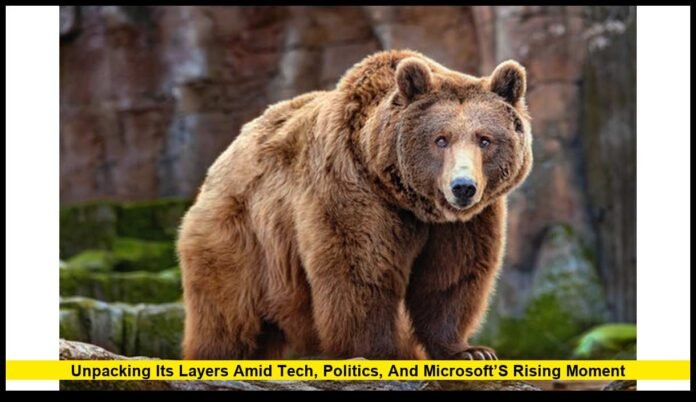

When you examine the phrase “big bear meaning” in today’s landscape, you discover far more than just an animal metaphor. At a time when dominant corporations exert political and economic power, the concept of the “big bear” has real-world resonance. The recent confrontation between former President Donald Trump and Microsoft—specifically his demand that Microsoft remove its global affairs leader Lisa Monaco—illustrates how the big bear isn’t roaming the forest anymore; it’s operating in boardrooms, cloud servers, and geopolitical corridors.
What “Big Bear Meaning” Signals Today
In its broadest sense, the big bear meaning evokes strength, influence, dominance. In ancient folklore, the bear stood for raw power—untamed, formidable, and often revered or feared. But in modern America, we encounter the “big bear” in a different guise: as powerful corporations, global tech platforms, deep-state references, and institutional giants whose reach extends across borders and economies.
Here are key layers of what the phrase now suggests:
- Massive presence: A “big bear” doesn’t just participate; it dominates. An entity that shapes norms, sets standards, and holds sway.
- Accountability gap: Because the bear is large and powerful, its actions attract attention—and sometimes challenge.
- Symbolic friction: The bigger you are, the more people either seek your protection or target your power.
- Metaphor in transition: The “bear” of folklore is wild; the “big bear” of today is corporate or institutional. When a bear shows up, everyone watches.
Case in Focus: Big Bear Meaning at Work in the Microsoft Monaco Moment
When Trump publicly called on Microsoft to fire Lisa Monaco, the event became a concrete manifestation of the “big bear meaning.” Here’s how:
- Microsoft, as one of the world’s largest tech firms with vast government contracts and global networks, is a textbook “big bear.”
- Monaco’s appointment as President of Global Affairs placed her at the heart of that bear’s intersection with government, diplomacy, and international policy.
- Trump’s demand framed Monaco’s role as a threat to national security, arguing the bear’s power must be closely monitored or constrained.
Timeline of events:
- In July 2025, Lisa Monaco joined Microsoft from her government background.
- On September 26, 2025, Trump posted on his platform, saying: “It is my opinion that Microsoft should immediately terminate the employment of Lisa Monaco.” He claimed her prior government service and the company’s federal contracts made her “a menace to U.S. National Security.”
- Microsoft publicly declined to comment; the broader corporate-political friction intensified.
This confrontation underscores how the big bear meaning is not just metaphorical—it touches governance, regulatory risk, and corporate strategy.
Why the “Big Bear Meaning” Matters for Business and Governance
The incident between Microsoft and Trump is a reminder of the stakes when giant institutions move into influential roles. The “big bear meaning” here engages four major themes:
- Scale = Scrutiny
The bigger you are, the more your actions—and your people—are under the microscope. Microsoft’s size and contracts made Monaco’s hire newsworthy and political. - Corporate roles in national affairs
When a tech firm leads on global affairs, the “bear” is no longer neutral—it becomes actor. That shift unsettles the traditional divide between business and government. - Symbolic power meets real power
The “big bear meaning” isn’t just about financial muscle—it’s about narrative control. Who gets to shape policy, public opinion, or global rules? That’s part of the bear’s domain now. - Challenge to bear behaviour
Power still invites challenge. The call for revenge or accountability—such as Trump’s demand—reflects the tension in letting the bear roam unchecked.
Layers of Meaning: How the “Big Bear” Plays Out Across Sectors
| Area | Bear Analogy | Why It Matters |
|---|---|---|
| Technology | A dominant platform (Microsoft, Google, etc.) | When one entity controls essential infrastructure, it becomes a “bear” to manage. |
| Business | Market leader or incumbent firm | New entrants often view the big bear as the obstacle to overcome. |
| Government / Global Affairs | Nation-state or agency with expansive reach | When states act like bears, the metaphor signals power and potential threat. |
| Culture / Society | Institution shaping norms or discourse | The bear is not just physically large—it shapes frameworks and values. |
By examining each sector, we can see the same pattern: bear power demands different responses. Sometimes cooperation, sometimes regulation, sometimes contest.
Implications of the Microsoft-Monaco Episode for the “Big Bear Meaning”
Let’s break down how this specific episode enriches our understanding of the big bear:
- Corporate as state-actor: Microsoft’s global affairs role positions it almost like a nation. That challenges the “bear” model we had until now, where companies were powerful but distinct from governments.
- Individual as symbol: Monaco functions like the bear’s ambassador. Her prior government service made her role symbolic of the bear’s fusion with public power.
- Political leverage of the bear: Trump’s public intervention shows how politicians recognise big bears as levers in power games. Influencing or targeting the bear becomes a strategy itself.
- Institutional trust and risk: The bear’s size brings responsibilities. Insiders like Monaco have access to sensitive networks and information—and that raises questions about oversight.
What Businesses Should Learn from the “Big Bear Meaning”
If you’re leading a company, or monitoring governance trends, here are key take-aways grounded in the concept of the big bear:
- Mind your bear status: If you control significant ecosystem power, you’re a big bear. That brings opportunity—and scrutiny.
- Define your role clearly: Power without clarity invites challenge. If you’re acting beyond your original remit, people will ask if you’re a bear roaming the woods, or a guardian of the forest.
- Be strategic in appointments: When you bring in figures from government or public power, you invite comparisons to the “bear with claws”—expect scrutiny, reputation risk, and political heat.
- Prepare for push-back: Bears attract attention. If your public role overlaps with policy, regulation, or national security, you must anticipate challenge.
- Communicate your purpose: Power is easier to accept when aligned with purpose. If you’re a “big bear” but only in the shadows, people will question how you use your strength.
What the Public Should Consider About the “Big Bear Meaning”
For citizens and observers, the modern bear metaphor signals several things:
- Transparency matters more than ever: The bigger the actor, the higher the expectation for accountability.
- Power shifts are hybrid: The bear of old roamed forests. The bear of now roams servers, boardrooms, and diplomatic halls.
- Watch the bears at work: Big corporations aren’t just economic players—they’re geopolitical ones. Their hires, actions, and alliances matter for society at large.
- Engagement and regulation are essential: If bears act beyond control, society needs tools—laws, norms, debate—to steer them.
Why the “Big Bear Meaning” Will Persist
The bear metaphor endures because it captures something primal: power, size, capability, unpredictability. And as our institutions — corporate, governmental and hybrid — grow in reach, the concept only becomes more apt. The Microsoft-Monaco event is a snapshot of how the big bear meaning evolves:
- Not just a symbol — an actor.
- Not just a metaphor — a contractual, regulatory reality.
- Not just dominant — visible and contested.
As long as major institutions accumulate power, the metaphor of a bear—that dominant force in the woods—will retain its resonance. What changes is the terrain: from wild forests to digital grids, from tribal societies to global systems.
Final Thoughts
The phrase big bear meaning is more than a curious expression. It’s a lens through which we can view the intersection of corporate capacity, global politics and individual roles inside powerful institutions. In the case of Microsoft and Lisa Monaco, the bear is here: large, global, politically visible — and for many, contested.
When a figure like Trump calls out the bear—he isn’t just targeting an executive. He is signalling that the bear’s territory, role or behaviour has been challenged. That’s the heart of the “big bear meaning”: when power is so large it demands recognition, conversation and sometimes confrontation.
What do you see as the “big bear” in your field? Are you watching the dominant player, or are you becoming the bear yourself? Let me know your thoughts.