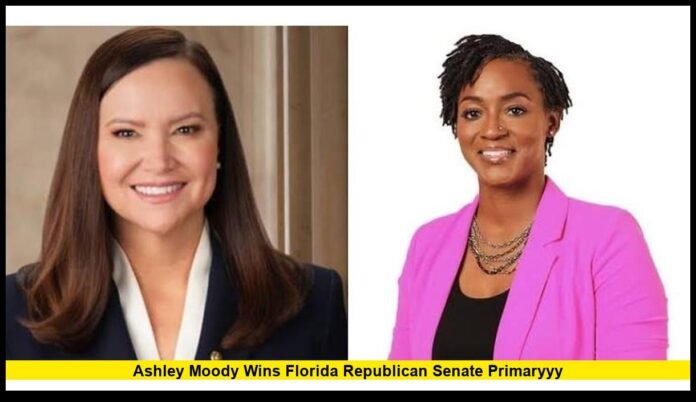

Ashley Moody wins Florida Republican Senate primary after easily defeating her GOP challengers, setting up a high-profile November contest against Democratic nominee Angie Nixon. The result gives Moody a clear path toward defending the Senate seat she currently holds and puts Florida’s evolving political landscape under a national spotlight.
Moody secures Republican nomination
Moody entered the Republican primary as the overwhelming favorite and delivered a decisive victory on Election Day. She received roughly 80% of the Republican vote, comfortably finishing ahead of Chris Gleason, Ernest Rivera and Neelam Perry.
The result was significant because the primary was part of a special election to determine who will serve the remaining portion of Marco Rubio’s Senate term. Rubio left the Senate after being selected to serve as secretary of state, and Florida Gov. Ron DeSantis appointed Moody to fill the vacancy.
Rather than facing a competitive Republican nomination battle, Moody was able to concentrate much of her political attention on the general election. Her large margin also demonstrated the strength of her position among Republican voters and gave her campaign an early advantage heading into the fall campaign.
In her victory remarks, Moody emphasized themes that have shaped her political career, including public safety, government accountability, affordability and reducing regulations that she argues make life more difficult for Florida families.
Her message is expected to remain focused on issues that resonate with Florida’s conservative electorate as the general election campaign accelerates.
Angie Nixon emerges as Moody’s Democratic opponent
Jacksonville state Rep. Angie Nixon defeated former national security official Alexander Vindman in the Democratic Senate primary. Nixon won despite entering the race with a dramatically smaller fundraising operation than her opponent.
Vindman had national recognition from his role during President Donald Trump’s first impeachment and had attracted substantial financial support. Nixon instead relied heavily on grassroots organizing, progressive activists and voters motivated by economic issues.
Her victory created an unexpected matchup for the November election.
Nixon has built her political identity around progressive economic policies and working-class issues. Her campaign has highlighted concerns including health care costs, child care, housing affordability, wages and the influence of wealthy donors in American politics.
The contrast with Moody is likely to become one of the central themes of the general election.
Why Nixon’s primary victory matters
Nixon’s nomination was widely viewed as an upset because of the financial and institutional advantages held by Vindman.
The race illustrated the continuing tension within the Democratic Party between candidates who emphasize traditional electability and candidates who argue that a more progressive platform can motivate voters who have become frustrated with the political establishment.
Nixon’s background as a community organizer and union advocate played an important role in her campaign. Instead of attempting to compete with Vindman’s national profile and fundraising network, she emphasized direct voter contact and grassroots participation.
That strategy proved effective in the primary.
Her victory also fits into a broader national pattern in which progressive Democratic candidates have made gains in several high-profile primaries. For Democrats, the question now is whether that energy can translate into a competitive statewide campaign in Florida.
Moody immediately draws a sharp contrast
Following the primary results, Moody moved quickly to define the November contest.
Republicans are expected to portray Nixon as significantly to the left of the state’s electorate, particularly because of her association with democratic socialism and her progressive policy agenda. The GOP is likely to argue that Nixon’s positions would move Florida away from the conservative policies that have dominated statewide politics in recent years.
That argument could become particularly important in Florida’s diverse electorate.
Moody and Republican strategists are expected to emphasize issues such as taxes, public safety, immigration, regulation, energy policy and the role of government. The campaign will also likely focus heavily on Nixon’s policy proposals and political affiliations.
For Nixon, the challenge will be to prevent the election from becoming solely a referendum on ideological labels.
She is expected to emphasize affordability and economic concerns while arguing that voters should judge candidates based on how they would address everyday financial pressures.
Florida’s political environment favors Republicans
The general election begins with Florida presenting a difficult environment for Democrats.
Republicans have strengthened their position across much of the state over the past several election cycles. The GOP has built a substantial advantage among registered voters and has performed strongly in statewide races.
That political environment gives Moody an important structural advantage.
Florida’s political shift has also changed the way Democratic candidates approach statewide elections. A campaign that might once have focused primarily on moderate suburban voters now has to account for a broader Republican coalition that includes conservatives across different regions of the state.
Nixon will therefore need to build a coalition capable of reaching Democratic voters while also attracting independents and potentially persuading voters who do not normally support progressive candidates.
That will be a difficult task, but her primary campaign demonstrated that she can generate enthusiasm among a motivated base.
The special election adds another layer
The Senate contest is not a standard six-year election.
The winner will serve the remaining two years of Rubio’s term. That makes the November race particularly important because the eventual senator will need to quickly establish a statewide record before another Senate election arrives in 2028.
For Moody, winning in November would allow her to continue serving in the Senate and give her additional time to build a record as an elected senator rather than an appointed one.
For Nixon, victory would represent a major political breakthrough and immediately elevate her from state-level politics to the national stage.
The unusual timing also means both campaigns have strong incentives to move quickly.
Moody’s record will face scrutiny
Although Moody enters the general election with the advantage of incumbency, her record will become a major focus of the campaign.
Before joining the Senate, Moody served as Florida attorney general. Her tenure in statewide office established her as a prominent Republican figure with a reputation for taking aggressive positions on law enforcement, public policy and issues important to conservative voters.
As a senator, she has continued to emphasize policies associated with the Republican Party.
Democrats are likely to use the campaign to scrutinize Moody’s voting record and challenge her positions on health care, the economy, reproductive rights, education, environmental policy and federal spending.
Moody, in turn, is expected to argue that her record reflects Florida’s priorities and that Democratic proposals would lead to higher costs or greater federal involvement.
Nixon faces the challenge of defining herself
One of Nixon’s biggest challenges will be introducing herself to voters beyond the Democratic primary electorate.
Her Jacksonville-based political career has given her a strong base in Northeast Florida, but a statewide Senate campaign requires a much broader coalition.
She will need to compete in major population centers while also making inroads in smaller communities and regions where Democrats have struggled in recent elections.
Her campaign is expected to emphasize her personal story, organizing background and focus on working families.
Nixon can also point to the fact that she won her primary while being dramatically outspent. That result allows her campaign to argue that enthusiasm and voter engagement can overcome traditional political advantages.
The challenge is turning that primary coalition into a statewide organization capable of competing against a well-funded incumbent.
Fundraising could shape the fall campaign
Money will be another major factor.
Moody entered the general election with a significant fundraising advantage and the backing of the Republican political establishment. That gives her the ability to spend heavily on television advertising, digital campaigns, voter outreach and statewide organization.
Nixon will need to raise substantial additional funds to compete on the same scale.
Her primary victory may help solve part of that problem. A surprise statewide nomination can attract national attention and bring new donors into a campaign.
Progressive organizations and Democratic fundraising networks now have a clear nominee to support, while Republicans have a clear target.
The result could produce a major increase in campaign spending as both parties attempt to shape the race before voters head to the polls.
The November campaign will test competing visions
The Moody-Nixon contest is likely to become a debate over the direction of Florida as much as a competition between two individual candidates.
Moody represents the state’s increasingly dominant Republican political establishment. Nixon represents a progressive movement attempting to expand its reach in a state where Democrats have faced significant statewide setbacks.
The candidates also offer sharply different approaches to government.
Moody is likely to argue for conservative policies, lower regulatory burdens, public safety and limited government. Nixon is expected to advocate a more expansive federal role in health care, child care, housing, wages and economic assistance.
That contrast gives voters a clear choice.
The campaign may also become an important test of whether progressive economic messaging can compete in a state where Republican candidates have successfully used cultural and ideological issues to build broad support.
National Democrats now face a strategic decision
Nixon’s victory presents national Democrats with a complicated choice.
The party can invest heavily in Florida and attempt to turn an unexpected nominee into a competitive statewide challenger, or it can focus resources on Senate contests where Democrats have a more favorable path to victory.
Nixon’s grassroots campaign gives Democrats a reason to believe that enthusiasm could produce stronger-than-expected results. At the same time, Florida’s Republican lean makes a statewide Democratic victory difficult.
Republicans face a different calculation.
With Moody already established as the GOP nominee, national Republicans can use the race to reinforce their message about the direction of the Democratic Party. The party is likely to make Nixon’s progressive positions a central part of its advertising strategy.
What voters should watch next
The next phase of the campaign will reveal whether the race develops into a competitive contest or remains a Republican-leaning battle.
Key issues will include the economy, inflation, housing costs, health care, immigration, abortion policy, public safety and federal spending. Both campaigns will also look closely at turnout among younger voters, Black voters, Hispanic voters, suburban residents and independent voters.
Debates could become particularly important because Nixon needs opportunities to introduce herself to a statewide audience, while Moody will need to defend her record and maintain her advantage.
The candidates’ fundraising numbers will also provide an early indication of how seriously national political organizations view the race.
Most importantly, voter turnout could determine whether Nixon’s grassroots energy can challenge Florida’s Republican advantage.
A closely watched Florida Senate race
The outcome of the primary has transformed the Florida Senate contest into one of the more closely watched political races of the 2026 election cycle.
Moody enters the general election with the advantages of incumbency, Republican voter registration strength, name recognition and substantial political resources. Nixon enters with the momentum of an unexpected primary victory and a campaign centered on progressive economic issues and grassroots organizing.
The two candidates now have several months to make their case to Florida voters.
For Moody, the objective is straightforward: defend the Senate seat, strengthen her statewide mandate and continue the Republican dominance that has characterized Florida politics in recent years.
For Nixon, the task is much more ambitious. She must persuade voters that Florida is ready for a different political direction while expanding her coalition far beyond the voters who propelled her through the Democratic primary.
The general election will ultimately determine whether the state’s increasingly conservative political landscape remains intact or whether Democrats can stage a major statewide comeback.
The Florida Senate race is only beginning, and the November showdown could offer one of the clearest tests yet of where the state’s voters want to take their politics next.