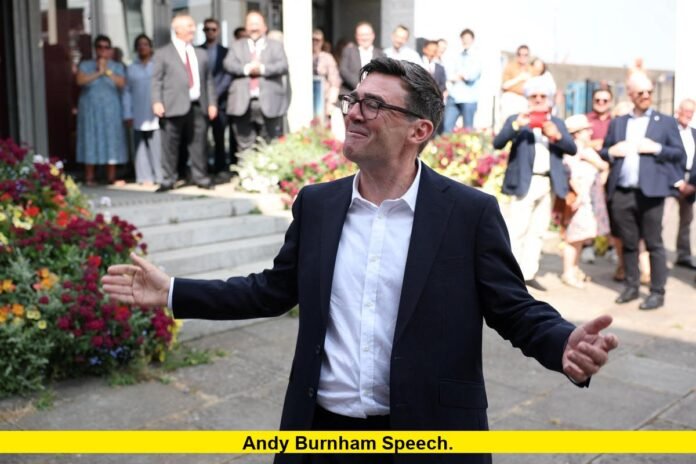

The first andy burnham speech since taking office as the United Kingdom’s prime minister has offered the clearest indication yet of how the new government intends to shape its policy agenda. Focusing on economic growth, public services, housing, and regional development, Burnham presented a message centered on long-term planning rather than short-term political gains. His address marked the beginning of a new chapter for both the Labour government and the country’s political landscape.
A Leadership Transition With Immediate Priorities
Burnham assumed the role of prime minister following Labour’s leadership transition in July 2026, moving from regional government to the nation’s highest political office. His arrival at Downing Street follows years of public service that included Cabinet roles, a lengthy period as Mayor of Greater Manchester, and a reputation for advocating greater powers for England’s cities and regions.
His opening days in office have been dedicated to outlining broad national priorities while assembling a Cabinet expected to oversee the government’s first legislative initiatives.
Rather than announcing sweeping overnight changes, Burnham emphasized that meaningful progress would require sustained work over several years.
Economic Growth at the Center of Government Plans
Economic policy featured prominently throughout the prime minister’s remarks.
Burnham argued that future growth should deliver visible improvements in everyday life rather than simply producing stronger national statistics. His government has signaled that boosting wages, encouraging business investment, supporting innovation, and creating skilled jobs will be among its principal objectives.
The administration also intends to pursue policies designed to increase productivity while helping regions that have experienced slower economic development over recent decades.
Officials have indicated that additional economic announcements may follow as ministers complete departmental reviews.
Regional Decision-Making Remains a Defining Theme
One of the most consistent elements of Burnham’s political career has been his support for devolution, and that priority has now become part of the government’s national agenda.
He has argued that local leaders should have greater authority over transport, housing, infrastructure, and economic planning. According to the government’s position, decisions made closer to communities may lead to more effective public services and stronger local accountability.
This approach reflects Burnham’s experience leading Greater Manchester, where regional governance became a key part of his political identity.
Housing Policy Expected to Receive Early Attention
Affordable housing remains another major area of focus.
The government has outlined ambitions to increase the supply of homes while addressing homelessness through coordinated national and local strategies. Ministers are also expected to examine planning reforms and investment in new housing developments as part of broader efforts to improve affordability.
Although detailed legislation has not yet been introduced, housing is widely expected to feature prominently during Parliament’s upcoming sessions.
Public Services Among Government Priorities
Healthcare, education, and social care continue to occupy a central place within the administration’s agenda.
Burnham has repeatedly stressed that strong public services are essential for economic success as well as social wellbeing. His government has pledged to review pressures affecting the National Health Service, workforce recruitment, and access to essential services.
Education reforms, skills training, and mental health support are also expected to receive significant attention during the first year of the new administration.
A Different Approach to National Investment
Infrastructure formed another important part of the prime minister’s message.
Rather than concentrating investment in a limited number of locations, the government aims to encourage development across multiple regions of the country. Transport improvements, digital connectivity, and industrial investment are expected to play an important role in that strategy.
Burnham has argued that stronger regional economies can contribute to national prosperity while reducing longstanding geographical inequalities.
Political Tone Reflects Local Government Experience
Observers have noted that Burnham’s communication style differs from that of several recent national leaders.
His speeches generally avoid highly theatrical language and instead emphasize practical objectives, community engagement, and everyday concerns affecting households.
That approach reflects much of his experience as Greater Manchester mayor, where public communication often focused on transport services, local investment, healthcare, and regional development rather than Westminster politics alone.
The andy burnham speech delivered after entering Downing Street continued that pattern by combining broad national ambitions with practical policy themes.
Public Response Continues to Develop
Reaction to the government’s opening agenda has been mixed, as is typical following a change in national leadership.
Supporters have welcomed the emphasis on regional investment, public service improvements, and long-term economic planning. Many local government leaders have also expressed interest in proposals that could provide additional powers to cities and combined authorities.
Opposition figures, meanwhile, have questioned how some initiatives will be financed and whether implementation can match the scale of the government’s ambitions.
As Parliament begins considering future legislation, debate over these proposals is expected to intensify.
Looking Ahead
The first weeks of Burnham’s premiership are likely to shape public expectations for the years ahead.
Cabinet ministers are expected to introduce more detailed policy proposals covering economic reform, housing, infrastructure, healthcare, education, and local government. Those measures will provide a clearer picture of how campaign commitments will be translated into practical legislation.
While many initiatives remain at an early stage, the administration has made clear that it intends to pursue a long-term strategy rather than relying on short-term policy announcements.
Success will ultimately depend on economic conditions, parliamentary support, and the government’s ability to deliver measurable improvements across the country.
For now, Burnham’s opening message establishes a governing philosophy built around regional empowerment, economic opportunity, and investment in public services. The coming months will determine how those priorities evolve into concrete action and whether they achieve the outcomes the new government has promised.