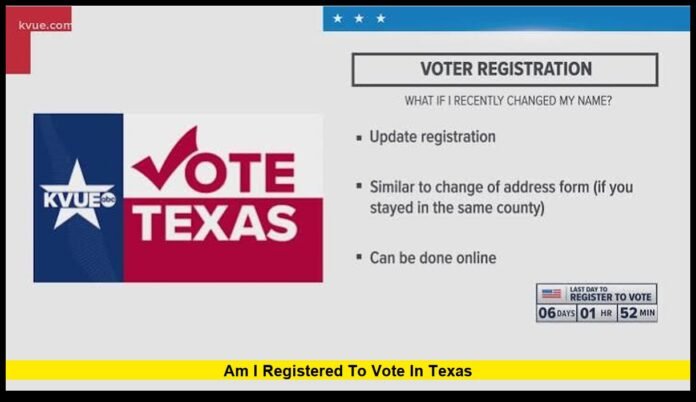

If you are asking, am i registered to vote in texas, checking your status before Election Day is one of the simplest ways to make sure you are prepared to cast a ballot. Texas voters can verify their registration information through the state’s voter registration system, review their address and registration status, and take action if their information needs to be updated.
The November 3, 2026, general election is approaching, making voter registration verification particularly important. Texas has set October 5, 2026, as the deadline to register or make certain registration changes for the November election. Voters who wait until the last minute could have fewer options if they discover an address or registration problem.
How to Check Your Texas Voter Registration
Texas provides an online voter registration lookup service that allows eligible voters to search for their records.
The state generally provides several ways to locate a voter registration record. Depending on the information available to you, you may be able to search using:
- Your Voter Unique Identifier, commonly called a VUID
- Your Texas driver’s license number and other requested information
- Your first and last name along with additional identifying information
The VUID appears on a Texas voter registration certificate. If you have your certificate, keeping the number available can make it easier to locate your registration record.
If you cannot find your information online, you should not immediately assume that you are not registered. Voter registration records are maintained at the county level, and voters can contact their county voter registrar for assistance.
What Information Should You Verify?
Finding your registration record is only the first step. Once you locate it, carefully review the information associated with your record.
Pay particular attention to your:
- Full name
- Residential address
- County of registration
- Voter registration status
- Voter identification information
- Voting precinct
Your address is especially important because Texas elections are organized around residential districts, precincts and counties. A move can affect which candidates and local measures appear on your ballot and where you are expected to vote.
Even if you have voted in previous elections, it is a good idea to review your record after moving or changing your name.
What Does “Suspense” Mean on a Texas Voter Record?
One of the biggest sources of confusion for Texas voters is the word “Suspense.”
A suspense designation does not necessarily mean that a voter has been removed from the registration rolls or is prohibited from voting. Instead, it generally indicates that election officials have reason to question whether the voter still lives at the address listed in the registration record.
For example, a voter can be placed on the suspense list after election-related mail is returned as undeliverable. Address information can also become an issue when election officials receive information suggesting that a voter may have moved.
Texas currently has more than 1.2 million voters listed in suspense status, according to recent reporting on state election records. The designation has received increased attention ahead of the 2026 general election.
The important point is that suspense status should not automatically be interpreted as cancellation.
If your registration displays a suspense designation, review your address and contact your county election officials if you need clarification.
Can You Vote If Your Status Is Suspense?
In many circumstances, yes.
Texas election rules provide procedures allowing eligible voters on the suspense list to cast a ballot. Depending on the voter’s circumstances, that may involve completing a Statement of Residence or following another procedure at the polling place.
The process can be different if you have moved within the same county compared with moving to an entirely different county.
This is why voters should not simply ignore a suspense designation. If your address is outdated, correcting the information before the registration deadline can make the voting process easier.
What If You Recently Moved?
Moving is one of the most common reasons Texans should review their voter registration.
Texas voter registration is county-based. If you move to another residence, you should update your voter registration information as soon as possible.
For the November 3, 2026, election, October 5 is the deadline for a registration or address change to be effective under the normal registration rules.
If you moved within the same county but did not update your registration before the deadline, Texas provides certain fail-safe procedures that can allow eligible voters to cast a ballot under specific circumstances.
Moving to a different county can be more complicated.
A voter who has moved to another county without updating their registration by the deadline may qualify for a limited ballot during early voting. A limited ballot generally covers candidates and measures that are common between the voter’s former and new jurisdictions.
The limited-ballot option has specific requirements and is not available in the same way on Election Day. Voters in this situation should contact election officials in their new county before attempting to vote.
What Is the Texas Voter Registration Deadline for 2026?
The voter registration deadline for the November 3, 2026, Texas general election is October 5, 2026.
The deadline applies to new registrations and certain changes to existing registration information.
Texas law generally requires voters to register by the 30th day before an election. Because the normal 30th day before November 3 falls on a Sunday, the applicable deadline moves to the next regular business day.
Voters should avoid waiting until the final day whenever possible. Submitting an application earlier provides additional time to address problems or missing information.
Can You Register to Vote Online in Texas?
Texas allows voters to begin the registration process online.
However, voters should understand an important distinction: completing an online voter registration application does not necessarily mean the entire process has been completed electronically.
A voter who fills out the Texas application online may need to print the completed application and submit it to the appropriate county voter registrar.
Registration applications are also available through various locations, including county voter registrar offices and other approved distribution sites.
Because processing requirements can affect when a registration becomes effective, voters who are not currently registered should begin the process as early as possible.
When Does a New Texas Voter Registration Become Effective?
A Texas voter registration generally becomes effective 30 days after the application is submitted and accepted by the county voter registrar, subject to applicable requirements.
That means registering shortly before an election does not necessarily make someone immediately eligible to vote in that election.
For the November 2026 election, October 5 is therefore an important date for eligible Texans who are not already registered.
After an application has been processed, the voter receives a registration certificate. Voters should review the certificate carefully and report errors to the appropriate county election office.
What If You Never Received Your Voter Registration Certificate?
Not receiving a voter registration certificate does not automatically mean you are no longer registered.
Texas sends new certificates periodically to voters using the most recent address in their registration record. If a certificate is returned because it cannot be delivered, election officials may need to verify the voter’s address.
That can result in a voter being placed on the suspense list.
Instead of relying only on whether you have a physical voter card, checking your registration record provides a better way to determine what information is currently associated with your registration.
If something appears incorrect, contact the county voter registrar responsible for your registration.
Important Texas Election Dates for 2026
Texas voters preparing for the November general election should keep several dates in mind.
October 5, 2026 — Voter Registration Deadline
This is the deadline to register to vote for the November 3 general election and the deadline for certain registration updates to take effect for that election.
October 19, 2026 — Early Voting Begins
Texas early voting by personal appearance begins October 19.
Registered and eligible voters can generally vote at any designated early voting location within their county during the early voting period.
October 23, 2026 — Mail Ballot Application Deadline
October 23 is the deadline for the early voting clerk to receive an application for a ballot by mail for the November election, subject to applicable eligibility requirements.
October 30, 2026 — Early Voting Ends
The final day of early voting by personal appearance is October 30.
November 3, 2026 — Election Day
The Texas general election will take place on Tuesday, November 3, 2026.
Election Day polling places generally operate from 7 a.m. to 7 p.m., although voters should verify the location and applicable procedures for their county before heading to the polls.
What Identification Do Texas Voters Need?
Texas generally requires voters casting ballots in person to present an approved form of photo identification.
Acceptable identification includes several types of government-issued identification, including certain Texas-issued documents and a U.S. passport.
There are also procedures for voters who do not possess an acceptable form of photo identification and who cannot reasonably obtain one. In qualifying circumstances, a voter may use a supporting form of identification and complete a Reasonable Impediment Declaration.
Voters should check the current identification requirements before Election Day rather than relying on rules from a previous election.
What If You Cannot Find Your Registration Record?
If your voter registration does not appear in the online search, first make sure that the information you entered is correct.
Try another available search method if appropriate. A voter who has a VUID, for example, can use that information rather than relying only on a name search.
If you still cannot locate your record, contact the voter registrar in your Texas county.
There can be several reasons a voter may have difficulty locating a record, including a recent move, a name change, an application that has not yet been processed, or differences in the information entered during the search.
Do not wait until Election Day to resolve an uncertainty that can be addressed beforehand.
Why Checking Your Registration Matters in 2026
The 2026 Texas election is expected to draw significant attention because voters will decide numerous federal, statewide and local races.
The ballot will include major offices such as governor and U.S. senator, along with congressional, legislative, judicial and local contests.
Your residential address determines which districts and local races apply to you. An outdated registration can therefore create more than a simple administrative inconvenience.
Checking your registration in advance can help you:
- Confirm that your name appears in the voter database
- Verify your current residential address
- Determine your county and precinct
- Identify whether your record has a suspense designation
- Update information after a move
- Resolve registration questions before Election Day
- Prepare for early voting
For voters searching am i registered to vote in texas, the most reliable approach is to use the state’s voter registration lookup system rather than relying on an old registration card or memory.
What Should You Do Before October 5?
If you are already registered and your information is correct, there may be nothing else you need to do regarding registration.
If you recently moved, changed your name or discovered an incorrect address, begin the update process immediately.
If you are not registered, submit your application before the October 5 deadline.
If your record shows suspense, determine whether the address listed is still correct and contact your county election officials if you need assistance.
Taking these steps before the deadline can reduce the possibility of encountering an avoidable registration problem when voting begins.
Frequently Asked Questions
How can I check my Texas voter registration?
You can use the Texas voter registration lookup system to search for your record using available identifying information, including your VUID or other requested voter information.
What is the voter registration deadline in Texas for the November 2026 election?
The deadline is October 5, 2026.
Does suspense mean I cannot vote?
No. A suspense designation generally means that election officials need to verify the voter’s residential address. Eligible voters on suspense can still have procedures available to cast a ballot.
What happens if I moved to another Texas county?
You should update your voter registration. If you miss the registration deadline, you may qualify for a limited ballot during early voting if you meet the applicable requirements.
When does early voting begin in Texas in 2026?
Early voting for the November 3 general election begins October 19 and ends October 30.
When is Election Day in Texas?
The 2026 general election is scheduled for Tuesday, November 3, 2026.
Bottom Line
Texas voters do not have to wait until Election Day to discover whether their registration information is correct. Checking the state voter database, confirming your address and resolving any registration issues early can make the voting process much smoother.
The October 5 registration deadline is particularly important for Texans who are not registered or who have recently moved. Voters should also understand that a suspense designation does not automatically mean they have been removed from the voter rolls.
With early voting beginning October 19 and Election Day scheduled for November 3, 2026, now is a good time to verify your voter registration and make sure your information is ready for the election.