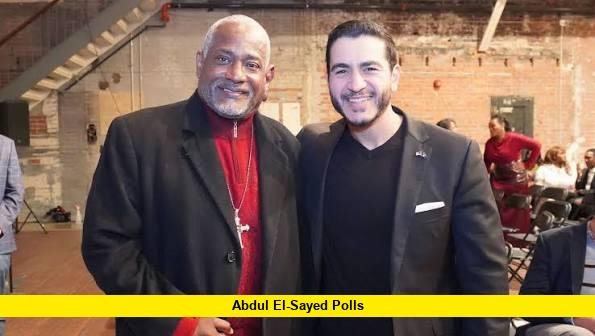

Abdul El-Sayed polls have shown a dramatic swing in his favor heading into the August 4, 2026, Michigan Democratic primary for U.S. Senate. What began the year as a tight three-way contest between El-Sayed, Representative Haley Stevens, and state Senator Mallory McMorrow has narrowed into a two-person race, and the final surveys before Election Day suggest El-Sayed has built real momentum. With Michigan’s Senate seat considered one of the most competitive and consequential races of the 2026 midterms, the numbers behind Abdul El-Sayed’s candidacy have drawn national attention from party leaders, pundits, and prediction markets alike.
Who Is Abdul El-Sayed
Abdul El-Sayed, whose full name is Abdulrahman Mohamed El-Sayed, was born on October 31, 1984, in Detroit. He is the son of an Egyptian immigrant father who studied engineering at Wayne State University and a mother who works as a nurse practitioner. El-Sayed studied biology and political science as an undergraduate at the University of Michigan, earned a Rhodes Scholarship to Oxford’s Oriel College, and completed his medical degree at Columbia University, where he also briefly taught.
At age 30, El-Sayed became the youngest health officer in a major U.S. city when Detroit Mayor Mike Duggan appointed him to rebuild the Detroit Health Department following the city’s 2012 bankruptcy. He later served as director of Wayne County’s Department of Health, Human and Veterans Services, a role covering roughly 1.8 million residents, from late 2022 until his resignation in 2025 as he weighed a run for higher office. He is married to physician Sarah Jukaku, and the couple have two daughters.
El-Sayed is not new to statewide politics. In 2018, he ran for governor of Michigan on a progressive, Medicare for All platform, finishing second in a three-way Democratic primary while earning more than 340,000 votes and endorsements from Senator Bernie Sanders and Representative Alexandria Ocasio-Cortez. That campaign built the grassroots network and progressive credibility he has leaned on heavily in his 2026 Senate bid.
Career and Public Health Background
Before entering electoral politics full time, El-Sayed built a career centered on public health and government reform rather than partisan office. As Detroit’s health director, he led efforts to curb sulfur dioxide emissions from a major refinery and to reduce lead exposure in city schools. As Wayne County’s health officer, his office worked to erase roughly $700 million in medical debt for residents, expanded air quality monitoring, and helped provide free eyeglasses to children in lower-income schools.
Outside of government, El-Sayed has built a national media profile. He hosts the podcast “America Dissected,” has authored three books including “Healing Politics” and “Medicare for All: A Citizen’s Guide,” and has published more than 100 peer-reviewed academic papers. He has also worked as a CNN commentator and held academic appointments at the University of Michigan, Harvard’s T.H. Chan School of Public Health, Wayne State University, and American University. This combination of public health credentials and media visibility has shaped how voters and pollsters describe him: a progressive outsider running against Washington’s status quo, campaigning on affordability, getting money out of politics, and passing Medicare for All.
Public Interest and the Primary Polling Trend
Public interest in Abdul El-Sayed polls has intensified sharply since Michigan’s Senate seat opened up after Senator Gary Peters announced he would not seek reelection. Early in the race, polling from Emerson College showed a much closer contest. A survey conducted April 11–13, 2026, found El-Sayed and McMorrow tied at 24% each among likely Democratic primary voters, with Stevens trailing at 13% and more than a third of voters still undecided. That poll also showed a clear generational divide, with voters under 40 favoring El-Sayed by a wide margin while voters over 50 leaned toward McMorrow.
As the race narrowed to a two-candidate contest between El-Sayed and Stevens, later polling showed a substantial shift toward El-Sayed. An Emerson College survey conducted July 26–27, 2026, found El-Sayed leading Stevens 54% to 39%, with 6% undecided; when undecided voters’ leanings were included, the gap widened to 57%–41%. That same poll found independents breaking for El-Sayed by 27 points and Democrats favoring him by 9 points, while voters over 60 remained one of the few groups still favoring Stevens.
In the campaign’s final stretch, additional polls reinforced the trend. A Zenith Research survey of likely Democratic primary voters, conducted July 26–30, 2026, put El-Sayed ahead 53% to 34%, expanding to an 18-point edge once undecided voters were pushed to choose. A Tavern Research poll from the same window showed El-Sayed up 11 points, 48% to 37%. Not every survey told the same story, however: a Glengariff Group poll for The Detroit News, conducted July 8–11, 2026, had shown Stevens ahead by 7 points, 48% to 41%, illustrating how quickly sentiment appeared to move in the final weeks before voting.
Key factors cited in coverage of the race’s late shift include:
- High-profile endorsements for El-Sayed from national progressive figures, including Senator Bernie Sanders and Representative Alexandria Ocasio-Cortez.
- A generational split, with younger and independent voters consistently favoring El-Sayed by wide margins in multiple surveys.
- Ongoing friction between the campaigns, including sharp exchanges over Middle East policy that drew national media attention.
- Continued institutional support for Stevens, including an endorsement from outgoing Senator Gary Peters and backing from established party groups.
Latest Updates
As Michigan’s Democratic primary reached its final days, most published polling and prediction markets pointed toward El-Sayed as the favorite to win the nomination. CNN data analyst Harry Enten described El-Sayed as the “heavy favorite” heading into primary day, framing the race as a test of whether progressive energy can overcome establishment backing in a battleground state. Prediction markets tracked ahead of the primary also showed bettors favoring El-Sayed to win, according to multiple reports.
The primary itself is being held on August 4, 2026, with the winner set to face Republican nominee Mike Rogers, a former U.S. representative who is the presumptive GOP candidate, in the November 3, 2026, general election. Because official primary results were still being tabulated as of this writing, there is no official confirmation yet of the final outcome, and any reported margins should be understood as based on pre-election polling rather than certified results. Voters and observers looking for the definitive answer will need to watch results as they are reported on primary night and in the days that follow, since Michigan’s Senate race is widely expected to be closely contested and closely watched all the way to November.
Final Thoughts
The trajectory of Abdul El-Sayed polls over 2026 tells the story of a campaign that started as an underdog in a crowded field and appeared to gain significant ground by primary day, particularly among younger and independent voters. Whether that late polling momentum translates into an actual primary win will depend on turnout patterns that pollsters can estimate but not guarantee. Regardless of the outcome, the attention paid to this race reflects a broader debate within the Democratic Party about the balance between progressive candidates and more centrist, establishment-backed alternatives heading into the 2026 midterms.
Stay tuned for more updates on Michigan’s Senate primary, and share your thoughts on the race in the comments below.