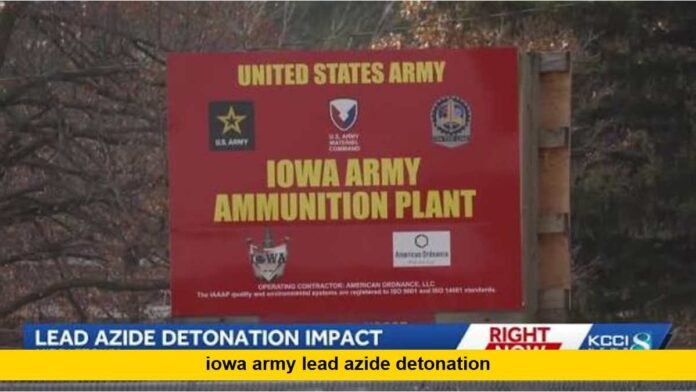

The iowa army lead azide detonation plan has drawn growing attention as federal officials attempt to address deteriorated explosive material stored at the Iowa Army Ammunition Plant in Middletown, Iowa. The proposed operation has become a complicated issue involving military safety assessments, environmental concerns, legal challenges, government decisions, and questions from residents about potential risks to surrounding communities.
The U.S. Army has been preparing for a controlled detonation involving lead azide, a highly sensitive explosive compound used in military applications. Officials say the material’s deteriorated condition has created a safety concern that must be addressed. At the same time, environmental organizations and community members have questioned whether the proposed disposal method could expose nearby areas to lead-containing particles.
The operation has faced multiple schedule changes and legal developments. The Army’s latest announced schedule placed the operation on November 25, 2026, but developments involving the federal court and a presidential directive have added uncertainty. The situation remains fluid, making official updates particularly important for residents in southeastern Iowa and potentially affected neighboring communities.
What Is Stored at the Iowa Army Ammunition Plant?
The material involved is deteriorated lead azide stored at the Iowa Army Ammunition Plant, a military installation near Middletown in southeastern Iowa. Lead azide is an explosive compound associated with military ammunition and initiation systems. In this case, officials say the material’s condition has deteriorated to the point that handling or moving it presents serious safety risks.
Reports describe 68 barrels containing approximately 9,700 pounds of material, including a substantial amount of lead. The stockpile was discovered earlier in 2026, and officials have been evaluating how to address it safely.
The concern is not simply the age of the material. Officials say the condition of the stored explosive has created the possibility of an uncontrolled reaction. The Army has argued that an accidental explosion could be more dangerous than a planned operation conducted with safety measures, controlled conditions, and emergency coordination.
Why the Army Says the Operation Is Necessary
Military officials have said the deteriorated material may be too dangerous to move, open, or treat using ordinary disposal procedures. The Army’s position is that the explosive has become highly sensitive and that an uncontrolled explosion could create a substantially greater danger.
Cold temperatures have also been cited as a factor in the urgency surrounding the operation. Officials have warned that changing conditions may increase the risk of an accidental explosion, making the timing of the planned disposal important.
The Army says a controlled detonation allows it to implement protective measures that would not be available during an unexpected explosion. These include barriers, weather-related restrictions, public notifications, environmental monitoring, and coordination with government agencies.
Critics have questioned whether the government adequately examined alternative treatment methods before selecting detonation. The disagreement has contributed to the legal challenge and public debate.
Why Environmental Organizations Are Challenging the Plan
The proposed detonation has faced opposition from environmental organizations, including the Iowa Environmental Council and the Iowa chapter of the Sierra Club. Their legal challenge has raised concerns about the EPA’s emergency permit and whether sufficient safeguards were established before the Army’s plan was authorized.
The groups have argued that the operation could disperse lead-containing particles and that residents need more information about potential exposure, monitoring, and environmental consequences. They have also questioned whether alternatives to detonation were adequately evaluated.
The legal dispute has focused on the emergency permit and the government’s environmental review. The court’s decision to lift its administrative stay allowed the permit-related operation to move forward, but the broader legal challenge remains part of the developing situation.
Federal Court Ruling and Presidential Intervention
The Eighth Circuit Court of Appeals has lifted its temporary administrative stay and declined to grant an emergency request to block the operation. The court acknowledged that the planned detonation carries risks but concluded that the situation also involves the danger of an uncontrolled explosion involving the deteriorated material.
President Donald Trump subsequently directed the military to pause the operation pending court agreement and agreement from Iowa Governor-elect Rob Sand. This created a conflict between the Army’s announced schedule and the President’s stated direction.
The Army had previously indicated it intended to proceed with the operation on Wednesday, November 25, based on weather conditions and mitigation preparations. The court’s ruling and the presidential directive mean the schedule remains subject to clarification.
The latest developments have made the operation a significant federal, state, and legal issue rather than simply a military disposal matter.
Potential Environmental and Public Health Effects
The primary environmental concern is the possibility that lead-containing dust could become airborne during the operation and travel beyond the ammunition plant. Lead is a toxic metal that can affect human health, particularly when particles are inhaled or accidentally ingested.
Possible exposure pathways include airborne particles, dust deposited on soil, outdoor surfaces, vehicles, playgrounds, buildings, and other locations. The extent of any impact would depend on actual weather conditions, wind direction, atmospheric movement, and the results of environmental monitoring.
Lead exposure is especially concerning for young children and pregnant women. Lead can affect neurological development and may cause other health problems. Public health authorities emphasize that there is no established safe level of lead exposure, making prevention and monitoring important.
Potential contamination is not the same as confirmed contamination. Environmental projections can identify areas that may be affected, but actual conditions would need to be evaluated through monitoring and testing. Residents should not interpret preliminary maps as proof that their homes, properties, or communities have been contaminated.
How Weather Could Affect the Operation
Weather is a major factor in the Army’s planning. Officials have repeatedly adjusted the schedule while considering atmospheric conditions and the potential movement of airborne particles.
The Army has said that its latest proposed timing was selected to provide more favorable conditions and additional time for safety measures. Forecast wind conditions are particularly important because they may influence where airborne material could travel.
Environmental modeling is being used to estimate potential exposure and deposition areas. These models can change when weather forecasts are updated, meaning previously published projections may not remain accurate.
The Army and government agencies have indicated that updated projections and public notices are important parts of the planning process. Residents should therefore follow current announcements rather than older information.
What Safety Measures Are Being Considered?
Federal authorities have described several measures intended to reduce risks associated with the planned operation. These include protective barriers, weather restrictions, public notification, environmental modeling, and monitoring.
The Army has also discussed additional mitigation measures and coordination with federal, state, and local agencies. These measures are intended to reduce the possibility of particles traveling beyond the designated area and to provide authorities with information about potential environmental effects.
Officials have advised residents who may be affected to follow local emergency guidance. Depending on the latest instructions, precautions could include remaining indoors during the operation, limiting outdoor activity, keeping windows closed, and avoiding contact with outdoor dust until officials provide updated guidance.
The specific recommendations may vary depending on location and changing conditions. Residents should follow instructions issued for their community rather than applying general advice to every area.
How Iowa and Neighboring States Are Responding
State agencies have been coordinating with federal authorities as the operation’s schedule and legal status have changed. Iowa officials have activated emergency-response resources and are working to communicate information to residents.
Neighboring states have also been monitoring the situation. Illinois agencies, for example, have prepared information for residents and are tracking potential impacts using updated environmental modeling.
The interstate response reflects concerns that airborne particles, depending on weather conditions, may not remain limited to the immediate area around the ammunition plant. State officials are preparing to provide public information and monitor developments if their communities could be affected.
Residents should look for updates from state emergency management agencies, public health departments, and local authorities because those organizations may provide community-specific information.
What Residents Should Know Before Any Operation Takes Place
Residents in potentially affected areas should remain attentive to official information as the situation continues to change. The Army’s schedule, legal developments, weather forecasts, and environmental projections may affect the instructions provided to the public.
Important precautions include:
- Monitor government announcements and emergency notifications.
- Check whether updated impact projections apply to your community.
- Follow any shelter-in-place or other protective instructions.
- Keep children away from outdoor dust or potentially affected surfaces if officials advise precautions.
- Avoid entering restricted areas near the ammunition plant.
- Do not touch suspicious debris or unfamiliar materials.
- Contact a medical professional or public health authority if concerned about possible lead exposure.
The operation’s status is especially important to confirm because the Army’s announced schedule and the President’s direction to pause the operation have created uncertainty. Residents should not assume the planned event will occur at a particular time until authorities provide confirmation.
What Could Happen After the Detonation?
If the operation proceeds, authorities may continue environmental monitoring and assess whether airborne particles or other contaminants were detected. Monitoring information could help determine whether additional protective measures or environmental testing are needed.
The Army and other agencies may provide updated information about the estimated affected area, the duration of any airborne exposure concern, and whether additional public guidance is necessary.
Residents should watch for post-operation announcements. Preliminary projections made before the event may differ from findings based on actual conditions and monitoring results.
The response could also involve further assessment of soil, outdoor surfaces, water-related concerns, or other environmental pathways if agencies determine that testing is warranted.
Final Outlook
The planned operation at the Iowa Army Ammunition Plant presents a difficult balance between explosives safety and environmental protection. The Army maintains that the deteriorated lead azide presents a serious danger and that controlled detonation is the safest available approach. Environmental organizations and some residents continue to raise concerns about lead dispersal, transparency, monitoring, and the consideration of alternative methods.
The federal court’s recent decision has removed an important legal obstacle, but President Trump’s directive has introduced a new uncertainty into the timeline. As a result, the Army’s previously announced November 25 schedule should not be treated as a final confirmation that the operation will take place as planned.
For residents in southeastern Iowa and surrounding communities, the key issues remain the operation’s final status, updated weather conditions, potential environmental impacts, public safety instructions, and monitoring results. The situation continues to develop, and the latest official announcements will be essential for understanding what happens next.
Share your thoughts in the comments and stay updated as new information emerges about this developing Iowa public safety situation.