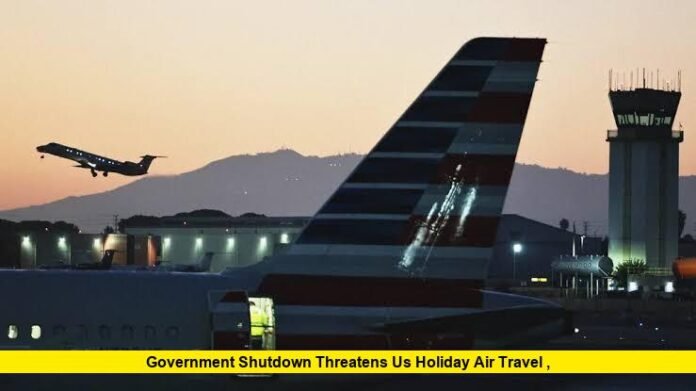

Government Shutdown Threatens US Holiday Air Travel as federal funding is set to expire just days before the busiest travel period of the year. With millions of Americans preparing to fly for Thanksgiving, Christmas, and New Year’s, lawmakers face growing pressure to reach a budget agreement before a potential shutdown disrupts airport security operations, air traffic control staffing, and airline schedules.
The current federal funding measure expires on December 11, 2026, creating the possibility of a funding lapse beginning December 12 if Congress does not approve another spending agreement. The timing raises concerns because a shutdown could affect the Federal Aviation Administration (FAA) and Transportation Security Administration (TSA) during the peak holiday travel season.
Although airports and airlines would not automatically shut down, a prolonged funding lapse could create staffing pressures, longer security lines, flight delays, cancellations, and additional uncertainty for travelers.
The biggest concern is not an immediate nationwide grounding of flights. It is the possibility that unpaid aviation workers face mounting financial pressure during an extended shutdown, potentially weakening staffing and creating operational disruptions at airports across the country.
When Could a Government Shutdown Begin?
The current funding agreement keeps the federal government operating through December 11, 2026. Unless Congress passes full-year appropriations or another temporary funding measure, a funding gap could begin on December 12.
That deadline places the potential shutdown directly in the holiday travel window. Thanksgiving travel will occur before the current funding deadline, but travelers heading out for Christmas, Hanukkah-related trips, New Year’s celebrations, and other December holiday plans could face greater uncertainty if negotiations fail.
The deadline is not itself a shutdown announcement. Congress still has time to pass legislation, and lawmakers could approve another short-term funding extension to keep federal agencies operating while negotiations continue.
The uncertainty is what matters for travelers: the possibility of a shutdown is real, but a shutdown has not been confirmed or scheduled.
Why a Government Shutdown Could Affect Holiday Flights
Air travel depends on federal employees whose work cannot simply stop when funding expires. The FAA manages air traffic control and important aviation safety functions, while TSA employees screen passengers and baggage at airports.
During a shutdown, many employees in these critical positions are generally required to continue working because their duties are considered necessary for protecting life and property. However, they may not receive regular paychecks until funding is restored or another payment mechanism is authorized.
That creates several potential problems:
- Air traffic controllers may have to work without immediate pay.
- TSA officers could face delayed paychecks.
- Financial stress may increase unscheduled absences.
- Some employees could leave their jobs if a shutdown becomes prolonged.
- Reduced staffing could affect airport operations and passenger screening.
- FAA operational restrictions could become necessary at affected facilities or airports.
Aviation operations are designed to prioritize safety. If staffing becomes inadequate, the FAA may reduce traffic rather than operate with insufficient personnel. That could mean fewer flights, longer delays, or cancellations for passengers.
FAA Air Traffic Controllers Could Face Additional Pressure
Air traffic controllers are among the most important workers in the aviation system. They coordinate aircraft movements, maintain safe separation between planes, and manage traffic at airports and through airspace.
During a government shutdown, controllers generally continue working, but financial uncertainty can create significant personal and operational pressure.
A shutdown does not mean controllers suddenly stop directing aircraft. However, prolonged funding disputes can affect workforce morale, increase absenteeism, and complicate staffing at already busy facilities.
The aviation system is particularly vulnerable when staffing problems occur at major air traffic control centers or busy terminal facilities. A shortage at one location can have ripple effects across the national flight network.
TSA Security Lines Could Become Longer
TSA officers are another group of federal workers whose jobs generally continue during shutdowns. Passenger screening remains necessary even when federal funding temporarily lapses.
But airport security operations can become more difficult if officers are required to work without timely pay.
Previous shutdowns have demonstrated how financial pressure can affect attendance and staffing. Travelers may experience longer checkpoint lines, slower screening operations, and uncertainty about how early they should arrive at the airport.
The situation could become especially challenging at major airports serving large holiday crowds, including:
- New York-area airports, including JFK, LaGuardia, and Newark
- Chicago O’Hare International Airport
- Los Angeles International Airport
- Dallas-Fort Worth International Airport
- Atlanta’s Hartsfield-Jackson International Airport
- Miami International Airport
- Seattle-Tacoma International Airport
- Denver International Airport
- San Francisco International Airport
- Boston Logan International Airport
These airports handle substantial passenger volumes and serve as important connections in the national aviation network. Even relatively small staffing disruptions could create wider delays when flights, crews, and aircraft are tightly scheduled.
How a Shutdown Could Affect Different Parts of the United States
The effects would not necessarily be identical at every airport.
Northeast: Airports serving New York, Boston, Philadelphia, and Washington, D.C., could be particularly vulnerable to delays because of dense air traffic, weather-related disruptions, and the interconnected nature of regional flight schedules.
Midwest: Chicago O’Hare and other major regional hubs could experience cascading delays if air traffic staffing or passenger screening operations become constrained.
South: Atlanta, Dallas-Fort Worth, Miami, Houston, and other major southern hubs handle significant connecting traffic. Disruptions at these airports could affect passengers traveling well beyond the region.
West Coast: Los Angeles, San Francisco, Seattle, and other large airports could experience delays that affect domestic and international connections.
Smaller and regional airports: Travelers using smaller airports may also be affected. A disruption at a major hub can cause aircraft and crews to arrive late, affecting flights at airports far from the original problem.
These are potential impacts, not confirmed airport-specific shutdown plans. The actual effect would depend on the length of the funding lapse, staffing levels, FAA operational decisions, airline schedules, and weather conditions.
What Happened During Previous Government Shutdowns?
The concerns surrounding holiday air travel are based on previous shutdown experiences rather than speculation alone.
During past funding lapses, FAA and TSA employees have continued performing critical duties while facing delayed compensation. Over time, financial strain has contributed to staffing challenges, absenteeism, and operational disruptions.
The 2018–2019 government shutdown, which lasted 35 days, demonstrated how a prolonged funding dispute could affect aviation. The shutdown eventually contributed to airport staffing concerns and broader travel disruptions before Congress reached an agreement.
More recent shutdowns have also affected aviation operations. Congressional analysis has documented the connection between shutdowns, unpaid aviation employees, longer security waits, flight delays, cancellations, and temporary traffic restrictions at major airports.
Readers can review the broader aviation impact in this Congressional Research Service report on government shutdowns and civil aviation.
For background on the previous funding crisis and its effects on airport workers, readers can also review the shutdown’s impact on TSA workers and airport operations.
Why Thanksgiving Travel Is Different From Christmas Travel
The current funding deadline creates an important distinction between holiday periods.
Thanksgiving travel takes place before the December 11 funding deadline, meaning a shutdown triggered by the expiration of the current continuing resolution would not directly begin before Thanksgiving under the present schedule.
Christmas and New Year’s travelers, however, could face greater uncertainty if Congress fails to reach an agreement before the funding deadline.
That does not mean Thanksgiving flights will automatically operate without problems. The aviation system has already faced major disruptions from other operational issues, and travelers should continue monitoring their flights.
The recent nationwide FAA ground stop also highlighted how quickly a technical problem can create widespread disruption. A shutdown would represent a separate risk involving staffing and funding rather than necessarily a technical failure.
Could Flights Be Canceled if the Government Shuts Down?
Yes, flight cancellations are possible during a prolonged shutdown, but they are not automatic.
Airlines generally make decisions about their schedules based on staffing, aircraft availability, crew availability, airport operating conditions, and FAA restrictions.
If air traffic control staffing becomes inadequate at certain facilities, the FAA could introduce operational restrictions. Airlines might then cancel flights, reduce schedules, or delay departures to comply with those restrictions.
The impact could spread beyond the airport where the staffing problem initially develops. Aircraft and crews may become displaced, creating additional cancellations later in the day or on subsequent days.
Travelers should therefore understand that a flight may be disrupted even if the airport itself remains open and security checkpoints continue operating.
What Travelers Should Do Before Holiday Flights
Passengers with holiday travel plans should take practical steps now rather than waiting for a shutdown announcement.
Monitor Your Airline’s Flight Status
Check your airline’s app or website regularly before departure. Flight schedules can change quickly during periods of operational uncertainty.
Turn on notifications for:
- Gate changes
- Departure delays
- Flight cancellations
- Boarding updates
- Schedule changes
- Rebooking notifications
Arrive Early
If airport staffing becomes strained, security checkpoint lines could become longer than usual.
Travelers should check their airport’s recommendations and allow additional time, particularly for international flights, connections, and travel during peak holiday periods.
Avoid Tight Connections
A tight connection can become risky when flights experience delays. Travelers with connecting itineraries may want to consider longer layovers when possible.
A delay on the first leg of a trip could cause passengers to miss a connecting flight, especially during crowded holiday periods.
Understand Your Airline’s Rebooking Policies
Passengers should review their airline’s policies before traveling.
If a flight is canceled or significantly delayed, airlines may offer rebooking options depending on the circumstances. Travelers should understand whether they can make changes through the airline’s app, website, customer service, or airport staff.
Keep Important Travel Information Accessible
Save boarding passes, confirmation numbers, hotel details, and important travel documents where they can be accessed quickly.
Having these details available can make rebooking or changing travel plans easier if disruptions occur.
For official airport security guidance, travelers can consult the Transportation Security Administration’s travel tips.
Will the Government Shutdown Actually Happen?
A shutdown is not inevitable.
Congress could still pass full-year appropriations bills, approve another continuing resolution, or reach a compromise that extends funding beyond December 11.
The current temporary funding law is designed to keep agencies operating through the deadline. The legal funding deadline is established by the continuing appropriations legislation, which can be reviewed through the official government funding law.
Political negotiations remain important because lawmakers must resolve disagreements over spending priorities and other policy issues before the deadline. If negotiations produce an agreement in time, the aviation system could avoid the additional shutdown-related staffing pressures.
If lawmakers instead allow funding to lapse, the severity of the travel impact would depend largely on how long the shutdown lasts.
A brief funding lapse might produce limited operational effects. A longer shutdown could place greater pressure on aviation employees and increase the possibility of staffing-related disruptions.
Readers seeking broader background can also review what a federal government shutdown means for services and federal workers.
How Travelers Can Track Aviation Disruptions
Passengers should rely on official information rather than social media rumors or unverified claims about airport closures.
The FAA’s National Airspace System status information provides updates about airport delays, ground stops, traffic restrictions, and other operational conditions. Travelers can check the FAA’s official National Airspace System status page when preparing for a flight.
Airline notifications should remain the primary source for individual flight changes because carriers control passenger bookings and rebooking options.
Travelers should also remember that airport conditions can change rapidly. A flight that appears on time hours before departure could be delayed later because of weather, aircraft availability, crew scheduling, air traffic restrictions, or other operational issues.
What Happens Next?
The next major development will be whether Congress passes a funding agreement before December 11, 2026.
Until lawmakers resolve the budget situation, travelers should watch for:
- New funding legislation or a continuing resolution
- Statements from congressional leaders about negotiations
- FAA announcements concerning operational restrictions
- TSA updates about airport security operations
- Airline advisories concerning holiday schedules
- Changes to airport security wait-time guidance
The key issue is whether lawmakers can avoid another funding lapse during a period when millions of Americans are depending on the aviation system to reach family, friends, and holiday destinations.
Government Shutdown Threatens US Holiday Air Travel: What It Means for Passengers
The possibility of a government shutdown is adding another layer of uncertainty to the 2026 holiday travel season. While flights would not automatically stop operating, a prolonged funding lapse could place pressure on TSA officers, air traffic controllers, and other aviation employees whose work keeps the nation’s airports running.
Thanksgiving travel is scheduled to take place before the current December funding deadline, but Christmas and New Year’s travelers could face greater uncertainty if Congress fails to act.
For passengers, the best approach is to remain informed, monitor airline updates, allow extra time at airports, and avoid assuming that every flight will operate exactly as scheduled during a prolonged funding dispute.
Do you think Congress will reach a funding agreement before the deadline, or could a government shutdown disrupt holiday travel this year? Share your thoughts and stay tuned for the latest updates.