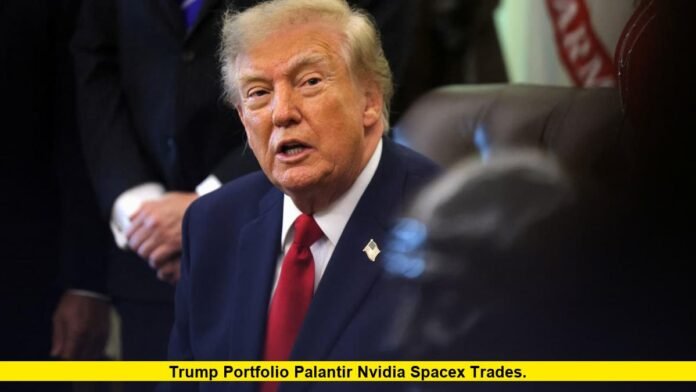

The latest Trump portfolio Palantir Nvidia SpaceX trades are drawing renewed attention after a newly released financial disclosure revealed additional purchases involving major technology companies, artificial intelligence stocks, and Elon Musk’s SpaceX. The reported transactions include investments in Nvidia, Palantir Technologies, and SpaceX, placing the president’s financial portfolio back in the spotlight as investors and ethics watchdogs examine the timing and size of the trades.
The latest disclosure, made public in November, covers transactions during September 2026. It shows that Trump’s investment accounts continued buying and selling shares in companies with major commercial, technology, defense, and government connections. However, the filing reports transaction values in ranges, meaning the exact dollar amounts of many individual trades are not publicly available.
The disclosures have also revived questions about presidential financial transparency, potential conflicts of interest, investment management arrangements, and the relationship between government policy and companies operating in sectors influenced by federal decisions.
What the Latest Trump Portfolio Disclosure Reveals
The newest filing identifies transactions involving several prominent technology and AI-related businesses. The most closely watched companies include:
- Nvidia (NVDA): A major semiconductor and artificial intelligence computing company.
- Palantir Technologies (PLTR): A software company serving commercial customers and government agencies.
- SpaceX: Elon Musk’s aerospace and satellite communications company.
- Tesla (TSLA): The electric vehicle and energy technology company also led by Musk.
The disclosure shows that these investments were part of a broader series of financial transactions rather than isolated purchases. Trump’s investment accounts reported activity across numerous publicly traded companies and other financial instruments.
The filing is particularly significant because Nvidia, Palantir, and SpaceX operate in areas where federal policy, government procurement, national security, technology regulation, and public-sector spending can have substantial commercial implications.
Trump’s Nvidia Trades: AI Stocks Remain a Major Focus
Nvidia continues to attract significant attention because of its central role in the artificial intelligence industry. Its graphics processing units and AI computing infrastructure are used by technology companies, cloud providers, research institutions, and businesses developing advanced AI systems.
The latest financial disclosure indicates that Trump’s accounts made additional Nvidia transactions during September, including purchases and sales.
According to reporting on the filing, the September activity included Nvidia purchases worth as much as $265,000, alongside a reported sale valued at up to $15,000. Because government disclosure forms use financial ranges, these figures represent maximum reported transaction values rather than confirmed exact amounts.
The Nvidia transactions are notable for several reasons.
First, Nvidia remains one of the most influential companies in the AI infrastructure market. Demand for AI computing has helped make its products strategically important to the U.S. technology sector.
Second, the company has been affected by federal decisions involving semiconductor exports, particularly restrictions and licensing requirements related to advanced chips and overseas markets.
Third, Nvidia’s market performance can be influenced by government policy, international trade rules, competition, and the broader development of artificial intelligence.
The transactions do not establish that Trump personally selected Nvidia shares or directed individual purchases. The White House has said that independent investment managers handle his portfolio.
Palantir Stock Purchases Draw Attention
Palantir Technologies is another company appearing in Trump’s recent financial disclosures.
Palantir develops data analytics and software platforms used by businesses, government organizations, and institutions. Its technology has attracted attention for applications involving artificial intelligence, data integration, defense, intelligence, logistics, and operational decision-making.
The latest filing shows Palantir purchases during September, including transactions on September 2 and September 9.
The reported purchase ranges included:
| Transaction date | Reported transaction | Disclosed value range |
|---|---|---|
| September 2, 2026 | Palantir purchase | $15,001–$50,000 |
| September 9, 2026 | Palantir purchase | $1,001–$15,000 |
These figures are disclosed ranges, not exact amounts.
Palantir’s inclusion is especially notable because the company has significant government business. Federal agencies and defense-related organizations have used technology associated with Palantir’s software platforms for data management, analytics, and operational systems.
That connection makes the company’s stock particularly sensitive to developments involving government spending, defense priorities, federal contracts, technology procurement, and national security policies.
The transactions alone do not demonstrate wrongdoing or prove that government decisions influenced investment activity. However, they help explain why presidential stock disclosures involving government-connected technology businesses receive scrutiny from ethics experts and the public.
SpaceX Trades Include Stock and Debt Investments
SpaceX has also become a major focus of the latest Trump financial disclosure.
The filing identifies transactions involving SpaceX securities, including purchases during September. Reporting on the disclosure indicated that Trump’s accounts purchased SpaceX shares during the month, while the filing also contains SpaceX-related debt securities.
An important distinction is that buying company stock and buying company bonds are not the same investment.
A stock purchase generally represents ownership in a company. A bond or note represents a debt obligation, meaning the investor lends money to the company in exchange for interest and repayment according to the terms of the security.
This distinction matters when reviewing Trump’s SpaceX transactions. The disclosure should not be interpreted as showing that every SpaceX-related purchase represented direct ownership of company shares.
SpaceX operates in commercially important sectors, including:
- Commercial space launches
- Satellite communications
- Starlink broadband services
- Government and military space missions
- Space transportation technology
- Advanced aerospace development
The company also has substantial relationships with federal agencies, making its financial activity particularly interesting to observers studying presidential investments and government contracting.
Readers looking for additional background about the company’s shares and market access can read the existing article on SpaceX stock ticker and whether investors can buy its shares.
Why Trump’s SpaceX Investments Are Receiving Increased Attention
SpaceX is closely connected to the U.S. government’s space, satellite, communications, and national-security infrastructure. The company has contracts and business relationships involving federal agencies, and its commercial operations can be influenced by government priorities.
That creates an additional layer of public interest when presidential financial disclosures identify transactions involving the company.
The central issue is not simply whether an investment was profitable. Observers also consider whether government officials have responsibilities involving policies that could affect companies in which their financial accounts hold investments.
The White House has stated that independent third-party investment managers make decisions involving Trump’s portfolio and that Trump and his family do not direct those decisions.
The public filings, meanwhile, provide transaction information but do not establish whether the president personally knew about individual trades before they occurred.
For additional coverage of SpaceX investment discussions, readers can also visit the existing report examining Jim Cramer’s SpaceX investment commentary.
How Much Were the Latest Trades Worth?
A significant limitation of government financial disclosures is that transaction amounts are generally presented in ranges rather than exact figures.
For example, a transaction reported as $50,001 to $100,000 does not reveal whether the actual purchase was close to the lower end or the upper end of that range.
This means readers should avoid treating the maximum reported value as the precise amount Trump invested.
The September disclosure includes numerous transactions involving major companies, and the total reported activity represents a substantial amount of buying and selling across his investment accounts.
Financial disclosure reporting is designed to provide transparency about investment activity, but it does not function like a brokerage statement showing exact prices, share counts, account balances, or real-time holdings.
The filing therefore provides a snapshot of disclosed transactions rather than a complete picture of the portfolio’s current market value.
Why the Timing of the Trades Matters
The timing of certain transactions has become an important part of the public discussion.
Some purchases involving technology companies occurred around periods when those companies were receiving government attention, pursuing contracts, or operating in industries affected by federal policy.
However, timing by itself does not prove that a trade was influenced by confidential information or a government decision.
There are several possible explanations for investment activity, including:
- Portfolio rebalancing
- Tax-management strategies
- Investment-manager decisions
- Changes in market conditions
- Adjustments to sector exposure
- Risk-management considerations
- Long-term investment strategies
The administration has maintained that independent managers make investment decisions without direction from Trump or his family.
At the same time, critics argue that active trading in companies affected by presidential decisions can raise questions about transparency and public confidence, even when investment managers are responsible for the transactions.
Trump’s Portfolio and Potential Conflict-of-Interest Concerns
The latest trades have renewed broader discussions about presidential financial interests.
Presidents are not subject to exactly the same financial-disclosure and conflict-of-interest rules that apply to many other federal employees. Nevertheless, their financial relationships can generate substantial public scrutiny because presidential decisions may affect companies, industries, and markets.
The concerns surrounding investments in Nvidia, Palantir, SpaceX, and other technology companies generally involve several issues.
Government contracts: Companies that sell products or services to federal agencies may benefit from procurement decisions, funding, or policy changes.
Technology regulation: AI, semiconductors, cybersecurity, communications, and data systems are areas where federal policy can influence the business environment.
National security: Companies working with defense, intelligence, satellite systems, or critical infrastructure may be affected by government priorities.
Public confidence: Even when a portfolio is managed independently, the appearance of potential conflicts can become a public concern.
These issues are part of a wider debate about how presidents and other senior officials should manage investments while serving in government.
What the White House Says About Trump’s Investments
The White House has maintained that Trump’s investment portfolio is handled by independent third-party managers.
According to the administration’s position, neither Trump nor members of his family direct the investment decisions or provide input about when securities are bought or sold.
That position is important when evaluating the latest disclosure. The filing identifies financial transactions associated with Trump’s accounts, but it does not independently establish that Trump personally initiated or approved the trades.
The distinction between the account owner and the investment manager is central to the administration’s explanation of how the portfolio operates.
The latest filing also does not establish that any of the reported transactions involved illegal activity.
How Government Financial Disclosures Work
Presidential financial transactions are reported through disclosure requirements intended to provide transparency into the financial activities of government officials.
Periodic transaction reports, commonly known as OGE Form 278-T, disclose certain purchases, sales, and exchanges of securities.
The forms generally include:
- The name of the company or security
- Whether the transaction was a purchase or sale
- The transaction date
- The reported value range
- Certain reporting and filing information
The U.S. Office of Government Ethics explains that periodic transaction reports are used to disclose financial transactions involving securities and that reporting deadlines generally apply after transactions occur.
Readers can review the latest filing directly through the official Trump financial transaction disclosure.
The official government resource explaining disclosure requirements is available through the U.S. Office of Government Ethics financial disclosure information.
What the Latest Disclosure Means for Investors
The latest Trump portfolio disclosure is relevant to investors primarily because it highlights the continued importance of AI, defense technology, satellite communications, and major technology companies within the president’s reported investment activity.
However, investors should not assume that Trump’s trades are recommendations or signals for future stock performance.
A disclosed purchase does not guarantee that a company will rise in value. Similarly, a disclosed sale does not necessarily mean an investor should avoid the stock.
Investors evaluating Nvidia, Palantir, or SpaceX-related securities should consider their own investment objectives, financial circumstances, risk tolerance, company fundamentals, valuation, competitive conditions, and regulatory environment.
The disclosures may be useful as information about reported transactions, but they should not be used as a substitute for independent investment research.
What Readers Should Watch Next
Several developments could keep the Trump portfolio story in the news.
Future financial disclosures: Additional filings may reveal more transactions involving Nvidia, Palantir, SpaceX, Tesla, and other companies.
Federal policy decisions: Developments involving AI regulation, semiconductor exports, government technology procurement, defense spending, and space policy may continue to affect companies in Trump’s reported portfolio.
Ethics discussions: Lawmakers, watchdog organizations, and ethics experts may continue debating whether current financial disclosure and investment-management arrangements provide sufficient transparency for presidents.
Company developments: Earnings reports, major contracts, new technology, regulatory decisions, and market performance could affect the value of the securities identified in the disclosures.
Investment-management clarification: Further statements from the White House or Trump’s representatives could provide additional information about the arrangements governing his investment accounts.
Latest Update on Trump Portfolio Palantir Nvidia SpaceX Trades
The latest Trump portfolio Palantir Nvidia SpaceX trades disclosure shows that investment activity involving these high-profile companies continued during September 2026.
The filing identifies purchases involving Nvidia and Palantir and transactions involving SpaceX securities. The disclosures also include activity involving other major corporations and investment products.
The exact value of many transactions remains uncertain because government filings report dollar ranges rather than precise amounts.
The latest developments have increased attention on Trump’s financial holdings, particularly investments in companies connected to artificial intelligence, government contracting, defense, and space technology. The White House continues to maintain that independent managers oversee the portfolio and that Trump and his family do not direct individual investment decisions.
For readers, the most important takeaway is that the disclosure provides a record of reported financial activity—not proof of investment strategy, insider knowledge, wrongdoing, or a recommendation to buy or sell any of the companies.
More details may emerge as future financial reports become available and the public continues examining the relationship between presidential financial interests and government policy.
Recent Reporting and Government Contract Context
The latest disclosures have been covered by major news organizations, with reporting highlighting the reported Nvidia purchases and SpaceX transactions. Reuters’ coverage of the latest filing provides additional context about the reported transactions and the administration’s explanation that independent managers oversee Trump’s investments.
Readers interested in the broader relationship between federal spending and private companies can also review government contract information through the official USAspending.gov federal spending database, which allows users to examine federal awards and spending information.
These resources can help readers distinguish between reported financial transactions, government contracting information, and speculation about the significance of individual trades.
Stay tuned for the latest developments in Trump’s financial disclosures, and share your thoughts on whether presidential investment transparency should be strengthened.