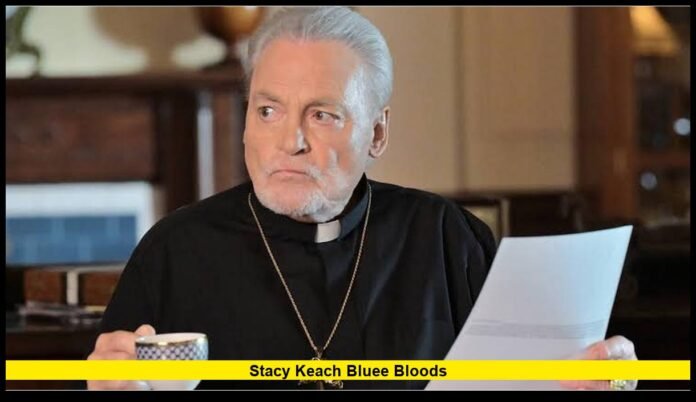

The legacy of Stacy Keach Blue Bloods fans remember is closely connected to his portrayal of Archbishop Kevin Kearns, a respected religious leader whose friendship with NYPD Commissioner Frank Reagan brought some of the CBS crime drama’s most compelling moral conflicts to the screen. Keach, the acclaimed actor known for his commanding voice and decades of work across film, television, and theater, died at age 85 on November 10, 2026, following a prolonged battle with a serious heart condition and heart failure.
His death has renewed interest in the performances that defined his career, including his recurring appearances in Blue Bloods. While the series focused primarily on the Reagan family and the challenges facing New York City law enforcement, Keach’s character introduced another dimension to its storytelling. Through conversations about religious responsibility, criminal investigations, and personal convictions, Kearns challenged Frank Reagan to consider questions that could not always be answered by police procedure alone.
Although Keach was not a member of the show’s regular cast, his appearances left a distinctive impression. His character demonstrated how a recurring guest role could contribute significantly to a long-running television drama without appearing in every episode.
Key Points Summary
╔════════════════════════════════════════════════════════════════════╗
║ – Stacy Keach played Archbishop Kevin Kearns, a recurring religious leader in Blue Bloods. ║
║ – His character developed a meaningful friendship with NYPD Commissioner Frank Reagan, portrayed by Tom Selleck. ║
║ – Kearns appeared in storylines involving the Catholic Church, criminal investigations, religious confidentiality, and the death penalty. ║
║ – Keach brought decades of experience from theater, film, and television to his role in the CBS police drama. ║
║ – The veteran actor died at age 85 on November 10, 2026, following serious heart complications. ║
║ – Blue Bloods concluded its original 14-season run in December 2024, preserving Keach’s performances as part of the show’s television legacy. ║
╚════════════════════════════════════════════════════════════════════╝
Who Was Stacy Keach in Blue Bloods?
Stacy Keach portrayed Archbishop Kevin Kearns, a prominent figure in New York City’s Catholic community who shared a longstanding friendship with Frank Reagan. Played by Tom Selleck, Frank served as NYPD commissioner and frequently confronted situations in which public expectations, police responsibilities, and personal beliefs came into conflict.
Kearns offered a different perspective from the officers, detectives, and prosecutors who dominated the series. His responsibilities involved the Church and its community, giving him a distinct set of obligations when criminal investigations touched on religious institutions.
Rather than functioning as a conventional supporting character who simply agreed with Frank, Kearns often questioned his friend’s assumptions. Their discussions explored whether an action could be legally justified yet remain morally troubling, and whether institutional responsibilities sometimes required difficult compromises.
Keach’s restrained performance suited this role. He conveyed authority through his delivery and presence, allowing disagreements to develop naturally instead of turning them into exaggerated confrontations.
The character’s importance came from his ability to challenge Frank while preserving their friendship. Kearns could disagree with the commissioner on sensitive issues without becoming an enemy of law enforcement.
How Archbishop Kevin Kearns Became an Important Recurring Character
Blue Bloods built much of its identity around the Reagan family’s commitment to public service, tradition, and personal accountability. Its storylines frequently examined how the family balanced professional obligations with relationships and deeply held values.
Kearns expanded that framework by introducing a religious leader whose work occasionally intersected with the NYPD’s most difficult decisions.
His position within the Catholic Church meant that he could be involved in disputes concerning priests, parish communities, and the Church’s responsibility to protect confidential religious conversations. These situations created conflicts that could not be resolved simply by ordering officers to gather more evidence or asking prosecutors to pursue a stronger case.
Kearns was especially effective because he was not written as a character who always delivered the correct answer. His own responsibilities sometimes placed him in difficult positions, and his conversations with Frank reflected the complexity of balancing competing duties.
This approach gave the character credibility. Viewers could understand why Frank defended the police department while also recognizing the concerns Kearns raised.
Keach’s background in serious dramatic roles helped establish the character’s credibility. He brought a sense of history and personal conviction to their conversations, making it believable that the two men had developed a relationship over many years.
Stacy Keach and Tom Selleck: A Friendship Built on Respect and Disagreement
The relationship between Kearns and Frank Reagan was one of the most distinctive elements of Keach’s recurring appearances.
Frank was responsible for overseeing a major police department, responding to public criticism, and making decisions that could affect the lives of officers and civilians. His position demanded discipline and accountability, but it also placed him under constant pressure to defend the institution he led.
Kearns approached similar questions through his religious responsibilities. He could consider the consequences of an investigation from the standpoint of conscience, forgiveness, and the obligations of the Church.
Their conversations were compelling because neither character needed to abandon his principles to understand the other. Frank could recognize the sincerity of Kearns’s concerns without agreeing with every conclusion. Kearns could respect Frank’s responsibilities while questioning the consequences of certain police decisions.
That tension reflected a broader theme running through Blue Bloods: people can share a commitment to public service while disagreeing about how best to fulfill it.
Selleck’s controlled portrayal of Frank also complemented Keach’s acting style. Their scenes often relied on dialogue, pauses, and thoughtful exchanges rather than action. The result was a relationship that felt grounded in mutual respect.
The Blue Bloods Storylines That Defined Keach’s Character
Several episodes demonstrated why Kearns remained relevant to the series long after his introduction.
“Good Intentions” Explored Conflict Between the Church and Police
In the Season 12 episode “Good Intentions,” Kearns and Frank found themselves on opposing sides of a dispute involving a priest who advocated defunding the NYPD.
The disagreement highlighted the tension that can arise when religious leaders speak publicly about policing and community safety. Frank had to consider how criticism affected the department, while Kearns had to address the Church’s relationship with a priest whose public position created controversy.
The storyline showed that their friendship did not prevent them from confronting one another directly. Both men understood the importance of their respective institutions, but their obligations led them to different conclusions.
“The Reagan Way” Examined the Limits of Confidentiality
Another significant appearance came in “The Reagan Way,” a Season 12 episode that aired in January 2022.
The story placed Kearns in a difficult position after he became convinced that the NYPD had arrested the wrong person for murder. He believed information connected to the crime could help uncover the truth, but the information was protected by the sacrament of confession.
This created a conflict between the pursuit of justice and the Church’s commitment to religious confidentiality.
Frank needed reliable evidence to move the investigation forward, while Kearns could not simply disclose what he had learned through confession. Their disagreement demonstrated that even a well-intentioned effort to solve a crime can encounter ethical and institutional limits.
The episode also highlighted one of the show’s enduring strengths: its willingness to examine the difficult questions surrounding justice instead of presenting every investigation as a straightforward contest between right and wrong.
“Keeping the Faith” Continued Kearns’s Story
Kearns returned in the Season 13 premiere, “Keeping the Faith,” which aired in October 2022.
His appearance continued the character’s involvement in the moral questions surrounding Frank’s work. By this stage, viewers understood that Kearns was someone Frank could consult when professional judgment and personal conscience collided.
The character’s continued presence helped maintain the sense that Frank’s life extended beyond the police department. His responsibilities involved relationships with people whose experiences and beliefs differed from his own.
“Forgive Us Our Trespasses” Brought Kearns Back in Season 13
Keach appeared again in “Forgive Us Our Trespasses,” which aired in May 2023.
The episode formed part of the character’s later appearances, reinforcing his position as a recurring figure who could bring religious and ethical considerations into the show’s crime-focused storytelling.
“Life Sentence” Marked His Final Listed Appearance
Keach’s final listed appearance as Kearns came in Season 14’s “Life Sentence,” which aired during the show’s final season in October 2024.
The episode involved an allegation of jury tampering connected to Erin Reagan and a homicide investigation. It also brought Frank and Kearns into conflict over the death penalty.
The subject was particularly suited to their relationship. Frank’s work required him to consider criminal justice through the responsibilities of law enforcement, while Kearns approached the issue through his religious convictions.
Their disagreement underscored how the same event could raise different questions for people working within different institutions.
The episode became the final chapter of Keach’s recurring contribution to the series before Blue Bloods concluded its original run.
What Made Stacy Keach’s Acting Style Right for Blue Bloods?
Keach had a distinctive screen presence developed over a career spanning more than six decades. His voice, measured delivery, and ability to communicate authority made him a natural fit for a character occupying a senior position within the Church.
However, his performance was not limited to projecting authority. Kearns also needed to convey concern, uncertainty, and the personal weight of decisions involving other people’s lives.
Keach could make a conversation feel consequential without raising his voice or relying on dramatic gestures. This was particularly valuable in Blue Bloods, where important conflicts frequently unfolded through discussions between characters with opposing viewpoints.
His acting also gave Kearns a believable sense of independence. The archbishop was not simply an adviser created to reinforce Frank’s beliefs. He had his own responsibilities, and those responsibilities sometimes demanded that he challenge his friend.
That balance helped prevent the character from becoming predictable. Whenever Kearns appeared, the audience could expect a serious discussion, but not necessarily an easy resolution.
Stacy Keach’s Career Extended Far Beyond the CBS Drama
Although television audiences may associate Keach with his role in Blue Bloods, his career encompassed a wide range of performances.
He became widely recognized for playing private investigator Mike Hammer in television adaptations of Mickey Spillane’s detective stories. The character established his reputation as an actor capable of portraying determined, tough-minded figures.
Keach also earned considerable respect for his theater work. His classical training and stage experience included performances in major Shakespearean roles, while his Broadway appearance in Indians earned him a Tony Award nomination.
His portrayal of Ernest Hemingway in the television miniseries Hemingway brought further recognition, including a Golden Globe win. He also received an Emmy nomination for the performance.
His filmography included Fat City, The Long Riders, American History X, The Bourne Legacy, and Nebraska. Television viewers also encountered him in productions such as Prison Break, Titus, and The Blacklist.
Keach’s work across different genres reflected his versatility. He could portray a hard-edged detective, a historical figure, a theatrical protagonist, or a religious leader without relying on the same performance style for every role.
His appearance in Blue Bloods drew on that breadth of experience, bringing a seasoned dramatic actor to a series that regularly examined complicated questions of authority and responsibility.
Stacy Keach’s Death at 85 and His Lasting Television Legacy
Keach died at his home in Magdalenka, Poland, on November 10, 2026. His wife, Malgosia Tomassi Keach, announced that he had died following a prolonged battle with a serious heart condition and heart failure.
The news marked the loss of a veteran performer whose career crossed generations of theatergoers and television and film audiences.
His legacy includes acclaimed stage performances, memorable film appearances, and television roles that introduced him to viewers with different interests. For Blue Bloods fans, Archbishop Kearns remains a particularly meaningful part of that body of work.
The character offered a perspective that differed from those of the Reagan family while remaining closely connected to the show’s central concerns. Through Kearns, the series examined how faith, law, personal conviction, and institutional responsibility could intersect in difficult circumstances.
Keach’s contribution also illustrates why recurring guest characters matter in long-running dramas. A performer does not need to appear in every episode to become an essential part of a show’s world. The strength of Kearns’s relationship with Frank came from the consistency of his principles and the seriousness of the conversations he brought to the screen.
Did Stacy Keach Appear in the Blue Bloods Series Finale?
No. Keach’s final listed appearance as Kearns was in “Life Sentence,” rather than the series finale, “End of Tour.”
The original Blue Bloods run concluded in December 2024 after 14 seasons. Keach’s final appearance came earlier in that final season, closing his on-screen involvement with the drama before the show’s last episode.
His absence from the finale does not diminish his role in the series. Kearns had already established a meaningful connection with Frank Reagan through multiple seasons of conversations and disagreements.
Those appearances remain worth revisiting for viewers interested in the moral and philosophical dimensions of the show. They reveal a side of Frank’s life that extended beyond police briefings and family dinners, showing how a trusted friend could challenge his thinking without weakening their relationship.
Keach’s portrayal gave those moments a lasting sense of gravity, helping make Archbishop Kearns a memorable supporting character in one of CBS’s best-known crime dramas.
Stacy Keach’s remarkable career leaves behind performances that continue to connect with audiences—share your favorite Kearns storyline in the comments and follow along for more television tributes and entertainment updates.