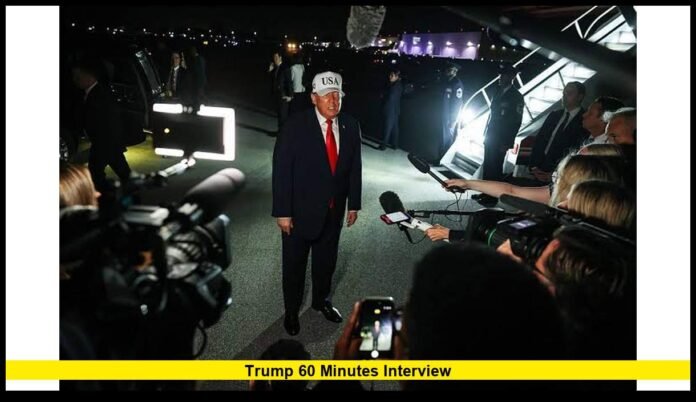

The Trump 60 Minutes interview has drawn significant attention following the Republican Party’s disappointing performance in the 2026 midterm elections. In the televised conversation with correspondent Ross Douthat, President Donald Trump addressed the election results, economic concerns, immigration enforcement, the war involving Iran, and possible changes within his administration. The interview, which aired on November 8, also offered insight into how the president views the political challenges facing his administration as Democrats prepare to take control of Congress.
Recorded at the White House on November 6, the interview came at a critical moment for Trump. Republican losses raised questions about the administration’s policies, the public’s economic concerns, and the president’s ability to maintain support among voters who helped return him to office. Trump defended several of his major decisions while acknowledging that his administration’s economic messaging had fallen short and that some immigration enforcement policies may have been too aggressive.
The conversation also attracted attention because Trump indicated that additional personnel changes could follow the election. His comments came shortly before the announcement that Susie Wiles would leave her position as White House chief of staff and Stephen Miller would take over the role.
Trump 60 Minutes Interview Examines the Republican Midterm Defeat
The 2026 midterm election results formed the central political backdrop of the interview. Democrats made substantial gains in both chambers of Congress, creating a difficult environment for the Republican administration during the remaining years of Trump’s presidential term.
When Douthat asked Trump to explain the losses, the president argued that his absence from the ballot had been a major factor. He suggested that his personal popularity and campaign appearances had not translated into sufficient support for Republican candidates across the country.
Trump also pointed to dissatisfaction with the Iran war and higher gasoline prices as important reasons voters turned against Republicans. He maintained that some candidates struggled to attract the same level of enthusiasm he had generated during his own campaigns.
However, the results raised broader questions about whether the administration had adequately addressed voters’ concerns about everyday expenses, economic conditions, and foreign policy.
The election also highlighted the challenge of transferring presidential support to other Republican candidates. Even in areas where Trump had previously performed strongly, some Republican contenders encountered significant resistance.
The interview did not resolve every question surrounding the election results. Instead, it revealed how Trump interpreted the setback and which issues he believed had contributed most directly to the outcome.
For Republicans, the results could affect legislative priorities, party leadership decisions, and the administration’s strategy for dealing with a Congress controlled by Democrats.
Trump Defends His Economic Record Amid Voter Concerns
Economic conditions were another major subject during the Trump 60 Minutes interview. Trump defended his administration’s performance, pointing to financial market gains, retirement account values, and his expectations for manufacturing growth.
He argued that the economic numbers were strong but acknowledged that his administration had struggled to communicate its achievements effectively to the public.
Trump described the problem as one of messaging, suggesting that voters had not fully recognized what his policies were intended to accomplish. He maintained that Americans might see more tangible benefits over the following several months.
Nevertheless, the interview highlighted a gap between the president’s assessment of the economy and voters’ experiences with household expenses.
Gasoline prices were a particularly important concern. Trump acknowledged that fuel costs had increased substantially and connected that rise to the conflict involving Iran. For households that depend on cars for work, school, and daily errands, higher fuel expenses can place additional pressure on monthly budgets.
Food, utilities, health care, and other essential costs also remained important issues in the election. Voters can evaluate the economy through their personal spending experiences, even when financial markets or selected economic indicators perform well.
This distinction matters because strong stock market performance does not necessarily translate into immediate financial relief for every household. People without substantial retirement investments may not experience the same benefits as those with large investment portfolios.
Trump maintained that his economic policies could produce stronger results over time. The interview, however, underscored the political importance of demonstrating measurable improvements in affordability and explaining how those improvements reach ordinary Americans.
Trump Acknowledges Immigration Enforcement May Have Been Too Tough
Immigration emerged as one of the most consequential subjects in the interview. Trump said his administration’s aggressive deportation policies had both helped and hurt Republicans politically.
He acknowledged that the approach to removing people who had lived in the United States for a decade or longer may sometimes have been too tough. The comments represented a notable acknowledgment of concerns about how immigration enforcement has affected established communities.
Immigration was an important issue in Trump’s political rise and his 2024 presidential victory. His campaign emphasized border security, stricter enforcement, and the removal of people living in the country without legal authorization.
Since returning to the White House, his administration has pursued an aggressive enforcement strategy, including increased interior arrests and deportations. Supporters have argued that these actions are necessary to enforce immigration laws and strengthen public safety.
Critics, meanwhile, have raised concerns about detention practices, enforcement operations in American cities, family disruption, and the treatment of migrants who have lived in the country for many years.
The midterm results added another political dimension. Some heavily Latino communities that had moved toward Republicans in previous elections showed signs of shifting away from the party.
Trump’s comments suggested that his administration recognized the political consequences of its enforcement strategy, even as he continued to defend the broader goal of restricting unlawful immigration.
His acknowledgment should not be interpreted as an announcement that the administration will abandon deportations or fundamentally reverse its immigration agenda. The interview did not establish a comprehensive new policy or provide a detailed timetable for changes.
Instead, it revealed that the president was willing to recognize that certain enforcement decisions may have produced negative political consequences.
The practical significance of these remarks will depend on whether they lead to changes in enforcement priorities, administrative guidance, or the treatment of long-established immigrant communities.
Iran War Remains a Major Point of Contention
The war involving Iran was another central issue in the Trump 60 Minutes interview. Trump defended the decision to take military action, even while acknowledging that the conflict and its economic consequences contributed to Republican losses.
The president argued that preventing Iran from obtaining a nuclear weapon was a necessary national security objective. He maintained that the military campaign had weakened Iran’s conventional military capabilities and set back its nuclear program.
Trump also rejected the idea that the election results should automatically lead him to reconsider the decision to attack Iran. He suggested that historians might judge the decision more favorably over time than voters were judging it during the immediate aftermath of the conflict.
His position reflected a distinction between short-term political costs and his assessment of long-term national security interests.
However, the conflict has created challenges for the administration. Higher fuel prices can affect transportation costs, business expenses, and household budgets. These economic effects can influence public opinion even among voters who support the stated objective of preventing Iran from developing nuclear weapons.
Trump said he was not looking to escalate the war following the midterm elections and did not believe there was a reason to do so at that point. He also expressed the view that Iran might be approaching a possible agreement.
Those comments indicated that the president was leaving room for diplomacy while continuing to defend the military campaign.
The interview did not establish that a final agreement had been reached. Any diplomatic breakthrough would depend on negotiations, the positions of the parties involved, and the terms of a potential arrangement.
For Americans, the situation remains significant because developments involving Iran may affect national security, energy markets, international relations, and the broader economic outlook.
Trump Signals More Changes Within His Administration
Personnel decisions became another major focus after Trump indicated that additional changes could follow the midterm losses.
Asked whether he expected to remove officials from his team, Trump said he did and suggested that he would make a few changes. He did not identify every official who might be affected.
His remarks gained immediate significance because the president announced that Susie Wiles would leave her position as White House chief of staff and that Stephen Miller would replace her.
Wiles had been one of the most influential figures in Trump’s political operation and his administration. Her departure represented a significant change in the White House leadership structure.
Miller, a longtime Trump adviser associated with the administration’s immigration agenda, was selected to take over the chief of staff position beginning November 9.
The timing connected the leadership change directly to the wider political uncertainty surrounding the midterm results, although Trump’s public comments did not establish that every potential personnel decision would be based on the election.
Trump also expressed confidence in Defense Secretary Pete Hegseth during the interview. He pushed back against calls for Hegseth to leave his position and defended the administration’s military record.
The president’s remarks did not guarantee that no further changes would occur. He had indicated that additional adjustments were possible without naming specific individuals.
Future personnel decisions may affect how the White House coordinates policy, communicates with Congress, and manages its response to the election results. They could also influence the administration’s approach to immigration, national security, and other major policy areas.
For now, the confirmed leadership change involving Wiles and Miller is distinct from the broader possibility of additional departures, which Trump has not fully detailed.
Trump Discusses His Potential Successor in the 2028 Election
The interview also touched on the future of the Republican Party and the possibility of Trump endorsing a candidate in the 2028 presidential election.
Vice President JD Vance and Secretary of State Marco Rubio are among the prominent Republican figures whose political futures have attracted attention. Both have national profiles and established relationships within the party.
When asked whether he would endorse a successor, Trump said he probably would, but he did not commit to doing so. He also noted that Republicans have several potential candidates and suggested that he might decide not to intervene in the primary contest.
The remarks left the question open rather than establishing a formal endorsement plan.
Trump’s eventual position could carry considerable weight among Republican voters. His support has influenced primary contests, and a presidential endorsement can affect fundraising, campaign visibility, and the willingness of party supporters to back a candidate.
However, the 2026 midterm results may also shape how Republicans assess the future of the party. Candidates and strategists may debate which elements of Trump’s political approach remain effective and which policies require adjustment to appeal to a broader electorate.
The interview offered no definitive answer about who will become the Republican nominee in 2028. It instead showed that Trump intends to retain the option of influencing the contest without making an immediate commitment.
Trump Addresses Pardons and His Approach to Political Opponents
Presidential pardons and Trump’s relationship with political opponents also featured in the conversation.
Trump said he intended to issue substantial numbers of pardons before leaving office. He framed the use of presidential clemency as a way to protect people he believes have been unfairly targeted by political or legal proceedings.
He also discussed the January 6 defendants and reiterated his view that they had been treated unfairly. His remarks reflected his longstanding position on the prosecutions connected to the attack on the U.S. Capitol.
The president’s comments about forgiveness were similarly direct. When Douthat asked whether he could forgive political adversaries in exchange for entering heaven, Trump acknowledged that he could not honestly promise to do so.
These exchanges moved beyond conventional discussions of economic policy and election strategy. They offered a glimpse into Trump’s personal approach to political conflict, accountability, and the use of presidential authority.
The discussion of pardons is particularly relevant because the president possesses constitutional clemency powers for federal offenses. However, any future pardon remains subject to the specific circumstances and legal scope of the president’s authority.
Trump did not announce a comprehensive list of future recipients during the interview. His comments described his intentions rather than confirming individual pardon decisions.
Why the Trump 60 Minutes Interview Matters
The significance of the Trump 60 Minutes interview extends beyond its individual headlines. The conversation brought several challenges facing the administration into focus at the same time: a major electoral setback, public concerns about affordability, debate over immigration enforcement, the economic consequences of war, and uncertainty about White House leadership.
Trump defended the overall direction of his administration while acknowledging weaknesses in economic communication and possible excesses in immigration enforcement. His comments suggested some recognition of the political difficulties revealed by the midterm results, but they did not amount to a sweeping reversal of his policies.
The interview also gave viewers an opportunity to hear the president explain his decisions directly in response to questions from Douthat. That format allowed the discussion to move between policy arguments, political accountability, and the president’s own assessment of his performance.
The broader test will come through subsequent decisions. Changes to immigration enforcement, developments in negotiations with Iran, economic performance, and the administration’s relationship with the incoming Congress will provide clearer evidence of whether the interview signals a shift in direction.
The White House will also need to navigate congressional investigations and oversight as Democrats assume control of both chambers. That change could affect legislative negotiations and increase scrutiny of administration policies.
Although the interview addressed many of these issues, it did not settle them. Several important questions remain dependent on future decisions and events.
For readers interested in catching more episodes and special segments, knowing the program’s weekly schedule is equally important. Find out what time 60 Minutes is on tonight to plan ahead and avoid missing the broadcast.
Latest Update on the Trump 60 Minutes Interview
As of November 9, 2026, the interview has aired, and its principal developments include Trump’s explanation for the Republican midterm losses, his defense of the Iran military campaign, his acknowledgment that immigration enforcement may have been too tough in some cases, and his indication that additional personnel changes may occur.
The departure of Susie Wiles and the appointment of Stephen Miller as White House chief of staff are confirmed leadership developments associated with the same period. Trump’s broader comments about potential changes do not establish that any other specific official will leave.
The president has also left open whether he will endorse a Republican presidential candidate for 2028. No definitive endorsement commitment emerged from the interview.
These distinctions are important when evaluating subsequent headlines about the administration. Trump’s stated intentions, confirmed personnel decisions, and possible future policy changes are separate matters and should not be treated as interchangeable.
Further developments may clarify whether the administration adjusts its strategy following the midterm results. Until specific decisions are announced, claims about additional departures or major policy reversals should be treated as unconfirmed.
Final Thoughts on the Trump 60 Minutes Interview
The Trump 60 Minutes interview offered a detailed look at how President Donald Trump is responding to a difficult political moment. His comments covered the Republican election defeat, the economy, immigration enforcement, the Iran war, possible personnel changes, and the future of Republican leadership.
While Trump continued to defend many of his administration’s major decisions, he acknowledged that economic messaging had been inadequate and that some deportation policies may have gone too far. His remarks about potential staff changes also gained significance following Wiles’ departure and Miller’s appointment.
The interview did not announce a complete change in the administration’s agenda. Instead, it highlighted the pressures that may influence the president’s decisions in the months ahead.
The most important developments to watch are whether the White House changes its approach to immigration enforcement, how the administration responds to economic concerns, whether tensions involving Iran ease, and how Trump manages relations with a Congress controlled by Democrats.
Share your thoughts on the Trump 60 Minutes interview in the comments, and stay updated for the latest verified developments in U.S. politics and the White House.