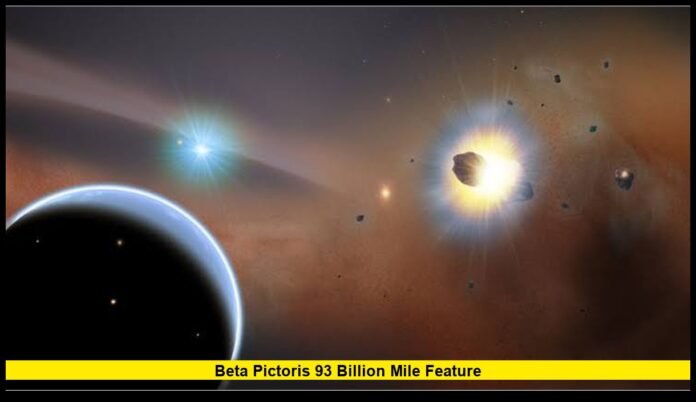

The Beta Pictoris 93 billion mile feature is drawing attention from astronomers because of its extraordinary size, unusual dust composition, and possible connection to a massive collision in a young planetary system. Located around the nearby star Beta Pictoris, the mysterious structure is known as the Cat’s Tail because its curved appearance resembles the tail of a cat extending from a much larger cloud of planetary debris.
The discovery provides an opportunity to investigate how planetary systems develop, how collisions distribute material through space, and how dust particles change over millions of years. Observations from NASA’s James Webb Space Telescope first revealed the unusual structure in infrared light, while Hubble Space Telescope observations have provided additional information about its appearance and physical characteristics.
Beta Pictoris is particularly interesting because it is much younger than our Sun. Its surrounding environment contains planets, dust, and debris left over from the processes that accompany planetary formation. By studying this system, researchers can investigate conditions that may resemble some of the earliest stages of our own solar system.
The Cat’s Tail is not a newly discovered planet or a single solid astronomical object. It is a large structure of dust whose unusual properties may preserve evidence of energetic events in the system’s history. Its estimated scale, approximately 1,000 astronomical units or 93 billion miles, makes it an especially interesting subject for modern astronomical research.
Understanding the Size of the Beta Pictoris Cat’s Tail
The reported scale of the Beta Pictoris 93 billion mile feature helps explain why the discovery has attracted attention beyond the astronomy community. A distance of 93 billion miles corresponds to approximately 1,000 astronomical units, making it an enormous scale by planetary-system standards.
An astronomical unit, commonly abbreviated as AU, measures the average distance between Earth and the Sun. One AU equals approximately 93 million miles. Astronomers use this measurement to describe the distances between stars, planets, and debris structures without relying on extremely large numbers.
However, the Cat’s Tail requires careful interpretation. The 1,000-AU figure describes the scale associated with its reported structure and possible three-dimensional extent. It should not be treated as a confirmed, straight-line measurement of a solid object.
Earlier interpretations suggested that the tail extended a considerable distance away from the main disk and behind the star from Earth’s viewing perspective. Research combining Hubble and Webb observations indicates that this interpretation may be incomplete.
The structure could instead extend predominantly sideways across the plane of the sky. This distinction affects how scientists interpret its apparent shape and physical dimensions.
Astronomers must account for viewing angles, the distribution of particles, and the limits of their observations when estimating the dimensions of distant objects. Images show how material appears from Earth, but they do not automatically reveal its complete three-dimensional arrangement.
The Cat’s Tail illustrates why astronomical measurements sometimes change as researchers develop better models and collect additional observations.
What Makes Beta Pictoris Different From Other Stars?
Beta Pictoris stands out because it provides a relatively close view of a young planetary system undergoing the processes that shape planets and smaller celestial bodies.
The star lies approximately 63 light-years from Earth in the constellation Pictor. It is considerably younger than the Sun, with its age generally estimated at around 20 million years.
Although the system is young, it already contains several known giant planets. Astronomers have also identified multiple components within its surrounding debris disk.
These characteristics make Beta Pictoris a valuable target for studying how planets interact with the material left over from their formation.
The system’s main debris disk appears nearly edge-on when viewed from Earth. This orientation allows astronomers to study the distribution of material along the disk and investigate structures that might otherwise be difficult to separate from the surrounding environment.
The disk also contains an inclined secondary component, which differs in orientation from the primary disk. This complex arrangement indicates that the material surrounding the star does not form one perfectly uniform structure.
The Cat’s Tail adds another layer of complexity to the system.
Rather than simply observing a star with a ring of debris, astronomers are examining a dynamic environment containing different dust populations, planetary influences, and possible remnants of major collisions.
How the James Webb Space Telescope Changed the Investigation
The James Webb Space Telescope transformed the investigation by revealing the Cat’s Tail through infrared observations.
Webb was designed to observe infrared radiation with exceptional sensitivity. This capability allows astronomers to study dust, cool objects, and structures whose properties may not be obvious in visible-light images.
Researchers used Webb’s Mid-Infrared Instrument, or MIRI, to observe the Beta Pictoris system at wavelengths where dust can emit detectable thermal radiation.
The observations revealed an unusual curved structure extending from the system’s secondary debris disk. Its appearance distinguished it from the surrounding material and suggested that it deserved further investigation.
Webb’s results also helped researchers examine differences between the main disk and the secondary disk. These differences can provide clues about the sizes, compositions, and temperatures of the particles present.
The discovery did not immediately answer every question about the Cat’s Tail. Instead, it provided new evidence that astronomers could use to test competing explanations.
Infrared observations are particularly valuable because a dust structure may absorb visible light while still producing measurable thermal emission. This allows researchers to identify material that would otherwise remain difficult to distinguish.
The Cat’s Tail became an example of how a new generation of telescopes can reveal previously overlooked features in familiar astronomical systems.
What Hubble’s Latest Observations Reveal
The Hubble Space Telescope provided a complementary view of the Cat’s Tail by detecting its scattered-light component.
In research published in October 2026, a team led by planetary scientist Arin Avsar of the University of Arizona combined Hubble observations from six observing periods between 2012 and 2025.
The researchers used the Space Telescope Imaging Spectrograph, known as STIS, to examine the faint material surrounding Beta Pictoris.
Their analysis detected the disk at projected distances of approximately 500 AU from the star. It also identified the visible and near-infrared scattered-light component associated with the Cat’s Tail.
This result was important because the structure had previously been identified primarily through Webb’s mid-infrared observations.
Hubble’s measurements helped researchers compare how the dust behaves at different wavelengths. The team found that the scattered-light signal from the Cat’s Tail was only a small fraction of its measured mid-infrared emission.
That difference helped constrain models of the particles’ physical properties.
The observations also provided evidence of an asymmetrical structure in the outer dust halo. Researchers proposed that gravitational interactions between planets and surrounding material could contribute to this pattern.
However, the exact cause of the halo’s shape has not been conclusively established. Additional modeling will be necessary to determine how well planetary interactions explain the observed structure.
Why the Dust Particles Are So Unusual
One of the most interesting aspects of the Beta Pictoris 93 billion mile feature is the nature of its dust.
Researchers’ models indicate that the Cat’s Tail contains highly porous grains composed largely of organic refractory material. This description refers to carbon-rich material that remains solid under conditions where more volatile substances may evaporate.
The grains are microscopic, yet their combined distribution produces a structure visible across vast astronomical distances.
Their apparent porosity is especially important. Rather than behaving like compact spheres of solid material, the grains may have a loose, fluffy internal structure.
This property affects how particles scatter light, absorb radiation, and interact with the surrounding environment.
Scientists use these optical characteristics to estimate what the grains may be made of and how they could have formed.
The observations do not mean that the Cat’s Tail contains evidence of life. In astronomy, the term organic refers to carbon-bearing chemistry and does not establish the presence of biological organisms.
Organic material can form through nonbiological processes in planetary environments, interstellar space, and the debris produced by collisions.
In the Beta Pictoris system, the unusual dust composition is relevant because it may preserve information about the physical conditions experienced by the material during its formation.
Could a Collision Between Large Bodies Explain the Cat’s Tail?
Researchers consider a collision between large planetary bodies one of the leading explanations for the Cat’s Tail.
In this scenario, two substantial objects collided, producing debris that eventually contributed to the observed dust structure. The proposed bodies may have been comparable in mass to large dwarf planets in our solar system.
The Hubble research estimates that each colliding object may have required a mass of at least \(1\text{–}3 \times 10^{21}\) kilograms to produce the observed quantity of organic refractory material, depending on the assumptions used about the objects’ composition.
That estimate is comparable to the masses of Charon and Makemake, two bodies associated with the outer solar system.
It is important to distinguish this mass estimate from a direct measurement of the original objects. Astronomers did not observe the bodies before they collided. Instead, they used the dust’s inferred composition and quantity to estimate what kind of collision could have supplied the material.
The collision itself remains a proposed explanation supported by observations and modeling, not an event that scientists witnessed directly.
Researchers also continue to investigate how the particles acquired their unusual internal structure. One possibility is that the collision generated enough heat to vaporize some carbon-rich material, which later condensed into porous grains as it cooled.
That mechanism remains under investigation. The available observations do not establish every stage of the proposed process.
How the Discovery Helps Scientists Understand Planet Formation
Planetary systems develop through a long series of physical processes. Dust particles collide, material accumulates, larger bodies form, and gravitational interactions change their orbits.
Collisions can create new material while also destroying existing bodies. Some impacts produce fragments, while more energetic events may heat or vaporize material before it cools again.
The Beta Pictoris system allows researchers to investigate these processes in an environment much younger than our own solar system.
The Cat’s Tail may represent a particularly useful example of material produced or transformed during a major collision.
By studying its dust, scientists can test models of how planetary debris forms, how quickly particles spread, and how different materials respond to high-energy impacts.
The research may also help explain why some debris structures appear more prominent at certain wavelengths than others.
These questions matter because the observable appearance of a planetary system depends not only on its planets but also on the material surrounding them.
A system can contain planets that are difficult to image directly while still revealing their influence through the shape and distribution of nearby debris.
Beta Pictoris offers an opportunity to connect observations of dust with the gravitational and physical processes that shape planetary environments.
What the Cat’s Tail Can Tell Us About Our Solar System
The discovery also has implications for research into the early history of our solar system.
Earth and the other planets formed from material surrounding the young Sun. The process involved repeated collisions between smaller bodies, the growth of planetary building blocks, and substantial changes in the distribution of debris.
Some of that ancient material survives today in asteroids, comets, and objects beyond Neptune.
The Kuiper Belt, which contains numerous icy bodies, provides a particularly useful comparison with the kinds of small objects that may exist around Beta Pictoris.
Studying the Cat’s Tail could help researchers investigate what happens when large bodies collide and how the resulting material behaves.
However, the Beta Pictoris system should not be treated as an exact replica of the early solar system. Its planets, disk structure, and evolutionary history may differ in important ways.
Instead, it serves as a natural laboratory where scientists can examine physical processes that are difficult to reconstruct from the surviving evidence in our own planetary neighborhood.
Comparing observations from different systems helps astronomers determine which features are common outcomes of planetary formation and which depend on a system’s particular circumstances.
Could Planets Be Responsible for the Distortion in the Dust Halo?
Hubble’s observations also revealed a prominent distortion and brightness asymmetry in Beta Pictoris’s outer dust halo.
The halo is a region of diffuse material surrounding the main debris disk. Its appearance can change depending on the distribution of particles and the way those particles interact with light.
Researchers have proposed that gravitational interactions involving planets may contribute to the observed distortion.
A planet does not need to collide with dust to influence its distribution. Its gravity can change the orbital paths of smaller bodies, gradually altering the arrangement of material around the star.
When a planet’s orbit is inclined relative to a disk, its gravitational influence may help produce a warped structure under suitable conditions.
The Beta Pictoris system contains giant planets capable of exerting substantial gravitational effects on their surroundings.
However, the newly observed halo distortion does not by itself prove which planet caused it or establish a complete explanation for the structure.
The researchers have noted that further dynamical modeling is needed to test the proposed connection between planetary interactions and the observed shape.
This finding is separate from the question of how the Cat’s Tail itself formed, even though both investigations concern the relationship between planets and surrounding debris.
What Astronomers Still Need to Find Out
Despite the progress made with Webb and Hubble, several questions remain unresolved.
Scientists need to refine their understanding of the Cat’s Tail’s three-dimensional geometry. Its apparent shape in astronomical images does not necessarily reveal how all the material is distributed in space.
Researchers must also determine how closely the dust’s inferred properties match the conditions expected after a major collision.
The proposed collision model depends on estimates of the original bodies’ composition, their masses, and the physical processes that transformed their material into microscopic grains.
Different assumptions can influence the results, making further observations and modeling important.
The surrounding disk and halo also require additional study. Astronomers need to investigate whether the observed distortions are consistent with the gravitational influence of known planets and how those interactions affect the distribution of debris over time.
Future observations may help clarify these issues, but the outcomes cannot be assumed in advance.
For now, the strongest conclusions concern the detection of the Cat’s Tail in scattered light, the unusual properties inferred for its dust, and the evidence that its surrounding environment is more complex than earlier observations revealed.
Latest Update on the Beta Pictoris 93 Billion Mile Feature
As of November 7, 2026, the most significant recent development is the Hubble-based investigation published in October.
The study added visible-light evidence to the earlier infrared discovery and provided new constraints on the Cat’s Tail’s dust composition and geometry.
It also identified a distortion in the outer dust halo that may be related to planet–disk interactions.
The researchers’ results support further investigation of a possible collision between large planetary bodies, but they do not establish every detail of the event.
The latest findings also reinforce the value of combining observations from different telescopes. Webb and Hubble measure different aspects of the dust’s interaction with light, allowing scientists to build a more complete picture than either set of observations could provide alone.
The Beta Pictoris system continues to offer valuable opportunities to investigate planetary formation, collision debris, and the influence of planets on surrounding material.
Frequently Asked Questions
Q1. What is the Beta Pictoris 93 billion mile feature?
A: The Beta Pictoris 93 billion mile feature refers to the Cat’s Tail, an unusual dust structure associated with the debris disk surrounding the young star Beta Pictoris. Its reported scale is approximately 1,000 astronomical units, although its full three-dimensional geometry remains an important part of the investigation.
Q2. How far is Beta Pictoris from Earth?
A: Beta Pictoris is approximately 63 light-years from Earth. It lies in the constellation Pictor and is close enough for powerful telescopes to examine its surrounding debris disk in considerable detail.
Q3. Which telescope first revealed the Cat’s Tail?
A: NASA’s James Webb Space Telescope first revealed the Cat’s Tail through infrared observations. Later observations from the Hubble Space Telescope detected its scattered-light component and provided additional information about the dust.
Q4. What is the Cat’s Tail made of?
A: Researchers’ models indicate that the structure contains highly porous dust grains composed largely of organic refractory material. This describes carbon-rich material and does not indicate that the structure contains life.
Q5. Did two Pluto-sized objects collide to create the structure?
A: A collision between large planetary bodies is a leading explanation. Researchers estimate that the original objects may have had masses comparable to large dwarf planets, but the collision has not been directly observed.
Final Thoughts
The Beta Pictoris 93 billion mile feature offers an unusual view of the physical processes that can shape a young planetary system. Its dark, porous dust, enormous reported scale, and possible connection to a major collision make it an important subject for continuing astronomical research.
Webb’s infrared observations revealed the Cat’s Tail, while Hubble’s later observations helped researchers investigate its composition and structure. Together, these findings show how observations across different wavelengths can uncover details that would otherwise remain hidden.
The proposed collision origin is scientifically significant, but important questions remain about how the dust formed and how the surrounding planets influence the system. Continued research may help answer those questions and improve our understanding of planetary evolution.
Share your thoughts in the comments and stay updated for more news about space discoveries, distant planetary systems, and the latest developments in astronomy.