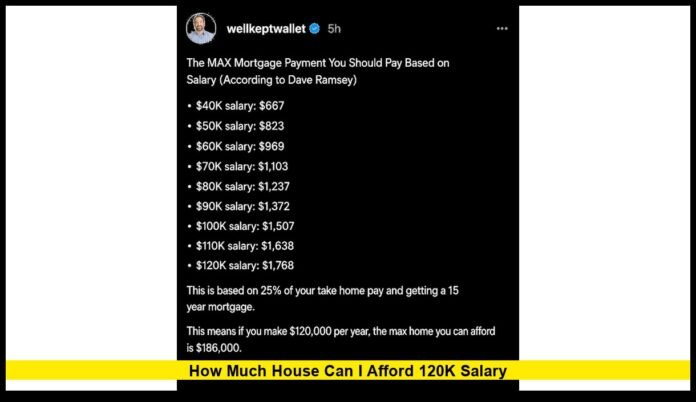

Earning $120,000 annually can put you in a strong position to purchase a home, but determining how much house I can afford on a 120k salary requires looking beyond your yearly income. Your mortgage eligibility and comfortable home-buying budget depend on several factors, including your credit score, existing debt, down payment, mortgage interest rate, property taxes, and homeowners insurance.
A $120,000 annual salary translates to approximately $10,000 in gross monthly income. However, the amount deposited into your bank account will be lower after taxes, insurance premiums, retirement contributions, and other deductions. This difference matters because your mortgage payment must fit into your actual household budget.
Depending on your financial circumstances, a home priced between $350,000 and $500,000 may be worth considering. Buyers with substantial savings and limited debt may have more flexibility, while those with significant monthly obligations may need to consider a less expensive property.
The goal is not simply to qualify for the largest mortgage possible. It is to purchase a home that provides long-term financial stability without making everyday expenses difficult to manage.
How Much House Can You Afford With a $120K Salary?
A household earning $120,000 annually may be able to explore properties in the $350,000 to $500,000 range. However, this is an illustrative shopping range, not a guaranteed mortgage approval amount.
Mortgage lenders evaluate an applicant’s complete financial situation before determining how much they may borrow. Annual income is important, but it is only one part of the assessment.
The following factors can influence your purchasing power:
- Gross annual and monthly income.
- Existing monthly debt payments.
- Credit score and credit history.
- Available savings and down payment.
- Current mortgage interest rates.
- Property taxes and homeowners insurance.
- Mortgage term and loan type.
- Employment and income stability.
For example, two people earning $120,000 annually may receive different mortgage approvals. One borrower might have no outstanding debt and an $80,000 down payment, while another might have substantial student loans and limited savings.
Although their salaries are identical, their financial circumstances are different.
Here is a general comparison of home prices worth evaluating:
| Annual Income | Illustrative Home Price |
|---|---|
| $120,000 | $350,000 |
| $120,000 | $400,000 |
| $120,000 | $450,000 |
| $120,000 | $500,000 |
These prices are starting points for financial planning. Your actual affordability will depend on the mortgage payment and additional costs associated with the property.
What Is the Monthly Income From a $120K Salary?
Before estimating a mortgage, calculate your monthly gross income.
If your annual salary is $120,000, the calculation is:
$120,000 ÷ 12 = $10,000.
This means you earn approximately $10,000 per month before taxes and other deductions.
Your take-home pay will depend on your state, tax filing status, health insurance, retirement contributions, and other payroll deductions.
For mortgage qualification, lenders generally consider gross qualifying income rather than simply using the amount deposited into your bank account. However, your personal affordability calculation should also consider your actual take-home pay.
This distinction is important. A mortgage that appears affordable using gross income may leave less money available for everyday expenses after taxes and deductions.
Understanding the 28/36 Rule for Home Affordability
The 28/36 rule is a commonly used budgeting guideline that helps prospective homeowners evaluate housing expenses and total debt obligations.
For someone earning $120,000 annually, gross monthly income is $10,000.
Using this guideline:
- 28% of monthly income equals $2,800.
- 36% of monthly income equals $3,600.
The 28% portion provides a reference for total monthly housing expenses. It generally includes mortgage principal, interest, property taxes, homeowners insurance, mortgage insurance when applicable, and HOA fees.
The 36% portion considers total monthly debt obligations, including housing expenses and qualifying payments such as student loans, auto loans, and credit card minimum payments.
These percentages are budgeting guidelines, not universal mortgage approval requirements. Some mortgage programs allow higher debt-to-income ratios when borrowers satisfy their underwriting requirements.
How Existing Debt Changes Your Mortgage Budget
Your outstanding debt can reduce the amount available for housing.
Consider the following example using the 36% guideline:
| Monthly Debt Payments | Remaining Housing Budget |
|---|---|
| $0 | $3,600 |
| $500 | $3,100 |
| $1,000 | $2,600 |
| $1,500 | $2,100 |
| $2,000 | $1,600 |
These calculations assume $10,000 in gross monthly income.
A borrower with $2,000 in monthly debt payments would have significantly less room for housing costs than someone without existing debt.
This is why reducing outstanding obligations before applying for a mortgage may improve your financial flexibility.
Can You Afford a $350,000 House on a $120K Salary?
A $350,000 home may be a practical option for someone earning $120,000, particularly if the buyer wants to maintain room in the budget for savings and other financial goals.
A lower purchase price generally means a smaller mortgage balance, assuming the down payment and other loan terms are comparable.
This may also provide greater flexibility when managing property taxes, insurance, utilities, and maintenance expenses.
However, the purchase price alone does not determine affordability. A property with unusually high insurance costs or property taxes may still create a significant monthly expense.
Before choosing a $350,000 home, estimate the full monthly payment and compare it with your take-home income.
Can You Afford a $400,000 House on a $120K Salary?
A $400,000 home may be affordable for some buyers earning $120,000 annually.
The final calculation depends on how much you borrow and the interest rate available when you apply.
For example, putting 10% down on a $400,000 property requires $40,000 upfront and leaves a $360,000 mortgage balance before applicable adjustments.
A larger down payment could reduce the amount borrowed and potentially lower the monthly payment.
However, buyers should also account for property taxes, homeowners insurance, mortgage insurance when required, and other ownership costs.
If the complete payment fits your budget while leaving sufficient money for savings and regular expenses, a $400,000 property may be worth considering.
Can You Afford a $450,000 House on a $120K Salary?
A $450,000 home may be within reach for certain households earning $120,000, but the financial requirements become more demanding as the purchase price increases.
Your ability to manage this purchase depends on your existing debts, savings, mortgage terms, and location.
A buyer with a substantial down payment and limited monthly obligations may have more flexibility than someone who needs to finance nearly the entire purchase price.
Consider how much money will remain after paying the mortgage, insurance, property taxes, utilities, transportation, food, and other household expenses.
If the purchase requires sacrificing emergency savings or retirement contributions, a less expensive property may be a better choice.
Can You Afford a $500,000 House on a $120K Salary?
Buying a $500,000 home with a $120,000 annual salary may be possible for some borrowers, but it requires careful financial planning.
The mortgage amount, interest rate, down payment, and property expenses will determine whether the purchase is manageable.
For example, a 20% down payment on a $500,000 home would equal $100,000, leaving a $400,000 mortgage balance before applicable adjustments.
A buyer who can make a larger down payment may have a lower monthly mortgage obligation than someone financing a greater percentage of the purchase price.
However, a large down payment should not leave you without money for emergencies, repairs, and other expenses.
A $500,000 property may also be difficult to manage if you have significant student loans, car payments, or other recurring debt.
How Much Down Payment Do You Need on a $120K Salary?
Your down payment determines how much of the home’s purchase price you must finance.
You do not necessarily need to save 20% before purchasing a home. Depending on the mortgage program, some eligible borrowers can purchase properties with smaller down payments.
Consider a $400,000 home:
| Down Payment | Cash Required | Mortgage Balance |
|---|---|---|
| 3% | $12,000 | $388,000 |
| 5% | $20,000 | $380,000 |
| 10% | $40,000 | $360,000 |
| 20% | $80,000 | $320,000 |
These calculations exclude closing costs and other transaction expenses.
A larger down payment reduces the initial mortgage balance and may lower the monthly payment. On many conventional loans, putting 20% down can also eliminate the need for private mortgage insurance, provided the applicable requirements are met.
However, smaller down payments may help buyers enter the housing market sooner.
Available mortgage options include:
Conventional Mortgages: These loans are offered through private lenders and may allow eligible borrowers to purchase with a relatively small down payment.
FHA Loans: These government-insured mortgages may provide an option for qualifying borrowers who meet the program’s credit, down payment, and property requirements.
VA Loans: Eligible military service members, veterans, and certain surviving spouses may qualify for VA-backed home loans, which can offer a no-down-payment option.
USDA Loans: Eligible buyers purchasing qualifying properties in eligible rural areas may have access to USDA financing with no down payment, subject to program requirements.
Compare the costs and eligibility conditions before choosing a mortgage.
How Mortgage Interest Rates Affect Your Buying Power
Mortgage interest rates have a direct effect on monthly payments and the amount you can borrow.
When interest rates increase, the cost of financing a home generally rises. A buyer who wants to maintain the same monthly payment may need to choose a less expensive property.
When rates decrease, the same monthly budget may support a larger loan amount.
For someone earning $120,000, even a relatively small difference in the mortgage rate can affect long-term borrowing costs.
When comparing mortgage offers, review:
- Interest rate.
- Annual percentage rate.
- Monthly principal and interest.
- Loan term.
- Closing costs.
- Mortgage insurance.
- Discount points and lender fees.
A 30-year fixed-rate mortgage provides a consistent principal-and-interest payment throughout the loan term, although property taxes, insurance premiums, and other housing costs may change.
A 15-year mortgage generally has higher monthly principal-and-interest payments but allows borrowers to repay the loan more quickly.
The best option depends on your financial goals, available income, and preferred repayment schedule.
How Your Credit Score Influences Home Affordability
Your credit score can influence mortgage eligibility and the interest rate offered by a lender.
Borrowers with stronger credit profiles may qualify for more competitive financing, depending on the loan program and other financial circumstances.
A lower credit score may result in fewer available mortgage options or higher borrowing costs.
Before applying, consider reviewing your credit reports and addressing potential problems.
Useful steps include paying bills on time, reducing credit card balances, correcting reporting errors, and avoiding unnecessary new debt.
There is no single credit score that guarantees approval for every mortgage. Requirements vary according to the lender and loan program.
Improving your credit before applying may help you obtain better financing terms and improve overall affordability.
Additional Homeownership Expenses You Should Include
The mortgage payment is only one part of owning a home. Buyers earning $120,000 should also prepare for additional expenses.
Property Taxes: Local property taxes depend on the home’s assessed value and applicable tax rates. These expenses can differ substantially between locations.
Homeowners Insurance: Insurance premiums depend on property characteristics, coverage, location, and potential risks.
Maintenance and Repairs: Homeowners must pay for repairs and ongoing maintenance. Roofs, plumbing, appliances, heating systems, and other components may eventually require attention.
Utilities: Electricity, natural gas, water, sewer, internet, and waste collection should be part of your household budget.
HOA Fees: Some neighborhoods and condominium communities require monthly or annual association payments.
Closing Costs: Mortgage-related expenses, appraisal fees, title services, prepaid taxes, and insurance can increase the cash required at closing.
These costs should be evaluated before making an offer. A home may appear affordable based on its mortgage payment but become expensive when all ownership expenses are included.
How to Calculate Your Affordable Home Price
You can create a practical home-buying budget by following a few steps.
Step 1: Determine Your Gross Monthly Income
Divide your annual salary by 12.
$120,000 ÷ 12 = $10,000.
Step 2: Establish a Monthly Housing Target
Use the 28% guideline as an initial reference.
$10,000 × 28% = $2,800.
This is a general target for total housing expenses, not just principal and interest.
Step 3: Calculate Your Existing Debt
Add monthly student loan payments, auto loans, credit card minimums, and other qualifying debts.
Step 4: Determine Your Available Down Payment
Calculate how much you can contribute while maintaining sufficient emergency savings.
Step 5: Estimate Property Expenses
Research local property taxes, homeowners insurance, HOA fees, and potential maintenance costs.
Step 6: Compare Mortgage Offers
Request personalized quotes from different lenders and compare the interest rates, APRs, loan terms, and fees.
Step 7: Review Your Take-Home Budget
Make sure your expected housing payment leaves enough money for everyday living expenses, savings, and unexpected costs.
This process can help you identify a realistic home price before beginning your property search.
Common Homebuying Mistakes to Avoid on a $120K Salary
Even borrowers with relatively high incomes can experience financial difficulties if they purchase more home than they can comfortably afford.
Avoid these mistakes:
- Choosing a property based only on mortgage approval: The amount a lender approves may exceed your personal comfort level.
- Ignoring property taxes: These can increase your monthly housing costs.
- Underestimating insurance: Premiums can vary significantly depending on location and property characteristics.
- Using every dollar for the down payment: Emergency savings remain important after purchasing.
- Overlooking repairs: Home maintenance can create unexpected financial obligations.
- Taking on new debt before closing: Additional debt may affect mortgage approval.
- Failing to compare lenders: Mortgage offers can differ in interest rates, fees, and loan conditions.
A sensible purchase should support your financial goals rather than create unnecessary pressure.
FAQs About How Much House You Can Afford on a $120K Salary
1. How much house can I afford on a $120K salary with no debt?
If you earn $120,000 annually and have no outstanding monthly debt, you may have greater borrowing flexibility. A home priced between $350,000 and $500,000 may be worth exploring, depending on your down payment, credit profile, interest rate, property taxes, and insurance costs.
2. Is $120,000 a good salary to buy a house?
Yes. A $120,000 annual income can provide a strong foundation for purchasing a home in many U.S. housing markets. However, affordability depends on local property prices, existing debt, mortgage rates, and available savings.
3. Can I afford a $400,000 house with a $120K salary?
A $400,000 home may be affordable if your other financial obligations are manageable. Calculate the mortgage payment, taxes, insurance, and other housing expenses before deciding whether the purchase fits your budget.
4. Can I afford a $500,000 house making $120K a year?
It may be possible, particularly if you have a substantial down payment and limited monthly debt. However, the higher purchase price can create a significant monthly obligation. Your complete financial situation will determine whether it is affordable.
5. What is the monthly gross income for a $120K salary?
A $120,000 annual salary equals approximately $10,000 per month before taxes and deductions. Your actual take-home income will depend on your tax situation and payroll contributions.
6. How much mortgage payment can I afford with a $120K salary?
The 28% budgeting guideline suggests approximately $2,800 per month for total housing expenses. This includes principal, interest, taxes, insurance, and applicable housing fees. Your personal target may be lower depending on your expenses and financial priorities.
7. Can I buy a house on a $120K salary with student loans?
Yes. Having student loans does not automatically prevent you from purchasing a home. However, lenders consider qualifying monthly student loan obligations when evaluating your debt-to-income ratio.
8. How much down payment should I save on a $120K salary?
Your down payment depends on the property price and mortgage program. Some eligible borrowers can purchase with 3% or 5% down, while a 20% down payment may reduce borrowing costs and avoid private mortgage insurance on many conventional loans.
9. Does a $120K salary qualify me for a jumbo mortgage?
Not automatically. Jumbo mortgage eligibility depends on the loan amount, applicable conforming loan limits, lender requirements, credit profile, assets, and debt-to-income ratio. A $120,000 salary alone does not establish eligibility.
10. Should I choose a 15-year or 30-year mortgage?
A 15-year mortgage generally has higher monthly payments but allows you to repay the loan faster. A 30-year mortgage usually provides lower monthly principal-and-interest payments but increases the time over which interest is paid. Choose based on your budget and long-term financial goals.
11. Can a single person earning $120K afford a home?
Yes. A single buyer earning $120,000 may be able to purchase a home without a second household income. However, the buyer must cover the mortgage and all household expenses independently.
12. How much should I save after buying a home?
You should maintain an emergency fund that can cover unexpected expenses and necessary repairs. The appropriate amount depends on your household expenses, job stability, property condition, and other financial responsibilities.
Final Thoughts
A $120,000 annual salary can provide meaningful opportunities for homeownership, but choosing the right property requires careful financial planning. Homes priced between $350,000 and $500,000 may provide a starting range for evaluating your options, although your actual purchasing power depends on your personal financial circumstances.
Before making a purchase, review your debts, calculate your down payment, compare mortgage offers, and account for property taxes, insurance, maintenance, and closing costs.
Most importantly, do not confuse mortgage approval with financial comfort. The right home is one that meets your needs while leaving enough money for savings, everyday expenses, and unexpected situations.
Are you planning to purchase a home with a $120K annual salary? Share your thoughts in the comments and stay updated for more mortgage, housing, and homeownership information.