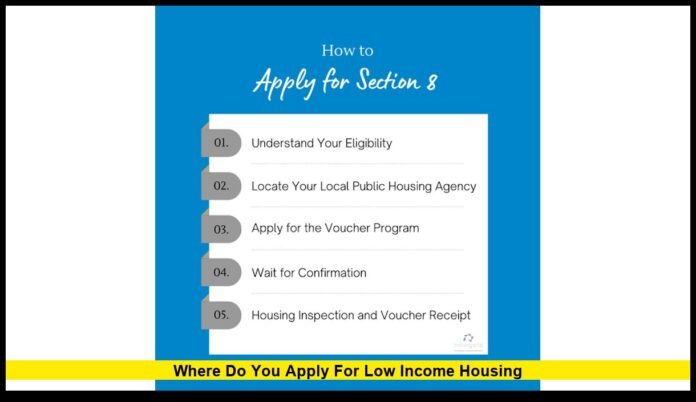

Finding an affordable place to live can be difficult when rent prices continue to put pressure on household budgets. For individuals and families struggling with housing costs, understanding where do you apply for low income housing is an important first step toward finding financial relief. In the United States, eligible residents can apply through local Public Housing Agencies, affordable apartment communities, state housing departments, and organizations that administer rental assistance programs.
Low-income housing programs are designed to help people who cannot comfortably afford private-market rental prices. They serve a wide range of households, including working families, single adults, senior citizens, people with disabilities, and individuals experiencing housing insecurity.
However, the application process is not identical everywhere. Some programs offer government-owned rental housing, while others provide financial assistance that reduces the amount an eligible household must pay toward rent. Certain affordable apartment communities also have their own application procedures and income requirements.
Applicants should understand which programs are available, how eligibility is determined, and where applications are accepted before beginning the process. Knowing these details can help you avoid unnecessary paperwork and identify more housing opportunities.
Where Do You Apply for Low Income Housing in the United States?
The most common starting point is a local Public Housing Agency, often called a PHA. These agencies administer important federal housing programs and help eligible households access affordable rental opportunities.
If you want to apply for low-income housing, there are several places to consider.
Local Public Housing Agency: Contact the housing authority serving your preferred city or county. It can explain public housing applications, Section 8 vouchers, eligibility requirements, and waiting-list procedures.
Affordable housing apartment complexes: Some privately owned apartment communities offer reduced rental rates to households that meet specific income requirements. Applications are generally handled by the property’s management office.
State housing departments: State agencies may provide information about affordable rental developments, housing initiatives, and assistance programs available to residents.
Nonprofit housing organizations: Certain nonprofit organizations help people locate affordable rentals, supportive housing, emergency shelter, and other housing resources.
Specialized housing providers: Seniors, veterans, and people with disabilities may have additional opportunities through programs designed for their particular circumstances.
It is important to remember that applying for one housing program does not automatically enroll you in every other affordable housing opportunity.
For example, a Section 8 application may be separate from an application for public housing. Similarly, an income-restricted apartment community may maintain its own waiting list.
For this reason, applicants should explore multiple suitable options rather than depending on a single application.
How to Locate the Housing Authority Responsible for Your Area
A Public Housing Agency is generally the most useful starting point for people seeking government-supported rental assistance.
Housing authorities operate in different geographic areas. Some serve individual cities, while others cover several municipalities or an entire county.
Their responsibilities may include accepting applications, reviewing household eligibility, maintaining waiting lists, managing public housing developments, and administering rental voucher programs.
To find the correct housing authority, begin by identifying the community where you would like to live.
You can then use the official HUD housing authority directory to identify the agency serving that location.
Once you find the agency, visit its website and review the available programs.
Look for information about:
- Public housing applications.
- Section 8 Housing Choice Vouchers.
- Current waiting-list openings.
- Income eligibility requirements.
- Application deadlines.
- Required identification and financial documents.
- Applicant status updates.
- Contact information for housing assistance.
If the information is unclear, contact the agency directly.
Ask whether you must live within its service area before applying. Some housing authorities accept applications from people who live elsewhere, while others may apply local residency or employment preferences.
If the agency is not accepting new applications, ask whether it has announced another application period.
Understanding the Different Affordable Housing Programs
Knowing which housing program you want to apply for can make the process easier.
The United States has several affordable housing options, and each serves a different purpose.
1. Public Housing
Public housing provides rental homes and apartments for eligible low-income households.
These properties are generally owned or managed by local Public Housing Agencies. Depending on the community, housing may include apartment buildings, townhomes, smaller residential developments, or other rental properties.
Public housing is available to different types of households, including:
- Families with children.
- Single adults.
- Older adults.
- People with disabilities.
- Other eligible low-income residents.
The housing authority reviews household income, family composition, and other program requirements when determining eligibility.
Rent is generally calculated using household income and applicable program regulations. The amount may be affected by permitted deductions, household circumstances, and other factors.
Where to apply: Contact the local Public Housing Agency that manages public housing in your preferred area.
Ask whether its public housing waiting list is open and whether you need to complete a separate application for each property or program.
One important distinction is that public housing is not the same as Section 8. Although both provide housing assistance, they operate through different arrangements.
2. Section 8 Housing Choice Voucher Program
The Housing Choice Voucher Program, commonly known as Section 8, helps eligible households afford privately owned rental properties.
Instead of placing every participant in a government-managed apartment, this program provides rental assistance that can be used toward an eligible private rental home.
The housing authority evaluates the household’s financial situation and determines the assistance according to applicable program requirements.
Participants generally pay an approved portion of their income toward rent and utilities. The housing authority provides the remaining approved subsidy to the landlord.
The actual amount depends on household income, payment standards, utility allowances, and the approved rental arrangement.
Receiving a voucher does not mean that every available apartment automatically qualifies. The property and rental arrangement must satisfy program requirements.
Where to apply: Submit an application through a Public Housing Agency that operates the Housing Choice Voucher Program.
Some agencies maintain long waiting lists because demand exceeds available assistance. Others periodically open their lists to accept new applications.
If you are interested in Section 8, check the agency’s application announcements before preparing your submission.
3. Income-Based and Income-Restricted Apartments
Income-restricted apartments provide rental opportunities for households that fall within specified income categories.
These properties may participate in the Low-Income Housing Tax Credit program or other affordable housing initiatives.
Their rental rates and eligibility requirements depend on the development, household size, location, and applicable program restrictions.
Some income-restricted communities are privately owned and operated. Therefore, you may need to apply directly through the apartment management office.
When contacting a property, ask whether it offers affordable units and whether its application process is currently open.
You should also request information about:
- Household income limits.
- Available apartment sizes.
- Monthly rent.
- Utility costs.
- Application requirements.
- Waiting-list procedures.
- Any property-specific eligibility conditions.
Income-restricted apartments may be particularly useful for people who want affordable rental housing but do not currently have a Section 8 voucher.
4. Project-Based Rental Assistance
Project-based rental assistance provides financial support through specific participating housing developments.
Unlike a portable Housing Choice Voucher, assistance is generally connected to a particular property or unit.
Eligible households receive reduced rental costs while living in the participating development, subject to the program’s rules.
These communities may serve families, seniors, people with disabilities, and other qualifying households.
Applications are often handled through the property’s management office or the agency responsible for administering the assistance.
If you are interested in this type of housing, ask whether the property has a separate subsidized housing waiting list.
5. Affordable Housing for Senior Citizens
Older adults may have access to affordable apartment communities and housing assistance programs designed for their needs.
Some developments have age-based eligibility requirements, while others offer general affordable housing that accepts eligible seniors.
Depending on the community, apartments may include accessibility features and services intended to support independent living.
Older applicants should contact their local housing authority and ask about senior housing developments in their area.
They should also confirm the minimum age requirement, income restrictions, rental costs, and application procedures.
6. Housing Programs for People With Disabilities
People with disabilities may qualify for general affordable housing or specialized housing opportunities.
Some communities provide accessible apartments designed to accommodate mobility and other accessibility requirements.
Certain programs may also offer supportive housing arrangements for eligible residents.
When applying, explain any accessibility requirements that affect your housing search.
You may ask about elevators, step-free entrances, accessible bathrooms, parking arrangements, and other necessary features.
Housing providers must follow applicable fair housing and reasonable accommodation requirements.
How to Apply for Low Income Housing: A Complete Process
Once you identify the program that meets your needs, you can begin the application process.
Although the exact procedures differ, the following steps explain how many housing applications work.
Step 1: Identify the Housing Assistance You Need
Start by determining what type of rental assistance you are looking for.
If you prefer a government-managed apartment, investigate public housing.
If you want to rent from a private landlord with assistance toward your rental costs, consider Section 8.
If you are looking for a reduced-rent apartment without a voucher, explore income-restricted communities.
Your household size, preferred location, budget, and accessibility needs should all influence your decision.
Step 2: Review the Eligibility Requirements
Before applying, check whether your household meets the program’s basic eligibility requirements.
Income is an important consideration, but it is not the only factor.
Depending on the program, the housing authority may review:
- Total household income.
- Number of people in the household.
- Age of household members.
- Assets and financial resources.
- Citizenship or eligible immigration status.
- Previous housing-related information.
- Other program-specific eligibility conditions.
Some programs also provide preferences for particular applicant groups.
Do not assume that your income automatically qualifies or disqualifies you. Ask the administering agency to explain the current requirements for your household.
Step 3: Find Out Whether Applications Are Being Accepted
One of the most important parts of the process is checking the waiting-list status.
Many housing authorities have more applicants than available apartments or vouchers.
As a result, some agencies temporarily close their waiting lists.
Others accept applications only during announced enrollment periods.
Before starting your application, contact the agency and confirm whether new applicants are being accepted.
If the waiting list is closed, ask whether the agency has announced a reopening date or provides notifications when applications become available.
Do not rely on an estimated date unless the housing authority has officially confirmed it.
Step 4: Prepare Your Financial and Personal Documents
Housing authorities and apartment managers need information to verify applicant eligibility.
The documents requested depend on the program, but commonly include:
- Government-issued identification.
- Household member information.
- Social Security information or other permitted identification details, where required.
- Recent employment pay statements.
- Employer information.
- Social Security or SSI benefit statements, when applicable.
- Pension or retirement income records.
- Tax documents for self-employed applicants.
- Bank and asset information, when required.
- Relevant household or family documentation.
- Disability-related records, when applicable.
If you receive several forms of income, make sure you understand what the agency needs to verify each one.
Applicants with irregular earnings or self-employment income may need to provide additional financial records.
Submit only the information requested by the official housing provider.
Step 5: Complete the Application Form
Many housing agencies offer online applications.
Depending on the agency, you may also be able to apply by mail or in person.
Read the instructions carefully before entering your information.
You will generally be asked to provide details about your household, income, current housing situation, and contact information.
Make sure that the information is accurate and consistent with your supporting documents.
If the application is incomplete, the agency may ask you to provide additional information, which can delay the review.
Save a copy of the completed application and any confirmation number you receive.
Step 6: Wait for the Application Review
After submitting your application, the housing authority or property manager may review the information to determine whether you meet the initial requirements.
Depending on the program, you may be placed on a waiting list.
Being placed on a waiting list does not necessarily mean that you have received final approval.
The agency may conduct additional verification when your application reaches the appropriate stage.
Step 7: Respond to Agency Communications
Keep checking your email, telephone messages, and postal mail after applying.
The housing authority may request updated financial documents, household information, or an interview.
Respond within the deadline stated in the communication.
If your address or telephone number changes, notify the agency according to its procedures.
Failing to respond to important communications may affect your application status.
What Income Qualifies for Low-Income Housing?
There is no single income limit for every affordable housing program in the country.
HUD publishes income limits based on geographic location and household size.
These limits help determine eligibility for several federally supported housing programs.
Income categories commonly include extremely low-income, very low-income, and low-income households.
The applicable threshold depends on the program.
For example, a household consisting of one person may have a different income limit from a household consisting of four people.
Similarly, income limits in expensive metropolitan areas may differ from those in smaller communities.
Housing agencies may consider several income sources, including employment earnings, self-employment income, Social Security benefits, retirement payments, and certain public assistance payments.
The agency determines how these amounts are treated under the relevant program rules.
Applicants should request the current income limits for their location and household size instead of relying on general national estimates.
Can You Apply for Low-Income Housing Without a Job?
Yes, it may be possible to qualify for certain affordable housing programs without currently working.
Employment is not a universal requirement for public housing, Section 8, or every income-restricted apartment community.
However, applicants must satisfy the applicable eligibility requirements.
The housing authority may ask about other financial resources, including Social Security, disability benefits, retirement income, or other qualifying payments.
If you have no current income, you should report that information accurately.
The agency may request additional documentation or verification to determine your financial circumstances.
Eligibility is determined by the specific program rather than simply by whether an applicant has a job.
Can You Apply for Low-Income Housing Online?
Many housing authorities and affordable apartment communities allow applicants to submit applications online.
However, not every program uses the same application system.
Some agencies maintain their own applicant portals, while others accept applications through designated platforms.
Certain properties may require applicants to contact the leasing office before submitting an application.
When applying online, make sure you are using the official website of the housing authority or apartment management company.
You should also:
- Read the application instructions.
- Confirm that the correct program is selected.
- Enter accurate household information.
- Upload documents in the requested format.
- Save your application confirmation.
- Keep your login details secure.
- Monitor the application portal for updates.
If you cannot complete an online application, ask whether assistance or another submission method is available.
Be cautious of websites claiming to guarantee Section 8 approval or immediate placement on a housing waiting list. No private website can guarantee a government housing decision.
How Long Does It Take to Get Approved for Low-Income Housing?
The time required to receive affordable housing assistance depends on the location and program.
Some applicants may receive an opportunity sooner, while others may remain on a waiting list for an extended period.
The main factors include the number of applicants, available rental units, funding, local demand, and program preferences.
Public housing and Section 8 may have different waiting periods.
Individual apartment communities may also maintain separate waiting lists.
If an agency provides an estimated waiting period, remember that it is not a guaranteed move-in date.
Applicants should also make sure they remain active on the waiting list by following any instructions from the housing authority.
If possible, apply to other suitable affordable housing programs while waiting for a response.
What Can You Do If the Section 8 Waiting List Is Closed?
A closed Section 8 waiting list can limit your options, but it does not necessarily mean that affordable housing is unavailable.
There are several alternatives worth considering.
Explore other housing authorities.
Different cities and counties may operate separate voucher programs. One agency may have a closed list while another accepts applications.
Apply for public housing.
Public housing may have a separate application process and waiting list.
Contact income-restricted apartments.
Some affordable apartment communities accept applications independently of the local Section 8 program.
Look into project-based assistance.
Certain apartment developments provide rental assistance connected to specific properties.
Check specialized housing opportunities.
Seniors, veterans, and people with disabilities may qualify for additional programs.
Contact local nonprofit organizations.
Some nonprofit housing organizations help residents locate affordable rentals and identify available assistance.
The best approach is to investigate several options and verify their current application status.
How to Find Affordable Apartments Without a Section 8 Voucher
You do not always need a Section 8 voucher to find an affordable apartment.
Some properties offer reduced rents through income-restricted housing programs.
These communities may be privately managed and may have separate eligibility requirements.
Start by searching for affordable apartment developments in the city or county where you want to live.
Contact the leasing office and explain that you are looking for an income-restricted rental.
Ask about the following:
- Available apartment sizes.
- Maximum household income.
- Minimum or maximum occupancy requirements.
- Monthly rental costs.
- Additional utility expenses.
- Application procedures.
- Waiting-list availability.
- Required financial documentation.
Some affordable properties have different income restrictions for different apartments within the same development.
Therefore, ask which units may be appropriate for your household.
You should also confirm whether the advertised rental price includes utilities or whether those expenses are paid separately.
What If You Need Housing Assistance Immediately?
If you are facing an eviction, homelessness, or an urgent housing problem, a traditional affordable housing application may not provide an immediate solution.
Waiting lists and eligibility reviews can take time.
In this situation, contact 211 to ask about local emergency housing services, shelter options, rental assistance, and homelessness prevention resources.
You may also contact a HUD-approved housing counseling agency for guidance.
Depending on your circumstances, additional support may be available through veteran services, senior housing organizations, disability support programs, or local nonprofit organizations.
If you need emergency shelter, ask about immediate placement options instead of waiting for a long-term housing program to become available.
Availability and eligibility vary by location.
Latest Information About Low-Income Housing Applications
Affordable housing applications are managed through different agencies and property providers across the United States.
As a result, application availability can change from one community to another.
A housing authority may open its Section 8 waiting list while another agency continues to accept applications for public housing only.
Similarly, an apartment community may have available income-restricted units even when local voucher applications are temporarily closed.
There is no single nationwide application schedule or waiting-list status that applies to all programs.
Applicants should verify current information about:
- New application periods.
- Open and closed waiting lists.
- Income eligibility limits.
- Required application documents.
- Available apartment communities.
- Local housing assistance programs.
- Changes to application procedures.
If a housing authority has not published an official reopening date, there is no confirmed date applicants should rely on.
Checking directly with the relevant agency is the best way to avoid outdated or inaccurate information.
Frequently Asked Questions About Applying for Low-Income Housing
1. Where do you apply for low income housing in the United States?
You can apply through your local Public Housing Agency for public housing and Section 8 assistance. For income-restricted apartments, contact individual property management offices. State housing agencies and nonprofit organizations may also provide information about local opportunities.
2. Can I apply for low-income housing if I live alone?
Yes. Single individuals may qualify for certain affordable housing programs. Eligibility depends on household income, location, available units, and program requirements.
3. Is there a fee to apply for low-income housing?
Requirements vary by program and property. Confirm any application fee directly with the housing authority or apartment management office. Be cautious of unofficial services promising guaranteed housing assistance in exchange for payment.
4. Can someone with a full-time job qualify for Section 8?
Yes. Having a full-time job does not automatically disqualify someone from Section 8. The housing authority evaluates household income and other eligibility requirements.
5. Can I apply for public housing and Section 8 at the same time?
You may be able to apply for both programs if the housing authority accepts applications for each. However, they may have separate waiting lists and application procedures.
6. What happens after my application is submitted?
The agency reviews your information and may place you on a waiting list. When your application reaches the appropriate stage, you may be asked to provide additional documents or complete an eligibility review.
7. Can I apply for low-income housing in another state?
Some programs accept applications from people living outside their service areas. Others have residency or local preference requirements. Contact the housing authority to understand its policies before applying.
8. Does receiving Social Security affect housing eligibility?
Receiving Social Security does not automatically disqualify you. The agency considers applicable benefit income when evaluating your household’s financial eligibility.
9. How can I check my housing application status?
You can contact the housing authority or use its official applicant portal if one is available. Keep your application number and contact information ready when requesting an update.
10. Can I apply if I have no current income?
You may qualify for certain housing programs even without employment income. However, you must disclose your financial circumstances and satisfy all other program requirements.
11. What should I do if my housing application is denied?
Ask the agency for the reason for the denial and review the instructions provided with its decision. Depending on the program, you may have the right to request an informal review or hearing within a specified period.
12. Does applying for low-income housing guarantee an apartment?
No. Submitting an application does not guarantee approval or immediate placement. You must meet the eligibility requirements, complete the required verification, and wait for assistance or a suitable unit to become available.
Final Thoughts
Finding the right place to apply for affordable housing requires understanding the different programs and the organizations responsible for managing them.
For most people, a local Public Housing Agency is the best starting point for public housing and Section 8 rental assistance. Those interested in reduced-rent apartments should also contact income-restricted housing communities directly.
Before submitting an application, check the current income requirements, waiting-list status, and documentation rules. Keep your information updated and respond promptly whenever a housing provider requests additional details.
If one program is unavailable, explore other housing authorities, subsidized developments, and community assistance organizations.
The application process may take time, but understanding your options can help you make informed decisions and identify affordable housing opportunities that match your household’s circumstances.
Are you currently searching for affordable housing or waiting for a housing assistance application? Share your experience in the comments and stay updated for more information about low-income housing programs.