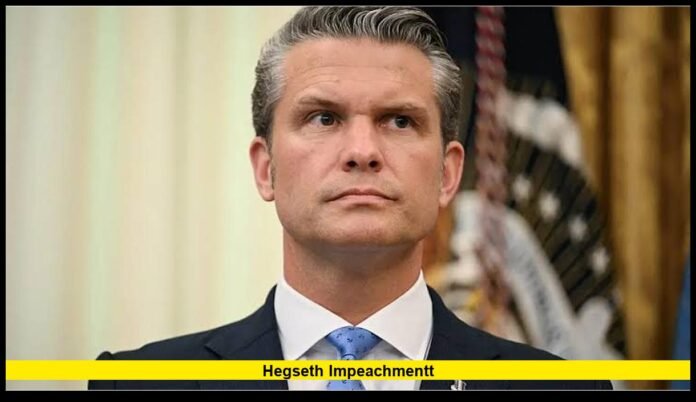

Hegseth impeachment has become a major political and constitutional issue for the Trump administration as congressional scrutiny of Defense Secretary Pete Hegseth intensifies. Republican Rep. Thomas Massie of Kentucky is seeking to advance an impeachment resolution that challenges Hegseth’s handling of military operations, his interpretation of presidential war powers and the Pentagon’s relationship with Congress. The proposal has not passed the House, but the dispute has created another difficult test for the administration.
The controversy reaches beyond the future of one Cabinet official. It raises important questions about who controls decisions involving American military force, how much authority a president can exercise without congressional approval and what responsibilities the defense secretary has when carrying out military orders.
The November 2026 midterm elections have added another dimension. Democrats are preparing to take control of Congress in January 2027, potentially creating a more challenging oversight environment for the Pentagon. Meanwhile, Massie wants the current House to consider his resolution before the congressional session ends.
For Hegseth, the coming weeks could prove politically significant. His position depends on continued presidential support, the decisions of congressional leaders and the outcome of any formal proceedings.
What Is Behind the Impeachment Controversy?
The current impeachment effort began with Massie’s decision to introduce eight articles against Hegseth on September 15, 2026.
Massie argues that the defense secretary has failed to respect legal and constitutional restrictions governing the use of American military power. His resolution identifies several areas of concern, including the Iran conflict, military operations outside conventional battlefields, civilian protection and the treatment of political critics.
The Republican congressman believes Congress must exercise its constitutional responsibilities rather than allow the executive branch to make major military decisions without meaningful legislative involvement.
His proposal is particularly notable because Massie belongs to the same political party as President Donald Trump. Republican lawmakers do not commonly initiate impeachment proceedings against members of their own administration.
However, Massie has frequently challenged Republican leadership on issues involving government spending, executive authority and constitutional limits.
The resolution represents his position that Hegseth’s conduct deserves formal congressional accountability.
It is important to distinguish between allegations and established findings. Introducing articles of impeachment does not prove that an official violated the law. The House must examine the charges and decide whether they justify impeachment.
As of November 5, 2026, the House has not approved Massie’s articles, and Hegseth remains in office.
Thomas Massie’s Role in the Impeachment Campaign
Thomas Massie has emerged as the central Republican figure behind the current effort.
Representing Kentucky’s 4th Congressional District, Massie has developed a reputation for opposing policies he believes exceed the federal government’s constitutional authority.
His disagreements with Trump have become increasingly visible. The president has criticized Massie, and the congressman lost his Republican primary in 2026 to a Trump-backed challenger.
That electoral defeat has given the impeachment effort additional political significance.
Massie is approaching the end of his congressional service. Unless circumstances change, he will leave the House when the current term expires in January 2027.
This creates a limited window for him to pursue the resolution while he remains a voting member.
Massie has indicated that he wants the House to address the proposal when lawmakers return following the midterm election recess.
His position is that congressional responsibility does not disappear because a measure is politically difficult or unlikely to succeed in the Senate.
He has also indicated that the articles could receive adjustments, although the central allegations would remain focused on Hegseth’s military and administrative decisions.
The effort could test whether Republicans are willing to break with the president on an issue involving national security and the leadership of the Pentagon.
The Iran War Is the Most Important Part of the Case
The military conflict involving Iran forms the central constitutional issue in Massie’s resolution.
The United States began military operations against Iran on February 28, 2026. The administration’s decision to conduct the campaign without a specific congressional authorization became a major source of disagreement in Washington.
Massie argues that Hegseth participated in directing military action that exceeded the authority available to the executive branch.
His position relies heavily on the division of powers established by the Constitution.
Article I gives Congress the authority to declare war. Article II designates the president as commander in chief of the armed forces.
These provisions create a system in which the president directs military operations, but Congress retains important responsibilities over war, military funding and the legal framework governing the armed forces.
The disagreement concerns how far presidential authority extends when the United States becomes involved in sustained hostilities.
Presidents from both political parties have historically relied on commander-in-chief powers to authorize certain military actions without obtaining a formal declaration of war.
Congress has also passed laws governing the use of military force in particular situations.
Massie argues that the Iran operation required a stronger congressional role and that Hegseth failed to respect the limits imposed by law.
The administration has defended its national security decisions. Its position is that the president must retain the ability to respond to threats and protect American interests.
The constitutional debate is therefore broader than a disagreement over one military campaign.
How the War Powers Resolution Affects the Dispute
The War Powers Resolution of 1973 is an important part of the impeachment debate.
Congress enacted the law following concerns about presidential decisions involving military deployments during the Vietnam War.
Its purpose was to establish procedures for informing Congress when American forces enter hostilities and to limit the ability of presidents to maintain certain military operations without legislative authorization.
The law generally requires the president to consult Congress when possible before introducing U.S. forces into hostilities. It also establishes reporting requirements and a framework for terminating unauthorized military involvement.
The administration’s interpretation of the law and Massie’s understanding of its restrictions differ.
Massie believes the Iran operation demonstrates why Congress must exercise greater control over military decisions.
The administration’s defenders may argue that the president possesses constitutional authority to respond to national security threats, particularly when military action is considered necessary to protect the country.
This disagreement could influence future congressional hearings.
Lawmakers may request information about the legal justification for the Iran campaign, the timing of military decisions and communications between the White House and congressional leaders.
The dispute could also affect future presidents. A clear congressional response may influence how subsequent administrations approach military operations without formal authorization.
Eight Articles of Impeachment and Their Main Allegations
Massie’s September resolution contains eight articles covering different aspects of Hegseth’s conduct.
The allegations are intended to establish a broader argument that the defense secretary has failed to meet the constitutional responsibilities associated with his position.
The major subjects include:
- The legal authority behind military operations against Iran.
- The use of American military power in other international operations.
- Civilian protection and compliance with the laws of armed conflict.
- The use of lethal force against suspected drug-trafficking vessels.
- The treatment of political critics and members of Congress.
- The Pentagon’s responsibilities toward congressional oversight.
- The handling of military authority and executive power.
- Alleged misconduct connected with Hegseth’s leadership of the Defense Department.
These claims involve different legal questions and would require separate examination.
For example, the legality of an attack against a suspected criminal target depends on the circumstances, the applicable law and the available evidence.
Likewise, allegations involving congressional oversight require examination of what information the Pentagon provided, what lawmakers requested and whether any legal obligation was violated.
The impeachment process would require representatives to decide whether the evidence supports the constitutional standard of high crimes and misdemeanors.
The introduction of the eight articles does not establish that Hegseth is guilty of the alleged misconduct.
Military Operations Beyond Iran Also Face Scrutiny
Massie’s resolution raises concerns about U.S. military activities outside the Iran conflict.
Among the areas identified are operations involving Venezuela, Yemen, the Caribbean Sea and the eastern Pacific Ocean.
These activities raise questions about the legal authority for military action, the limits of presidential power and the responsibilities of senior defense officials.
One particularly sensitive issue involves military operations against suspected drug-trafficking vessels.
The United States has used military resources as part of its efforts to address drug trafficking and related security threats. However, the use of lethal force against suspected criminal targets raises complicated legal questions.
Criminal investigations and military operations do not necessarily operate under identical legal standards.
Authorities must consider the status of the individuals involved, the location of an operation, the threat presented and the applicable domestic and international rules.
Massie argues that the Pentagon must provide clear legal justification for these activities.
The administration has defended its national security approach, but the controversy could lead to additional questions from congressional investigators.
Lawmakers may seek operational records, legal assessments and explanations from military officials.
Civilian Protection and the Laws of Armed Conflict
Another significant issue involves the protection of civilians during military operations.
The laws of armed conflict establish rules governing how armed forces conduct hostilities. These include principles of distinction, proportionality and precautions in attack.
Distinction requires military forces to distinguish between combatants and civilians. Proportionality prohibits attacks expected to cause excessive civilian harm compared with the anticipated military advantage.
The rules also require parties to take feasible precautions to reduce civilian casualties.
Massie’s proposal challenges Hegseth’s handling of these responsibilities.
The issue carries particular importance during large-scale military operations, when decisions can have immediate consequences for civilian populations.
The Pentagon must evaluate military targets, operational risks and the legal requirements governing attacks.
Congressional scrutiny could examine whether military decisions followed established rules and whether senior officials provided sufficient oversight.
However, the existence of civilian casualties alone does not establish that a particular attack violated international law. Each incident requires examination of the relevant facts and circumstances.
This distinction will be important if lawmakers consider the allegations during formal proceedings.
The Pentagon’s Treatment of Senator Mark Kelly
Massie’s resolution also raises concerns about the Pentagon’s treatment of Democratic Sen. Mark Kelly of Arizona.
Kelly is a former Navy pilot and astronaut. He has been involved in public discussions about the responsibilities of military personnel and the obligation to refuse unlawful orders.
The controversy developed after Kelly and other Democratic lawmakers participated in messaging directed toward members of the military concerning illegal orders.
The administration criticized their comments, while the Pentagon’s response raised questions about whether the department was using its authority to punish political criticism.
Massie considers this issue relevant to Hegseth’s responsibilities as defense secretary.
The First Amendment protects political speech, including criticism of government officials. At the same time, military personnel operate under specific rules governing discipline, command authority and lawful orders.
The legal questions depend on the precise actions taken by government officials and the protections applicable to the individuals involved.
The dispute could become part of a larger examination of whether the Pentagon has maintained appropriate boundaries between military administration and political disagreement.
The Signal Messaging Controversy and Hegseth’s Judgment
Hegseth has also faced criticism over the handling of sensitive military information through the Signal messaging application.
The controversy developed in 2025 after operational information concerning military activity in Yemen appeared in a Signal group chat that included individuals outside the official government communication structure.
The incident prompted questions about the protection of sensitive information and the use of commercial messaging platforms by senior government officials.
Critics argued that military operational information should remain within properly authorized communication systems.
The Pentagon faced scrutiny over whether appropriate safeguards were followed and whether sensitive details were exposed to unnecessary risks.
Hegseth’s supporters rejected broader claims that the episode demonstrated an inability to lead the department.
The controversy remains relevant to discussions about his management style, but it must be distinguished from the specific articles in Massie’s September resolution.
It also illustrates a wider challenge for senior government officials: maintaining secure communications while coordinating complex national security decisions.
Democrats Introduced a Separate Impeachment Resolution
Massie’s effort is not the only impeachment initiative directed at Hegseth in 2026.
Democratic Rep. Yassamin Ansari of Arizona introduced a separate resolution on April 15.
Her proposal contained six articles and addressed several issues involving the Iran war, civilian casualties, the handling of sensitive military information and the Pentagon’s relationship with Congress.
The Democratic initiative also raised allegations of abuse of power and misconduct that its sponsors believed justified impeachment.
The resolution was referred to the House Judiciary Committee but did not result in Hegseth’s impeachment.
The two initiatives have different political origins and should not be confused.
Ansari’s proposal came from Democratic lawmakers opposing the administration’s policies.
Massie’s resolution came from a Republican congressman challenging a defense secretary serving under a Republican president.
Their arguments overlap in some areas, particularly military authority and congressional oversight. However, the resolutions contain different articles and follow separate procedural paths.
The existence of two impeachment initiatives demonstrates the level of political opposition facing Hegseth, but neither establishes that he has been impeached.
Trump’s Support Could Determine Hegseth’s Political Future
President Donald Trump’s position remains an important factor in the dispute.
Trump appointed Hegseth to lead the Defense Department and has publicly defended his performance.
The president’s support gives the defense secretary significant political protection within the administration.
However, the November midterm elections have created additional pressure on the White House.
Democrats have gained control of Congress for the next legislative session, while disagreements over the Iran conflict have raised questions about the administration’s military strategy.
Reports of internal discussions about Hegseth’s future have also increased speculation about whether Trump will retain him.
As of November 5, no confirmed announcement of Hegseth’s removal had been made.
A presidential decision to replace the defense secretary could significantly change the impeachment debate.
Massie has indicated that his plans are tied to whether Hegseth remains in the position when lawmakers return.
If the secretary resigns or Trump removes him, Congress could still examine past decisions. However, the immediate objective of removing him from the Cabinet would change.
What the November 9 Congressional Session Could Bring
The House is scheduled to return to Washington on November 9 following the midterm election recess.
Massie intends to make his impeachment resolution a priority during the session.
His strategy involves a procedural mechanism known as a question of the privileges of the House.
This procedure can provide a route for members to bring certain matters before the chamber for consideration.
However, the procedure does not guarantee that the articles will receive approval.
House leaders could attempt to block further consideration through a motion to table the resolution.
If lawmakers proceed to debate and a vote, representatives would have to decide whether the allegations justify impeachment.
Several factors could influence the result:
- The number of representatives attending the session.
- Whether Republican lawmakers support Massie’s position.
- Whether Democrats vote together in favor of the articles.
- The procedural decisions made by House leadership.
- Whether Massie makes changes to the resolution before consideration.
Massie’s departure from Congress in January adds urgency to his effort.
The current House remains responsible for its business until the next Congress begins. Therefore, the impeachment proposal could receive attention before the new Democratic majority takes control.
How the Incoming Democratic Majority Could Change Pentagon Oversight
The November elections have created a new political environment for the Pentagon.
Democrats are preparing to take control of both chambers in January 2027, giving them greater influence over committee leadership and congressional investigations.
The House Armed Services Committee and other relevant panels could examine military operations, defense spending, leadership decisions and the administration’s use of executive authority.
The incoming majority may also request additional documents and testimony from Pentagon officials.
This does not mean Hegseth will automatically face impeachment or removal.
Congressional investigations and impeachment are separate processes. A committee can investigate an official without recommending impeachment.
Democratic leaders will also have to determine how to allocate their legislative time. National security, federal spending, domestic policy and other issues will compete for attention.
Nevertheless, the incoming majority could make it more difficult for the administration to avoid congressional scrutiny.
How the Constitutional Impeachment Process Works
The U.S. Constitution establishes a two-stage process for impeaching federal officials.
The House of Representatives has the sole authority to impeach. The Senate has the responsibility to conduct the trial.
The process generally works as follows:
| Stage | Explanation |
|---|---|
| Introduction | A representative submits impeachment articles. |
| House consideration | Members examine the allegations and consider procedural motions. |
| House vote | A majority of members voting can approve an article. |
| Senate trial | Senators consider the charges under impeachment procedures. |
| Final decision | A two-thirds vote of senators present is required for conviction. |
Impeachment itself is not the same as removal.
If the House approves articles against Hegseth, he would become an impeached official. He would not automatically lose his position.
The Senate would then need to conduct its proceedings and reach the required threshold for conviction.
A Senate acquittal would mean that the official was not convicted through impeachment.
What Happens If the Senate Refuses to Convict?
Even if the House approves Massie’s resolution, the Senate could reject the charges.
The Constitution requires a two-thirds vote of senators present for conviction. This is a significantly higher threshold than the simple majority generally required in the House.
Political party control, the strength of the evidence and senators’ views about executive authority could all influence the outcome.
If senators do not reach the required threshold, Hegseth would not be removed through impeachment.
The House’s decision would still carry political significance because impeachment formally expresses the chamber’s conclusion that an official should face trial.
It could also influence public debate about the administration’s military policies and the limits of presidential authority.
Frequently Asked Questions About the Hegseth Impeachment
1. Has Pete Hegseth been impeached in 2026?
No. As of November 5, 2026, the House has not approved the articles introduced by Thomas Massie. Hegseth continues to serve as defense secretary.
2. Who introduced the current impeachment resolution?
Republican Rep. Thomas Massie of Kentucky introduced the current eight-article resolution on September 15, 2026.
3. Why does Thomas Massie want Hegseth impeached?
Massie alleges that Hegseth exceeded his authority through military decisions, particularly involving Iran. The proposal also raises concerns about civilian protection, military operations and congressional oversight.
4. When could the House vote on the resolution?
Massie intends to pursue consideration during the week of November 9, when lawmakers return from their election recess. The exact timing depends on House procedures and leadership decisions.
5. Does President Trump support Hegseth?
Trump has publicly praised Hegseth and defended his performance. Reports of internal discussions about Pentagon leadership have created uncertainty, but no confirmed removal decision had been announced as of November 5.
6. Did Democrats introduce impeachment articles against Hegseth?
Yes. Rep. Yassamin Ansari introduced a separate six-article resolution on April 15, 2026. It did not result in impeachment.
7. Can Congress remove Hegseth without a Senate trial?
Not through the constitutional impeachment process. The House must approve articles, and the Senate must convict by a two-thirds vote of senators present to remove him through impeachment.
8. Will Democrats investigate the Pentagon in 2027?
The incoming Democratic majority will have greater control over congressional oversight and committee agendas. Investigations are possible, but their specific subjects and timing depend on decisions made by congressional leaders.
9. What happens if Hegseth resigns?
If Hegseth leaves office, Congress could still investigate his conduct while he served as defense secretary. However, the immediate question of removing him from the position would no longer apply.
10. Why is the Iran war important to the impeachment debate?
The conflict raises questions about the balance between presidential military authority and Congress’s constitutional power over war. Massie argues that the administration should have obtained stronger congressional authorization.
The Road Ahead for Pete Hegseth and the Pentagon
The political future of Pete Hegseth will depend on several decisions that are still unfolding. Massie’s impeachment proposal has created a direct challenge to the defense secretary, while the midterm results have opened the possibility of more extensive oversight under a Democratic-controlled Congress.
The immediate focus is the House’s return on November 9. Lawmakers must decide whether to consider the resolution, block it through procedural action or leave the issue for the incoming Congress.
For now, Hegseth remains in office, the allegations remain unresolved and no Senate impeachment trial is underway.
Do you believe Congress should pursue impeachment or focus on investigating the Pentagon’s military decisions? Share your opinion and follow the latest developments in Washington.