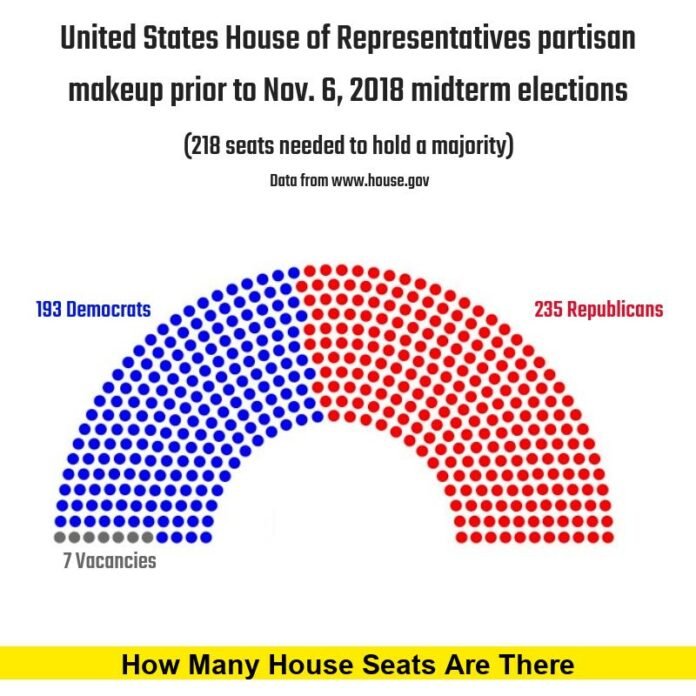

How many House seats are there in the U.S. Congress, and who holds them now? The House has 435 voting seats, and Democrats won control in the November 3, 2026 midterms. Final counts are still moving, with dozens of races uncalled as of Thursday morning.
Networks called the majority for Democrats early Wednesday. The Associated Press made its call at 1:24 a.m. ET. NBC News projects Democrats will finish with at least 258 seats, and at least 218 are needed for control.
Here is the full picture, from the basic seat count to the party-by-party numbers.
How Many Seats Are in the U.S. House of Representatives?
The House has 435 voting members. Each one represents a single congressional district. A party needs 218 seats for a simple majority.
Congress fixed the size of the chamber at 435 after the 1910 census. The Permanent Apportionment Act of 1929 made that cap permanent. Alaska and Hawaii briefly pushed the total to 437 after they became states. It returned to 435 in 1963.
Six more seats belong to non-voting members:
- Washington, D.C. has one delegate.
- Puerto Rico has one resident commissioner.
- American Samoa has one delegate.
- Guam has one delegate.
- The Northern Mariana Islands have one delegate.
- The U.S. Virgin Islands have one delegate.
These members can serve on committees and speak in debate. They cannot vote on final passage of bills.
How Many People Does Each House Member Represent?
The Census Bureau counts the population every 10 years. After each count, the 435 seats are redistributed among the states. A state’s share depends on its population.
After the 2020 census, the average district held about 760,000 people. California has the most seats with 52. Seven states have only one seat each: Alaska, Delaware, North Dakota, South Dakota, Vermont, Wyoming and, since the 2020 reapportionment, no others beyond those six. Montana now holds two.
Mid-decade redistricting has reshaped several maps this cycle. That helps explain why some districts, such as California’s 1st and 6th, changed hands in November.
Where the House Stood Before Election Day
Before voters went to the polls, Republicans held a razor-thin majority. The party breakdown looked like this:
- Republicans held 218 seats.
- Democrats held 214 seats.
- One independent caucused with Republicans.
- Two seats sat vacant after the resignations of Rep. Tony Gonzales of Texas and Rep. Sheila Cherfilus-McCormick of Florida.
That margin left Speaker Mike Johnson very little room to lose votes. A handful of absences or defections could stall any bill.
House Seats by Party: The Latest Count
Every seat was on the ballot this year. Democrats needed a net gain of about five seats to flip the chamber. They gained far more.
The table below shows the most recent tallies. Counts differ by outlet because each updates on its own schedule.
| Measure | Democrats | Republicans | Uncalled |
|---|---|---|---|
| Before the election | 214 | 218 (plus 1 independent) | 2 vacancies |
| AP count, Wednesday midday | 229 | 139 | 67 |
| NBC News count, latest | 242 | 151 | 42 |
Fox News showed 237 Democratic seats to 139 Republican seats in its own tracker. The gap between outlets reflects timing and call decisions, not disagreement about who won.
Projected Final Seat Totals
Many districts, especially in California, are still counting ballots. Mail ballots and late-reported precincts will shift the numbers over the coming days. Several outlets have published projections for where the totals will land:
- NBC News projects Democrats will win at least 258 seats.
- CBS News estimates Democrats will hold between 251 and 268 seats.
- CNBC’s Election Desk projects at least 250 Democratic seats and at least 165 Republican seats.
- House Democratic Leader Hakeem Jeffries has said Democrats will win at least 255 seats.
These estimates all point the same way. Democrats are on track for one of their widest House margins in decades. NBC describes a 258-seat floor as the largest House margin for any party since 1993.
How Many Seats Did Democrats Flip?
Democrats flipped dozens of Republican-held seats. NBC’s tracker showed 35 flips among called races, for a net gain of 34 seats at the time of its snapshot.
Several wins stood out:
- Democrats flipped three of Iowa’s four House seats.
- Democrats flipped three Michigan seats held by Republicans.
- Three Pennsylvania Republicans lost: Ryan Mackenzie, Scott Perry and Rob Bresnahan.
- Rep. Tom Kean Jr. of New Jersey lost his bid for reelection.
- Rep. David Valadao of California lost to Democrat Randy Villegas.
- Democrats also held all three competitive Nevada seats.
Democrats also protected some of their own incumbents in districts President Trump carried. Rep. Tom Suozzi won reelection in New York’s 3rd District, and Rep. Susie Lee won in Nevada’s 3rd.
What the Result Means for Congress
Democrats also won the Senate, where they led 54-44 with Alaska and Mississippi uncalled. That gives the party control of both chambers for the final two years of Trump’s term.
With a House majority, Democrats gain subpoena power and committee gavels. They can launch oversight investigations and shape which bills reach the floor. Jeffries has launched a bid to become Speaker.
Speaker Johnson said he was disappointed in the results but not discouraged. Trump told CNBC he can work with Democrats on “many more things than people understand.”
When Does the New House Take Office?
The current House keeps its sitting members until the new Congress begins. The 120th Congress convenes on January 3, 2027. Until then, the chamber stays at its current breakdown of 218 Republicans, 214 Democrats, one independent and two vacancies.
The House is on a district work period right now. Votes are expected to resume Monday, November 9. Lawmakers who lost their races will remain in office through the lame-duck session.
Why the Exact House Count Keeps Changing
Several factors can change the totals before every race is final:
- Counties in California and other states take days or weeks to finish counting mail ballots.
- Very close races can trigger automatic recounts.
- Some states allow time to fix ballot problems before certification.
- Special elections can fill vacancies after the new Congress begins.
Expect the called numbers to climb for several more days. Official results will not be final until each state certifies its vote.
Quick Reference: House Seat Facts
- Total voting seats: 435
- Seats needed for control: 218
- Non-voting members: 6
- Current Democratic projection: at least 250 to 258 seats, depending on the outlet
- Next Congress begins: January 3, 2027
Remember that the numbers above come from live tallies. Check back as races are called, because the final split will land a little higher for Democrats than today’s called totals.
Which House race are you watching most closely? Share your thoughts in the comments and check back for the final seat count.