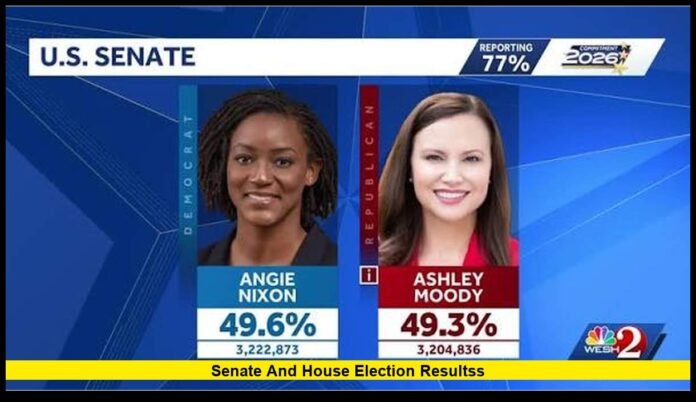

The senate and house election results from November 3, 2026, have delivered a sweeping Democratic victory, changing control of the U.S. Congress and creating a major political setback for President Donald Trump. Democrats captured both chambers after winning key contests across the country, including races in states that had backed Trump in the 2024 presidential election. The outcome sets up a new period of divided government beginning in January 2027, with potentially significant consequences for federal legislation, executive oversight and the national political debate.
The election results reflect a combination of economic frustration, concerns about presidential leadership and a strong Democratic performance in competitive races. Although counting and certification procedures continue in some jurisdictions, the overall balance of power has shifted decisively toward Democrats.
Democrats Win the Battle for Congressional Control
Control of Congress was the central question of the 2026 midterms. Republicans entered Election Day holding narrow majorities in both chambers, leaving Democrats with an opportunity to change the direction of federal policymaking.
That opportunity became reality as Democratic candidates won important Senate races and flipped numerous Republican-held House districts. The victories give Democrats control over the legislative calendar, committee leadership and the organization of both chambers.
The change is particularly consequential because congressional majorities determine which proposals receive consideration and how lawmakers conduct investigations. Democrats will have greater authority to challenge administration policies, negotiate spending legislation and influence the direction of national debates.
The final seat counts may change as outstanding contests are resolved. Nevertheless, the projected Democratic victories have already established a new political environment in Washington.
Senate Election Results Reveal a Changing Electoral Map
Democrats made substantial gains in the Senate, capturing seven seats in the reported results. The party now has 54 seats when including two independents who caucus with Democrats, compared with 44 Republicans. Two races remained uncalled in the latest reported tally.
The result is notable because several Democratic victories came in states where Republican candidates had enjoyed considerable electoral advantages.
Texas Produces a Major Democratic Victory
Texas was among the most closely watched Senate contests. Democrat James Talarico defeated Republican Ken Paxton, delivering a significant victory for Democrats in a state that has long been a Republican stronghold in federal elections.
The outcome could influence how both parties approach future campaigns in Texas. Democrats will likely view the result as evidence that competitive statewide races are possible, while Republicans will face pressure to reconsider their strategy for attracting voters.
Maine and Ohio Add to Democratic Gains
In Maine, Democrat Troy Jackson defeated Republican incumbent Susan Collins. The victory ended Collins’ long Senate tenure and gave Democrats an important seat in their effort to establish a stronger majority.
Ohio also shifted toward Democrats, with Sherrod Brown defeating Republican incumbent Jon Husted in a special election.
Democratic victories in Kansas, Iowa, North Carolina and South Carolina contributed to the broader change in Senate control. These outcomes demonstrate that national political conditions can influence voters even in states that have traditionally supported Republican candidates.
What the Senate Majority Means
A Democratic Senate majority will influence confirmation proceedings, committee assignments and negotiations over federal legislation.
The chamber plays a central role in confirming many presidential nominees, including federal judges and senior executive branch officials. Democratic leaders will therefore have greater authority to scrutinize appointments and determine how Senate business proceeds.
However, Senate control does not mean that Democrats can enact every proposal they support. Legislative negotiations, chamber rules and the president’s veto power will continue to shape what becomes law.
House Results Give Democrats Control of the Lower Chamber
The House of Representatives also shifted to Democratic control. The latest reported tally showed Democrats with 228 seats and Republicans with 139 among the 367 races called, with additional contests still unresolved.
A party generally needs 218 seats to hold a majority in the 435-member House. Democrats have crossed that threshold, positioning themselves to elect the speaker and lead the chamber’s committees.
The result reflects a broad Democratic performance across competitive districts. Republican candidates lost seats in areas where local concerns and national political developments helped shift voter preferences.
Committee Leadership Becomes a Priority
House committee chairs have considerable influence over hearings, investigations and legislative proposals. Democratic leaders will be able to direct attention toward issues they consider important, including government spending, healthcare and executive branch accountability.
The new majority is also expected to examine the administration’s policy decisions. Congressional oversight can involve hearings, requests for records and testimony from government officials, subject to the authority and procedures governing each committee.
For Republicans, the loss of the House majority means a reduced ability to advance legislation without Democratic support. Party leaders will need to identify ways to influence debates and negotiate with the incoming majority.
Economic Pressure and Public Confidence Shape the Outcome
The election results reflect more than party competition. Household finances and confidence in government emerged as important considerations for voters.
Affordability Remains a Central Concern
Many Americans continue to pay close attention to housing, healthcare, food and energy expenses. These costs have become important measures by which voters evaluate economic conditions and political leadership.
Democratic candidates emphasized affordability and argued for policies intended to ease financial pressure on households. Republicans faced questions about the administration’s economic record and its ability to address voters’ concerns.
The results suggest that economic dissatisfaction helped Democrats in several competitive contests, although individual races were influenced by different local circumstances.
Foreign Policy and Government Accountability
The war with Iran also featured prominently in the political debate. Questions about military decisions, national security and the financial consequences of the conflict added to discussions about the administration’s priorities.
Concerns about government accountability and the use of presidential authority were also significant. For some voters, congressional control offered a way to demand stronger scrutiny of executive branch decisions.
What the Election Means for President Trump
The Democratic victory will complicate the administration’s legislative plans. With both chambers controlled by the opposition, the White House will face a Congress more willing to challenge its proposals and investigate its decisions.
Federal spending negotiations could become particularly difficult. Congress must approve funding measures, and disputes over spending levels or policy conditions may require extensive negotiations.
Healthcare, immigration and other domestic priorities could also become subjects of renewed congressional debate. Democrats may seek legislative changes, while Republicans and the president could oppose proposals that conflict with their policy goals.
The Senate majority will give Democrats additional influence over presidential appointments, while House control will provide greater authority over committee investigations.
Trump will retain his executive powers and can veto legislation he opposes. As a result, the coming two years could feature a combination of political confrontation, bargaining and selective cooperation.
What Happens Before the New Congress Begins?
Election officials must complete the required counting, recount and certification procedures for individual contests. A projected winner is not the same as a formally certified result, and close races may take additional time to resolve.
Party leaders will also prepare for the transition. Democrats must organize their leadership teams, assign committee positions and establish legislative priorities. Republicans will assess their losses and determine how to operate effectively in the minority.
The 120th Congress is scheduled to convene in January 2027. Lawmakers will then begin their terms and prepare for a legislative session that could feature intense disputes over funding, oversight and domestic policy.
Conclusion
The 2026 midterm elections have reshaped the balance of power in Washington. Democratic victories in the Senate and House give the party greater influence over legislation, federal spending negotiations and congressional oversight.
The senate and house election results also underline the importance of economic concerns, voter confidence and candidate performance in determining control of Congress. As outstanding races are finalized, attention will turn toward how the incoming majority uses its authority and whether it can deliver meaningful results for voters.
The new Congress will begin work in January 2027, opening a consequential period for the administration, lawmakers and the American public.