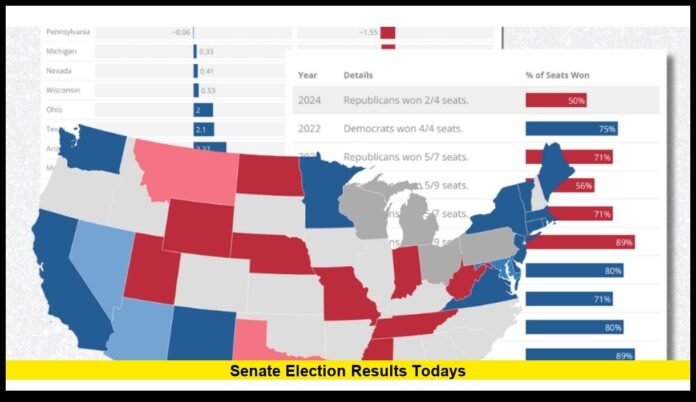

The senate election results today are attracting nationwide attention as Americans vote in the 2026 midterm elections, with control of the U.S. Senate emerging as one of the most important political questions of the night. Thirty-five Senate seats are scheduled to be contested, and the outcomes will influence the balance of power in Washington, the future of federal legislation, and the direction of congressional oversight during the remaining years of President Donald Trump’s term.
The election is especially significant because Republicans entered the midterms controlling the Senate, while Democrats are attempting to gain enough seats to take over the chamber. Several competitive contests across the country could determine whether the existing majority survives or a new party assumes control in January 2027.
Voters are considering candidates with different positions on the economy, immigration, health care, government spending, reproductive rights, and national security. Although these issues vary in importance from state to state, the combined results will help establish the political environment for the next Congress.
Understanding the election requires looking beyond individual victories. The number of seats each party already holds, the races still being counted, and the margins separating candidates will all matter when determining the final Senate balance.
Key Points Summary
╔════════════════════════════════════════════════════════════════════╗
║ – The 2026 U.S. midterm elections are taking place on November 3, 2026. ║
║ – Thirty-five Senate seats are scheduled to be contested through regular and special elections. ║
║ – Republicans entered Election Day with a 53-seat Senate majority. ║
║ – Democrats need a net gain of four seats to reach a 51-seat majority under the current party alignment. ║
║ – Michigan, Maine, Ohio, Texas, Georgia, Alaska, and Iowa are among the important Senate battlegrounds. ║
║ – Election-night vote totals are unofficial until the required counting and certification procedures are completed. ║
║ – The winning party will influence Senate leadership, committee assignments, federal appointments, and congressional priorities. ║
╚════════════════════════════════════════════════════════════════════╝
Why the 2026 Senate Elections Matter
The U.S. Senate is one of the two chambers of Congress and has considerable authority over national policymaking. Its members help write and approve federal legislation, consider presidential nominations, confirm federal judges, and conduct oversight of the executive branch.
Unlike the House of Representatives, where all 435 voting seats are contested every two years, Senate elections follow a staggered schedule. Senators serve six-year terms, meaning only approximately one-third of the chamber is normally up for election during each regular election cycle.
This structure makes every Senate contest important. A party can win several competitive races but still fail to obtain control if it does not secure enough seats overall.
The 2026 election includes 35 contests, creating opportunities for both parties to change the chamber’s composition. The results will determine which party controls important committees, influences the legislative calendar, and exercises greater authority over the Senate’s proceedings.
The election also carries significance for the White House. A president’s ability to advance nominations and negotiate legislation can be affected substantially by whether the opposing party controls the Senate.
Understanding the Senate Majority Before Election Day
Republicans began the 2026 election cycle with 53 Senate seats. Democrats held 45 seats, while two independents caucused with Democrats.
Under this alignment, Democrats need to gain four seats on a net basis to reach 51 seats. The vice president can break a 50-50 tie when voting in the Senate, so the practical implications of a tied chamber depend on which party holds the vice presidency.
Republicans, meanwhile, are working to defend their existing majority. Their objective is to retain enough seats to continue controlling the chamber after the new Congress begins.
The arithmetic makes the individual state contests especially important. A Republican victory in a state already considered competitive could make it harder for Democrats to reach a majority. Similarly, a Democratic win in a Republican-held seat could create momentum for additional gains.
The final outcome will depend on the combined results rather than the performance of any single candidate.
Michigan Senate Race: A Closely Watched Contest
Michigan is among the states receiving substantial attention during the 2026 Senate elections. The seat is open following Democratic Sen. Gary Peters’ decision not to seek another term, creating an opportunity for both parties to compete for a position in a politically important state.
Democrat Abdul El-Sayed and Republican Mike Rogers are the leading candidates in the contest. Their campaigns have addressed economic conditions, manufacturing jobs, health care, and the role of the federal government.
Michigan’s electorate includes urban, suburban, and rural communities with different political priorities. The distribution of votes across these areas may influence the final margin and determine how quickly the outcome becomes clear.
Because the state is competitive, early totals should be interpreted carefully. Results from individual counties may favor different candidates, and the overall picture can change as more ballots are counted.
Maine Senate Election: Can Democrats Gain a Seat?
Maine is another important state in the contest for Senate control. Republican Sen. Susan Collins is facing Democrat Troy Jackson in a race that could have national implications.
Collins has built a political career around representing Maine, while Jackson is seeking to turn Democratic support in the state into a Senate victory. The contest places particular importance on voters’ views about the economy, health care, federal spending, and the candidates’ records.
Maine’s election procedures may also influence how quickly the winner becomes clear. If the margin is close, additional counting and the state’s ranked-choice voting rules could affect the process of determining the final outcome.
The race is worth monitoring because a Democratic victory would help the party move closer to its goal of securing a Senate majority.
Ohio Special Senate Election
Ohio’s special Senate election is another contest with the potential to affect the chamber’s balance.
Republican Jon Husted and Democrat Sherrod Brown are competing for the seat previously held by JD Vance. The special election is taking place alongside the regular midterm contests, meaning its result will be included in the overall calculation of Senate control.
Ohio has generally favored Republican candidates in recent presidential elections, but Brown has an established political profile in the state. His campaign and Husted’s campaign are competing to persuade voters that their candidate is better positioned to represent Ohio’s interests in Washington.
The result could be particularly consequential if the wider Senate contests produce a narrow national margin. A victory in a single competitive state can become decisive when the parties are separated by only a few seats.
Texas, Georgia, and Alaska: Other Races to Watch
Texas is attracting national attention as Republican Ken Paxton faces Democrat James Talarico. The state has traditionally leaned Republican in federal elections, but Democrats view the contest as an opportunity to challenge that pattern.
Georgia is another important battleground, with Democratic Sen. Jon Ossoff facing Republican Mike Collins. Georgia’s recent history of competitive statewide elections has increased interest in its Senate contest, and turnout patterns may influence the final margin.
In Alaska, Republican Sen. Dan Sullivan is facing Democratic challenger Mary Peltola. The state’s distinctive political environment and geography make the contest important to follow, particularly if the margin remains close.
Iowa is also part of the national Senate battle. The open seat following Republican Sen. Joni Ernst’s decision not to seek reelection has created another opportunity for both parties to compete.
These contests are important because Democrats need multiple victories to change the Senate majority. Republicans, meanwhile, are seeking to retain their advantage by defending vulnerable seats and preventing a substantial shift in the chamber’s composition.
How Election Officials Count and Verify Votes
The election-night reporting process involves more than publishing the first available totals. State and local election officials must follow procedures designed to ensure ballots are counted accurately and eligible votes are included.
In-Person Ballots
Ballots cast at polling places are counted according to state and local procedures. Some jurisdictions report results relatively quickly after polls close, while others release totals in stages.
Mail-In and Early Votes
Mail ballots and early votes are important components of the overall count. Their reporting schedules vary by state, and some jurisdictions can begin processing ballots before Election Day while others must wait until later.
As these ballots are added to the totals, the relative positions of candidates can change. An early lead does not automatically indicate who will win.
Provisional Ballots
Provisional ballots require additional eligibility checks before they can be counted. Election officials review them under state law, and only ballots meeting the applicable requirements are included in the final tally.
Recounts and Certification
A narrow result may trigger a recount under state law or lead to additional legal proceedings. Once the counting and required verification processes are completed, officials certify the outcome.
These stages explain why the election-night winner and the officially certified winner are not necessarily announced at the same time.
What the Results Could Mean for Federal Policy
The Senate’s political balance has consequences well beyond party leadership. The chamber influences which bills receive consideration, how committees conduct investigations, and whether presidential nominees receive confirmation.
If Republicans retain their majority, they will continue to lead Senate committees and control much of the chamber’s legislative agenda. They will also have a stronger position in negotiations over federal spending, judicial nominations, and administration priorities.
If Democrats secure a majority, they would gain greater influence over committee leadership and the scheduling of Senate business. They could also change the approach to oversight of the Trump administration.
Neither outcome would automatically guarantee the passage of every proposal supported by the majority party. Legislation still faces procedural requirements, negotiations, and potential opposition from members of the same party.
The size of the majority matters, too. A narrow majority may require greater coordination among senators, while a larger margin can provide more flexibility when considering controversial legislation.
Why Early Election Results Can Be Misleading
Election-night coverage often focuses on which candidate is leading and how much of the vote has been reported. Those figures provide useful information, but they do not always tell the complete story.
A candidate might lead because the first reported counties strongly support that candidate. Later results from other parts of the state could narrow the margin or reverse the lead.
The percentage of precincts reporting also does not necessarily indicate the percentage of all ballots counted. Some jurisdictions report results in batches, and outstanding mail ballots may be concentrated in areas that favor one candidate.
Voters should therefore look at the reported margin, the geographic distribution of outstanding votes, and whether election officials have confirmed that most ballots have been counted.
Race projections should also be distinguished from official results. News organizations may project a winner when the available evidence indicates that the remaining votes cannot plausibly change the outcome. Certification follows a separate legal process.
What Happens After the Election?
After the Senate contests are decided, the results will determine the chamber’s composition for the next Congress. Regularly elected senators begin their new six-year terms on January 3, 2027, when the 120th Congress convenes.
The winning party will organize its leadership, establish committee assignments, and set priorities for the new legislative session. Senators will also return to negotiations over federal spending, judicial appointments, national security, and other policy matters.
Special elections can have different term arrangements because they fill vacancies rather than beginning a standard six-year term. The relevant state election rules and the term being filled determine how long the successful candidate serves.
The final seat count will be particularly important if control of the chamber depends on only a handful of races. A small number of victories could change which party directs Senate proceedings and determines committee leadership.
What Readers Should Watch Next
The most important developments are the release of official vote totals, the status of closely contested races, and announcements that individual contests have been projected or officially decided.
Michigan, Maine, Ohio, Texas, Georgia, Alaska, and Iowa are among the states that could shape the national outcome. However, the result in each state must be evaluated independently rather than inferred from national polling or previous election results.
Readers following senate election results today should also pay attention to the number of seats each party has secured and how many contests remain unresolved. This provides a clearer picture of whether either party is approaching the threshold needed to control the chamber.
At this stage, no final national outcome should be assumed until the relevant races have been decided. Election-night numbers may change as outstanding ballots are processed, and the official certification process remains essential.
The 2026 midterms will help determine the direction of congressional policymaking during the next two years. The Senate’s composition will influence legislation, presidential appointments, committee oversight, and the broader relationship between Congress and the White House.
Follow the latest election developments and join the conversation in the comments: Which Senate race do you believe will make the biggest difference to the balance of power in Washington?