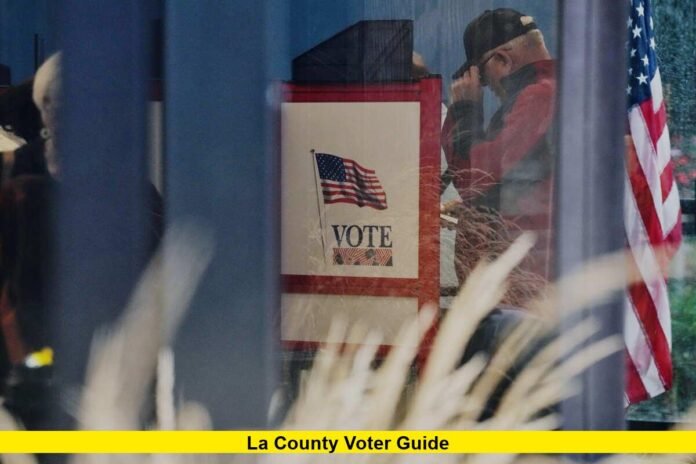

The LA County Voter Guide provides essential information for Los Angeles County residents preparing to vote in the November 3, 2026, General Election. Election Day is here, and voters can participate in person, return an eligible vote-by-mail ballot, or use an official ballot drop box. The election includes statewide contests, congressional and legislative races, judicial elections, and local contests or ballot measures that depend on a voter’s residential address.
Los Angeles County offers multiple ways to cast a ballot, with official Vote Centers available throughout the county and secure ballot drop boxes for voters who have completed their mail ballots. On Election Day, in-person voting locations are scheduled to operate from 7:00 a.m. to 8:00 p.m. Pacific Time. Voters who have not registered by the regular deadline may still have an opportunity to register and vote through California’s same-day conditional voter registration process.
Understanding the ballot, checking registration information, reviewing candidates, and knowing the applicable deadlines can help voters avoid last-minute problems. This guide explains the current election schedule, voting methods, ballot information, eligibility requirements, and important procedures for Los Angeles County voters.
LA County Voter Guide: Latest Election Updates
The November 3, 2026, General Election is the immediate focus for voters across Los Angeles County. The county’s election administration provides in-person voting, vote-by-mail services, ballot return locations, and registration assistance under California election law.
By Election Day, the county’s published election information identifies 646 Vote Centers and 429 ballot drop boxes as available voting resources. Vote Centers offer an in-person option for eligible voters, while drop boxes provide another way to return completed vote-by-mail ballots.
Voters should distinguish between a general election schedule and the information printed on their individual ballots. Not every Los Angeles County resident votes on the same local candidates or measures. Congressional districts, state legislative districts, judicial contests, municipal boundaries, and other voting districts determine which races appear on a particular ballot.
The most important information for November 3 includes:
- Election Day: Tuesday, November 3, 2026.
- In-person voting hours: 7:00 a.m. to 8:00 p.m. Pacific Time.
- Regular online voter registration deadline: October 19, 2026.
- Same-day registration: Eligible voters who missed the regular deadline may use conditional voter registration at a participating in-person voting location.
- Vote-by-mail return: Ballots may be returned by mail, at an official drop box, or at a participating Vote Center.
- Mail ballot deadline: A ballot must be postmarked on or before November 3 and received by the county elections office no later than November 10 to qualify under California’s standard postmark rule.
Voters should use the official election information associated with their address to confirm their ballot contents and the services available at a particular location. Election schedules and ballot information should be distinguished from unofficial commentary or predictions about the results.
When Are Polls Open in Los Angeles County?
Poll hours are an important part of the LA County Voter Guide because Election Day voters need to know when they can cast a ballot.
For the November 3, 2026, General Election, Los Angeles County Vote Centers are scheduled to open at 7:00 a.m. and close at 8:00 p.m. Pacific Time. These hours apply to Election Day voting.
The county began offering early in-person voting on October 24. During the early voting period, Vote Centers operated from 10:00 a.m. to 7:00 p.m. daily through November 2. On October 31, the remaining scheduled Vote Centers opened, making the county’s broader network available before Election Day.
Voters planning to visit a Vote Center on November 3 should allow enough time to travel, locate the entrance, and complete the voting process before closing.
What Voters Should Know About the 8 p.m. Deadline
The 8:00 p.m. deadline is important for people voting in person and for voters returning completed ballots at official drop boxes or participating Vote Centers.
Voters who are in line at a voting location when it closes should remain in line. Under California election rules, eligible voters who are in line by the applicable closing time must be permitted to vote.
However, arriving after closing without having joined the line in time may prevent a voter from casting a ballot at that location. Planning ahead is especially useful for people traveling from work, managing transportation, or relying on assistance to reach a voting site.
Voters should also avoid assuming that every election-related office or service operates on the same schedule. The hours for a Vote Center, county administrative office, or other election service may differ. Check the current information for the specific service before traveling.
What Is on the LA County Ballot in 2026?
The November 3 ballot includes contests at several levels of government. The exact combination depends on the voter’s residential address, so a countywide election summary cannot replace an individual sample ballot.
The election is part of California’s 2026 General Election, which includes statewide offices and other contests determined by district boundaries. Los Angeles County voters may also encounter local candidates, judicial races, and municipal or district ballot measures.
Statewide Offices and California Elections
California’s general election includes contests for statewide offices that are scheduled for election in 2026. These races are relevant to voters throughout Los Angeles County, although the candidates and any associated ballot information should be reviewed in the official voter materials.
Statewide offices may include the governor, lieutenant governor, attorney general, secretary of state, controller, treasurer, insurance commissioner, superintendent of public instruction, and other offices scheduled for election under California law.
The statewide ballot may also include propositions. Each proposition should be reviewed individually because ballot measures can address different public policies, legal changes, or government funding questions.
Voters should examine the official proposition title, summary, and impartial analysis where provided. Campaign advertisements and endorsements may offer arguments for or against a proposal, but they should not be treated as substitutes for understanding the measure’s actual provisions.
Congressional and State Legislative Races
Depending on their districts, Los Angeles County residents may vote in contests for the U.S. House of Representatives, California State Assembly, and California State Senate.
Congressional representatives participate in federal lawmaking, while California legislators consider state laws, the state budget, and policies affecting residents throughout California.
District boundaries determine which candidates appear on an individual ballot. Two residents who live in different parts of Los Angeles County may therefore see different congressional or legislative contests even though they vote in the same general election.
Voters can compare candidate qualifications, public statements, policy positions, and official candidate statements before making a decision. They should also confirm the names printed on their own ballots rather than relying on a list intended for another district.
Los Angeles County and Local Contests
Local elections are especially important because they affect public services and decisions that residents encounter in their communities.
Depending on a voter’s address and the applicable election schedule, local ballot contests may involve municipal offices, county offices, judicial positions, or local measures.
The City of Los Angeles has its own municipal election structure, which is separate from county government. Its November 3, 2026, general municipal election includes contests and measures determined by the city’s election schedule and the applicable districts.
Not every Los Angeles County resident lives within the City of Los Angeles. Residents of other incorporated cities and unincorporated communities may have different local government representatives and ballot measures.
The official sample ballot is the best way to determine which local races and proposals apply to an individual voter.
How to Find Your LA County Sample Ballot
A sample ballot helps voters prepare before entering a Vote Center or completing a vote-by-mail ballot. It provides the contests, candidates, and measures associated with a voter’s registration and electoral districts.
Reviewing the sample ballot in advance can make the process more organized, particularly when the ballot contains multiple candidates or lengthy propositions.
To prepare, voters should:
- Confirm their voter registration information.
- Identify the contests and measures appearing on their ballot.
- Review official candidate statements and ballot measure information.
- Decide how they intend to vote on each contest.
- Make a note of their choices to use as a reference when completing the official ballot, where permitted.
California’s official statewide voter information guide provides information about statewide candidates and propositions. Los Angeles County’s election materials provide additional information about county-administered contests and local voting arrangements.
Voters should remember that a sample ballot is a planning tool. It is not a substitute for submitting a completed official ballot, and it does not itself count as a vote.
Where to Vote in Los Angeles County
Los Angeles County uses Vote Centers for in-person voting. The county’s system gives eligible voters options beyond a single neighborhood polling place, subject to the locations and services offered for the particular election.
A voter may use the county’s official Vote Center locator to identify an appropriate location. Checking the location before leaving home can help prevent unnecessary travel and confusion.
Vote Centers on Election Day
Vote Centers provide in-person voting services and can also accept completed vote-by-mail ballots. They may offer registration assistance and accessibility services, depending on the service required.
For the November 3 election, Vote Centers are scheduled to operate from 7:00 a.m. to 8:00 p.m.
Voters who received a vote-by-mail ballot but would prefer to vote in person can take their ballot to a participating Vote Center. They should follow the instructions provided by election staff if they have questions about their existing ballot or need assistance completing the voting process.
A voter who has misplaced a mail ballot may be able to obtain a replacement through the county’s established procedures. Contacting election staff or visiting an appropriate Vote Center can help determine the available options.
Ballot Drop Boxes Across the County
Official ballot drop boxes offer a convenient alternative for voters who have already completed their vote-by-mail ballots.
Los Angeles County’s published election information identifies 429 ballot drop boxes for this election. These locations are intended to provide secure ballot return options across the county.
Before returning a ballot, voters should make sure they have followed the instructions included with the ballot, completed the required envelope information, and signed and dated the return envelope as directed.
Drop boxes remain available to receive ballots through 8:00 p.m. on Election Day under the county’s published schedule. Voters should use official drop boxes rather than leaving ballots at unapproved locations.
A completed ballot may also be returned at a participating Vote Center. Voters should choose the return method that best fits their circumstances while paying attention to the applicable deadlines.
Vote-by-Mail Rules for LA County Voters
California provides vote-by-mail ballots to registered voters. This option allows eligible voters to review the ballot and complete it without standing in line at a Vote Center.
For the November 3, 2026, election, ballots were scheduled to be mailed beginning October 5. Voters who have not returned their ballots should check their available return options immediately.
A vote-by-mail ballot generally requires more than marking candidate choices. The voter must follow the ballot’s instructions, place the completed ballot in the designated return envelope, and complete the required signature and date fields.
An unsigned return envelope or a signature that cannot be verified may require additional action before the ballot can be counted. Voters should carefully review the instructions to reduce the risk of avoidable problems.
Returning a Ballot by Mail
California’s standard rule allows a vote-by-mail ballot to be counted if it is postmarked on or before Election Day and received by the county elections office within seven days after the election.
For the November 3, 2026, election, the applicable receipt deadline is November 10 for ballots that meet the postmark requirement.
Election officials recommend mailing ballots well before Election Day because postal delivery times can vary. The ordinary recommendation to mail early is especially relevant for voters who have not yet returned their ballots.
If a voter is mailing a ballot on Election Day, California election guidance advises obtaining a manual postmark from a postal employee inside a United States Post Office. Voters should not assume that a ballot placed in a mailbox late on Election Day will automatically receive a qualifying postmark.
When time is limited, returning the ballot to an official drop box or participating Vote Center before the 8:00 p.m. deadline may be a more direct option.
Signing and Dating the Return Envelope
The return envelope is an important part of the vote-by-mail process. Voters should read the instructions and make sure they provide the required signature and date.
Election officials compare the signature on the return envelope with the signature associated with the voter’s registration records. If a signature is missing or cannot be matched, the voter may receive instructions explaining how to resolve the issue.
California provides procedures for addressing certain signature problems, including missing signatures and signatures that do not compare sufficiently with the registration record. Any notice from election officials should be read promptly because a response may be needed for the ballot to qualify for counting.
Voters should not sign for another eligible voter unless specifically authorized under applicable law and procedures. Each voter is responsible for following the instructions that apply to their own ballot.
Voter Registration and Same-Day Registration
The regular deadline to register online for California’s November 3, 2026, General Election was October 19.
Missing that deadline does not necessarily mean an eligible citizen must give up the opportunity to vote. California provides conditional voter registration, commonly described as same-day voter registration, through Election Day.
An eligible citizen who missed the regular registration deadline may register conditionally and vote at a participating in-person voting location in their county. The registration and ballot are handled under the applicable verification and processing rules.
Conditional registration is not an exemption from the requirements for voting eligibility. Applicants must meet California’s eligibility rules and provide the information needed to complete the process.
Voters who are uncertain about their registration status should seek assistance at an appropriate Vote Center rather than assuming they are ineligible. Election officials can explain the available process and the steps required to submit a ballot.
Who Can Vote in California?
In general, a person must be a U.S. citizen, meet California’s applicable age requirements, and satisfy the state’s residency and other eligibility rules to register and vote.
California permits eligible citizens who are at least 18 years old on Election Day to vote. Certain 16- and 17-year-olds may preregister, but preregistration does not allow them to vote before they meet the age requirement.
Some people with criminal convictions or records may remain eligible to vote under California law, while others may be temporarily disqualified depending on their circumstances. Eligibility should be assessed under the current state rules rather than assumptions based on a person’s past.
Voters should rely on official election guidance when determining their eligibility, particularly if their registration has changed, they recently moved, or they have questions about conditional registration.
How to Check Voter Registration Information
Checking registration details before voting can help identify errors or outdated information.
Voters should review their name, residential address, and other registration details. An address change can affect the congressional, legislative, municipal, and local contests appearing on a ballot.
A person who has moved within Los Angeles County should not assume that every part of their registration automatically reflects the new address. Updating the registration information helps election officials determine the appropriate voting districts.
If the registration record appears incorrect, voters should seek assistance from the county elections office or an authorized election service. They should explain the issue and ask which procedure applies to their circumstances.
Registration checks are also useful for voters who have not received a ballot, have questions about a previous registration update, or need to determine whether conditional registration is appropriate.
Tracking a Vote-by-Mail Ballot
Voters who return ballots by mail or through an official drop box may want to confirm that their ballots have been received and processed.
California provides a ballot-tracking service that can show status information for participating voters. Los Angeles County directs voters to its available ballot-tracking resources for information about receipt and processing.
Tracking information can help distinguish between a ballot that has been returned and one that has completed the applicable processing steps. The status displayed may change as election officials receive and review ballots.
Voters should not interpret a temporary delay in a status update as proof that a ballot has been lost or rejected. Processing times can vary, especially during a busy election period.
If a tracking record indicates a problem or the ballot has not appeared as expected, voters should contact election officials for guidance. They should avoid submitting another ballot without understanding the procedures that apply to their original ballot.
Accessibility and Language Assistance for Voters
Los Angeles County provides voting services intended to make participation accessible to eligible voters with different needs.
Voters who need assistance should review the available accessibility services before visiting a Vote Center. Depending on the location and circumstances, services may include accessible voting equipment and other assistance designed to help voters complete their ballots privately and independently.
A voter who needs help marking a ballot may be able to receive assistance under California’s voting rules. The person providing assistance must follow the applicable requirements and may not influence the voter’s choices.
Language access is also an important part of election administration in a county with residents who speak many languages. Official voter materials and assistance may be available in multiple languages, depending on the document and service.
Voters should check the language and accessibility options available for their specific needs. Planning ahead can help them identify a suitable voting method and avoid unnecessary delays.
Voting Rights and Election Security in Los Angeles County
Eligible voters have important rights when participating in California elections. These include the right to cast a ballot if they meet the eligibility requirements, the right to receive assistance when legally entitled to it, and the right to have their ballot handled according to applicable election procedures.
Voters should receive clear instructions about registration, ballot completion, and return requirements. If they encounter a problem at a Vote Center, they can ask election staff to explain the applicable process.
Election security involves several procedures, including registration verification, signature review for vote-by-mail ballots, secure ballot collection, and official counting and reporting processes.
These safeguards are designed to protect the integrity of the election while allowing eligible voters to participate. A procedural question or an isolated delay does not, by itself, establish that misconduct has occurred.
Claims about election irregularities should be assessed using verifiable information and official findings. Voters who witness a specific issue can report it through the appropriate election or law-enforcement channel, depending on the circumstances.
It is also important to distinguish unofficial election-night estimates from certified results. The final outcome is determined through the established counting, canvassing, and certification procedures.
When Will LA County Election Results Be Available?
Election results are a major public interest during the November 3 general election, but the timing of reported results is different from the deadline for casting a ballot.
Initial results may be released after voting locations close and election officials begin publishing available returns. These early figures may not include every ballot, and totals can change as additional eligible ballots are processed.
Vote-by-mail ballots, provisional ballots, and ballots requiring further review may take additional time to process under California’s election rules. The number of outstanding ballots and the pace of processing can affect how quickly the reported totals become complete.
A candidate or measure should not be described as officially decided solely because of an unofficial projection or a partial tally. Media organizations may make projections, but official election results remain subject to the county’s canvass and certification procedures.
Voters seeking the most reliable information should distinguish among preliminary returns, unofficial final results, and certified results. The county’s election administration is responsible for reporting the official count for contests it administers.
As of Election Day, the final outcome of any contest that has not yet been officially determined should be described as pending rather than assumed.
Common Mistakes LA County Voters Should Avoid
A few practical steps can help voters prevent unnecessary complications on Election Day.
Do not assume every ballot is identical. Candidates and measures vary according to residential address and electoral district. Review the ballot associated with your registration.
Do not overlook the return envelope. Vote-by-mail ballots must be completed and returned according to the provided instructions, including required signature information.
Do not wait until the last minute to choose a voting location. Confirm the address and Election Day hours before traveling.
Do not assume a mailed ballot has been received. Use available tracking services and seek assistance if the status indicates a problem.
Do not confuse registration deadlines with Election Day eligibility. California’s conditional registration process may provide an option for eligible citizens who missed the regular deadline.
Do not rely on unofficial claims about candidates or measures. Review the ballot, candidate information, and official measure materials before making a decision.
Do not assume early results are final. Election officials must complete the required counting, canvassing, and certification procedures.
These steps can help voters make informed choices and understand the process without relying on rumors or incomplete information.
Final Thoughts on the LA County Voter Guide
The LA County Voter Guide is especially useful on November 3, 2026, because voters need clear information about poll hours, registration options, ballot return rules, and the contests appearing on their individual ballots.
Los Angeles County voters have several ways to participate, including in-person voting at a Vote Center and returning a completed vote-by-mail ballot through an approved method. Election Day voting hours are scheduled for 7:00 a.m. to 8:00 p.m. Pacific Time, and eligible citizens who missed the regular registration deadline may still be able to register conditionally and vote in person.
The most effective preparation begins with checking registration information, reviewing the sample ballot, and selecting a voting method that meets the applicable deadlines. Voters should also remember that local contests vary across the county, so information intended for one city or district may not apply to another.
As election officials process ballots and release results, readers should look for verified information and distinguish preliminary totals from certified outcomes. Accurate election information helps residents understand their options, protect their voting rights, and participate confidently in the democratic process.
Have you voted in the November 3 election, or are you still preparing your ballot? Share your experience in the comments and stay updated on the latest verified LA County election developments.