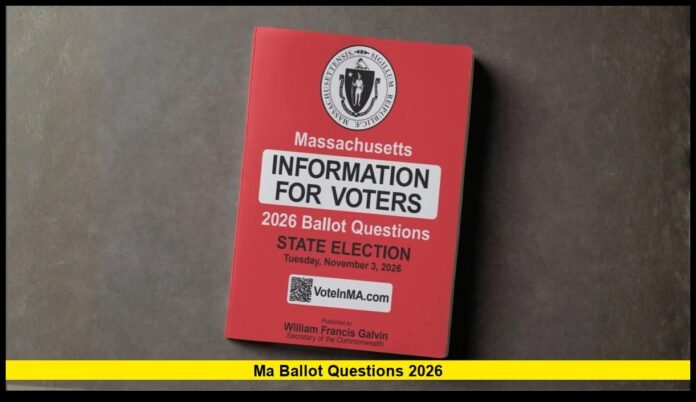

Massachusetts voters face several important decisions in the November 2026 election, with proposals covering government transparency, employee rights, election procedures, taxation, environmental protection, housing development, marijuana regulation, and firearm laws. The MA ballot questions 2026 are especially significant because they give residents an opportunity to influence state policies directly, rather than relying exclusively on decisions made by elected officials.
The nine statewide ballot questions address different aspects of life in Massachusetts. Some propose introducing new laws, while others seek to change existing government policies or determine whether legislation already enacted should remain in effect. Each question has different implications for residents, businesses, public institutions, and local communities.
For voters, the challenge is understanding what each proposal would actually accomplish. A YES vote does not always have the same practical meaning across different types of ballot questions, and some measures contain multiple provisions that could influence how state agencies and municipalities operate.
November 3, 2026, is Election Day in Massachusetts. Reviewing the proposals, their potential consequences, and their implementation timelines can help residents make informed choices when completing their ballots.
Key Points Summary
╔════════════════════════════════════════════════════════════════════╗
║ – Massachusetts voters are considering nine binding statewide ballot questions in the November 3, 2026, election. ║
║ – The proposals address public records, collective bargaining, primary elections, and voter registration. ║
║ – Other measures concern state revenue limits, environmental conservation, residential development, and recreational marijuana. ║
║ – Question 9 asks voters whether to retain or repeal the state’s 2024 firearms law. ║
║ – Some proposals include future implementation dates rather than taking effect immediately after the election. ║
║ – Additional non-binding questions may appear on ballots in particular legislative districts. ║
╚════════════════════════════════════════════════════════════════════╝
Massachusetts 2026 Election: Why the Ballot Questions Matter
Statewide ballot questions are an important part of Massachusetts’ democratic process. They allow eligible voters to approve proposed legislation, reject policy changes, or express their position on laws already passed by the Legislature.
The 2026 election is particularly important because the measures cover several subjects that have generated public discussion across the commonwealth. Government accountability, affordable housing, voting access, environmental investment, and public safety are all represented in the proposals.
The questions also differ in how they would affect residents. Some could change government procedures, while others could influence the distribution of public money or the rules governing particular industries.
Voters should remember that the ballot summary is only an introduction to each proposal. The full legal text may include exceptions, eligibility requirements, administrative responsibilities, and effective dates that are not immediately apparent from a short description.
Nine Massachusetts Statewide Ballot Questions Explained
Question 1: Greater Public Access to Government Records
Question 1 focuses on government transparency and public access to official records. It proposes extending Massachusetts’ Public Records Law to cover most records maintained by the Legislature and the governor’s office.
Under the existing framework, records held by these branches receive different treatment from records maintained by many other government offices. The proposal seeks to reduce that distinction and give residents greater opportunities to examine government activities.
Supporters of increased transparency argue that citizens should be able to understand how government decisions are developed, how public resources are managed, and how elected officials conduct public business.
However, the proposal also recognizes that certain communications and documents require protection. Exemptions would apply to specified policy-development materials and certain communications between legislators and constituents seeking assistance with government services.
What voters should consider: The main issue is finding an appropriate balance between public accountability and the confidentiality needed for legitimate government work.
A YES vote would approve the proposed expansion of public records access. A NO vote would leave the existing framework unchanged.
Question 2: Collective Bargaining Rights for Public Counsel Employees
Question 2 addresses employment rights at the Committee for Public Counsel Services, the organization responsible for providing legal representation to eligible individuals who cannot afford private attorneys in qualifying cases.
Employees working within this system perform important functions related to criminal defense, civil legal representation, and access to justice.
The proposal would authorize these employees to participate in collective bargaining with their employer. It would also establish a process under which the organization would request necessary funding from the governor after reaching a negotiated agreement.
Collective bargaining can cover subjects such as compensation, workplace conditions, employee protections, and other employment-related matters.
The proposal does not automatically establish particular salary increases or guarantee that every requested benefit will be approved. Those matters would depend on negotiations and the applicable funding process.
What voters should consider: The question concerns how public legal-service employees negotiate employment conditions and how the state supports the resulting agreements.
A YES vote would approve the proposed collective bargaining arrangement. A NO vote would leave the existing rules unchanged.
Question 3: A New Approach to State Primary Elections
Question 3 proposes changing how Massachusetts conducts primary elections for state offices.
Under the proposed system, candidates from different political parties would compete in a common primary rather than appearing exclusively on separate party ballots.
Voters would have the opportunity to choose among the participating candidates regardless of party affiliation. The two candidates receiving the highest number of votes would advance to the general election.
This means the general election could feature two candidates from the same political party if they receive the most support in the primary.
The proposal also includes changes concerning joint candidacies for governor and lieutenant governor and the requirements for political parties to qualify for official recognition.
Supporters may see this approach as a way to encourage competition and give voters more flexibility. Opponents may question whether it could weaken traditional political party structures or create disadvantages for certain candidates.
What voters should consider: The proposal could fundamentally change how candidates qualify for general elections and how political parties participate in the nomination process.
A YES vote would approve the proposed primary system. A NO vote would preserve the existing party-primary structure.
Question 4: Registering to Vote on Election Day
Question 4 concerns voting access and proposes allowing eligible Massachusetts residents to register or update their registration addresses at their polling places on Election Day.
Under the proposed system, eligible individuals would be able to complete the registration process while visiting their assigned polling location.
Voters would need to provide acceptable documentation establishing their identity and residential address. The proposal includes procedures for individuals who cannot immediately provide the required documentation, including provisional voting arrangements subject to verification deadlines.
The measure is intended to provide an additional opportunity for eligible citizens who miss the regular registration deadline or need to correct their residential information.
Importantly, the proposal includes a future implementation date of January 1, 2028. Therefore, approval would not automatically introduce Election Day registration for the November 2026 election.
The proposal also distinguishes registration from party affiliation changes. It would not generally allow voters to change their political party designation through the Election Day registration process.
What voters should consider: The central question is whether additional registration opportunities would improve participation while maintaining reliable procedures for verifying voter eligibility.
A YES vote would approve the proposed registration system. A NO vote would maintain existing registration requirements.
Question 5: Limiting State Revenue and Returning Excess Collections
Question 5 addresses Massachusetts’ approach to state revenue and taxpayer refunds.
The proposal would establish a revised formula for determining how much revenue the state could collect. The calculation would use the previous year’s net state revenue and adjust it according to the average growth in Massachusetts wages and salaries over the preceding three years.
If state revenue exceeded the applicable limit, the excess amount would be returned to taxpayers through refunds in the following year.
The proposal also addresses the treatment of revenue collected through the state’s additional tax on annual income exceeding $1 million.
This question is significant because state revenue directly influences the government’s ability to finance public education, transportation, health services, infrastructure, and other programs.
Supporters of stricter revenue limits may argue that taxpayers should receive excess collections instead of allowing government revenue to grow beyond the proposed formula.
Critics may be concerned that a restrictive system could make it more difficult for the state to respond to increasing public-service costs or changing economic conditions.
The proposal includes an effective date of July 1, 2027.
What voters should consider: The decision involves balancing taxpayer refunds against the state’s responsibility to maintain funding for essential services.
A YES vote would approve the new revenue calculation and refund system. A NO vote would preserve the existing framework.
Question 6: Funding Conservation and Outdoor Recreation
Question 6 proposes creating a Natural Resource Conservation Fund to support environmental protection and improve access to outdoor recreation throughout Massachusetts.
The proposed fund would receive a share of state sales and use tax revenue collected from sporting goods, recreational vehicles, and golf courses. During its first year, the fund would receive 50% of the eligible revenue, subject to legislative appropriation. After July 1, 2028, the allocation would increase to 100% of the specified revenue, subject to the proposal’s provisions and legislative appropriation.
The measure identifies several potential uses for the money, including protecting drinking water, restoring rivers and lakes, conserving forests and agricultural land, improving parks and trails, and preserving environmentally or culturally significant areas.
Eligible public agencies, municipalities, tribal governments, and qualifying conservation organizations could benefit from funding for approved projects.
What voters should consider: Question 6 would change how certain existing tax revenues are allocated rather than simply introducing a new tax rate. Its impact would depend on the revenue collected, legislative appropriations, and the projects receiving support.
A YES vote would approve the proposed fund. A NO vote would leave the current revenue allocation system unchanged.
Question 7: Building Single-Family Homes on Qualifying Lots
Housing availability is a significant concern in Massachusetts, where construction costs, land prices, and local zoning requirements can influence the supply of residential properties.
Question 7 proposes allowing single-family homes on qualifying residential lots measuring at least 5,000 square feet, provided the property has at least 50 feet of frontage and access to public water and sewer services.
Cities and towns would retain the ability to impose reasonable regulations covering building height, setbacks, open space, parking, and short-term rentals. The state housing agency could also issue guidance or regulations to administer the proposed law.
Supporters may view the measure as an opportunity to make residential development possible on qualifying lots that might otherwise face zoning barriers. Others may raise concerns about infrastructure capacity, neighborhood development, and the authority of local governments to determine land-use policies.
What voters should consider: Approval would not automatically guarantee new construction or lower housing prices. The outcome would depend on available land, infrastructure, permitting, financing, and construction costs.
A YES vote would approve the proposed housing rules. A NO vote would leave existing laws governing single-family construction unchanged.
Question 8: Ending Retail Sales of Recreational Marijuana
Question 8 proposes repealing Massachusetts laws that legalize, regulate, and tax retail sales of adult-use recreational marijuana.
If approved, the measure would take effect on January 1, 2028, giving the state time to implement the proposed changes.
The proposal would preserve limited possession rights for adults age 21 and older, allowing possession of up to one ounce of marijuana, including no more than five grams of concentrate. It would also establish penalties for certain possession violations and different requirements for younger individuals.
Existing recreational marijuana businesses could apply through an expedited process to become medical marijuana dispensaries. The proposal would also allow qualifying businesses to transfer remaining recreational inventory to medical dispensaries under its provisions.
The Cannabis Control Commission would continue operating, but its regulatory responsibilities would be modified to focus on medical marijuana.
What voters should consider: The proposal could affect cannabis businesses, employees, consumers, tax collections, and the state’s regulatory system. Supporters of repeal may emphasize public health and safety concerns, while opponents may point to economic consequences and the risks associated with restricting a regulated market.
A YES vote would approve the proposed restrictions on recreational retail sales. A NO vote would preserve the existing recreational marijuana framework.
Question 9: The Future of Massachusetts’ Firearms Law
Question 9 asks voters whether to retain or repeal the state’s 2024 firearms law. Unlike the other eight questions, this measure concerns legislation that has already been enacted.
The law covers multiple areas of firearm regulation, including licensing, safety training, privately made firearms, weapons classifications, and procedures for responding to certain threats.
It also expands the circumstances in which courts can issue Extreme Risk Protection Orders, which can require individuals to surrender firearms and related licenses or permits. The law includes provisions allowing certain school administrators and licensed health care providers to request these orders under specified conditions.
Additional provisions address firearm possession in certain locations, including polling places, government buildings, and schools, with exceptions. Other requirements concern firearm dealers, licensing procedures, reporting, and enforcement.
Supporters of retaining the law argue that stronger safeguards and licensing rules can help reduce risks associated with firearms. Opponents raise concerns about restrictions on lawful gun owners, regulatory burdens, and constitutional rights.
What voters should consider: This question addresses the existing law as a whole, so the consequences extend beyond any single firearm restriction.
A YES vote would keep the 2024 firearms law in place. A NO vote would repeal that law, although other Massachusetts firearm laws would remain in effect unless separately changed.
Local Ballot Questions and District-Specific Measures
Massachusetts voters may encounter additional questions depending on where they live. Some legislative districts have non-binding public policy questions asking voters whether their representatives should support particular proposals.
These questions may address county government, carbon emissions fees, social housing, health care policy, or legislative compensation.
Unlike the nine binding statewide questions, these district-specific questions do not directly create or repeal state law. Instead, they communicate voters’ preferences to their elected representatives.
Residents should review their individual ballots because local questions are not necessarily identical across the commonwealth.
How to Prepare for the Massachusetts Election
With nine statewide questions on the ballot, preparation can help voters avoid confusion and understand the consequences of their choices.
Before voting, residents should review the official ballot wording, identify the differences between YES and NO votes, and pay attention to provisions that would take effect in future years.
The MA ballot questions 2026 also demonstrate why voters should distinguish between proposed legislation and referendums on existing laws. For example, Questions 1 through 8 ask voters to approve or reject proposed laws, whereas Question 9 asks whether an existing firearms law should remain in place.
Massachusetts election officials have provided an official voter information guide containing summaries, fiscal information, arguments for and against the questions, and the relevant legal text. Reviewing this material can help residents understand the proposals beyond campaign messaging.
Voters should also remember that approving a proposal does not necessarily mean every provision will take effect immediately. Effective dates, implementation requirements, and legislative appropriations can influence when and how a law operates.
What the 2026 Ballot Could Mean for Massachusetts
The nine statewide measures present voters with decisions involving government accountability, public employment, elections, state finances, conservation, housing, marijuana, and firearms.
Some proposals could alter how public institutions operate, while others could change the rules governing residential construction, state revenue, or regulated industries. Their effects will depend on the final vote, the provisions of each measure, and any implementation requirements.
For Massachusetts residents, the most important step is to understand what each question would change and how that change aligns with their priorities.
The November 3 election gives voters an opportunity to influence these policies directly. Reading the ballot carefully and evaluating the practical consequences of each proposal can help ensure that decisions are based on accurate information rather than assumptions.
Share your views on the Massachusetts ballot questions in the comments, and stay tuned for the latest election developments and official results.