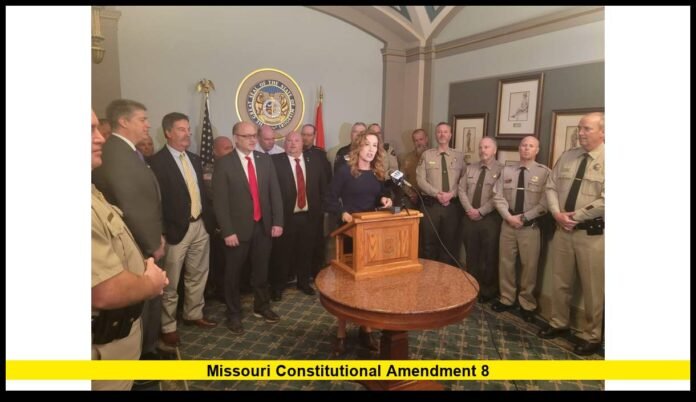

Missouri constitutional amendment 8 is one of the important questions appearing on the November 3, 2026, general election ballot. The proposed constitutional change focuses on county sheriffs, their election, their responsibilities, and the legal process required to remove them from office. Missouri voters are being asked whether these provisions should receive constitutional protection rather than remain governed primarily by state statutes.
The measure, officially known as the Require Election of County Sheriffs Amendment, was referred to voters by the Missouri General Assembly through Senate Joint Resolution 87 (SJR 87). It proposes establishing the office of county sheriff as a constitutionally recognized position, requiring four-year elections in the counties covered by the proposal, and limiting the removal of an elected sheriff to a legal proceeding known as a writ of quo warranto initiated by the Missouri Attorney General.
The proposal is particularly significant because most Missouri counties already elect their sheriffs. Consequently, the amendment is not simply about introducing sheriff elections for the first time. It would place important provisions concerning the office directly into the Missouri Constitution, potentially making them more difficult for future lawmakers to change through ordinary legislation.
As voters consider the measure, understanding its actual language, potential consequences, geographic exceptions, and differences between a YES and NO vote is essential. Here is what Missouri residents need to know about the proposal and its latest election developments.
What Is Missouri Constitutional Amendment 8?
Missouri constitutional amendment 8 is a legislatively referred constitutional amendment on the November 3, 2026, general election ballot. Its primary objective is to establish stronger constitutional protections for the office of county sheriff.
The proposal addresses three central areas:
- Preserving the election of county sheriffs for four-year terms.
- Recognizing sheriffs as chief law enforcement officers and establishing their responsibilities within the state constitution.
- Restricting the removal of an elected sheriff to a writ of quo warranto initiated by the Attorney General.
The official ballot question asks voters whether the Missouri Constitution should be amended to support law enforcement by preserving citizens’ ability to elect county sheriffs, preventing their removal except through a writ of quo warranto, and recognizing the sheriff’s office as part of the administration of justice.
The measure is not a proposal to create a new statewide police department, increase police funding, or establish a new state tax.
Instead, it concerns the legal position of county sheriffs and the rules governing their authority and removal.
An important distinction: Missouri already requires sheriff elections under existing state law in the counties covered by the proposal. Amendment 8 would move key provisions from ordinary statutes into the state constitution.
Why Is Amendment 8 on the November 2026 Ballot?
The proposal reached voters through the Missouri Legislature.
State Senator Jill Carter sponsored Senate Joint Resolution 87, which was introduced during the 2026 legislative session. The resolution proposed constitutional changes concerning the position of county sheriff and the legal framework governing the office.
The proposal passed through the legislative process before being approved in its final conference committee form.
The Missouri Senate initially approved the resolution on March 25, 2026. The House subsequently considered and amended the measure. After further negotiations between the two chambers, lawmakers approved the final conference committee substitute on May 15, 2026.
The final version was designated CCS/HCS/SS/SJR 87.
Because the proposal changes the Missouri Constitution, voters must decide whether it should become part of the state’s governing document.
Legislatively referred constitutional amendments are different from ordinary bills. They require approval from Missouri voters before the proposed constitutional language takes effect.
The measure was subsequently certified for the November 3 general election.
Its appearance on the ballot gives registered Missouri voters an opportunity to decide whether the proposed protections for elected county sheriffs should become constitutional requirements.
What Would Missouri Amendment 8 Actually Change?
Understanding the amendment requires separating existing state law from the new constitutional protections.
Missouri already has a system in which county sheriffs are generally elected to four-year terms. Their responsibilities and the rules governing their offices are addressed through state statutes.
Amendment 8 would place important elements of that system into the state constitution.
1. Constitutional recognition of elected county sheriffs
The amendment would establish the election of county sheriffs as a constitutional requirement in the counties covered by the proposal.
Under its provisions, each applicable county would elect a sheriff for a four-year term through a majority vote of qualified county voters.
This would give the office a stronger constitutional foundation.
Currently, election requirements are established through state law. If lawmakers want to change statutory provisions, they can generally do so through the legislative process.
Constitutional protections operate differently. Once a provision becomes part of the state constitution, changing it generally requires another constitutional amendment or another legally authorized constitutional process.
For residents, this means the election of county sheriffs would receive additional protection against ordinary legislative changes.
2. Recognition of sheriffs as chief law enforcement officers
Another important provision identifies the sheriff as the chief law enforcement officer in the applicable county.
This establishes the sheriff’s position within the county’s law enforcement structure.
The constitutional language would recognize the sheriff’s responsibility for maintaining public order and carrying out important law enforcement functions.
These responsibilities include preserving the peace, responding to disturbances, apprehending individuals accused or convicted of serious offenses, and carrying out legal responsibilities associated with the courts.
However, the designation should not be interpreted as giving sheriffs unlimited authority.
Sheriffs remain subject to applicable federal and state laws, constitutional protections, judicial authority, and other legal requirements.
3. Constitutional protection for sheriff responsibilities
The proposal also places certain duties of county sheriffs into the Missouri Constitution.
These responsibilities include:
- Preserving peace and maintaining public order.
- Suppressing riots and disturbances.
- Apprehending individuals subject to lawful arrest.
- Taking felons and other specified individuals into custody.
- Attending circuit court proceedings as required.
- Executing court orders and other legal processes.
- Hiring deputies and employees to assist with the sheriff’s responsibilities.
These duties are connected to the traditional responsibilities of county sheriffs in Missouri.
Moving them into the constitution would provide a different level of legal protection than leaving them exclusively in ordinary state statutes.
4. A different process for removing an elected sheriff
Perhaps the most consequential part of Missouri Amendment 8 concerns the removal of county sheriffs.
Under the proposed language, an elected sheriff could be removed through a writ of quo warranto initiated by the Attorney General.
A writ of quo warranto is a legal proceeding that challenges an individual’s authority or legal right to hold a public office.
The amendment would therefore establish a specific constitutional mechanism for challenging an elected sheriff’s right to remain in office.
This is an important distinction because the proposal would make the Attorney General the official responsible for initiating that proceeding under the amendment.
It would change the existing statutory framework governing the removal of sheriffs.
The provision could affect how allegations involving an elected sheriff are handled, particularly when questions arise about legal qualifications, authority, or eligibility to continue serving.
It does not mean that sheriffs would become immune from criminal investigations, prosecution, or other applicable legal proceedings.
The amendment concerns removal from the office itself, rather than eliminating the general application of criminal and civil law.
Which Missouri Counties Are Excluded From Amendment 8?
One of the most important details voters should understand is that the amendment does not apply to every Missouri county.
The final version of SJR 87 specifically excludes three jurisdictions:
- St. Louis City
- St. Louis County
- St. Charles County
These exclusions were included in the final legislative language.
This means the proposed constitutional requirements concerning sheriff elections and responsibilities would apply to the counties covered by the amendment, rather than universally across all Missouri jurisdictions.
The exclusions are particularly relevant to voters in the St. Louis metropolitan region.
Residents should avoid assuming that every county-level provision described in discussions of Amendment 8 applies identically throughout Missouri.
The final approved legislative text is the controlling version voters are considering.
Why Are Sheriff Elections Important in Missouri?
County sheriffs occupy an important position in local government.
Unlike many law enforcement officials who are appointed by municipal or county administrators, elected sheriffs receive their authority through the voting process.
This creates a direct relationship between the officeholder and the residents of the county.
Voters can evaluate a sheriff’s record, public statements, management decisions, and approach to law enforcement when deciding whether to support another term.
Sheriff elections can also make local law enforcement leadership more visible to the public.
The responsibilities of a sheriff may extend beyond routine policing. Depending on applicable law and local government arrangements, the office can involve jail operations, court security, civil process, arrest responsibilities, and coordination with other law enforcement agencies.
Amendment 8 seeks to give this office a more permanent constitutional position.
For supporters of elected sheriff systems, constitutional recognition may provide additional protection against changes that could weaken the independence of the office.
However, the question of how much authority an elected sheriff should possess, and how that official should be held accountable, remains an important part of the public discussion.
What Does a YES Vote on Missouri Amendment 8 Mean?
A YES vote supports the proposed constitutional changes.
If voters approve the measure, the Missouri Constitution would be amended to include provisions concerning elected county sheriffs, their responsibilities, and their removal from office.
A YES vote would support:
- Requiring covered counties to elect sheriffs for four-year terms.
- Recognizing sheriffs as chief law enforcement officers.
- Establishing certain sheriff responsibilities in the state constitution.
- Requiring removal proceedings through a writ of quo warranto initiated by the Attorney General.
- Providing constitutional recognition to the office of county sheriff.
The practical significance is that important aspects of the sheriff’s office would no longer depend exclusively on ordinary state legislation.
This could provide greater continuity for the office across future legislative sessions.
However, approving the amendment would not automatically result in new sheriff elections immediately after the election.
Missouri already conducts sheriff elections under existing law. The proposal is primarily concerned with constitutional protection rather than introducing an entirely new election schedule.
A YES vote also would not automatically increase police salaries, provide additional county law enforcement funding, or create new public safety programs.
What Does a NO Vote on Missouri Amendment 8 Mean?
A NO vote rejects the proposed constitutional amendment.
If voters reject the measure, the Missouri Constitution would remain unchanged by this proposal.
Existing state statutes governing county sheriff elections, responsibilities, and removal would continue to apply unless lawmakers changed them through the regular legislative process or another applicable legal process.
A NO vote would therefore preserve the current statutory framework rather than add the proposed constitutional protections.
Importantly, rejecting Amendment 8 would not automatically eliminate sheriff elections.
This is a point that voters should understand before making a decision.
Missouri law already provides for the election of county sheriffs to four-year terms in the applicable counties.
Therefore, a NO vote would not immediately mean that residents lose the ability to elect their county sheriff.
The primary difference is whether the relevant provisions should remain in state statutes or receive constitutional protection.
Missouri Amendment 8: YES vs. NO Vote Explained
| Issue | YES Vote | NO Vote |
|---|---|---|
| Sheriff elections | Adds constitutional protection for four-year elections in covered counties | Existing statutory election requirements remain |
| Sheriff responsibilities | Places specified duties in the Constitution | Existing statutory framework remains |
| Sheriff authority | Constitutionally recognizes the sheriff as chief law enforcement officer | No constitutional change under this proposal |
| Removal process | Requires a quo warranto proceeding initiated by the Attorney General | Existing statutory removal framework remains |
| Constitutional changes | Amends the Missouri Constitution | Does not amend the Constitution |
| Tax impact | No increase or decrease in taxes | No direct tax change from rejecting the measure |
This comparison highlights why the amendment is more complicated than a simple question about whether voters support electing sheriffs.
The central issue is whether the office should receive constitutional protection and whether the proposed removal process is appropriate.
What Is a Writ of Quo Warranto and Why Does It Matter?
The legal terminology used in Amendment 8 may be unfamiliar to many voters.
A writ of quo warranto is a legal mechanism used to question the authority under which an individual occupies a public office.
The expression comes from Latin and essentially concerns the legal authority by which someone holds a position.
In the context of Missouri Amendment 8, the proposal would require a writ of quo warranto initiated by the Attorney General as the process for removing an elected sheriff.
This provision is important because it identifies a specific legal route rather than allowing removal through the broader procedures that may exist under current statutes.
The proposal would therefore change who can initiate the designated removal proceeding.
The Attorney General is Missouri’s chief legal officer and represents the state in important legal matters.
Giving the Attorney General this role could centralize responsibility for initiating proceedings against elected county sheriffs.
It is also important to understand what the provision does not say.
It does not provide a general exemption from criminal law, court orders, or constitutional requirements.
A sheriff accused of committing a crime would not automatically be protected from investigation or prosecution simply because Amendment 8 became law.
The distinction is between criminal accountability and the specific legal procedure for removing someone from an elected county office.
Why Supporters Consider Amendment 8 Important
Support for Amendment 8 is connected to the idea that county sheriffs should have a clearly established constitutional position.
Supporters of the proposal emphasize the importance of allowing county residents to elect their sheriff and protecting that election system from future legislative changes.
They also point to the traditional responsibilities of sheriffs in maintaining public safety and enforcing court orders.
From this perspective, placing sheriff elections and duties in the Constitution could provide greater stability.
Another important argument concerns the independence of elected law enforcement officials.
An elected sheriff receives a mandate directly from county voters. Constitutional recognition may strengthen the office’s position within the state government structure.
Supporters may also view the proposed removal process as a way to establish a consistent legal standard for removing elected sheriffs.
Rather than relying on different statutory procedures, the amendment would establish a constitutional mechanism involving the Attorney General.
These arguments form the basis of the proposal’s law enforcement and constitutional accountability themes.
What Concerns Could Voters Have About Amendment 8?
Although the proposal is presented as a measure supporting law enforcement, voters may also consider the potential consequences of changing the sheriff removal process.
One major consideration is the concentration of responsibility in the Attorney General’s office.
If the amendment passes, the Attorney General would have the specified authority to initiate the quo warranto proceeding for removing an elected sheriff.
This raises questions about how the process would operate when allegations arise at the local level.
For example, residents may want to understand how concerns about a sheriff’s conduct would be handled if the Attorney General does not initiate the required proceeding.
Another consideration is the balance between independence and accountability.
Elected officials have a responsibility to the voters who place them in office. However, elections take place periodically, and serious questions about an officeholder’s conduct may arise between elections.
The legal framework must therefore address both the independence of elected officials and the need for effective accountability.
Constitutional provisions can also be more difficult to change than ordinary statutes.
If Amendment 8 passes, future lawmakers would have less flexibility to adjust the constitutional provisions through routine legislation.
Voters may therefore consider whether the proposed rules should remain in place over the long term.
These are questions about the structure of government and the legal accountability of public officials, not simply about whether county sheriffs should be elected.
Does Missouri Amendment 8 Affect Taxes?
No direct tax increase or decrease is associated with Missouri Amendment 8.
The official ballot language states that state and local governmental entities estimate no costs or savings.
This means the proposal is not designed to establish a new tax, increase an existing tax rate, or create a new revenue source.
It also does not establish a new statewide law enforcement funding program.
The measure focuses on constitutional rules governing the county sheriff’s office.
Voters should distinguish this proposal from other Missouri ballot measures that deal directly with taxation, public finances, or government revenue.
Amendment 8 is primarily an institutional and legal proposal.
How Could Amendment 8 Affect Local Law Enforcement?
The potential effects would depend on how the constitutional provisions interact with existing county government arrangements.
For most covered counties, the immediate day-to-day responsibilities of the sheriff may not change dramatically because sheriffs already perform many of the duties described in the proposal.
However, constitutional recognition could have longer-term implications.
Greater protection for the elected office
A constitutional requirement could make it more difficult for future lawmakers to replace the existing election structure through ordinary legislation.
A more clearly defined position
Recognizing the sheriff as chief law enforcement officer could strengthen the constitutional description of the office.
A different removal procedure
The requirement for a quo warranto proceeding initiated by the Attorney General could change how removal cases are handled.
Greater importance of constitutional interpretation
If disputes arise over the amendment’s provisions, courts may need to interpret the constitutional language and determine how it applies in specific circumstances.
The proposal does not automatically reorganize every police department, sheriff’s office, or county government.
Municipal police departments would continue operating under their applicable legal structures.
Similarly, federal law enforcement agencies would not become subordinate to county sheriffs because of this amendment.
How Did Missouri Amendment 8 Reach Voters?
The amendment originated in the Missouri General Assembly through Senate Joint Resolution 87.
Its legislative journey included consideration by both chambers, amendments, and a conference committee process.
The final proposal was approved by lawmakers in May 2026 and subsequently referred to voters.
The process is significant because the measure is not a citizen-initiated petition.
Instead, it is a legislatively referred constitutional amendment.
This means elected state lawmakers approved the proposal for consideration by Missouri voters.
The measure now requires voter approval to become part of the Missouri Constitution.
The distinction matters because Missouri has different procedures for citizen-led constitutional amendments and amendments referred by the legislature.
In this case, voters are deciding whether to approve the constitutional language developed through the legislative process.
Missouri Constitutional Amendment 8 and the November 3, 2026, Election
November 3, 2026, is the scheduled general election date for Missouri Amendment 8.
Missouri voters will encounter the question alongside other statewide ballot measures and candidate contests.
The amendment is one of four constitutional amendments certified for the November general election, alongside Proposition A.
The other constitutional proposals address separate subjects, including abortion policy, voter-led ballot initiatives, and a proposed state investment fund.
Amendment 8 is specifically concerned with county sheriffs.
As election day arrives, voters should carefully review the exact wording on their ballots rather than relying exclusively on short campaign descriptions.
The distinction between existing state law and proposed constitutional changes is particularly important for this measure.
Are Missouri Amendment 8 Election Results Available?
As of the latest available information for November 3, 2026, the election is taking place today, and a final statewide result has not been officially confirmed.
Voters should not treat unofficial predictions, campaign statements, or preliminary reports as certified election results.
The outcome will depend on the votes counted across Missouri.
Once election officials release preliminary totals, those figures may change as additional ballots are processed and reported.
The official election outcome must be determined through the state’s election reporting and certification procedures.
There is no confirmed basis at this stage to state that Amendment 8 has passed or failed.
What Should Missouri Voters Consider Before Voting?
Before voting on the proposal, residents may want to examine several important issues.
First, understand the existing system.
Missouri already elects sheriffs in the counties covered by the proposal. A YES vote would provide constitutional protection rather than introduce elections for the first time.
Second, understand the removal provision.
The requirement for a writ of quo warranto initiated by the Attorney General is one of the amendment’s most important changes.
Voters should consider how this process could affect accountability and local government oversight.
Third, recognize the geographic exceptions.
St. Louis City, St. Louis County, and St. Charles County are excluded from the final proposal.
Fourth, distinguish constitutional protection from expanded police powers.
The amendment recognizes certain sheriff responsibilities but should not be interpreted as granting unlimited authority or removing existing legal restrictions.
Finally, consider the long-term consequences.
Constitutional provisions can be more difficult to change than ordinary laws. Voters are deciding whether the proposed framework should become part of Missouri’s fundamental governing document.
These considerations can help residents make an informed decision based on the actual proposal rather than political messaging.
Frequently Asked Questions
Q1. What is Missouri Amendment 8 in 2026?
Missouri Amendment 8 is a proposed constitutional amendment concerning county sheriffs. It would establish constitutional protections for four-year sheriff elections in covered counties, recognize sheriffs as chief law enforcement officers, establish certain official responsibilities, and limit removal through a writ of quo warranto initiated by the Attorney General.
Q2. When will Missouri Amendment 8 be voted on?
Missouri Amendment 8 is on the November 3, 2026, general election ballot. Missouri voters can decide whether to approve or reject the proposed constitutional changes on election day.
Q3. What happens if voters approve Amendment 8?
If approved, the Missouri Constitution would be amended to establish provisions concerning sheriff elections, duties, and removal. The amendment would apply to the counties covered by the final legislative proposal, excluding St. Louis City, St. Louis County, and St. Charles County.
Q4. What happens if voters reject Amendment 8?
If voters reject the measure, the Missouri Constitution will not be changed by this proposal. Existing state statutes governing sheriff elections, responsibilities, and removal will remain in effect unless changed through another lawful process.
Q5. Does Amendment 8 increase taxes in Missouri?
No. The official ballot language indicates that state and local governmental entities estimate no costs or savings. The proposal does not establish a new tax or directly increase existing tax rates.
Q6. Are Missouri sheriffs already elected?
Yes. Missouri already requires county sheriff elections under existing state law in the counties covered by the proposal. Amendment 8 would place the election requirement into the state constitution.
Q7. What does quo warranto mean in Amendment 8?
Quo warranto is a legal proceeding that challenges a person’s authority to hold public office. Under Amendment 8, an elected sheriff could be removed through this type of proceeding initiated by the Missouri Attorney General.
Q8. Does Amendment 8 apply to St. Louis County?
No. The final version specifically excludes St. Louis County, St. Louis City, and St. Charles County from the amendment’s provisions.
Q9. Does Amendment 8 give sheriffs unlimited law enforcement authority?
No. The proposal recognizes sheriffs as chief law enforcement officers in covered counties and places certain responsibilities in the Constitution. Sheriffs would still be required to follow federal law, state law, constitutional protections, and applicable court orders.
Q10. Has Missouri Amendment 8 passed in the 2026 election?
A final result should not be declared until election officials report and certify the outcome. As of the latest available election information, November 3 is election day, and there is no officially confirmed final statewide result.
Final Thoughts on Missouri Constitutional Amendment 8
Missouri constitutional amendment 8 presents voters with an important decision about the future legal status of county sheriffs. Although most covered counties already elect their sheriffs, the proposal would place the election requirement and certain responsibilities into the state constitution.
Its most significant provision concerns the removal of elected sheriffs through a writ of quo warranto initiated by the Attorney General. This could change the balance between local accountability and the constitutional independence of elected law enforcement officials.
For supporters, the amendment offers stronger constitutional protection for an established county office. For voters who have concerns about the removal process, the measure raises questions about oversight and how elected officials should be held accountable.
Ultimately, the decision belongs to Missouri voters. Understanding the difference between existing state law and the proposed constitutional changes is essential when evaluating the YES and NO options on the November 3 ballot.
What do you think about Missouri Amendment 8? Share your opinion in the comments and stay updated for the latest verified 2026 election developments.