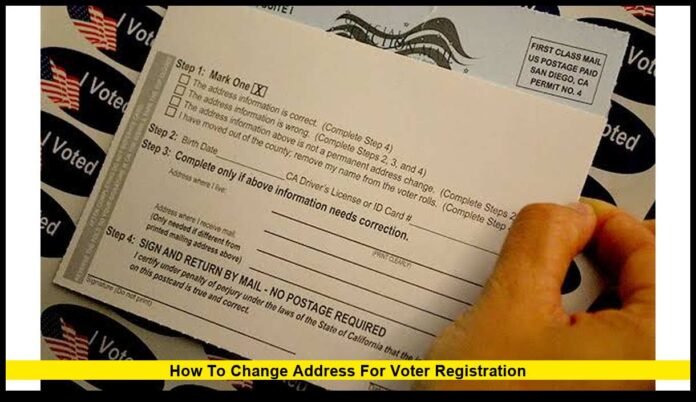

Moving to a new home can affect where you vote, which candidates appear on your ballot, and the local elections in which you can participate. Understanding how to change address for voter registration helps ensure your voter record reflects your current residence and that you know where to cast your ballot in upcoming elections. In the United States, the process depends on the state where you live, with options that may include online updates, paper applications, in-person assistance, and certain motor vehicle agency transactions.
Whether you have moved to another home in the same neighborhood, relocated to a different county, or settled in another state, updating your voter registration should be an important part of your moving checklist.
Why Updating Your Voter Registration Address Matters
Your residential address generally determines your election district, assigned polling location, and the local contests for which you are eligible to vote. When you move, your previous voter registration may no longer reflect the correct information for your new residence.
An outdated address can create confusion about where to vote or whether your registration has been updated successfully. Depending on state law and the circumstances of your move, you may need to complete a new registration application rather than simply changing one field in an existing record.
Updating your information also helps election officials maintain accurate voter registration records. Although moving does not automatically mean that you have lost your eligibility to vote, you should not assume that your registration has transferred to your new address without checking.
The most reliable approach is to review your registration status, submit the appropriate change, and confirm that the election office has processed it.
How to Change Address for Voter Registration Online
Online registration services are available in many states and are often a convenient way to update voter information. However, online availability, identification requirements, and processing times vary by jurisdiction.
The following steps provide a general process for voters whose states offer online address changes.
Step 1: Find your official state election website
Start with the federal government’s voter registration information service and select your state or territory. This helps you identify the appropriate official election website rather than relying on an unofficial registration service.
Step 2: Check your current voter registration
If your state offers an online voter lookup tool, use it to review your registration status and the address currently listed on your record. You may need to provide identifying information, such as your name, date of birth, or other details required by your state.
Step 3: Select the address update option
Look for an option to update voter registration, change residential information, or submit a new registration application. Some states allow existing voters to update their records directly, while others may require a new application.
Step 4: Enter your new residential address
Provide your complete residential address, including the street number, apartment or unit number, city, state, and ZIP code. If your mailing address differs from your residential address, enter it in the appropriate field when requested.
Step 5: Complete the required information
Depending on your state, the application may request your date of birth, identification number, signature, or other information used to verify your identity and eligibility.
Review every entry before submitting the application. Incorrect apartment numbers, ZIP codes, or other details may delay processing or cause your registration to reflect the wrong voting district.
Step 6: Submit the application and retain confirmation
Follow the instructions to complete your submission. Save any confirmation number or receipt provided by the system.
Submitting an online request does not necessarily mean the update has already been approved. Check your registration again after the state has had time to process the application.
How to Change Voter Registration Address by Mail
Voters who cannot use an online service may be able to update their registration by mail. This option can be useful for people who prefer paper applications or live in jurisdictions with limited online services.
The National Mail Voter Registration Form can be used to update an address, change a name, or make other registration changes in participating jurisdictions. State-specific instructions determine how the form must be completed and where it should be sent.
To update your address by mail:
- Obtain the appropriate voter registration form and read the instructions for your state.
- Enter your current personal information and new residential address.
- Complete any required identification details and signature fields.
- Include any additional information or documentation required by state law.
- Mail the completed form to the designated state or local election office.
- Keep a copy of the completed application for your records.
The National Mail Voter Registration Form is not accepted in every state. North Dakota, New Hampshire, and Wyoming have exceptions to its general availability, and state-specific rules may affect how voters in those jurisdictions register or update their information.
Before mailing your application, verify the correct destination and registration deadline. A form sent to the wrong office or received after the applicable deadline may not be processed in time for an upcoming election.
Changing Your Address When Moving Within the Same State
Moving within your existing state is generally different from relocating across state lines. Your voter registration may remain associated with the same statewide system, but your new address could place you in a different county, city, legislative district, or voting precinct.
For example, a move across town may change your assigned polling location even when you remain in the same county. A move to another county may require the election office to transfer your registration record or process a new application.
The correct procedure depends on state election law. Some states allow online changes, while others provide paper forms, telephone assistance, or in-person services through local election officials.
After submitting an address change, check your registration details to confirm that the new residence is recorded correctly. If your address has changed but the online record still displays your former residence, contact your election office rather than assuming the update has been completed.
How to Change Voter Registration After Moving to Another State
Moving to a different state generally requires you to register under the new state’s election rules. Your previous registration does not automatically establish that you are registered at your new residence.
Begin by reviewing the voter eligibility requirements and registration deadlines in your new state. Residency rules, accepted identification, application procedures, and the treatment of existing registrations differ across jurisdictions.
Once you establish eligibility, submit a new voter registration application using the available online, mail, or in-person process. Provide accurate information about your new residence and complete any required verification steps.
You may also want to review the status of your previous registration. Many states do not require voters to cancel an old registration separately after moving, but procedures differ. Follow the guidance provided by the election offices involved.
Do not submit a registration application using an address where you no longer reside simply because you are familiar with the former polling location. If your move occurs close to an election, ask election officials about the lawful options available under the rules of your former and new states.
Can You Change Your Voter Registration Address at the DMV?
In some states, a driver’s license or state identification transaction provides an opportunity to register to vote or update existing voter registration information.
This can make the process more convenient when you are already updating your driver’s license after a move. However, changing your address with a motor vehicle agency does not guarantee that your voter registration record has been updated in every state.
Check whether your state’s DMV or equivalent agency offers voter registration updates and whether you must select a separate election-related option during the transaction.
If you have already changed your driver’s license address, verify your voter registration independently. This is particularly important if you are approaching an election deadline.
Important Voter Registration Deadlines to Remember
Voter registration deadlines are among the most important factors to consider when changing your address. Each state establishes its own rules for registration and updates, and the deadline may differ depending on whether you apply online, by mail, or in person.
Some states require registration changes to be completed well before Election Day. Others offer later registration opportunities, including certain in-person options. The availability of these options should never be assumed without checking the applicable state rules.
For instance, Washington generally requires online and mail registration updates to be received at least eight days before Election Day, while in-person registration is available through Election Day under state rules. Other states have different deadlines and procedures.
If you move shortly before an election, contact your state or county election office immediately. Officials can explain whether your address change can take effect for the upcoming election and what options may be available if the regular deadline has passed.
Allow enough time for processing, especially when applying by mail. A postmark or application receipt may not satisfy every state’s deadline requirements.
Documents and Information You May Need
The information required for a voter registration address change depends on state law and the application method. Preparing the necessary details before starting can help prevent errors and delays.
Commonly requested information includes:
- Your full legal name.
- Your date of birth.
- Your previous registered address, when requested.
- Your new residential address.
- Your mailing address, if different.
- A driver’s license number, state identification number, or another permitted identifier.
- The last four digits of your Social Security number, where applicable.
- Your signature or an electronic method of signing the application.
Some states use information already maintained by their motor vehicle agencies to verify applications. Others provide alternative procedures for eligible voters who do not have a driver’s license or state identification card.
Do not assume that every voter must provide the same documents. Review the instructions for your state and use only the official application process.
How to Verify Your Voter Registration After an Address Change
Checking your registration after submitting an update is an essential final step. A completed application and an updated voter record are not necessarily the same thing.
Use your state’s official voter lookup system, if available, to confirm that your registration remains active and that the correct address appears on your record. Review your assigned voting location and other available registration details.
If the update is not visible immediately, allow the processing time specified by your election office. If the information remains incorrect or your registration status is unclear, contact the relevant office for assistance.
You may receive a new voter registration card after your record is updated. Delivery times vary, and a missing card does not necessarily mean that your registration has failed. Verify your status directly rather than relying only on postal delivery.
Your polling place may also change when your new address is processed. Check your assigned location before voting instead of traveling to the polling place associated with your former residence.
Special Considerations for Absentee and Mail-In Voters
Voters who receive ballots by mail should pay particular attention to address changes. An outdated residential address may affect their assigned election district, while an outdated mailing address may prevent election materials from reaching them.
Update your voter registration and review your state’s absentee or mail-in voting requirements before requesting a ballot. Depending on the jurisdiction, you may need to submit a separate application or update an existing request.
If you have already requested a ballot before moving, contact your election office to determine how the move affects that request. Do not assume that a ballot sent to your former address will automatically be forwarded or that a new ballot will be issued without additional steps.
Military voters and U.S. citizens living abroad may have separate procedures for updating registration and requesting absentee ballots. The Federal Voting Assistance Program provides information tailored to eligible military and overseas voters.
Latest Updates on Changing a Voter Registration Address
The central guidance for U.S. voters remains consistent: address changes should be handled through the election authority responsible for the voter’s current residence, and the applicable state rules determine the available methods and deadlines.
Federal voter information services direct voters to their state or territorial election offices for instructions. The U.S. Election Assistance Commission also identifies online state services, paper applications, and motor vehicle agency transactions as possible ways to update voter information, depending on the jurisdiction.
There is no single nationwide deadline or universal online application that guarantees an immediate address change for every voter. Procedures can differ even between neighboring states, so voters should rely on the current instructions for their own jurisdiction.
For the November 2026 election period, voters should pay particular attention to state-specific deadlines and any special registration provisions that may apply. Rules can vary by election and application method, and eligibility to update a record does not automatically establish eligibility to vote at a particular location on Election Day.
The safest approach is to check your registration, submit the correct application as early as possible, and verify the result before voting.
Common Mistakes to Avoid When Updating Voter Registration
A few avoidable mistakes can complicate the address change process.
Assuming a driver’s license update automatically changes voter registration: Some states connect these services, but others require a separate election-related step.
Waiting until Election Day without checking the rules: Late registration or address changes may be allowed in some jurisdictions but not others.
Using a mailing address instead of a residential address when the form requires residence information: Follow the form’s instructions and provide a separate mailing address when appropriate.
Assuming an application was approved immediately: Check your registration status after submission and contact election officials if the record is incorrect.
Going to your former polling place without checking: Your new address may place you in a different voting district or assign you to another location.
Avoiding these mistakes can help reduce uncertainty and make the voting process more straightforward.
Final Thoughts
Learning how to change address for voter registration is an important step after relocating. Whether you move within the same neighborhood, across county lines, or to another state, updating your voter information helps ensure that election officials have the correct residential details and that you can identify the appropriate voting location.
Start with your official state election website, review the applicable deadline, and choose an available online, mail, or in-person option. If you have moved close to an election, seek guidance from your election office promptly rather than assuming that your previous registration remains sufficient.
Most importantly, confirm that the address change has been processed and verify your current registration status before Election Day.
Share your experience in the comments and stay updated on important voter registration rules and election information.