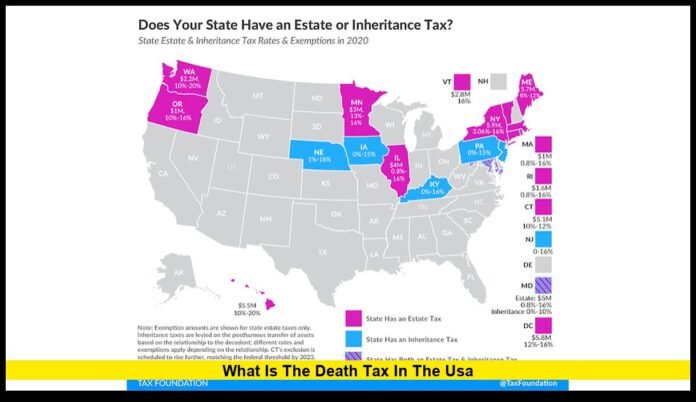

What is the death tax in the USA? It is a common name for taxes connected to transferring wealth after death, especially the federal estate tax. In 2026, the federal estate tax exclusion stands at $15 million per individual, while the highest federal estate tax rate is 40%. The exclusion increased from $13.99 million in 2025 under federal legislation enacted in July 2025. Although most estates do not owe federal estate tax, some families face state estate taxes or inheritance taxes that follow different rules.
These taxes matter when families transfer homes, investment portfolios, savings, business interests, and other valuable property to heirs. The federal government calculates estate tax on the deceased person’s taxable estate, while some states tax the estate or the people who receive an inheritance. Understanding the difference can help families estimate potential liabilities, prepare the necessary documents, and make informed decisions about estate planning.
Understanding the Death Tax in the United States
The phrase death tax is not the official name of a single tax imposed on every American who dies. It is a general expression used to describe taxes that may arise when a person’s wealth passes to others after death.
The principal federal tax in this category is the estate tax. It applies to the taxable estate under federal law, after the appropriate deductions and credits. The estate’s value, the deceased person’s lifetime taxable gifts, and other relevant factors help determine the final amount.
The estate tax is generally an obligation of the estate rather than a tax charged directly to each heir. An executor or personal representative handles the estate’s administration, including required tax returns and payments.
State laws add another layer. Some states impose their own estate taxes, while others collect inheritance taxes from beneficiaries who receive property. Maryland imposes both types.
This distinction is important because the federal exclusion does not eliminate every possible state tax. A family can have no federal estate tax liability and still need to address a state-level obligation.
The central question is not simply how much money someone inherits. It is which tax applies, who is responsible for paying it, and how the relevant rules affect the transfer.
Federal Death Tax Exemption for 2026
The federal estate tax exclusion is $15 million per individual for 2026. This is the basic exclusion amount under the federal estate and gift tax system.
The exclusion was $13.99 million in 2025. Legislation enacted on July 4, 2025, raised the amount to $15 million for 2026 and provides for inflation adjustments in later years.
The exclusion generally allows an individual to transfer a substantial amount of wealth without incurring federal estate and gift tax, subject to the applicable rules. However, the calculation can include certain taxable gifts made during the person’s lifetime.
Consider an individual who dies in 2026 with a gross estate valued at $9 million. If the relevant adjusted taxable gifts and other amounts do not change the calculation, the estate would generally remain below the federal exclusion and would not owe federal estate tax.
A different analysis applies to an estate worth more than $15 million. The executor must calculate the taxable estate, review lifetime gifts, subtract allowable deductions, and apply the available credits before determining the amount due.
The gross estate and taxable estate are not necessarily identical. Certain expenses and qualifying transfers can reduce the amount subject to tax.
The exclusion also does not mean that every estate below $15 million can ignore federal filing requirements. An executor may need to file a federal estate tax return to preserve a deceased spouse’s unused exclusion for the surviving spouse.
How Much Is the Death Tax Rate?
The federal estate tax reaches a top marginal rate of 40%. That does not mean the government automatically takes 40% of an estate’s total value or 40% of every dollar above the exclusion.
Federal estate tax uses a graduated rate schedule. The calculation takes account of taxable transfers during life and at death, as well as the applicable credits and other rules.
For example, an estate valued at $18 million exceeds the $15 million basic exclusion by $3 million before accounting for other adjustments. That difference alone does not provide a complete tax calculation.
The executor must consider the taxable estate, adjusted taxable gifts, allowable deductions, and applicable credits. The resulting tax may differ from a simple multiplication of the excess amount by 40%.
State estate taxes follow separate rate schedules. Some states use progressive rates that reach 16%, while Washington and Hawaii have rates that reach 20%. Connecticut generally has a 12% estate tax rate, while Vermont applies a 16% rate.
Inheritance taxes can have different rates and exemptions based on the beneficiary’s relationship to the deceased.
For that reason, the maximum tax rate is only one part of the picture. The actual amount owed depends on the complete tax calculation and the applicable jurisdiction.
How the Federal Estate Tax Is Calculated
An executor must follow several steps to determine whether federal estate tax is due and how much the estate must pay.
1. Establish the gross estate
The gross estate may include real estate, bank accounts, stocks, bonds, business interests, certain life insurance proceeds, and other assets covered by federal law.
Ownership arrangements and beneficiary designations can affect whether particular property is included. An asset does not necessarily escape estate tax merely because it passes outside probate.
2. Determine allowable deductions
Depending on the circumstances, deductions may include qualifying debts, funeral expenses, estate administration expenses, charitable bequests, and qualifying transfers to a surviving spouse.
The executor must satisfy the relevant legal requirements and retain supporting documentation.
3. Calculate the taxable estate
After applying allowable deductions, the executor determines the taxable estate. This amount may be lower than the gross estate.
4. Review lifetime taxable gifts
Certain taxable gifts made during the deceased person’s lifetime affect the federal estate tax calculation. The executor must consider these gifts when determining the available exclusion and the tax due.
5. Apply the tax rates and credits
The executor calculates the applicable tax and subtracts available credits. The resulting figure determines the estate’s federal tax liability.
This process can become complicated when an estate contains private businesses, jointly owned assets, trusts, or substantial lifetime gifts. Professional tax advice can help executors address these issues correctly.
Which States Impose Estate Taxes in 2026?
Federal estate tax rules apply throughout the country, but certain states impose an additional estate tax. These state taxes can affect estates that fall well below the federal exclusion.
As of October 2026, 12 states and the District of Columbia impose estate taxes. Their exemption amounts differ.
| State or jurisdiction | 2026 estate tax exemption |
|---|---|
| Connecticut | $15,000,000 |
| Hawaii | $5,490,000 |
| Illinois | $4,000,000 |
| Maine | $7,160,000 |
| Maryland | $5,000,000 |
| Massachusetts | $2,000,000 |
| Minnesota | $3,000,000 |
| New York | $7,350,000 |
| Oregon | $1,000,000 |
| Rhode Island | $1,838,056 |
| Vermont | $5,000,000 |
| Washington | $3,000,000 for deaths on or after July 1, 2026 |
| District of Columbia | $4,988,400 |
These figures are state-specific exemptions, not universal guarantees that no state tax or filing requirement will apply. The exact treatment depends on state law, deductions, asset ownership, and the date of death.
Oregon has a notably low estate tax exemption of $1 million. Massachusetts has a $2 million exemption, while Illinois and Minnesota have exemptions of $4 million and $3 million, respectively.
Washington’s exemption is $3 million for deaths occurring on or after July 1, 2026. The state uses its own filing threshold and tax rate schedule, which differ from federal rules.
Connecticut’s exemption matches the federal basic exclusion amount for 2026, but its estate tax calculation remains separate from the federal calculation.
Families with homes or other property in more than one state should consider residency and property ownership when evaluating potential tax exposure.
Which States Collect an Inheritance Tax?
Five states impose inheritance taxes in 2026:
- Kentucky
- Maryland
- Nebraska
- New Jersey
- Pennsylvania
An inheritance tax generally applies to the beneficiary receiving property rather than to the deceased person’s estate as a whole.
The tax treatment often depends on the beneficiary’s relationship to the deceased. A spouse or close relative may qualify for an exemption or a lower rate, while a more distant relative or unrelated beneficiary may face a different tax treatment.
Kentucky and New Jersey have top inheritance tax rates of 16%. Nebraska’s top rate is 15%, and Pennsylvania’s top rate is also 15%. Maryland’s inheritance tax generally reaches 10% for taxable transfers that do not qualify for favorable treatment.
These are maximum rates, not the amount every beneficiary pays. State exemptions, beneficiary categories, and other statutory provisions determine the actual liability.
Maryland is especially important to understand because it imposes both an estate tax and an inheritance tax. Each tax follows its own rules, so the two must be evaluated separately.
Beneficiaries should not assume that the federal estate tax exclusion eliminates their state inheritance tax obligations.
Estate Tax and Inheritance Tax: Key Differences
Estate tax and inheritance tax are related, but they are not interchangeable.
An estate tax is imposed on the deceased person’s taxable estate. The estate generally pays the tax as part of the administration process before distributing the remaining assets.
An inheritance tax applies to property received by a beneficiary, subject to the relevant state’s rules. The beneficiary’s relationship to the deceased can influence the applicable rate and exemption.
The federal government imposes an estate tax but does not impose a separate federal inheritance tax merely because someone receives inherited property.
For example, an individual who inherits money from a parent generally does not owe federal income tax on that money simply because it was inherited. However, state inheritance tax rules may apply.
Separate income tax issues can arise after the inheritance. Interest, dividends, rental income, certain retirement account distributions, and gains from selling inherited property may be taxable.
Inherited assets may also receive special tax-basis treatment. Many inherited capital assets generally receive a basis tied to their fair market value at the date of death, subject to exceptions and applicable rules.
These consequences should not be confused with estate tax. The tax on an estate, tax on a beneficiary’s inheritance, and income tax on subsequent earnings or sales are distinct matters.
Who Is Responsible for Paying the Death Tax?
Under the federal estate tax system, the estate generally bears the tax obligation. The executor or personal representative administers the estate and arranges the required tax filings and payments.
Beneficiaries do not automatically owe federal estate tax simply because they inherit money, property, or investments.
An inheritance tax works differently. The beneficiary may be responsible for paying tax on the property received, depending on state law.
Suppose an estate contains a home, investment accounts, and a private business. If estate tax is due, the executor must account for the liability during administration. The executor may need to consider the estate’s available cash and how to meet the obligation without unnecessarily disrupting distributions.
The will, trust documents, asset ownership, and state law can affect how expenses and taxes are allocated.
For that reason, families should not assume that the estate and every beneficiary have identical responsibilities. The type of tax and the applicable law determine who must pay.
Federal Estate Tax Return Requirements and Deadlines
For a U.S. citizen or resident who dies in 2026, the executor generally must file Form 706 when the gross estate, adjusted taxable gifts, and relevant statutory amounts exceed $15 million.
An estate may also need to file Form 706 when the executor elects to transfer a deceased spouse’s unused exclusion to the surviving spouse, even if the estate is below the normal filing threshold.
The return is generally due nine months after the date of death. An executor can request an extension of up to six months to file, but an extension to file does not automatically extend the deadline to pay any tax due.
State filing requirements may differ from federal requirements. An estate may need to file a state estate tax return even when no federal return is required.
Nonresident individuals who are not U.S. citizens may face different rules when they own U.S.-situated property. Their filing obligations depend on the assets involved and the applicable legal provisions.
Executors should evaluate the filing threshold, relevant gifts, and possible elections rather than relying only on the estate’s net value.
How Married Couples Can Use Their Estate Tax Exclusions
Married couples may potentially use both spouses’ federal estate tax exclusions. At the 2026 basic exclusion amount, the combined potential exclusion is $30 million if both spouses have their full $15 million exclusions available.
However, the combined amount does not always apply automatically. A surviving spouse generally must benefit from a valid portability election to use the deceased spouse’s unused exclusion.
The executor generally makes this election by filing Form 706 within the applicable deadline or under an available extension procedure.
For example, if the first spouse dies after using only part of the available exclusion, the unused portion may be transferred to the surviving spouse through portability. This may reduce federal estate tax exposure when the surviving spouse later dies.
Portability does not solve every estate planning issue. State estate tax laws may differ, and other arrangements may be relevant depending on the family’s financial circumstances.
Married couples should review their wills, trusts, beneficiary designations, and asset ownership to understand how their available exclusions will work.
Ways to Manage Death Tax Exposure Legally
Estate planning can help families evaluate and manage potential estate tax obligations. The appropriate approach depends on asset values, family circumstances, state law, and the applicable federal rules.
Common considerations include:
- Lifetime gifts: Certain gifts may reduce the assets remaining at death, but gift tax rules and reporting requirements can apply.
- Marital deductions: Qualifying transfers to a surviving spouse who is a U.S. citizen may qualify for the federal marital deduction.
- Charitable gifts: Qualifying charitable transfers may reduce the taxable estate.
- Trust planning: Properly structured trusts may support estate planning goals, depending on their terms and tax treatment.
- State tax planning: Reviewing residence, property ownership, and applicable state rules can help identify potential state tax exposure.
- Accurate records: Maintaining records of gifts, debts, asset values, and ownership can help the executor administer the estate correctly.
The annual gift tax exclusion is separate from the lifetime estate and gift tax exclusion. Gifts that qualify for the annual exclusion generally receive different treatment from taxable gifts that use part of the lifetime exclusion.
A gift does not automatically eliminate all future tax obligations. Federal gift tax rules, estate tax calculations, and state law can interact in complicated ways.
Families should also consider liquidity. An estate may contain substantial wealth in a home, private business, or other assets that cannot easily be converted into cash. Planning for potential tax payments can help the executor avoid unnecessary difficulties during administration.
Why Death Tax Planning Matters in 2026
The death tax remains relevant because estate values can rise over time. Increasing property values, investment gains, business ownership, and accumulated savings can push an estate above a state exemption even when it remains below the federal exclusion.
The federal exclusion increased to $15 million in 2026, but state estate taxes and inheritance taxes remain separate considerations. A family may owe no federal estate tax and still face a state-level obligation.
Lifetime taxable gifts can also affect the federal calculation. The value of assets remaining at death does not always tell the entire story because certain earlier gifts must be considered.
Executors should distinguish between filing requirements and actual tax liability. A return may be required even when deductions and credits ultimately eliminate the tax due. State filing rules can create separate obligations.
Reviewing estate documents when tax laws change, assets appreciate, or family circumstances shift can help reduce uncertainty. Accurate records and updated plans can also make the administration process easier for beneficiaries and executors.
Frequently Asked Questions
What is the death tax in the USA in 2026?
The death tax is a common term for taxes associated with transferring wealth after death, particularly the federal estate tax. The federal estate tax exclusion is $15 million per individual for 2026, and the top marginal rate is 40%.
How much money can someone inherit before federal death tax applies?
The federal estate tax generally applies to the deceased person’s taxable estate, not directly to each beneficiary’s inheritance. The basic exclusion is $15 million per individual for 2026, subject to applicable rules.
Does every American have to pay death tax?
No. Most estates do not owe federal estate tax because they fall below the federal exclusion. State estate taxes or inheritance taxes may still apply depending on the estate and the relevant jurisdiction.
Does the federal government impose an inheritance tax?
No. The federal government imposes an estate tax rather than a separate inheritance tax on beneficiaries simply for receiving property. Certain inherited assets may have separate income tax consequences.
Which states impose inheritance taxes in 2026?
Kentucky, Maryland, Nebraska, New Jersey, and Pennsylvania impose inheritance taxes. Rates and exemptions vary by state and may depend on the beneficiary’s relationship to the deceased.
Which states have estate taxes in 2026?
Twelve states and the District of Columbia impose estate taxes. Their exemption amounts differ, and some states tax estates worth considerably less than the federal exclusion.
Is inherited money taxable income?
Inherited money generally is not federal taxable income simply because it was inherited. However, income earned from inherited assets, certain retirement account distributions, and gains from selling inherited property may be taxable.
Does a surviving spouse pay federal estate tax?
Qualifying transfers to a surviving spouse who is a U.S. citizen generally qualify for the federal marital deduction. Other rules can apply to noncitizen spouses, and state tax treatment may differ.
When must an executor file Form 706?
For deaths in 2026, Form 706 is generally required when the gross estate plus adjusted taxable gifts and relevant statutory amounts exceeds $15 million. A return may also be needed to elect portability of a deceased spouse’s unused exclusion.
Can an estate owe state estate tax without owing federal estate tax?
Yes. State estate tax exemptions can be much lower than the federal exclusion. An estate may therefore owe state estate tax even when no federal estate tax is due.
Can married couples use a combined $30 million federal exclusion?
Potentially. Each spouse has a basic exclusion of $15 million in 2026, but a surviving spouse generally needs a valid portability election to use the deceased spouse’s unused exclusion.
Can lifetime gifts reduce estate tax?
Certain lifetime gifts can reduce the property remaining at death, but federal gift tax rules and reporting requirements apply. Taxable gifts can also affect the estate tax calculation.
Is death tax the same as capital gains tax?
No. Estate tax applies to the deceased person’s taxable estate. Capital gains tax may arise when a beneficiary sells inherited property for more than its tax basis. The taxes follow different rules.
Does Washington have a death tax?
Yes. Washington imposes a state estate tax. For deaths on or after July 1, 2026, its filing threshold and exclusion amount are $3 million. Washington does not impose a separate inheritance tax on beneficiaries.
Can an estate avoid filing Form 706 if it owes no tax?
Not always. The executor may need to file if the estate exceeds the applicable threshold or if the executor elects portability of a deceased spouse’s unused exclusion. Filing requirements and actual tax liability are separate issues.
Final Thoughts
The death tax in the United States does not apply equally to every estate or beneficiary. The federal exclusion is $15 million per individual in 2026, but state estate taxes and inheritance taxes can create additional obligations. Understanding the applicable rules, maintaining accurate records, and reviewing estate plans can help families prepare for the transfer of wealth.
Have you considered how federal and state death tax rules could affect your family’s inheritance? Share your thoughts in the comments and follow the latest confirmed tax developments.