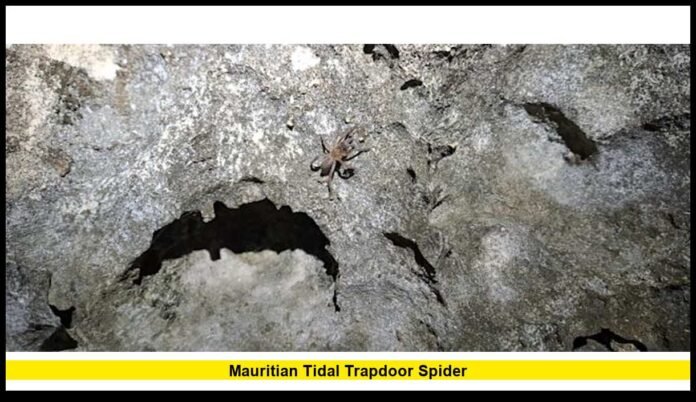

The Mauritian tidal trapdoor spider has attracted scientific interest because of its unusual ability to inhabit coastal rock formations exposed to changing tides and powerful waves. Identified as Idioctis marevallum, this distinctive spider was first discovered in 2023 and formally described as a new species in 2026. Its discovery highlights the remarkable biodiversity of Mauritius and shows how specialized wildlife can remain unnoticed in habitats that receive little attention during conventional surveys.
Unlike many spiders that build retreats in soil, this species occupies natural cavities in coastal bedrock. It seals its shelter with a camouflaged trapdoor, creating an unusual refuge in the intertidal zone, where seawater regularly covers exposed surfaces.
A New Species With an Unusual Lifestyle
The scientific description of Idioctis marevallum established its identity as a member of the family Barychelidae. This family includes trapdoor spiders that use silk-lined retreats to shelter from environmental conditions and wait for opportunities to capture prey.
What distinguishes this Mauritian species is its close association with the shoreline. Its habitat places it in a challenging environment where exposure to seawater, changing moisture levels, and wave action can influence survival.
The discovery also highlights the importance of examining small, overlooked habitats. A narrow opening in coastal rock may appear insignificant, yet it can shelter an animal with highly specialized environmental requirements.
Scientists now have a formal name for this spider and a foundation for investigating its biology, distribution, and conservation needs.
Where Scientists Found the Spider
Researchers first encountered the species on Ilot Vacoas, a small island off the southeastern coast of Mauritius. The discovery occurred in 2023 during a wildlife survey connected with conservation work on the island.
The team later confirmed the spider’s presence on Ile aux Fouquets, another nearby island. These records establish two locations where the species occurs, although they do not necessarily represent its entire natural range.
Both locations provide the coastal rock habitat associated with the spider. Instead of excavating a traditional underground burrow, it occupies narrow tubes already present within the bedrock.
Researchers believe these cavities formed through the activity of other marine organisms, including worms and molluscs, over long periods. The spider takes advantage of these existing structures to create a protected retreat.
This unusual habitat makes targeted coastal surveys particularly valuable. Searches focused only on forest floors, leaf litter, or ordinary soil burrows could overlook a species living within rocky shorelines.
How Its Trapdoor Works
The spider’s retreat features a small door constructed from silk, sand, and algae. These materials help the entrance blend into the surrounding rock, making the shelter difficult to distinguish from nearby surfaces.
Camouflage is a familiar survival strategy among spiders, but the setting gives this adaptation particular significance. The entrance sits within a landscape constantly reshaped by waves, water movement, and changing tidal levels.
The rock cavity provides the basic shelter, while the trapdoor covers its opening. Together, these features form the defining structure of the spider’s retreat.
Scientists have documented this arrangement, but important questions remain about the shelter’s precise performance during prolonged submersion. Further observations are needed to establish how the spider manages oxygen availability, water exposure, and other physiological challenges associated with its habitat.
What Makes the Intertidal Zone Challenging?
The intertidal zone lies between the high-tide and low-tide marks. Depending on the location and conditions, coastal surfaces may remain exposed for hours before seawater returns.
Animals living in this environment must cope with repeated changes in temperature, moisture, water movement, and exposure. Strong waves can also affect the physical structures that provide shelter.
For a spider, these conditions differ considerably from those experienced by species living in relatively stable terrestrial habitats.
The presence of Idioctis marevallum in this environment raises important questions about its ecological adaptations. Researchers will need to determine how its behavior changes across tidal cycles and whether the spiders emerge at particular times to feed or perform other activities.
The discovery confirms the species’ association with this distinctive habitat. It does not yet answer every question about how the animal withstands the conditions there.
How the Discovery Changed Scientific Understanding
The identification process required more than recognizing an unusual spider in the field. Scientists needed to compare the specimens with known species and determine whether they represented an animal that had already been described.
Researchers initially considered a possible connection with Tigidia mauriciana, a species described in 1892. Detailed examination ultimately established that the newly collected specimens belonged to a distinct species.
The formal name, Idioctis marevallum, reflects the animal’s relationship with its coastal surroundings. The Latin elements refer to the sea and a wall or defensive barrier, evoking the rocky environment in which the spider shelters.
The discovery also formed part of broader research into the Mauritian archipelago’s spider diversity. The same study reported 14 spider species not previously recorded in the archipelago, increasing the known spider diversity by approximately 27.45 percent.
That figure concerns the study’s overall findings, rather than the new trapdoor spider alone. Together, the records demonstrate how targeted research can reveal species that routine wildlife observations may miss.
What Is Known About Its Diet and Behavior?
The species’ precise diet remains insufficiently documented. Trapdoor spiders commonly use their retreats as protected bases from which they can capture small animals, but researchers have not established a complete list of prey for Idioctis marevallum.
Its coastal setting makes this an especially interesting research question. The intertidal zone supports a variety of small invertebrates, and their availability may change with water levels and local conditions.
Scientists also need more information about the spider’s daily activity, reproductive cycle, growth, and lifespan. These details would help explain how it survives in a specialized habitat and how its population responds to environmental changes.
Until direct observations provide clearer answers, its hunting patterns and dietary preferences should not be treated as confirmed facts.
Conservation Questions Remain
The discovery establishes the spider’s identity, but it does not automatically determine its conservation status. A reliable assessment requires information about population size, geographic distribution, population trends, and potential threats.
The two confirmed island locations provide an important starting point for additional surveys. Researchers could examine similar coastal formations elsewhere in Mauritius to determine whether other populations exist.
Habitat monitoring would also help establish whether the spider’s rocky retreats remain suitable over time. Changes to shorelines, coastal development, pollution, and other environmental pressures may warrant investigation, although the specific effects on this species have not been established.
No verified population estimate or formal IUCN Red List category is established in the discovery information discussed here. Therefore, describing the species as endangered or claiming that its population is declining would go beyond the available evidence.
Why Mauritius Matters for Spider Research
Mauritius is known for its distinctive island wildlife, but its biodiversity extends beyond familiar birds, reptiles, and other highly visible animals. Small invertebrates can occupy narrow ecological niches that require specialized survey methods.
The newly described spider illustrates this point. Its habitat is not a conventional forest floor or garden, but a coastal rock formation that alternates between exposure to air and seawater.
Studying such animals helps scientists understand how species occupy different ecological environments. It also gives conservation teams a clearer picture of the wildlife supported by natural coastal formations.
The findings reinforce the value of field research, careful species identification, and continued monitoring of less-studied habitats.
What Researchers Need to Investigate Next
Future research can address several priorities:
- Distribution surveys: Determine whether the spider occurs beyond its two confirmed island locations.
- Population assessments: Estimate how many individuals occupy suitable coastal habitats.
- Behavioral studies: Document feeding, reproduction, and activity throughout the tidal cycle.
- Habitat research: Examine the characteristics of rock cavities used for shelter.
- Conservation monitoring: Identify potential threats and assess whether populations change over time.
These investigations would move the scientific understanding of the species beyond its initial description. They could also help establish whether targeted conservation measures are necessary.
For now, Idioctis marevallum represents a compelling example of how much remains to be learned about island biodiversity. Its specialized shelter and coastal setting make it a valuable subject for continued research.
Conclusion
The discovery of this unusual Mauritian spider offers a fresh perspective on the wildlife living along the island nation’s rocky shores. Its natural rock retreats, camouflaged trapdoor, and intertidal habitat distinguish it from many familiar spiders. Although researchers still need to establish its population size, complete distribution, and conservation status, the species has already demonstrated the importance of investigating overlooked coastal environments.
What interests you most about this remarkable coastal spider? Share your thoughts in the comments and follow the latest developments in wildlife discovery.