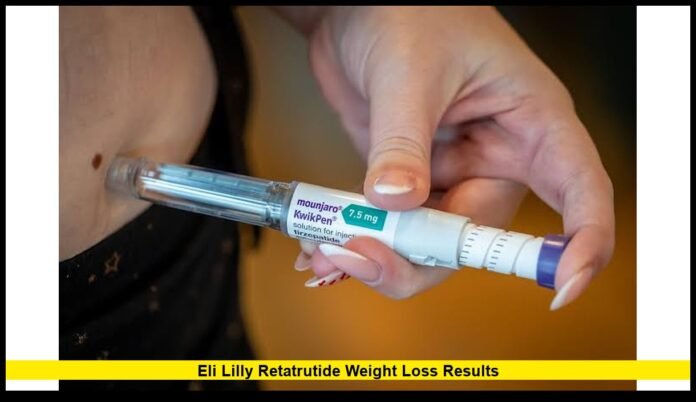

Eli Lilly retatrutide weight loss results have attracted significant attention after several Phase 3 clinical trials reported substantial weight reductions in adults with obesity and related health conditions. The latest findings show that participants receiving the highest studied doses lost an average of up to 28.3% of their body weight over 80 weeks in the TRIUMPH-1 trial. Additional results from trials involving people with type 2 diabetes and cardiovascular disease have also demonstrated meaningful weight loss.
Retatrutide is an investigational medication developed by Eli Lilly and Company. It works by activating three hormone receptors involved in appetite regulation, glucose metabolism, and energy balance. Researchers are studying whether this approach can produce substantial, sustained weight reduction while improving other measures of metabolic health.
The most important point for U.S. readers is that retatrutide remains investigational and is not FDA-approved for routine use. Its clinical trial results are encouraging, but researchers and regulators must continue evaluating its safety, effectiveness, and appropriate use before it can become an approved treatment.
The latest published research provides a clearer picture of how much weight participants lost, how results differed among trial populations, which side effects researchers observed, and what comes next in Eli Lilly’s development program.
Latest Eli Lilly Retatrutide Weight Loss Results
Eli Lilly has reported positive results from multiple Phase 3 trials in its TRIUMPH clinical development program. These studies evaluate retatrutide in adults with obesity or overweight, including people with type 2 diabetes, severe obesity, cardiovascular disease, and other weight-related complications.
The findings differ depending on participants’ health conditions, the dose they received, and the length of treatment. Therefore, the highest percentage reported in one trial should not be treated as the expected result for every patient.
The following table summarizes the major published findings available as of October 28, 2026.
| Clinical trial | Population studied | Reported weight-loss result |
|---|---|---|
| TRIUMPH-1 | Adults with obesity or overweight and at least one weight-related condition, without diabetes | Up to 28.3% average weight loss at 80 weeks |
| TRIUMPH-1 extension | Selected participants with a starting BMI of at least 35 who continued treatment | Up to 30.3% average weight loss at 104 weeks |
| TRIUMPH-2 | Adults with obesity or overweight and type 2 diabetes | Up to 20.8% average weight loss at 80 weeks |
| TRIUMPH-3 | Adults with severe obesity and established cardiovascular disease, with or without type 2 diabetes | Up to 22.6% average weight loss at 80 weeks |
These figures come from different study populations and analyses. The 104-week extension result applies to a selected subgroup, not everyone enrolled in TRIUMPH-1.
The results also represent averages across groups of trial participants. Individual weight changes varied, and the studies do not establish that every person taking retatrutide will lose a similar percentage of body weight.
New Retatrutide Results: Comparison With Ozempic
The latest update on October 28, 2026, adds another important finding to the discussion about retatrutide. Eli Lilly announced results from TRANSCEND-T2D-2, a Phase 3 trial that compared retatrutide with semaglutide, the active ingredient in Ozempic, in adults with type 2 diabetes.
At 80 weeks, participants receiving retatrutide achieved greater average weight loss and larger reductions in A1C than participants receiving the studied 2 mg dose of Ozempic.
| Treatment group | Average weight loss at 80 weeks | Average A1C reduction |
|---|---|---|
| Retatrutide 9 mg | 19.5% (44.3 pounds) | 2.2 percentage points |
| Retatrutide 12 mg | 20.9% (47.4 pounds) | 2.2 percentage points |
| Ozempic 2 mg | 9.4% (20.9 pounds) | 1.8 percentage points |
The study participants had an average starting weight of 225.8 pounds and an average BMI of 36.8.
These findings are particularly relevant because people with type 2 diabetes often experience different weight-loss outcomes from people with obesity who do not have diabetes. The comparison also provides evidence from a direct clinical trial rather than relying on separate studies with different participants.
However, retatrutide is not an approved replacement for Ozempic. The findings do not establish that every patient would achieve the same results, and they do not eliminate the need for regulatory review, individual medical assessment, or further evaluation of long-term safety.
The comparison also applies specifically to the doses and population studied. It should not be generalized to every semaglutide product, dose, or patient group.
What Is Retatrutide and How Does It Work?
Retatrutide, also known by its development code LY3437943, is an investigational medication designed to activate three hormone receptors:
- GIP receptors: Involved in nutrient-related signaling and the regulation of insulin secretion.
- GLP-1 receptors: Help regulate blood glucose and influence appetite and food intake.
- Glucagon receptors: Participate in glucose regulation and energy metabolism.
Scientists call retatrutide a triple hormone receptor agonist because one molecule activates all three receptor systems.
This mechanism distinguishes it from medicines that target only one or two of these pathways. Researchers are investigating whether the combined activity can produce substantial weight reduction and improve related metabolic measures.
In clinical trials, participants receive retatrutide as a once-weekly injection under a research protocol. Investigators evaluate its effects over extended periods, monitoring changes in body weight, blood glucose, waist circumference, and other health measures.
The medication’s three-receptor activity offers a scientific explanation for why researchers are studying it as a potential obesity treatment. Nevertheless, the mechanism alone cannot establish how safe or effective it will be in routine medical practice.
Retatrutide is still an investigational medicine, not an FDA-approved weight-loss drug. Its clinical results should therefore be understood as evidence from research rather than a guarantee of treatment outcomes.
TRIUMPH-1: Up to 28.3% Average Weight Loss
TRIUMPH-1 is one of the most closely watched studies in Eli Lilly’s retatrutide development program. The Phase 3 trial evaluated adults with obesity or overweight and at least one weight-related health condition, excluding people with diabetes.
Lilly announced positive topline results on May 21, 2026. Detailed findings were subsequently published in The New England Journal of Medicine on September 29, 2026.
At 80 weeks, the study reported the following average weight changes:
| Treatment | Average weight change |
|---|---|
| Retatrutide 4 mg | −19.0% |
| Retatrutide 9 mg | −25.9% |
| Retatrutide 12 mg | −28.3% |
| Placebo | −2.2% |
The highest studied dose produced the largest average reduction. Participants taking 12 mg lost an average of 70.3 pounds over 80 weeks, according to the reported trial results.
Participants receiving 9 mg lost an average of 64.4 pounds, while the 4 mg group lost an average of 47.2 pounds.
These figures demonstrate a dose-related pattern in average weight reduction within this study. They do not mean that increasing a dose independently or using a higher dose outside a supervised clinical trial would be safe.
How many participants lost at least 30% of their weight?
One particularly notable finding involved the proportion of participants who achieved very large reductions.
In the 12 mg group, 45.3% of participants achieved weight loss of at least 30% at 80 weeks. This result attracted attention because weight reductions of that magnitude are often associated with substantial changes in body size and health.
The study also found that 65.3% of participants taking the 12 mg dose reached a BMI below 30. That threshold falls below the standard BMI category for obesity in adults.
BMI is a screening measure based on height and weight. It does not independently establish a person’s overall health or determine whether treatment is appropriate.
What happened after 80 weeks?
Lilly also reported an extension analysis involving selected participants whose starting BMI was at least 35.
Those who continued taking the 12 mg dose achieved an average weight reduction of up to 30.3%, or 85 pounds, at 104 weeks.
This extension finding suggests that weight reduction continued in this selected group beyond the original 80-week assessment. It should not be interpreted as proof that everyone will continue losing weight at the same rate or that the same outcome will occur over longer periods.
The extension results also do not establish how much weight participants might regain after stopping treatment. That question requires evidence from appropriately designed follow-up studies.
TRIUMPH-2: Retatrutide Results in People With Type 2 Diabetes
Weight management can be particularly challenging for people who have obesity alongside type 2 diabetes. TRIUMPH-2 specifically evaluated retatrutide in adults with type 2 diabetes and obesity or overweight.
Lilly announced topline results on July 23, 2026, and published detailed findings on September 29, 2026.
At 80 weeks, average weight reductions were:
| Retatrutide dose | Average weight loss | Average reduction in pounds |
|---|---|---|
| 4 mg | 12.7% | 29.8 pounds |
| 9 mg | 19.1% | 45.4 pounds |
| 12 mg | 20.8% | 49.6 pounds |
| Placebo | 4.0% | Not specified here |
The 12 mg group achieved an average reduction of 49.6 pounds, equivalent to 20.8% of baseline body weight.
Although that result was lower than the 28.3% reported in TRIUMPH-1, the two trials studied different populations. People with type 2 diabetes may experience different average weight changes from participants without diabetes.
The results therefore should not be treated as a direct comparison of how well the medication works in the two groups.
Improvements in blood sugar control
TRIUMPH-2 also examined glycated hemoglobin, commonly known as A1C. This blood test reflects average blood glucose levels over approximately two to three months.
Participants receiving retatrutide experienced A1C reductions of up to an average of 1.6 percentage points.
In the highest-dose group, up to 40% of participants achieved an A1C below 5.7%, a level within the normal range for this laboratory measure.
These findings are relevant because obesity and type 2 diabetes frequently occur together. However, an A1C below 5.7% during treatment does not automatically establish that a person has been cured of diabetes or no longer needs medical monitoring.
Retatrutide remains investigational, and patients should not change prescribed diabetes medications based on these trial results.
TRIUMPH-3: Weight Loss in Adults With Severe Obesity and Cardiovascular Disease
TRIUMPH-3 evaluated retatrutide in adults with severe obesity and established cardiovascular disease, with or without type 2 diabetes. This trial focused on a population with significant health risks associated with excess body weight.
Eli Lilly announced positive topline findings on July 23, 2026. The 80-week results showed substantial average weight reductions in both active-treatment groups.
| Treatment | Average weight loss at 80 weeks |
|---|---|
| Retatrutide 9 mg | 21.6% |
| Retatrutide 12 mg | 22.6% |
| Placebo | 3.2% |
Participants receiving the 12 mg dose lost an average of 55.8 pounds, compared with 52.7 pounds among those receiving 9 mg.
The highest dose also improved several cardiovascular risk factors. Lilly reported average reductions in triglycerides, non-HDL cholesterol, systolic blood pressure, waist circumference, and high-sensitivity C-reactive protein.
These measures can help clinicians assess cardiometabolic health, but changes in risk factors do not automatically establish that a medication prevents heart attacks, strokes, or cardiovascular deaths. Those outcomes require appropriate evidence from clinical studies.
TRIUMPH-3 therefore adds important information about retatrutide in people with severe obesity and cardiovascular disease. It does not yet establish that the medication is an approved treatment for preventing cardiovascular events.
TRIUMPH-4: Results for Obesity and Knee Osteoarthritis
TRIUMPH-4 examined retatrutide in people with obesity and knee osteoarthritis, a condition that can cause pain and make physical activity difficult.
In December 2025, Lilly announced positive topline results from this Phase 3 trial. The primary assessment took place at 68 weeks.
The reported average weight reductions were:
- Retatrutide 9 mg: 26.4%.
- Retatrutide 12 mg: 28.7%.
- Placebo: 2.1%.
Participants taking the 12 mg dose lost an average of approximately 71 pounds.
The trial also assessed knee pain using the Western Ontario and McMaster Universities Osteoarthritis Index, commonly called WOMAC. Lilly reported substantial improvements in pain scores among participants receiving retatrutide.
These findings may be relevant to people whose excess weight places additional stress on their knees. However, weight loss and pain improvement are separate outcomes, and the results do not establish that retatrutide can reverse osteoarthritis or repair damaged joints.
The TRIUMPH-4 findings also demonstrate why the highest reported weight-loss figure varies across studies. Its 28.7% result was measured at 68 weeks in a specific population, while TRIUMPH-1 reported 28.3% at 80 weeks in a different population and under a different study protocol.
Those percentages should not be ranked as though the trials were identical experiments.
How Much Weight Did Retatrutide Produce in Earlier Research?
Before Phase 3 testing, researchers evaluated retatrutide in a Phase 2 trial published in The New England Journal of Medicine in June 2023.
The study included 338 adults with obesity or overweight and at least one weight-related condition. Participants received different doses of retatrutide or a placebo for 48 weeks.
At the end of treatment, the researchers reported the following average weight changes:
| Dose group | Average weight loss at 48 weeks |
|---|---|
| Retatrutide 1 mg | 8.7% |
| Retatrutide 4 mg | 17.1% |
| Retatrutide 8 mg | 22.8% |
| Retatrutide 12 mg | 24.2% |
| Placebo | 2.1% |
The results showed that the highest studied dose produced an average reduction of 24.2% over 48 weeks.
The researchers also found that participants continued losing weight throughout the treatment period. The study’s weight-loss trajectory suggested that participants had not reached a clear plateau by week 48.
However, the Phase 2 trial was smaller and shorter than the later Phase 3 studies. Its results helped researchers decide to pursue larger trials, but the findings alone could not establish the medication’s long-term safety or effectiveness.
The subsequent Phase 3 program provided additional evidence from larger populations and longer treatment periods.
What Side Effects Have Researchers Reported?
Strong weight-loss results do not remove the need to examine safety. Retatrutide’s clinical trials have reported adverse events, particularly those affecting the digestive system.
The most frequently reported side effects across several studies include:
- Nausea
- Diarrhea
- Constipation
- Vomiting
- Decreased appetite
- Dysesthesia, an abnormal sensation such as tingling or burning
The frequency of these events varies by study, dose, and patient population. Some participants discontinued treatment because of adverse effects.
In TRIUMPH-1, nausea occurred in approximately 42% of participants receiving 12 mg, compared with 15% receiving placebo. Diarrhea occurred in approximately 32% of the 12 mg group, compared with 13% in the placebo group.
The trial also reported dysesthesia in some participants. This finding is important because abnormal skin sensations can affect comfort and quality of life, even when events are generally mild or resolve during treatment.
In TRANSCEND-T2D-2, which compared retatrutide with Ozempic 2 mg, gastrointestinal symptoms were also common. The reported incidence of nausea was 21.2% with retatrutide 9 mg and 23.8% with 12 mg, compared with 21.3% with Ozempic.
Treatment discontinuation due to adverse events occurred in 4.8% of participants receiving retatrutide 9 mg and 7.9% receiving 12 mg, compared with 2.7% receiving Ozempic.
These figures show why effectiveness and tolerability must be evaluated together. A treatment that produces substantial weight loss still needs an acceptable safety profile for its intended use.
Retatrutide’s full long-term safety profile remains under investigation. Clinical trials cannot identify every possible risk, especially uncommon events or problems that emerge after longer exposure.
People should not attempt to reproduce trial dosing schedules or obtain unapproved retatrutide products for personal use.
When Could Retatrutide Become Available in the United States?
As of October 28, 2026, retatrutide is not FDA-approved and is not legally available as a routine prescription medicine.
Eli Lilly has reported positive results across multiple Phase 3 studies and has stated that it plans to submit a Biologics License Application to the U.S. Food and Drug Administration in the first quarter of 2027 for potential indications related to obesity, knee osteoarthritis pain, and obstructive sleep apnea.
The planned submission is an important development milestone, but it is not the same as FDA approval.
The FDA must review the application and determine whether the evidence supports the proposed use. The review can involve assessments of effectiveness, safety, manufacturing quality, and other regulatory requirements.
A planned submission date also does not guarantee that the application will be filed on schedule or that approval will follow within a particular period.
The type 2 diabetes development program has its own clinical and regulatory considerations. Results from TRANSCEND-T2D-2 add evidence for that population, but they do not independently establish an approved indication.
Can Americans buy retatrutide online?
Consumers should be cautious about websites, social media posts, or sellers advertising retatrutide for personal use.
Because the drug remains investigational, products advertised as retatrutide for human use are not FDA-approved medicines. Their identity, purity, strength, storage conditions, and safety may be uncertain.
A product label or online claim does not establish that a vial contains the compound used in Lilly’s clinical trials. Consumers also cannot assume that a product sold as a research chemical is suitable for injection.
The safest approach is to avoid unapproved retatrutide products and discuss currently approved treatment options with a qualified health care professional.
What the Latest Retatrutide Results Mean for Weight Loss
The growing body of evidence suggests that retatrutide could become an important future option for treating obesity if regulators approve it. Results from TRIUMPH-1, TRIUMPH-2, TRIUMPH-3, and TRIUMPH-4 show substantial average weight reductions across several patient populations.
The October 28, 2026, announcement from TRANSCEND-T2D-2 also adds a direct comparison with Ozempic in adults with type 2 diabetes. Participants receiving retatrutide lost more than twice as much weight on average as those receiving the studied 2 mg dose of Ozempic over 80 weeks.
Nevertheless, the findings require careful interpretation. Clinical trial averages do not predict an individual’s exact response, and results from different studies are not always directly comparable.
Researchers must also continue assessing long-term safety, the durability of weight loss, and the benefits and risks for different patient groups.
For people in the United States considering medical treatment for obesity, currently approved options remain the practical starting point for a discussion with a health care professional.
The bottom line: Eli Lilly’s retatrutide weight loss results are promising, but the medication remains investigational, and FDA review will be essential before it can become an approved treatment.
Frequently Asked Questions
1. How much weight can you lose with Eli Lilly’s retatrutide?
In TRIUMPH-1, participants receiving the 12 mg dose lost an average of 28.3% of their body weight over 80 weeks. In TRIUMPH-2, participants with type 2 diabetes lost an average of 20.8% over the same period. Actual results varied by study population and treatment group.
2. What is the latest Eli Lilly retatrutide weight loss update?
On October 28, 2026, Eli Lilly announced Phase 3 results from TRANSCEND-T2D-2. At 80 weeks, participants lost an average of 19.5% with retatrutide 9 mg and 20.9% with 12 mg, compared with 9.4% with Ozempic 2 mg.
3. Is retatrutide FDA-approved?
No. As of October 28, 2026, retatrutide remains investigational and has not received FDA approval for routine medical use.
4. When will retatrutide be available in the United States?
Eli Lilly has planned to submit a Biologics License Application for retatrutide in the first quarter of 2027 for potential obesity-related indications. Availability will depend on regulatory review and any subsequent approval. No confirmed commercial launch date has been established.
5. How does retatrutide work?
Retatrutide activates GIP, GLP-1, and glucagon receptors. These pathways influence appetite, glucose regulation, and energy metabolism. Researchers are studying how their combined activity affects weight loss and metabolic health.
6. What are the most common retatrutide side effects?
Reported side effects include nausea, diarrhea, constipation, vomiting, decreased appetite, and dysesthesia. Their frequency varies across studies and doses. Researchers continue evaluating the medication’s safety.
7. Did retatrutide produce more weight loss than Ozempic?
In the Phase 3 TRANSCEND-T2D-2 trial, retatrutide produced greater average weight loss than Ozempic 2 mg over 80 weeks. The results were 19.5% with retatrutide 9 mg, 20.9% with 12 mg, and 9.4% with Ozempic. These findings apply to the specific population and treatment regimens studied.
8. Is retatrutide more effective for people with diabetes or without diabetes?
TRIUMPH-1 reported greater average weight loss than TRIUMPH-2, but the studies enrolled different populations and used different trial protocols. Their results do not establish that one group universally responds better. A direct comparison would require an appropriately designed study.
9. Can retatrutide cause 30% weight loss?
In TRIUMPH-1, 45.3% of participants receiving the 12 mg dose achieved at least 30% weight loss by week 80. A selected subgroup with a baseline BMI of at least 35 achieved an average reduction of up to 30.3% at week 104. These findings do not guarantee that an individual will achieve the same result.
10. Can you buy retatrutide online?
Retatrutide is not an FDA-approved medicine and is not legally available as a routine prescription treatment. Products advertised online for human use may have uncertain ingredients, purity, or strength. Consumers should avoid unapproved products and consult a qualified health care professional about available treatments.
Stay informed about the latest Eli Lilly retatrutide weight loss results, and share your thoughts in the comments as new clinical evidence and regulatory updates emerge.