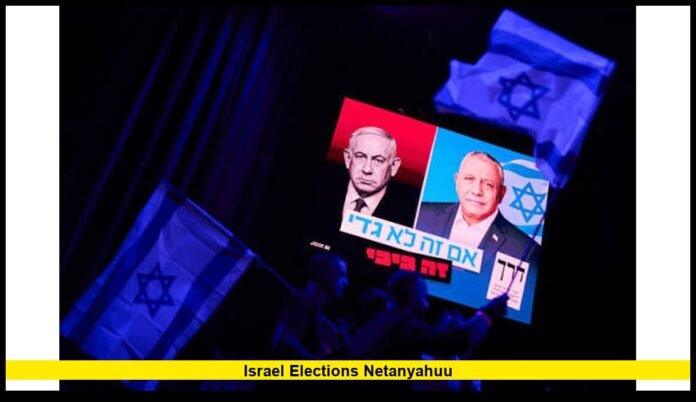

The Israel elections Netanyahu contest has placed Prime Minister Benjamin Netanyahu’s political future at the center of a closely watched parliamentary battle, with preliminary exit polls from the October 27, 2026, election indicating that neither major political camp has secured a clear majority. The projections point to difficult negotiations in the 120-member Knesset, where a candidate generally needs support from at least 61 lawmakers to form a government.
Netanyahu’s Likud party remains a major force in Israeli politics, but its individual performance does not automatically guarantee another term. The broader balance between right-wing, religious, centrist, left-wing, and Arab-led parties will determine whether the incumbent prime minister can retain power or whether opposition leaders can assemble an alternative government.
Gadi Eisenkot, a former chief of staff of the Israel Defense Forces and leader of the Yashar party, has emerged as an important opposition figure. His prospects depend on whether parties seeking political change can overcome their differences and agree on a common governing arrangement.
The election comes after years of security concerns, regional conflict, and intense domestic debate. The Hamas-led attack of October 7, 2023, the government’s handling of the subsequent war, military service exemptions, judicial reform, and the cost of living have all influenced the wider political environment.
The immediate question is no longer simply which party received the most votes. It is whether Netanyahu’s allies can secure enough parliamentary support to govern, or whether the opposition can turn its combined strength into a viable coalition.
Israel Election Results: Understanding the Latest Projections
The first exit polls released after voting closed on October 27 showed a closely divided political landscape. Different Israeli broadcasters produced different estimates, reflecting uncertainty about how voters’ choices would translate into seats.
Kan 11, Channel 12, and Channel 13 projected that Netanyahu’s bloc would fall short of a majority. Channel 14 presented a more favorable estimate for the incumbent’s political allies, although its projection also placed the bloc close to, rather than securely above, the threshold required to govern.
The preliminary figures highlighted how narrow the contest could become.
| Broadcaster | Netanyahu’s bloc | Opposition bloc | Arab-led parties |
|---|---|---|---|
| Kan 11 | 50 | 53 | 17 |
| Channel 12 | 50 | 52 | 18 |
| Channel 13 | 50 | 53 | 17 |
| Channel 14 | 60 | 43 | 17 |
These figures are preliminary estimates rather than official results. Exit polls can differ from the final vote count, and the way political blocs are defined can also affect comparisons between broadcasters.
The projections suggest that Netanyahu could face difficulty rebuilding the governing coalition that has supported him. The opposition, meanwhile, may have a numerical opportunity to challenge him, but a collection of parties does not automatically constitute a functioning government.
The final distribution of seats will determine how much negotiating power each party holds. Even a small change in the allocation could affect whether a political alliance can reach the required majority.
Likud’s expected position as a leading party gives Netanyahu a strong starting point. However, he must persuade other parties to support his candidacy and accept the terms of a coalition agreement.
Opposition leaders face the same challenge in reverse. They must identify a candidate, agree on key policies, and obtain enough parliamentary support to replace the incumbent administration.
Why Netanyahu’s Leadership Is Under Scrutiny
Netanyahu remains one of Israel’s most experienced and influential political figures. His supporters have emphasized his record in security and diplomacy, arguing that his experience matters during a period of regional uncertainty.
His opponents have questioned whether that experience is sufficient to justify another term. The October 7, 2023, attack became a defining event in the debate over the government’s security performance and responsibility.
The assault exposed serious failures in Israel’s security preparedness. In the years since, questions about accountability, intelligence, military planning, and government decision-making have remained important in public discussion.
The subsequent war also created difficult choices involving military objectives, the safety of Israeli communities, hostage negotiations, and relations with international partners. These issues have placed pressure on the government and intensified disagreement over the country’s direction.
For Netanyahu, the election represents a test of whether voters still trust him to manage these challenges. His supporters may see continuity as an advantage, while critics may view a change of government as necessary to restore confidence.
The election outcome should not be treated as a simple referendum on a single issue. Voters have different priorities, and their choices reflect a combination of security concerns, political loyalties, economic pressures, religious values, and views about democratic institutions.
Even if the final results show a weaker position for Netanyahu’s bloc, his political future will depend on negotiations rather than the exit polls alone.
Gadi Eisenkot and the Opposition’s Opportunity
Gadi Eisenkot has become a significant figure in the effort to build an alternative to Netanyahu’s government. His background as a former military chief gives him experience in national security, while his political platform seeks to appeal to voters who want changes in leadership and governance.
Eisenkot has emphasized national unity and a different approach to government responsibility. He has also placed military service obligations among the issues requiring attention.
His challenge is to turn opposition sentiment into a workable parliamentary majority. That requires cooperation among parties that may agree on replacing Netanyahu but disagree about other important questions.
Centrist and left-leaning parties can differ on security policy, constitutional reform, religious affairs, economic priorities, and relations with Arab-led lawmakers. These differences may become more difficult to manage when parties begin negotiating over cabinet positions and legislation.
A coalition agreement must offer enough common ground for its members to work together. It must also establish a practical approach to government budgets, national security, public services, and the other responsibilities of the state.
Eisenkot’s political prospects will become clearer once the final seat distribution is known. If opposition parties have enough seats collectively, their willingness to compromise could determine whether Netanyahu faces a serious transfer of power.
However, an opposition lead in exit polls does not itself establish that Eisenkot will become prime minister. The parliamentary process allows for negotiations, competing candidacies, and changes in political alignments.
How Israel’s Parliamentary System Determines the Winner
Israel uses proportional representation to elect members of the Knesset. Voters choose party lists, and parliamentary seats are allocated according to each qualifying party’s share of the vote.
The Knesset has 120 members, and a government generally needs the support of at least 61 lawmakers to command a majority. Since individual parties rarely win enough seats to govern alone, coalition agreements are a central feature of Israeli politics.
A coalition brings together parties that agree to support a government, even if they retain different positions on particular issues. These agreements may cover ministerial appointments, legislative priorities, public spending, religious policy, and security decisions.
The arrangement gives smaller parties an important role when the larger political camps are closely balanced. A party with only a few seats can become decisive if its support pushes a candidate above the majority threshold.
That is why the largest party does not automatically win the right to govern. Netanyahu may lead Likud to a strong result and still struggle to find enough partners. Likewise, opposition parties may collectively win more seats but fail to agree on a prime minister or common program.
The final result will therefore be determined by both electoral arithmetic and political negotiation.
Arab-Led Parties Could Influence Coalition Negotiations
Arab-led parties could hold considerable influence if the final results leave both major camps short of a majority. Early exit-poll estimates placed their combined representation at approximately 17 or 18 seats, although the final allocation may differ.
Their political priorities vary, so these parties should not be treated as a single group with one position on every question. They may differ over security, relations with Palestinians, social policy, economic development, and participation in a national government.
For opposition leaders, cooperation with Arab-led lawmakers could provide a route to a parliamentary majority. However, that option can create political difficulties for other parties whose voters or leaders oppose such an arrangement.
Support does not necessarily require every party to join a cabinet. In some circumstances, lawmakers may support a government from outside the coalition or cooperate on selected parliamentary votes.
Such arrangements require careful negotiation. The parties involved must decide whether they can support the government’s priorities while maintaining their own political commitments.
For Netanyahu, the strength of Arab-led parties could complicate efforts to secure a majority if his established allies cannot provide enough seats. For the opposition, their representation may create an opportunity, but one that depends on whether potential partners are willing to cooperate.
Their eventual role will depend on the final count and the positions adopted by party leaders after the election.
Military Service and Religious Politics Remain Key Issues
Military service exemptions for ultra-Orthodox Jewish men have become one of Israel’s most contentious domestic policy questions. The debate centers on fairness, religious freedom, and the military’s need for personnel during a prolonged period of security pressure.
Many Israelis who serve in the armed forces, including reservists, have faced extended demands on their time and family lives. Critics of broad exemptions argue that military obligations should be shared more equally across society.
Religious parties have traditionally played an important role in Netanyahu’s coalitions. Their support has often depended on protecting the interests of ultra-Orthodox communities, including their position on military service and religious education.
This creates a difficult choice for any prime minister who depends on these parties. Changes to exemption arrangements could satisfy voters seeking broader conscription, but they could also threaten the stability of a coalition.
Eisenkot and other opposition figures have emphasized the need to reconsider existing arrangements. Their proposals could appeal to voters who believe the current system places an unequal burden on those serving in the military.
Nevertheless, any reform would require negotiations over legislation, enforcement, and the practical needs of the armed forces. A new government would have to balance competing political demands with the country’s defense requirements.
The election results could influence how much leverage religious parties retain. If their seats prove essential to forming a majority, they may continue to exert substantial influence over military service policy.
Judicial Reform and Democratic Accountability
The debate over judicial reform has contributed to Israel’s political divisions for several years. At its core, the dispute concerns the relationship between elected officials and the judiciary, including the courts’ authority to review government decisions.
Supporters of judicial changes have argued that elected representatives should have greater influence over the legal system. Opponents have warned that weakening judicial oversight could reduce checks on government power and threaten institutional independence.
The disagreement has prompted protests and generated debate about the structure of Israeli democracy. It has also affected public confidence in political institutions.
Netanyahu’s government has been closely associated with the judicial reform agenda, making the issue a significant point of criticism from opposition parties. Those seeking a change of government have argued for a different approach to institutional accountability and political decision-making.
A new administration would need to determine whether to pursue further reforms, reconsider existing proposals, or seek compromise between competing positions.
Its ability to act would depend on the coalition agreement and the number of lawmakers willing to support legislation. A government with a narrow majority could find it difficult to implement controversial changes without risking internal disagreements.
Judicial reform is therefore likely to remain part of the broader political negotiations, although the precise direction of future policy cannot be determined from exit polls alone.
Economic Concerns Add Pressure on the Next Government
Economic conditions also matter to voters deciding whether to support Netanyahu or an alternative leadership team. Household expenses, housing costs, employment, taxes, and the availability of public services influence how people assess government performance.
Prolonged military conflict can create additional economic pressures. Defense spending may rise, businesses can experience disruptions, and reservists may face difficulties balancing military duties with their jobs and family responsibilities.
The effects vary across industries and communities, but the overall challenge is significant for a government managing both security demands and domestic priorities.
Coalition negotiations can shape economic policy because parties often seek commitments on spending, social programs, education, and support for their constituencies.
An incoming government would have to decide how to balance these demands against the costs of national defense and other public responsibilities. It would also need to consider the implications of its budget decisions for households and businesses.
Netanyahu’s supporters may argue that continuity provides a more predictable approach to economic management. His opponents may contend that a different government could improve accountability and reconsider spending priorities.
The election itself does not establish which economic policies will change. Those decisions will depend on the coalition that emerges and the legislation it can pass.
What Happens After Israel’s Election?
The process of forming a government continues after election officials establish the parliamentary seat distribution. Even when the final results identify the largest party, the political outcome may remain uncertain.
President Isaac Herzog plays an important role in the process. After consulting representatives of the elected parties, the president assigns the task of forming a government to the lawmaker considered most likely to succeed.
The designated candidate must then negotiate with potential coalition partners. These discussions can involve cabinet appointments, policy commitments, legislative priorities, and agreements on how the government will operate.
Under Israel’s government formation procedures, the candidate generally receives 28 days to complete the task, with a possible extension of up to 14 days. If the candidate cannot form a government, another lawmaker may receive an opportunity under the applicable rules.
This process means that Netanyahu could remain a contender even if the final results show his bloc falling short of a majority. He could negotiate with other parties, while opposition leaders pursue their own arrangements.
Likewise, an opposition bloc with more projected seats would still need to agree on a candidate and secure enough support to govern effectively.
If coalition negotiations fail, Israel could face another election. However, that outcome is only one possible scenario and cannot be established from preliminary projections.
Why the Election Matters to the United States
Israel’s political direction matters to the United States because the two countries maintain close security and diplomatic ties. Cooperation includes defense coordination, intelligence, and discussions about regional threats.
A change in government could affect the tone and priorities of relations with Washington. The extent of any shift would depend on the next coalition’s composition, its policy commitments, and developments across the Middle East.
Regional security, relations with neighboring countries, the Israeli-Palestinian conflict, and efforts to prevent further escalation are likely to remain important issues for both governments.
A Netanyahu-led administration would offer continuity in the prime minister’s leadership, although its coalition partners could influence its decisions. A government formed by Eisenkot or another opposition figure could introduce a different approach to domestic governance and some diplomatic priorities.
Neither outcome automatically guarantees a major change in the bilateral relationship. U.S.-Israel ties involve long-standing strategic interests as well as disagreements that can emerge over particular policies.
For American observers, the most important development is the identity and political composition of Israel’s next government. Those factors will help determine its approach to security cooperation, diplomacy, and regional challenges.
What to Watch in the Coming Days
Several developments will clarify the political outlook.
- Official election results: The final seat allocation will determine the actual parliamentary strength of each party.
- Likud’s coalition strategy: Netanyahu must establish whether his existing partners can provide the support needed for a majority.
- Eisenkot’s negotiations: The opposition will need to resolve differences among parties seeking a change of government.
- Arab-led party decisions: Their willingness to cooperate with other political groups could influence the available routes to a majority.
- Religious party demands: Negotiations over military service exemptions and religious policy could shape the coalition agreement.
- Presidential consultations: Herzog’s discussions with party representatives will help establish who has the strongest chance of forming a government.
These developments matter more than any single exit-poll projection. The final result will establish the parliamentary arithmetic, but negotiations will determine whether that arithmetic produces a functioning government.
Frequently Asked Questions
Did Netanyahu win the 2026 Israel election?
The preliminary exit polls did not establish a definitive winner. Likud remained a major political force, but most projections showed Netanyahu’s bloc short of the 61 seats required for a majority. The official results and coalition negotiations will determine the final outcome.
Who is challenging Netanyahu for leadership?
Gadi Eisenkot, a former chief of staff of the Israel Defense Forces and leader of the Yashar party, has emerged as a major opposition figure. His prospects depend on whether opposition parties can agree on a common government.
How many seats are required to form a government in Israel?
A government generally needs support from at least 61 of the Knesset’s 120 members. Because Israel uses proportional representation, coalition agreements between multiple parties are usually necessary.
Can Netanyahu remain prime minister if Likud wins the most seats?
Yes. Winning the most seats does not automatically guarantee the premiership, but it can strengthen Netanyahu’s negotiating position. He must still secure enough parliamentary support to form a government.
Could opposition parties form a government without winning the most seats individually?
Yes. Several parties can work together to establish a parliamentary majority. The key requirement is sufficient support in the Knesset and agreement on a candidate and governing arrangement.
Why are Arab-led parties important in the election?
Their seats could become decisive if neither major political camp reaches a majority independently. Their influence will depend on the final count and whether other parties are willing to negotiate with them.
What happens if no party can form a government?
If the available government formation procedures fail, Israel could eventually hold another election. Before that happens, political leaders may have further opportunities to negotiate a coalition.
Conclusion
Israel’s 2026 election has created a pivotal moment for Benjamin Netanyahu and the country’s political system. Preliminary projections point to a divided Knesset, leaving both the incumbent’s allies and the opposition with difficult negotiations ahead. The final results will establish the balance of parliamentary power, while coalition agreements will determine who leads the next government and what priorities shape its agenda.
Do you believe Netanyahu can secure enough support to remain in office, or will opposition leaders build a new coalition? Share your thoughts in the comments as Israel’s political future becomes clearer.