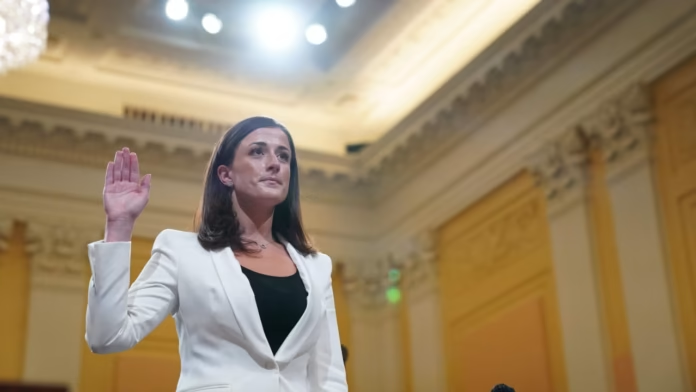

The DOJ grand jury Cassidy Hutchinson decision marks a significant development in the Justice Department’s investigation of the former White House aide, after a federal grand jury in Washington, D.C., declined to indict her on October 27, 2026. Prosecutors had sought criminal charges connected to her testimony about President Donald Trump’s actions surrounding the January 6, 2021, attack on the U.S. Capitol. The decision leaves the government without the requested indictment and raises fresh questions about the evidence presented to the grand jury.
Hutchinson became a nationally recognized witness in 2022 when she testified before the House committee investigating the Capitol attack. Her account described Trump’s reported reactions to the violence and his efforts to reach the Capitol after speaking to supporters. Her testimony also included a disputed account of an incident inside the presidential vehicle.
The grand jury’s decision does not amount to a criminal trial or an acquittal. Instead, it means prosecutors did not secure the indictment they sought from the panel. The precise allegations and the evidence presented during the confidential proceedings have not been fully disclosed publicly.
The latest development is particularly significant because the Justice Department had been investigating Hutchinson more than four years after her congressional testimony. The case also places renewed attention on the distinction between disputed testimony, allegations of criminal conduct, and the legal standards prosecutors must satisfy to bring a federal criminal case.
What Happened in the DOJ Grand Jury Cassidy Hutchinson Decision?
On October 27, 2026, a federal grand jury in Washington, D.C., rejected prosecutors’ request to indict Hutchinson, according to multiple news organizations citing people familiar with the proceedings.
The outcome followed reports earlier in October that the Justice Department had presented evidence to a grand jury concerning her testimony about January 6. The investigation focused on whether statements she made to congressional investigators could support criminal charges.
A Justice Department attorney informed a federal magistrate judge during a brief court appearance that the grand jury had not agreed to the proposed indictment. Reports described the outcome as a rejection or a “no bill,” a term used when a grand jury declines to approve an indictment.
The distinction matters. Prosecutors can investigate suspected criminal conduct and present evidence to a grand jury, but they cannot obtain an indictment if the panel does not approve the proposed charges.
The decision does not establish that every statement Hutchinson made was accurate. It also does not establish that she committed a crime. It reflects the grand jury’s refusal to authorize the indictment prosecutors presented.
As of the latest publicly reported information on October 28, 2026, the Justice Department had not publicly provided a comprehensive explanation of the rejected indictment. The specific charges proposed and the grand jurors’ reasoning remain unclear.
Why Was Cassidy Hutchinson Under Federal Investigation?
The investigation centered on Hutchinson’s testimony to the House Select Committee investigating the January 6 attack. She had served as an aide to Mark Meadows, who was White House chief of staff during Trump’s first administration.
Her position gave her access to senior officials and conversations surrounding the events leading up to January 6. During a widely watched public hearing on June 28, 2022, Hutchinson described discussions about the possibility of violence, security arrangements at Trump’s rally, and the president’s reported response as the Capitol attack unfolded.
Republican lawmakers challenged aspects of her testimony and argued that certain statements were false. Referrals from Republican representatives Jim Jordan and Barry Loudermilk contributed to the effort to examine whether her testimony warranted criminal prosecution.
The Justice Department subsequently investigated whether Hutchinson’s statements could support charges related to false testimony or other alleged misconduct. Reports in October 2026 indicated that prosecutors had presented evidence to a federal grand jury.
However, the exact legal theory behind the proposed indictment was not fully established in public reporting. Some earlier accounts described prosecutors exploring a possible civil rights violation, while subsequent reporting characterized the effort as involving allegations that Hutchinson lied to Congress.
Those descriptions should not be treated as confirmation that prosecutors formally proposed every charge discussed during the investigation. The grand jury’s rejection is the clearest confirmed development in the case.
What Did Hutchinson Tell the January 6 Committee?
Hutchinson’s June 2022 testimony attracted considerable national attention because she described events inside the White House and recounted conversations involving senior administration officials.
One major part of her testimony concerned warnings about potential violence on January 6. She said officials discussed the possibility that some Trump supporters were carrying weapons and described concerns about security measures at the rally.
Hutchinson also testified about Trump’s reported desire to go to the Capitol after addressing supporters. She described information she said she received from other administration personnel about an incident in the presidential vehicle.
Her account included an allegation that Trump became angry when Secret Service personnel prevented him from traveling to the Capitol and reached toward the vehicle’s steering wheel.
That particular account became a central point of public dispute. The presidential vehicle’s driver later disputed the physical details, saying he did not see Trump grab the steering wheel or lunge toward the front of the vehicle.
The disagreement over this episode became part of the broader debate surrounding Hutchinson’s credibility. However, a disputed account does not, by itself, establish that a witness knowingly made a false statement under oath.
For a criminal false-statements case, prosecutors generally must establish the applicable legal elements, including the required mental state. A mistake, an inaccurate recollection, secondhand information, and a deliberate lie are not automatically the same thing under federal criminal law.
The grand jury’s October 27 decision did not publicly resolve every factual disagreement surrounding Hutchinson’s testimony.
What Does a Grand Jury’s Refusal to Indict Mean?
A federal grand jury evaluates evidence presented by prosecutors and determines whether sufficient grounds exist to issue an indictment. An indictment formally charges a person with a crime and allows the prosecution to proceed toward the next stages of a criminal case.
A refusal to indict means the grand jury did not approve the proposed indictment. News reports may describe this outcome as a “no bill” or say that the grand jury declined to indict.
The process differs significantly from a trial. A grand jury does not conduct a full trial in which a defendant is convicted or acquitted after the prosecution and defense present their cases under trial procedures.
The outcome also does not necessarily reveal why the grand jurors rejected the proposal. They may have concerns about the evidence, the legal theory, or whether the government has met the applicable threshold. Without an official explanation, it would be inaccurate to claim that the panel rejected the case for one specific reason.
For Hutchinson, the immediate consequence is straightforward: prosecutors did not obtain the indictment they sought on October 27.
The decision does not automatically prevent every possible future investigation or prosecution. Whether prosecutors could lawfully present a revised case would depend on the circumstances, applicable law, available evidence, and any relevant procedural restrictions. There is no confirmed public announcement establishing that the Justice Department will pursue another indictment.
Why the Decision Matters for the Justice Department
The rejected indictment represents a setback for the federal prosecutors who sought charges against Hutchinson. It also brings attention to the challenges of turning politically contentious testimony into a criminal case.
The investigation had drawn scrutiny because Hutchinson’s testimony concerned one of the most politically consequential events in modern American history. It also involved allegations about a former presidential administration and a witness whose account was publicly challenged by Trump’s allies.
The Justice Department’s handling of the investigation attracted additional attention after reports indicated that its Civil Rights Division was involved in presenting the case. That approach was notable because the allegations publicly discussed had focused on the truthfulness of congressional testimony, although the precise proposed charges were not fully disclosed.
The grand jury’s decision does not independently prove that the investigation was politically motivated. Nor does the decision establish that prosecutors acted improperly. Those are separate questions that require evidence beyond the outcome itself.
Nevertheless, the case illustrates an important feature of the American criminal justice system: prosecutors do not control every charging decision. Grand jurors independently evaluate the proposed case, and they can refuse to approve an indictment even when federal officials want to proceed.
For the department, the immediate challenge is explaining the status of the investigation without disclosing protected grand jury material or making unsupported claims about what happened behind closed doors.
How the Decision Affects Cassidy Hutchinson’s Legal Position
The absence of an indictment is an important distinction in Hutchinson’s legal position. She was the subject of a federal investigation, but the grand jury did not approve the proposed charges reported on October 27.
Without an indictment, the prosecution cannot proceed on those rejected charges through the ordinary federal criminal process. There is no resulting trial, verdict, or sentence from this grand jury decision.
The outcome should not be described as a conviction, acquittal, dismissal after trial, or judicial finding that Hutchinson’s testimony was truthful. None of those descriptions accurately captures what happened.
Similarly, the rejection does not automatically settle the broader public debate over her 2022 testimony. Questions about individual statements, the information available to Hutchinson at the time, and conflicting accounts of particular events remain distinct from the grand jury’s charging decision.
Her testimony also remains part of the historical record of the House committee’s investigation. The October 2026 development concerns the Justice Department’s attempt to obtain a criminal indictment, not a reversal of the congressional hearing itself.
As of October 28, no publicly confirmed indictment resulting from this effort had emerged. The government had not publicly explained whether it intended to take further action.
What Happens Next in the Hutchinson Case?
The next steps depend on whether federal officials make any further decisions and whether additional information becomes public.
For now, several questions remain unanswered:
- The precise charges: Public reporting has not fully established the exact statutory charges prosecutors proposed to the grand jury.
- The evidence: Grand jury proceedings are generally confidential, so the complete presentation and deliberations are not publicly available.
- The reason for the rejection: No comprehensive public explanation from the grand jurors has established why they declined to approve the indictment.
- The Justice Department’s next move: There is no confirmed public announcement establishing that prosecutors will seek another indictment.
- Hutchinson’s response: The full legal and public response to the latest development remains unclear.
These unanswered questions make it important to distinguish confirmed facts from speculation. The confirmed outcome is that the grand jury declined to indict Hutchinson on October 27, 2026. Claims about a specific motive, a guaranteed future prosecution, or a definitive resolution of every allegation go beyond the information publicly established.
Any further development would need to be evaluated on its own merits, including official statements, court records, and reliable reporting that clarifies the status of the investigation.
DOJ Grand Jury Cassidy Hutchinson Decision: Key Takeaways
The DOJ grand jury Cassidy Hutchinson decision is a major development in the federal investigation into the former White House aide’s January 6 testimony. The Washington, D.C., grand jury rejected prosecutors’ request for an indictment on October 27, 2026, leaving the government without the requested criminal charges.
The investigation focused on allegations connected to Hutchinson’s statements to the House committee, including testimony that Trump’s allies disputed. Her account of events inside the presidential vehicle became particularly controversial after the driver challenged its physical details.
However, the legal outcome must be described precisely. The grand jury did not issue an indictment, but it did not conduct a trial or formally determine that every disputed statement was true. The specific allegations presented to the panel, its reasons for rejecting the proposed charges, and any potential next steps remain unconfirmed publicly.
The case highlights the difference between political controversy and criminal liability. Prosecutors must establish a legally sufficient basis for charges, and a grand jury can decline to authorize a prosecution even after an investigation reaches that stage.
What do you think the grand jury’s decision means for the future of the Hutchinson investigation? Share your thoughts in the comments and stay tuned for verified developments.