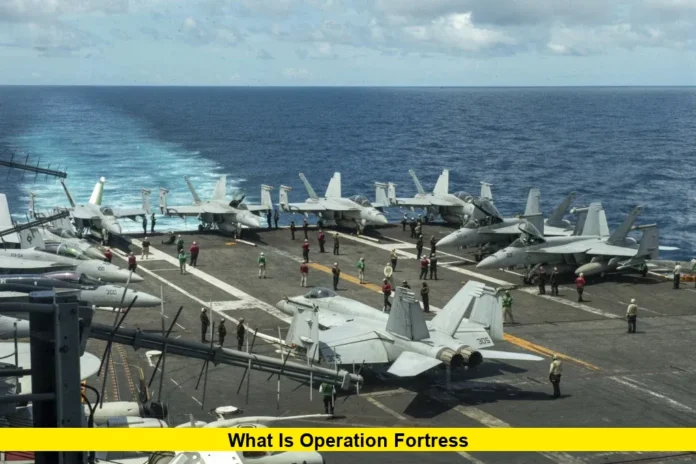

What is operation fortress? It refers to the Pentagon’s FORTRESS initiative, a military resilience effort designed to strengthen U.S. installations, energy independence, supply chains, and the ability to sustain operations during a major disruption. The latest update has drawn attention to reported plans for major American military bases to operate for 90 days without relying on the civilian power grid or outside assistance. The development comes as Britain encourages households to prepare for three days of disruption by keeping essential food, water, and emergency supplies at home.
The initiative highlights a growing U.S. defense priority: ensuring military forces can continue operating if cyberattacks, infrastructure failures, or a major conflict disrupt essential services. However, the reported 90-day planning standard should not be confused with a fully implemented requirement across every installation. The Pentagon has not publicly established a universal completion deadline or released a comprehensive program budget.
The development has also attracted public attention because of a separate emergency preparedness campaign in Britain. Although the two efforts address resilience, there is no confirmed evidence that the American military initiative and Britain’s household guidance are coordinated responses to an imminent war.
What Is Operation Fortress?
FORTRESS is an acronym for Federal Operations for Resilience, Troop Resources, Energy, Supply, and Survivability. The Pentagon initiative focuses on strengthening the military’s ability to withstand disruptions that could otherwise interrupt operations, communications, logistics, and access to critical resources.
Defense Secretary Pete Hegseth introduced the initiative during his September 30, 2026, State of the Force address. Its central objective is to reduce the military’s dependence on vulnerable civilian infrastructure and strengthen the systems that support American forces.
Military installations depend on more than personnel, weapons, and equipment. They also require reliable electricity, water, fuel, communications, medical supplies, spare parts, and functioning transportation networks. A prolonged outage affecting several of these services could disrupt a base’s ability to carry out its mission.
FORTRESS seeks to address those vulnerabilities before a crisis occurs. Its approach includes improving energy resilience, strengthening supply chains, maintaining essential reserves, and preparing industrial facilities to support defense production when necessary.
The initiative is therefore broader than an emergency electricity plan. It is intended to improve the military’s ability to continue essential activities when normal infrastructure and supply arrangements become unreliable.
Why Is the Pentagon Planning for 90 Days Without the Power Grid?
The latest reported development involves a proposed standard requiring major military installations in the continental United States to sustain essential operations independently for at least 90 days. The reported plan would cover electricity, water, fuel, communications, and other critical resources.
The details emerged in late October 2026 through reporting based on internal Pentagon planning documents. The full requirement has not been published as a finalized, department-wide implementation plan, and officials have not announced a universal deadline for completing the work.
The 90-day period matters because military bases could face extended interruptions during a major conflict. A damaged electrical grid, disrupted transportation routes, or interrupted deliveries could affect several essential services simultaneously.
Rather than relying entirely on civilian utilities and outside suppliers, installations would need systems that allow them to continue critical missions during prolonged disruptions.
This approach could involve independent power generation, energy storage, backup water arrangements, fuel reserves, and communications systems that remain functional when normal infrastructure fails.
The planning effort also reflects the military’s need to maintain readiness during emergencies. Bases support personnel, aircraft, vehicles, weapons systems, training, and logistical operations that may remain essential even when civilian infrastructure experiences serious problems.
However, the 90-day objective should be understood as a reported planning requirement rather than proof that every U.S. military base can already operate independently for three months.
How FORTRESS Could Strengthen Military Energy Independence
Electricity is a central component of the initiative because modern military installations rely on continuous power for nearly every major function.
Communications equipment, data networks, security systems, medical facilities, maintenance operations, and water infrastructure all depend on reliable electricity. Losing power for an extended period could create operational problems beyond the immediate blackout.
FORTRESS emphasizes reducing this vulnerability through alternative energy sources and systems that can function independently of the civilian grid.
Potential technologies include:
- Microgrids: Local electrical networks that can disconnect from the wider grid and continue supplying power to essential facilities.
- Advanced battery storage: Systems that store electricity and provide backup power when normal supplies become unavailable.
- Small nuclear reactors: Potential sources of continuous electricity for installations that require reliable, long-duration energy.
- Independent power generation: Additional capabilities that reduce dependence on external electricity suppliers.
These technologies serve different purposes. Batteries can provide immediate backup, while other generation systems may support operations for longer periods.
Microgrids can also help military installations isolate critical facilities from disturbances affecting the broader electrical network. Their effectiveness depends on available generation capacity, fuel or other energy supplies, maintenance, and the design of the local system.
The U.S. Army has already pursued nuclear microreactor projects. In August 2026, it announced awards worth up to $2.2 billion for projects involving five military installations. Those awards represent a related effort to explore resilient on-site power, not proof that all the planned reactors are operational.
FORTRESS builds on this broader emphasis on energy security. Its intended benefits extend beyond keeping lights on: dependable electricity helps preserve communications, logistics, command functions, and other essential military capabilities.
Why Supply Chains Are Another Major Priority
Military readiness depends on access to equipment and materials as well as electricity. Even a base with dependable power could experience serious difficulties if fuel deliveries stopped or essential replacement parts became unavailable.
FORTRESS addresses this problem through stronger supply-chain planning and strategic reserves.
The initiative’s reported priorities include maintaining access to:
- Fuel and other essential energy supplies.
- Ammunition and military equipment.
- Critical minerals and electronic components.
- Spare parts for vehicles, aircraft, and other systems.
- Medical supplies and essential operational materials.
The underlying concern is that modern production networks often depend on a limited number of suppliers. If a factory closes, a shipping route becomes inaccessible, or a key component becomes unavailable, military operations could face delays.
One proposed safeguard is to establish multiple qualified suppliers or production pathways for critical materials. This would reduce dependence on a single manufacturer or facility.
FORTRESS also incorporates the Civil Reserve Manufacturing Network, which is intended to identify commercial manufacturing facilities that could support defense production during a crisis.
Preparing these facilities in advance would involve identifying production requirements, establishing contractual arrangements, addressing cybersecurity protections, and determining how factories could shift to military-related manufacturing when needed.
Such preparation could reduce the time required to increase production during a national emergency.
Nevertheless, establishing alternative suppliers and building strategic reserves takes time. The initiative’s long-term effectiveness will depend on implementation, investment, industrial capacity, and the availability of the materials required for defense production.
What Does the Initiative Mean for National Security?
FORTRESS reflects concerns about the vulnerability of critical infrastructure during a major security crisis.
Cyberattacks, sabotage, severe weather, and physical damage can all interrupt essential services. A disruption affecting electricity may also affect water systems, communications, transportation, and industrial operations.
U.S. cybersecurity agencies have previously warned about state-sponsored cyber activity targeting networks associated with communications, energy, transportation, and water infrastructure. In February 2024, federal agencies identified the Chinese-linked hacking group known as Volt Typhoon as a threat involving compromised information technology networks.
Those warnings provide relevant background for understanding why infrastructure resilience matters to national security. They do not establish that FORTRESS targets one particular country or responds to a specific imminent attack.
The Pentagon has not publicly identified a single adversary as the exclusive target of the initiative.
Instead, the resilience strategy addresses a wider operational problem: military installations must remain functional even if the civilian systems and commercial networks supporting them experience significant disruption.
The distinction is important. Preparing for a potential emergency does not establish that the government expects the emergency to happen at a particular time.
Military planners routinely consider difficult scenarios because preparation can reduce the consequences of events that may be unpredictable.
Pentagon Costs and Implementation Timeline Remain Unclear
One of the major unanswered questions concerns the cost of making military installations more self-sufficient.
The Pentagon has not released a comprehensive budget for the reported 90-day standard. It also has not announced a single deadline by which all major installations must meet the proposed objective.
A senior defense official indicated in October 2026 that the department was still assessing the requirements across roughly 500 installations in the continental United States. Full implementation could take decades, depending on the infrastructure involved and the resources available.
The ultimate cost will depend on several factors, including existing infrastructure, local energy requirements, the amount of backup generation needed, and the availability of secure water, fuel, and supply arrangements.
Some installations may already possess capabilities that support prolonged operations during outages. Others could require substantial construction, equipment upgrades, or new arrangements with suppliers.
The military would also need to maintain these systems after installation. Backup generators, batteries, microgrids, and other equipment require testing, servicing, and trained personnel.
Energy independence does not automatically guarantee complete self-sufficiency. A base might retain electricity but still face shortages of food, medical equipment, fuel, or other supplies.
For this reason, the broader FORTRESS approach matters as much as the reported 90-day target. The objective is to strengthen the network of resources required to sustain military missions, rather than address only one vulnerability.
Pentagon Orders Bases to Plan for 90 Days Without the Grid as Britain Urges Families to Stockpile Food and Water
In a separate development, Britain launched its Be Ready emergency preparedness campaign on October 22, 2026, encouraging households to prepare for up to three days of disruption to essential services. The guidance recommends keeping drinking water, nonperishable food, flashlights, charged power banks, first-aid supplies, essential medicines, and a battery-powered or wind-up radio available at home. It also encourages families to consider cash for situations in which electronic payments or ATMs become unavailable. The Pentagon’s reported plan focuses on military installations sustaining essential operations for 90 days, while Britain’s campaign addresses short-term household preparedness for emergencies such as severe weather, power outages, and interruptions to communications. The two efforts have not been established as a coordinated response, and neither announcement confirms that a major war is imminent. For U.S. readers, the central takeaway is that infrastructure resilience and emergency planning are receiving renewed attention, although Britain’s three-day household guidance should not be mistaken for a new U.S. government requirement.
What Americans Should Understand About FORTRESS
For the American public, FORTRESS is primarily a military resilience initiative, not an announcement that households must prepare to live without electricity for 90 days.
The reported standard applies to military installations and their ability to sustain essential operations. It does not establish a nationwide instruction requiring American families to stockpile three months of food or water.
Nevertheless, prolonged power outages and other infrastructure disruptions can affect civilians as well as military facilities. Households may benefit from maintaining reasonable emergency supplies, keeping essential medications accessible, and knowing how to receive reliable information during an outage.
Americans can tailor preparations to local risks, including hurricanes, wildfires, winter storms, and interruptions to utilities. Emergency needs vary by location, household size, medical requirements, and the likely duration of a disruption.
The distinction between military planning and household preparedness remains essential. FORTRESS addresses the Pentagon’s operational requirements, while civilian emergency guidance serves a different purpose.
The initiative’s success will ultimately depend on whether military installations can put the necessary infrastructure, supply arrangements, and operational procedures into practice.
Frequently Asked Questions About Operation Fortress
1. What is Operation Fortress?
FORTRESS stands for Federal Operations for Resilience, Troop Resources, Energy, Supply, and Survivability. It is a Pentagon initiative intended to strengthen military energy independence, supply-chain security, and operational resilience during major disruptions.
2. Why does the Pentagon want bases to operate for 90 days without the grid?
The reported planning standard is intended to help major military installations maintain essential operations if civilian electricity and other critical services become unavailable during a prolonged emergency or conflict.
3. Does FORTRESS mean a war is about to begin?
No. The initiative reflects military planning for potential disruptions. Its announcement does not confirm an imminent war, identify a specific attack date, or establish that a particular adversary will trigger such a crisis.
4. Will every U.S. military base immediately operate independently for 90 days?
No. The 90-day standard has been reported as a developing planning requirement. The Pentagon has not announced a universal completion deadline, and implementation would require substantial planning and infrastructure investment.
5. Is Britain’s emergency preparedness campaign connected to FORTRESS?
There is no confirmed evidence that the two initiatives are coordinated. FORTRESS concerns military readiness, while Britain’s Be Ready campaign encourages households to prepare for short-term disruptions to everyday services.
6. Does the Pentagon initiative focus only on electricity?
No. Its broader objectives include strengthening fuel availability, water resilience, communications, strategic reserves, supply chains, and the industrial capacity needed to support military operations.
Conclusion
FORTRESS represents a significant shift toward preparing U.S. military installations for prolonged disruptions rather than assuming that civilian infrastructure and commercial supply chains will always remain available. The reported 90-day planning objective illustrates the scale of the challenge, but its final costs, implementation schedule, and installation-by-installation requirements remain unsettled. The initiative’s progress will depend on practical investments in energy systems, supply security, and operational resilience.
What do you think about the Pentagon’s 90-day resilience plan? Share your thoughts in the comments and stay updated as more confirmed details emerge.