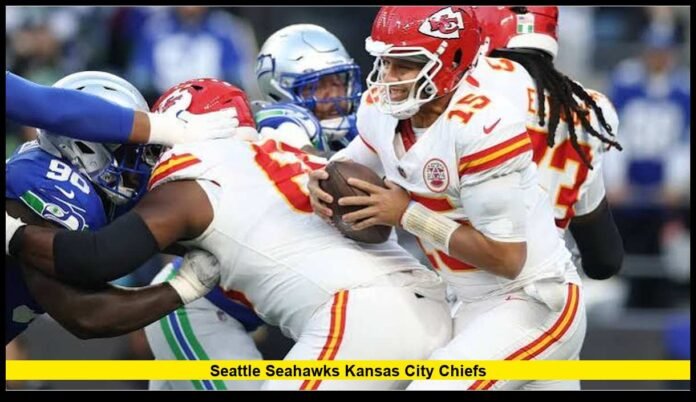

The Seattle Seahawks Kansas City Chiefs showdown ended with Seattle delivering one of its strongest defensive performances of the 2026 NFL season, defeating Kansas City 20-3 at Lumen Field on Sunday night. The victory improved Seattle’s record to 4-3, snapped a two-game losing streak, and handed the Chiefs their first defeat after five consecutive wins. Jaxon Smith-Njigba led the Seahawks’ offense with nine catches for 150 yards and a touchdown, while Emanuel Wilson rushed for 100 yards and scored the decisive fourth-quarter touchdown.
Seattle entered the matchup under pressure to respond after consecutive losses to the San Francisco 49ers and Denver Broncos. Kansas City, meanwhile, arrived unbeaten and looking to extend its strong start. The Seahawks answered that challenge with a balanced offensive performance, disciplined tackling, and relentless defensive pressure that restricted Patrick Mahomes and the Chiefs to just three points.
The final score reflected Seattle’s control of the game. The Seahawks accumulated 410 total net yards, possessed the ball for nearly 36 minutes, and converted 11 of 16 third-down attempts. Kansas City managed only 213 total net yards and failed to score a touchdown. The result strengthened Seattle’s position heading into the next stage of its schedule and gave Kansas City several important issues to address.
Seattle Seahawks vs. Kansas City Chiefs: Final Score and Game Overview
The Seahawks secured their victory through a combination of second-quarter scoring, third-down efficiency, and defensive consistency. After a scoreless opening quarter, Seattle established a 10-0 halftime lead and maintained its advantage throughout the second half.
Jason Myers opened the scoring with a 25-yard field goal in the second quarter. Seattle then extended its lead when quarterback Sam Darnold connected with Smith-Njigba for a 28-yard touchdown.
Kansas City struggled to respond. The Chiefs entered Seattle territory during their early possessions but could not convert those opportunities into points. Their only successful scoring drive came in the third quarter, when Harrison Butker kicked a 50-yard field goal.
Seattle answered with another Myers field goal before Wilson delivered a 21-yard touchdown run in the fourth quarter. That score pushed the lead to 20-3 with 3:47 remaining and effectively ended Kansas City’s hopes of a comeback.
| Game detail | Confirmed result |
|---|---|
| Final score | Seattle 20, Kansas City 3 |
| Date | October 25, 2026 |
| Stadium | Lumen Field |
| Location | Seattle, Washington |
| NFL week | Week 7 |
| Seattle’s record | 4-3 |
| Kansas City’s record | 5-1 |
| Total net yards | Seattle 410, Kansas City 213 |
| Time of possession | Seattle 35:51, Kansas City 24:09 |
The statistics highlight Seattle’s superiority in controlling the pace. The Seahawks ran 69 offensive plays compared with Kansas City’s 50, creating more opportunities to sustain drives and keeping Mahomes on the sideline.
Jaxon Smith-Njigba Leads Seattle’s Passing Attack
Smith-Njigba delivered the standout individual performance of the night. His nine receptions produced 150 receiving yards and one touchdown, giving Seattle a reliable offensive weapon against Kansas City’s defense.
The wide receiver established his influence early, helping Darnold move the ball downfield and setting up Seattle’s first scoring opportunity. His 28-yard touchdown reception in the second quarter gave the Seahawks a 10-point advantage.
The play was particularly important because Seattle had struggled to build momentum in its previous two games. By completing a scoring drive against an unbeaten opponent, the Seahawks gained confidence and forced Kansas City to play from behind.
Smith-Njigba continued producing after halftime. His ability to create separation, find openings in coverage, and turn completions into meaningful gains helped Seattle maintain possession.
His production also reduced the burden on Darnold. Instead of depending on difficult throws into tight coverage, Seattle could rely on its leading receiver to create opportunities and move the chains.
The performance reinforced Smith-Njigba’s growing importance to the Seahawks’ offense. His combination of route-running, hands, and yards after the catch gave Kansas City persistent problems.
For Seattle, the challenge now is to maintain that connection over the remainder of the season. Consistent production from Smith-Njigba can help the offense remain competitive even when opponents devote additional defensive attention to him.
Sam Darnold Delivers an Efficient Performance
Darnold completed 20 of 28 passes for 257 yards and one touchdown. He also threw one interception, leaving room for improvement despite an otherwise effective performance.
The quarterback showed improved decision-making after throwing two interceptions in Seattle’s previous loss to San Francisco. Against Kansas City, he distributed the ball effectively and used his mobility to extend important possessions.
Darnold’s third-down scrambles helped Seattle keep drives alive. Those plays complemented his connection with Smith-Njigba and allowed the offense to avoid predictable passing situations.
However, one mistake nearly gave Kansas City an opportunity to change the game before halftime.
After another long completion to Smith-Njigba moved Seattle close to the goal line, Darnold threw an end-zone interception. Chiefs cornerback Nohl Williams secured the ball and returned it approximately 64 yards, giving Kansas City possession near midfield.
The Chiefs attempted a 58-yard field goal before halftime, but Butker’s kick fell short. Kansas City therefore entered the break trailing 10-0 without having scored.
That sequence illustrated both the risk of turnovers and the importance of Seattle’s defensive resilience. Although Darnold gave the Chiefs an opportunity, Seattle prevented the mistake from affecting the scoreboard.
Darnold settled down in the second half and helped the Seahawks maintain their lead. His overall performance gave Seattle the passing production it needed without requiring the quarterback to carry the offense alone.
Emanuel Wilson Strengthens Seattle’s Running Game
Wilson supplied the physical element that helped Seattle control the game. The running back recorded 100 yards on 24 carries, consistently contributing to an offense that balanced passing and rushing.
His biggest play arrived in the fourth quarter. With Seattle leading 13-3, Wilson broke through for a 21-yard touchdown run with 3:47 remaining.
The touchdown extended the margin to 17 points and removed much of the uncertainty surrounding the outcome.
Seattle finished with 153 rushing yards on 41 attempts. That production helped the Seahawks control the clock, wear down Kansas City’s defense, and reduce the number of possessions available to Mahomes.
Wilson’s contribution became especially important because Zach Charbonnet was unavailable for the game while continuing his recovery from a torn ACL.
Rather than allowing that absence to disrupt the offense, Seattle received a productive performance from Wilson. His workload and touchdown helped demonstrate the team’s ability to adapt when personnel changes affect the backfield.
Seattle’s rushing attack also created favorable conditions for Darnold. By maintaining a credible ground threat, the Seahawks prevented Kansas City from concentrating exclusively on stopping the pass.
Seattle’s Defense Restricts Patrick Mahomes
The defensive performance was the defining feature of Seattle’s victory. Kansas City entered the game with an unbeaten record and an offense led by one of the NFL’s most accomplished quarterbacks.
The Seahawks held that offense to 213 total net yards and a single field goal.
Mahomes completed 19 of 33 passes for 165 yards and threw an interception. The Chiefs struggled to generate explosive plays, while Seattle consistently forced difficult third-down situations.
Safety Ty Okada intercepted Mahomes during the first half, disrupting a Kansas City possession and giving Seattle an important defensive play. Later, pressure from Seattle’s defense helped force another errant throw that Okada intercepted.
Seattle also made life difficult for Kansas City’s receivers. The secondary limited downfield opportunities, while defenders maintained pressure on Mahomes when he attempted to escape the pocket.
The Seahawks’ tackling was another major factor. Kansas City could not consistently turn short completions into substantial gains, making it harder to sustain long drives.
The result was especially impressive given the Chiefs’ established offensive leadership. Mahomes and head coach Andy Reid have built a reputation for making adjustments during difficult games, but Seattle consistently won the important situations.
The defensive performance also reflected the importance of playing complementary football. Seattle’s offense controlled possession, giving its defense time to recover and limiting Kansas City’s opportunities to find a rhythm.
Kenneth Walker III Held to 36 Rushing Yards
One of the most notable storylines involved Kenneth Walker III, who returned to Seattle as a member of Kansas City’s backfield after helping the Seahawks win Super Bowl LX.
Walker had entered the matchup as one of the NFL’s leading rushers. Seattle nevertheless limited him to 36 yards on 14 carries, preventing the Chiefs from establishing a reliable ground attack.
The Seahawks’ defenders closed running lanes quickly and limited Walker’s opportunities to break into the open field. He did not produce the explosive rushing plays that had characterized his opening weeks with Kansas City.
Containing Walker had consequences for the entire offense. Without an effective running game, Kansas City had fewer opportunities to create manageable third downs or use play-action to challenge Seattle’s secondary.
Mahomes consequently faced more pressure to produce through the air. Seattle’s defense could focus more attention on the passing game without worrying about consistent rushing gains.
For the Seahawks, stopping their former teammate added another meaningful dimension to the victory. It also reinforced the team’s defensive identity: limiting opposing running backs and forcing offenses to earn every yard.
Kansas City’s Missed Opportunities Prove Costly
The Chiefs did not lose solely because of one bad possession. Several promising drives ended without points, allowing Seattle to maintain control.
Kansas City entered Seattle territory on each of its first three possessions but failed to score. Those missed opportunities became increasingly important as the Seahawks established their lead.
Butker’s missed 58-yard field goal at the end of the first half prevented Kansas City from getting on the scoreboard before halftime.
The Chiefs finally scored in the third quarter with a 50-yard field goal, cutting Seattle’s advantage to 13-3. However, their next major opportunity ended in disappointment.
Mahomes led an 11-play, 60-yard drive that reached Seattle’s 27-yard line early in the fourth quarter. The possession offered Kansas City a chance to reduce the deficit to seven points.
Instead, Butker missed a 45-yard field goal attempt wide right.
That miss left the Chiefs trailing by 10 points and gave Seattle an opportunity to regain control. Wilson’s touchdown run followed, extending the lead to 20-3.
The missed kicks were part of a broader offensive problem. Kansas City had difficulty finishing drives, converting third downs, and producing the scoring plays needed to challenge Seattle.
Seattle Seahawks Kansas City Chiefs: Key Statistics and Takeaways
The numbers reveal how thoroughly Seattle controlled the contest.
| Category | Seahawks | Chiefs |
|---|---|---|
| Total net yards | 410 | 213 |
| Passing yards | 257 | 165 |
| Rushing yards | 153 | 50 |
| Offensive plays | 69 | 50 |
| Third-down conversions | 11 of 16 | 3 of 11 |
| Time of possession | 35:51 | 24:09 |
| Touchdowns | 2 | 0 |
| Field goals made | 2 | 1 |
Seattle’s 11 conversions on third down were particularly decisive. The Seahawks repeatedly extended possessions, including several difficult third-and-long situations.
Kansas City converted only three of 11 third-down attempts. That limited its ability to establish rhythm and left the offense with fewer opportunities to score.
The difference in rushing production also mattered. Seattle gained 153 yards on the ground, while Kansas City managed only 50.
Combined, these statistics show that the Seahawks won the game through sustained offensive execution and defensive discipline rather than one isolated scoring play.
Injury Updates and Upcoming Games
Both teams must now evaluate their personnel as they prepare for their next matchups.
Seattle wide receiver Rashid Shaheed left the game with a knee injury and did not return. Offensive tackle Charles Cross also exited in the fourth quarter with an ankle injury. Their availability for the next game will depend on subsequent medical assessments.
Kansas City linebacker Nick Bolton briefly left the contest because of neck spasms but returned to action.
The Chiefs also played without wide receiver Rashee Rice, who missed his third consecutive game with a hamstring injury, and starting offensive tackle Jaylon Moore, who remained in the concussion protocol.
Seattle’s next scheduled game is against the Chicago Bears at Lumen Field on Monday, November 2, 2026. The Seahawks will attempt to build on their victory and improve their record further.
Kansas City is scheduled to visit the Denver Broncos on Sunday, November 1. The divisional matchup offers the Chiefs an immediate opportunity to respond after losing their unbeaten record.
Both games carry importance for teams trying to establish consistency during the regular season. Seattle needs to sustain its defensive intensity, while Kansas City must demonstrate that it can recover quickly from a difficult offensive performance.
What the Victory Means for Seattle and Kansas City
Seattle’s victory provides a significant confidence boost after consecutive defeats. The Seahawks demonstrated that they can control a game against a strong opponent by combining efficient quarterback play, productive rushing, and an aggressive defense.
Smith-Njigba’s performance remains a major positive. His 150 receiving yards and touchdown helped establish the offensive advantage, while Wilson’s contribution gave Seattle another reliable scoring option.
Darnold’s performance was also encouraging, although his interception highlighted the need for better ball security. Improving red-zone execution could help Seattle turn more promising possessions into touchdowns.
Kansas City faces a different set of priorities. The Chiefs need to improve their rushing production, convert third downs more consistently, and avoid leaving scoring opportunities unused.
Mahomes will remain central to the team’s response, but the offense must provide him with better support. The performance against Seattle showed how quickly an opponent can gain control when Kansas City struggles to establish its preferred style.
The defeat does not erase the Chiefs’ strong opening run, but it does expose weaknesses that opponents may attempt to exploit. Their response against Denver will offer an early indication of how effectively they can make adjustments.
Final Verdict
Seattle earned its 20-3 victory through a complete team performance. Smith-Njigba dominated the receiving game, Wilson delivered a decisive rushing touchdown, and the Seahawks’ defense restricted Mahomes to 165 passing yards and one interception.
Kansas City failed to convert promising drives into touchdowns and missed two field goals. Those mistakes, combined with Seattle’s control of possession and third-down execution, determined the outcome.
The Seahawks now have an opportunity to build momentum against Chicago, while the Chiefs will look to recover against Denver. Both teams face important tests as the 2026 season continues.
What was the biggest factor in Seattle’s victory: its defense, Smith-Njigba’s receiving performance, or Wilson’s rushing attack? Share your thoughts in the comments and follow the latest NFL developments.