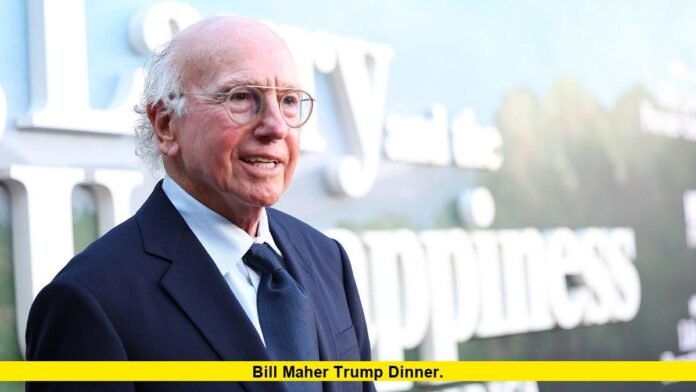

The bill maher trump dinner controversy returned to the spotlight after comedian Bill Maher defended his decision to meet President Donald Trump at the White House for a second time. During the October 23, 2026, episode of HBO’s Real Time with Bill Maher, the host responded bluntly to critics who questioned his willingness to dine with a president he frequently mocks on television. Maher said he enjoyed the dinners and argued that speaking directly with Trump allowed him to raise concerns that critics might otherwise discuss only from a distance.
The second dinner took place on October 15, 2026, and included sports commentator Stephen A. Smith and musician Kid Rock. Maher used his opening monologue to describe the lengthy conversation, explain why he accepted the invitation, and address the backlash surrounding his renewed contact with Trump.
His comments highlighted a recurring question in American political culture: Can a prominent critic engage privately with a political leader without abandoning their public positions?
For Maher, the answer is yes. He maintains that direct conversation and sharp public criticism can exist side by side.
Why Bill Maher Is Facing Criticism Over the Second Trump Dinner
Maher has spent years criticizing Trump through political satire, commentary, and interviews. His willingness to sit down with the president therefore creates an apparent contradiction for viewers who expect the comedian to maintain a consistent distance from the administration.
That tension first became prominent after Maher attended a White House dinner with Trump in April 2025. The gathering surprised some viewers because the two men had frequently exchanged insults and publicly disagreed about politics.
Following that meeting, Maher described Trump as more gracious and measured in private than he had anticipated. His assessment generated debate among people who viewed the president through a sharply different political lens.
The second dinner renewed that debate. Rather than quietly dismissing the criticism, Maher addressed it directly during his television monologue.
His message was unmistakable: he was not embarrassed about returning to the White House, and he did not intend to apologize simply because some viewers disliked his decision.
What Bill Maher Said About His Second Dinner With Trump
During the October 23 broadcast, Maher used profanity and his familiar confrontational humor to respond to those questioning his decision.
He declared, “Yeah, I did it again, bitches,” before explaining that critics viewed him as the bad guy for speaking face-to-face with Trump about issues they discussed in articles and public commentary.
Maher then made his position even clearer: “You know what? F— you. I like these dinners.”
The remarks reflected his frustration with the idea that meeting Trump necessarily represented political approval. Maher presented the dinners as opportunities to challenge the president directly rather than occasions to suspend his opinions.
He also joked about the unusual experience of being announced as a visitor near the Oval Office. In his telling, the presidential setting offered its own surreal comedy, especially when contrasted with his reputation as a frequent Trump critic.
The comedian’s comments quickly became a major talking point because they combined an unapologetic defense of the dinner with a willingness to mock the president and the White House environment.
What Happened During the October 15 White House Dinner?
The October 15 gathering brought together Trump, Maher, Smith, and Kid Rock for an extended conversation at the White House. The meeting lasted approximately four hours, according to Maher’s account, and covered a range of political and national issues.
Maher described the evening as an opportunity to raise subjects on which he strongly disagreed with the president. He said their conversation included the Supreme Court, immigration enforcement, Afghanistan, Defense Secretary Pete Hegseth, China, and the disputed aftermath of the 2020 presidential election.
He also said he challenged Trump’s comments about former President Barack Obama and criticized aspects of the administration’s approach to national and international affairs.
The dinner was not simply a social gathering in Maher’s description. He portrayed it as a lengthy exchange in which he could express his concerns directly to the president.
Sports commentator Stephen A. Smith also attended. Maher praised Smith’s contribution to the conversation, describing him as an effective participant who stayed on point.
Kid Rock attended as well. The musician had played a role in arranging Maher’s first dinner with Trump in 2025 and was present again for the second gathering.
The participants’ accounts presented the meeting as a wide-ranging discussion rather than a formal political event with a single announced policy objective.
The Issues Maher Said He Raised With Trump
Maher’s explanation of the dinner focused heavily on the subjects he said he challenged Trump about. These details matter because they help explain why the comedian considers private engagement compatible with his public criticism.
Among the subjects he identified were:
- The Supreme Court: Maher said the conversation included the nation’s highest court and the broader political questions surrounding it.
- Immigration enforcement: He referenced shootings involving Immigration and Customs Enforcement, or ICE, as an issue he raised.
- Afghanistan: Maher said he challenged Trump over the treatment of Afghans who had assisted American forces during the war.
- Defense leadership: He criticized Hegseth’s performance and told Trump that the defense secretary was hurting the administration.
- Barack Obama: Maher challenged Trump’s characterization of Obama and made a pointed comment about race.
- China: He warned against taking Chinese President Xi Jinping’s expressions of friendship at face value.
- The 2020 election: Maher referred to Trump’s defeat in the 2020 presidential election and the events surrounding the January 6, 2021, attack on the U.S. Capitol.
These were Maher’s descriptions of what he said during the dinner. They should not be confused with a complete, independently documented transcript of every exchange.
Nevertheless, his account makes one point clear: he did not present himself as a guest who simply agreed with everything Trump said.
Maher said he had plenty to complain about and used the dinner to communicate those concerns in person.
Maher Admits Trump Stayed Calm During Their Conversation
One of the most striking parts of Maher’s account concerned Trump’s behavior during the dinner.
Maher said the president did not lose his temper, yell at him, or interrupt him during their conversation. He also acknowledged that he himself had been less restrained at times.
In a characteristically provocative joke, Maher said he could not have been treated better if he were Russian.
The remark underscored his surprise at the president’s demeanor. Maher has spent years portraying Trump as a political figure whose public conduct deserves relentless scrutiny, yet he described their private interaction as notably civil.
His comments did not establish that Trump’s private behavior always matches his public conduct. Nor did they demonstrate that Maher had changed his overall political views.
Instead, they reflected the comedian’s account of a particular meeting.
Maher has argued that an honest description of his experience should not depend on whether the president is someone he supports. If Trump behaved politely during their conversation, Maher believes he should be able to say so while continuing to criticize the president elsewhere.
That distinction sits at the center of the controversy surrounding the second dinner.
Bill Maher Fires Back at Liberal Critics Over Second Trump Dinner
The headline, “Bill Maher Fires Back At Liberal Critics Over Second Trump Dinner: ‘Yeah, I Did It Again, B—!’” captures the combative tone of his response on Real Time.
Maher did not frame the criticism as a reason to avoid future conversations. Instead, he challenged the assumption that meeting with a political opponent makes someone disloyal to their own side.
He also argued that face-to-face conversations have value because they give participants a chance to challenge statements directly. His approach differs from the strategy of refusing contact with a political leader whose actions or policies a person opposes.
For Maher, the central issue is whether political disagreement should prevent conversation altogether.
His answer was no. He maintained that he could speak with Trump, raise difficult subjects, and return to his program to criticize the president.
The response also reflected his established comedic style. Rather than offering a lengthy apology or carefully worded defense, he turned the controversy into material for his monologue.
That choice made the exchange more entertaining for some viewers and more frustrating for others. People who objected to the dinner could interpret his defiance as dismissive, while supporters of open political dialogue could see it as a defense of independent judgment.
The disagreement is about more than one evening at the White House. It concerns what audiences expect from comedians and commentators who have built their reputations around political criticism.
How the Second Dinner Compares With the First Trump Meeting
Maher’s first White House dinner with Trump took place in April 2025. Kid Rock helped arrange that meeting, which also included UFC CEO Dana White.
Afterward, Maher told his audience that Trump had been gracious and measured during their private interaction. He also said the president appeared more self-aware than he had expected.
Those remarks attracted criticism because Maher had frequently attacked Trump on his show. Some viewers questioned why the comedian would accept an invitation and then describe the president in unexpectedly favorable personal terms.
Maher did not abandon his critical approach after the first dinner. He continued to make jokes about Trump and challenge the president’s political decisions.
The October 2026 dinner followed a similar pattern. Maher accepted another invitation, described the president’s behavior positively in certain respects, and continued to express substantial disagreements with him.
The key difference was that Maher now had an established history with Trump. The second dinner was not an isolated encounter between two people who had never met privately.
It represented a renewed willingness to engage despite their public disagreements.
The sequence also explains why the second dinner attracted so much attention. Critics had already debated the significance of the first meeting, and Maher’s return reopened that argument.
Trump’s Reaction to the Second Dinner
Trump also offered a positive assessment of the October gathering. He described the dinner as enjoyable and said the group discussed a wide range of subjects.
He further suggested that Maher liked him more than many people understood. That comment added another layer to the debate because it raised questions about how each man interpreted their relationship.
Maher did not respond by declaring political agreement with Trump. His account instead emphasized the opportunity to speak directly and the president’s demeanor during their conversation.
A cordial dinner does not necessarily indicate a political alliance. Two people can enjoy a conversation while disagreeing about public policy, leadership, and political priorities.
The available accounts also do not establish that the dinner produced a specific policy agreement or formal commitment between the participants.
Its immediate significance was largely political and cultural: a prominent Trump critic had accepted another invitation, and both men described the encounter in positive terms.
That combination ensured the meeting would remain a subject of public discussion.
Does Meeting Trump Mean Maher Supports His Policies?
The controversy surrounding the dinner depends partly on the distinction between personal interaction and political endorsement.
Meeting a president does not automatically mean a guest supports the administration’s agenda. Likewise, a friendly conversation does not erase years of public disagreement.
Maher has continued to criticize Trump even after describing their private meetings favorably. His October 23 monologue included both an explanation of the dinner and pointed remarks about the administration.
His approach is consistent with the argument that political engagement can be useful even when participants do not share the same beliefs.
However, critics are entitled to question the decision. They may argue that accepting repeated invitations gives the president an opportunity to project an image of bipartisan openness or personal popularity.
Others may consider direct conversation a better way to challenge political leaders than avoiding them entirely.
Neither interpretation changes the basic facts of the meeting. Maher attended the dinner, described the conversation as extensive, and defended his decision publicly.
The broader debate concerns how audiences should interpret those actions, not whether a private dinner automatically establishes political loyalty.
Why the Bill Maher Trump Dinner Story Matters
The renewed attention surrounding Maher and Trump reflects a wider disagreement over political engagement in an increasingly polarized United States.
For some Americans, meeting with a political opponent can demonstrate a willingness to listen, challenge assumptions, and communicate across ideological divisions. For others, access to a powerful political figure can create reputational risks, particularly when the guest has built a career criticizing that person.
Maher’s position is that direct engagement does not require silence. He believes he can speak with Trump privately and continue criticizing him publicly without compromising his independence.
His critics may evaluate the decision differently, especially given the president’s ability to use high-profile encounters to shape public perceptions.
The second dinner also illustrates the complicated relationship between political satire and personal interaction. Comedians often rely on sharp portrayals of public figures, but private encounters can reveal aspects of a person’s behavior that differ from their public image.
Those experiences do not automatically invalidate previous criticism. They can, however, complicate how audiences interpret it.
Maher has responded to that complication with humor and defiance rather than retreating from the discussion.
What Happens Next for Maher and Trump?
The immediate question is whether the second dinner will remain an isolated encounter or become part of a continuing relationship.
As of the latest reported updates, Maher has defended attending the October 15 gathering and has explained the subjects he said he raised with Trump. Neither man’s favorable description of the evening establishes that another dinner has been scheduled.
Maher continues to host Real Time with Bill Maher, where political commentary and interviews remain central to the program. His willingness to criticize Trump has not disappeared simply because he has met the president privately.
Future public remarks from either man could provide more insight into how they view their relationship. Until then, the clearest evidence comes from their statements about the two dinners and Maher’s continued commentary.
The second meeting has already renewed debate about whether political opponents should engage directly, even when their disagreements are substantial.
Maher has made his own position clear: he sees no reason to apologize for having a conversation with the president, and he intends to retain the freedom to criticize him afterward.
Final Thoughts
The latest Bill Maher Trump dinner controversy is about more than a comedian’s return to the White House. It highlights the tension between political loyalty, open dialogue, personal experience, and public accountability.
Maher’s October 23 response made clear that he would not let criticism dictate whom he was willing to meet. He described a lengthy conversation, identified issues he said he challenged Trump about, and maintained that a civil private interaction did not require him to abandon his public views.
Whether audiences consider that approach principled, provocative, or politically unwise will depend on their expectations of Maher and their interpretation of Trump’s presidency. What remains clear is that the second dinner has reignited a debate about the place of conversation in American political life.
What do you think about Bill Maher’s decision to dine with Trump again? Share your opinion in the comments and stay tuned for the latest developments.