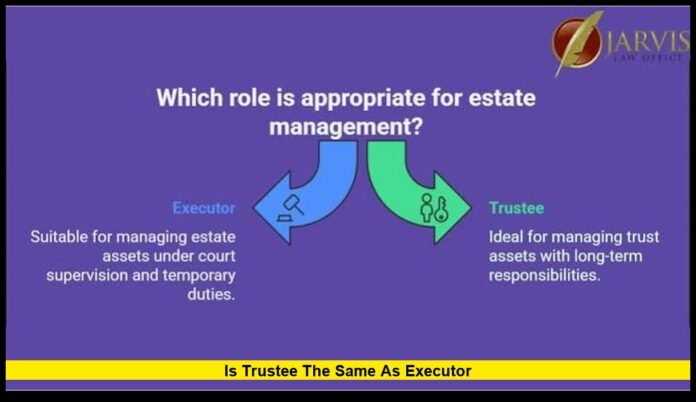

A trustee and an executor both play important roles in managing property, protecting beneficiaries, and carrying out a person’s wishes. However, is trustee the same as executor? No. Although the same individual can serve in both positions, each role has different responsibilities, legal authority, and obligations under U.S. estate law.
An executor is generally responsible for settling a deceased person’s estate, including handling probate proceedings, paying valid debts, managing estate expenses, and distributing assets according to the will. A trustee, on the other hand, manages property held in a trust and follows the instructions established in the trust agreement.
These roles often work together when an estate plan includes both a will and a trust. Nevertheless, they are not interchangeable. An executor does not automatically gain control over trust assets, and a trustee does not automatically have authority over property that remains outside the trust.
Understanding the difference between a trustee and an executor can help individuals create a more effective estate plan, choose appropriate representatives, and avoid misunderstandings when a loved one’s assets must be managed or distributed.
What Is the Main Difference Between a Trustee and an Executor?
The main difference between a trustee and an executor concerns the property they manage and the legal documents that establish their authority.
An executor administers the probate estate of someone who has died. This responsibility usually involves identifying assets subject to probate, addressing financial obligations, completing required paperwork, and distributing the remaining property to the appropriate beneficiaries.
A trustee manages assets that belong to a trust. The trustee must follow the trust agreement, comply with applicable law, and make decisions that serve the trust’s authorized purposes and beneficiaries.
The timing of these responsibilities can also differ. An executor generally begins administering an estate after the person’s death and any required appointment. A trustee may begin serving during the trust creator’s lifetime or take over after the creator dies, depending on the arrangement.
| Category | Executor | Trustee |
|---|---|---|
| Primary role | Settles a deceased person’s estate | Manages trust property |
| Legal authority | Will, probate appointment when required, and applicable law | Trust agreement and applicable law |
| Property involved | Assets subject to estate administration | Assets legally held in the trust |
| Main responsibilities | Estate expenses, creditor claims, tax matters, and distributions | Asset management, recordkeeping, and trust distributions |
| Court involvement | Probate proceedings may be required | Routine probate may not be necessary, but court involvement is sometimes needed |
| Duration | Usually ends when estate administration is complete | May continue for an extended period |
| Compensation | May be entitled to authorized compensation | May receive compensation under the trust or applicable law |
The exact rules depend on the state, the estate plan, and the circumstances involved.
The most important point is that an executor manages the estate, while a trustee manages the trust. Even when one person holds both positions, the assets and responsibilities associated with each role must be handled appropriately.
Understanding the Role of an Executor
An executor is the person named in a will to administer the deceased person’s estate. The executor helps ensure that the will is carried out according to its instructions and applicable legal requirements.
For example, someone may leave a home, savings, investments, and personal possessions to several relatives. The executor identifies the property subject to probate, protects the estate’s assets, addresses valid financial obligations, and arranges for the remaining property to be distributed.
The executor’s work is not limited to handing out inheritances. Estate administration can involve considerable paperwork, communication with financial institutions, tax matters, property management, and compliance with court procedures.
Some states use the term personal representative for the person responsible for administering an estate. Although terminology varies, the general purpose is similar.
How an Executor Receives Legal Authority
A will typically names the person the deceased wants to serve as executor. However, the appointment process depends on the jurisdiction and the type of estate.
When probate is required, the nominated executor generally files the necessary documents with the appropriate court. After the appointment is approved, the court may issue letters testamentary or other documentation confirming the person’s authority.
If the named executor cannot serve, an alternate may be able to take the position. If no suitable person is available, the court may appoint another qualified representative under state law.
Some estates qualify for simplified procedures, while others require formal probate administration. The executor must follow the procedure that applies to the particular estate.
Responsibilities of an Executor
An executor’s duties generally include the following:
- Locating the will and submitting required court documents.
- Identifying and protecting property belonging to the probate estate.
- Determining the value of estate assets when necessary.
- Providing notices to beneficiaries and creditors as required.
- Reviewing creditor claims and paying valid obligations.
- Arranging payment of authorized estate expenses.
- Addressing applicable tax filings and liabilities.
- Maintaining accurate records of estate transactions.
- Distributing assets according to the will and applicable law.
- Completing required accountings and closing procedures.
The complexity of these responsibilities depends on the estate. An executor managing a small estate may have relatively straightforward duties, while an executor handling real estate, business interests, investments, or disputes may need professional assistance.
An executor does not automatically become personally responsible for every debt left by the deceased. However, improper distributions, misuse of estate funds, or failure to comply with legal obligations may result in liability under applicable law.
How Long Does an Executor Remain in the Role?
An executor generally serves until the estate has been properly administered and the necessary closing requirements have been completed.
The process may take months or longer, depending on the assets involved, creditor claims, tax matters, disputes, and court procedures. Complicated estates may require additional time.
Once the estate administration is complete, the executor’s role usually ends. If a trust has been established to manage assets over a longer period, the trustee may continue administering those assets after the executor has finished.
Understanding the Role of a Trustee
A trustee is responsible for managing assets held in a trust for the benefit of one or more beneficiaries.
A trust is a legal arrangement that establishes how property should be held, managed, and distributed. The person who creates the trust may be called the grantor, settlor, or trustor.
The trustee has legal responsibilities concerning the trust property and must act according to the trust agreement and applicable law. The trustee cannot simply use the assets for personal purposes or distribute them without considering the beneficiaries’ rights.
For example, parents may create a trust for their children and specify that the funds should support education, housing, or other permitted expenses. The trustee manages the money and makes distributions according to the trust’s instructions.
When Does a Trustee Begin Managing Assets?
The starting point depends on the type of trust and the terms of the governing document.
With a revocable living trust, the person creating the trust may initially serve as trustee. A successor trustee may take over when the original trustee dies, resigns, becomes incapacitated under the applicable provisions, or otherwise stops serving.
A testamentary trust is established through a will and generally becomes effective through the estate administration process after death. The appointed trustee then manages the assets transferred into the trust.
Some trusts use professional trustees or financial institutions, while others appoint relatives, friends, or multiple co-trustees.
A successor trustee can often begin acting under the authority established by the trust without going through a routine probate appointment. However, documentation may be required by banks or other institutions, and court involvement may become necessary if authority is disputed.
What Are the Main Duties of a Trustee?
A trustee’s responsibilities generally focus on protecting and managing trust property while following the trust’s terms.
Typical duties include:
- Taking control of assets properly held in the trust.
- Protecting property from loss or unauthorized use.
- Managing investments prudently.
- Maintaining accurate financial records.
- Paying authorized expenses and obligations.
- Handling required trust tax filings.
- Providing information or accountings when required.
- Making distributions according to the trust agreement.
- Respecting the rights of current and future beneficiaries.
- Avoiding unauthorized personal benefits and conflicts of interest.
Trustees generally have fiduciary duties that require them to act within their authority and protect the interests of the beneficiaries.
For example, a trust may provide income to one beneficiary while preserving the principal for another person who will inherit later. The trustee must follow those provisions rather than making decisions based solely on personal preferences.
How Long Can a Trustee Serve?
A trustee may serve for a limited period or for many years.
Some trusts terminate after the assets have been distributed. Others continue until a beneficiary reaches a specified age, completes certain requirements, or dies.
A trust designed to provide ongoing financial support may require the trustee to manage investments, review distribution requests, maintain records, and communicate with beneficiaries for an extended period.
The trust document may name a successor trustee and explain the process for replacing the current trustee. State law may also establish procedures for resignation, removal, and court intervention.
This continuing responsibility is a major reason the trustee’s role differs from that of an executor.
Can One Person Serve as Both Trustee and Executor?
Yes. One individual can generally serve as both executor and trustee if the relevant documents appoint that person to each role and applicable legal requirements are satisfied.
This arrangement can be useful when a family wants one trusted individual to coordinate estate administration and manage assets held in a trust.
For example, a parent may name an adult child as executor in the will and successor trustee in a revocable living trust. After the parent’s death, the child may administer the probate estate while separately managing the trust property.
Although the same person performs both functions, the responsibilities remain legally distinct.
As executor, the individual handles probate matters, addresses estate obligations, and distributes assets according to the will and applicable law. As trustee, the individual manages trust property and follows the trust agreement.
The person must keep appropriate records and ensure that transfers between the estate and the trust are properly authorized.
Advantages of Having the Same Person in Both Roles
Naming one individual as executor and trustee can provide several practical benefits.
Better coordination: One person may find it easier to understand how the will and trust work together.
Consistent communication: The same representative can coordinate with beneficiaries, attorneys, accountants, and financial institutions.
Familiarity with the estate plan: A trusted family member may already understand the person’s wishes and financial arrangements.
Administrative continuity: The individual may be able to coordinate authorized transfers from the estate into the trust more efficiently.
However, appointing one person to both positions is not always the best option. A complicated estate, a large trust, family disagreements, or potential conflicts of interest may make separate representatives more appropriate.
The decision should consider the person’s availability, financial experience, organizational ability, impartiality, and willingness to take on the work.
Can an Executor Automatically Become a Trustee?
No. Being appointed executor does not automatically make someone a trustee.
A person must have the appropriate authority under the trust document, will, applicable law, or another legally valid appointment process to serve as trustee.
For example, a will may direct that a portion of an estate be placed in a trust for a minor child. The executor administers the estate and arranges for the authorized transfer of the designated assets. The trustee then manages those assets according to the trust’s terms.
If the will names the same individual for both positions, that person may take on both responsibilities once the relevant legal requirements have been satisfied.
The distinction matters because the executor and trustee may have different obligations. The executor must address estate administration, while the trustee must manage trust property according to the trust agreement.
An executor generally cannot use trust assets to pay unrelated estate expenses without legal authorization. Similarly, a trustee cannot assume that property outside the trust is available for trust purposes.
Each role must be exercised within its own legal boundaries.
What Happens When a Will and a Trust Are Used Together?
A will and a trust can work together as part of a comprehensive estate plan.
A revocable living trust may hold assets transferred into it during the creator’s lifetime. The trust agreement identifies the trustee and establishes how those assets should be managed during the creator’s life and after death.
A will may address property that was not transferred into the trust, appoint an executor, and provide instructions for any remaining probate assets.
Some estate plans include a pour-over will, which directs certain assets into an existing trust through the estate administration process. The effectiveness and timing of such transfers depend on the governing documents and applicable law.
Not every asset automatically becomes part of a trust when its owner dies. Ownership arrangements, beneficiary designations, and the way each asset is titled can affect how the property passes.
How the Executor and Trustee Coordinate Their Responsibilities
When an estate plan includes both positions, the process may involve several steps.
Identifying estate property: The executor determines which assets are subject to probate and takes appropriate measures to protect them.
Addressing financial obligations: The executor reviews creditor claims, arranges payment of authorized expenses, and handles required tax matters.
Distributing probate assets: The executor distributes property according to the will and applicable law, including authorized transfers into a trust.
Managing trust property: The trustee takes responsibility for assets properly held in the trust and follows the trust agreement.
Continuing trust administration: If the trust requires long-term management or staged distributions, the trustee continues serving after the estate administration is complete.
The sequence varies according to the estate plan. A living trust may already hold assets before death, while a testamentary trust generally depends on the administration of the estate.
Who Has More Power: The Trustee or the Executor?
Neither role is automatically more powerful than the other. Each representative has authority over specific property and must comply with the relevant legal requirements.
An executor administers the probate estate within the limits of the will and applicable law. A trustee manages trust assets according to the trust agreement and applicable trust law.
For example, a deceased person may leave a savings account that belongs to the probate estate and a separate investment account held by a trust. The executor handles the savings account if it is subject to probate, while the trustee manages the trust’s investment account.
Even if the same beneficiaries are entitled to receive both accounts, the executor and trustee cannot automatically treat the assets as one pool of money.
The executor generally cannot direct the trustee’s investment decisions or override the trust’s distribution provisions. Similarly, the trustee generally cannot take control of probate property simply because it may eventually benefit the trust’s beneficiaries.
Both representatives may need to cooperate, but their authority remains separate.
Do Trustees and Executors Have the Same Legal Duties?
Trustees and executors are both fiduciaries. They must fulfill their responsibilities in good faith and act within the limits of their legal authority.
However, the precise duties associated with each position differ according to applicable law and the governing documents.
Executor’s Legal Responsibilities
An executor generally must protect estate assets, maintain accurate records, address valid claims, and distribute property according to the will and applicable law.
The executor must avoid unauthorized personal benefits and should not favor personal interests over the obligations of the position.
Depending on the jurisdiction, the executor may also need to notify interested parties, submit accountings, and obtain court approval for particular transactions.
Trustee’s Legal Responsibilities
A trustee must administer the trust according to its terms and applicable law.
The trustee’s duties may include loyalty to the beneficiaries, prudent investment management, accurate recordkeeping, and impartial treatment of beneficiaries when required.
A trustee must also avoid unauthorized self-dealing and ensure that trust assets are used for permitted purposes.
What Happens When an Executor or Trustee Makes a Serious Mistake?
A breach of fiduciary duty can lead to legal consequences. Depending on the circumstances, a court may order an accounting, require the return of improperly transferred assets, award damages, or remove the representative.
Not every administrative error automatically creates personal liability. The outcome depends on the conduct involved, the harm caused, the applicable legal standard, and any available defenses.
Beneficiaries who believe that an executor or trustee has mishandled property may wish to review the relevant documents and financial records and seek advice from an estate or trust attorney.
Can Trustees and Executors Receive Compensation?
Both trustees and executors may be entitled to compensation for their work. However, the rules depend on the will, trust agreement, applicable state law, and circumstances of the appointment.
An executor may receive compensation for administering an estate. Some wills specify a payment arrangement, while state law may provide a method for calculating reasonable compensation.
A trustee may receive compensation for managing trust property and fulfilling ongoing responsibilities. The trust agreement may specify a fee or authorize reasonable compensation under applicable law.
A family member may sometimes choose to serve without compensation, subject to any relevant legal requirements or agreements.
Factors That Affect Compensation
Compensation may depend on:
- The size and complexity of the estate or trust.
- The time and effort required.
- The nature of the property being managed.
- The terms of the will or trust agreement.
- Applicable state compensation rules.
- Whether court approval is required.
Professional trustees and corporate fiduciaries may charge fees under established arrangements. Individual representatives may be compensated differently.
Authorized expenses incurred while performing the role may also be reimbursable. Compensation and expense reimbursement should be recorded appropriately.
Can an Executor or Trustee Also Receive an Inheritance?
In many circumstances, an executor or trustee can also be a beneficiary. Whether this arrangement is permitted and appropriate depends on the governing documents, applicable law, and potential conflicts of interest.
For example, a parent may appoint an adult child as executor while leaving part of the estate to that child and the remainder to other family members. The child may be able to serve in both capacities, but must administer the estate according to the will and applicable law.
Similarly, a trustee may also be a beneficiary if the trust arrangement permits it. The trustee must continue fulfilling the fiduciary duties associated with the position.
Having a personal interest in an estate or trust does not automatically disqualify someone from serving. However, it may complicate decisions involving distributions, investments, or disagreements among beneficiaries.
In situations where impartiality may become a concern, appointing an independent trustee or separate executor may be worth considering.
What Happens If No Executor or Trustee Is Available?
The appropriate procedure depends on the circumstances and whether the person left a will, established a trust, or named a qualified replacement.
If someone dies without a will, the estate may still need to be administered. A court may appoint an administrator or another authorized personal representative under state law. The distribution of the estate generally follows the applicable intestacy rules.
If a nominated executor cannot serve, an alternate named in the will may be able to take over. If no suitable nominee is available, the court may appoint another qualified person.
If a trustee cannot continue serving, the trust document may identify a successor. If no successor is available, the trust’s terms and applicable law determine how a replacement may be selected or appointed. A court may become involved when necessary.
Family members should not assume that they can take control of the property simply because no representative is available. Appropriate legal authority must be established before assets are managed or distributed.
How to Choose the Right Executor and Trustee
Choosing an executor or trustee requires careful consideration. Both positions involve legal obligations, financial decisions, recordkeeping, and communication with beneficiaries.
The same person may be suitable for both roles, but the choice should reflect the estate plan’s complexity and the person’s abilities.
Choosing an Executor
A suitable executor should be dependable, organized, and willing to manage administrative responsibilities.
The person may need to communicate with beneficiaries, creditors, financial institutions, attorneys, and tax professionals. Familiarity with financial records can be helpful, although professional financial qualifications are not always necessary.
Availability also matters. Managing an estate with real estate, business interests, outstanding claims, or complex tax issues can require considerable time.
Choosing a Trustee
A suitable trustee should be capable of managing assets prudently, maintaining records, following the trust’s instructions, and communicating with beneficiaries.
If the trust will continue for many years, the person should be willing to accept a long-term commitment. A trust holding investments, real estate, or business interests may require ongoing oversight.
For a large or complicated trust, a professional or corporate trustee may be appropriate. Professional administration can provide experience and continuity, although fees and the services offered should be evaluated carefully.
Should the Same Person Handle Both Roles?
Appointing separate individuals can provide additional oversight and divide the workload. This may be helpful when the estate is complicated or the trust requires specialized management.
Appointing the same person can provide continuity and simplify communication, but it requires the individual to understand and respect the boundaries of each role.
The right decision depends on the person’s capabilities, the complexity of the assets, the needs of beneficiaries, and the likelihood of disagreements.
Latest Considerations for Trustee and Executor Rules in the United States
The distinction between trustees and executors remains a fundamental part of U.S. estate administration. The roles operate under different legal frameworks, and the precise requirements vary by state.
There is no single nationwide rule that makes the two positions interchangeable. Even when one individual serves as both executor and trustee, the separate responsibilities associated with each position still apply.
State law can affect probate procedures, appointment requirements, fiduciary duties, compensation, accountings, and court oversight. Requirements may also vary depending on whether the estate qualifies for a simplified administration process or involves more complex assets.
Individuals reviewing an estate plan should consider whether their will and trust identify appropriate representatives and provide for successors if the original appointments cannot be fulfilled.
Changes in family circumstances, property ownership, financial arrangements, or intended beneficiaries may also make an estate plan review worthwhile.
These considerations do not mean that every existing estate plan needs to be changed. The appropriate steps depend on the person’s circumstances, the governing documents, and the law that applies.
Common Mistakes to Avoid When Comparing Trustees and Executors
Confusing the two roles can cause delays, disagreements, and improper handling of assets. Several mistakes are worth avoiding.
Assuming both roles are identical. An executor and trustee may be the same individual, but their legal authority and duties remain distinct.
Believing every asset must go through probate. Property held in a properly funded trust or transferred through certain ownership arrangements or beneficiary designations may pass outside probate.
Assuming a trustee can distribute assets whenever requested. A trustee must follow the trust’s terms and applicable law. Some trusts require ongoing management or limit when distributions can be made.
Distributing estate assets too early. An executor must account for valid claims, expenses, taxes, and legal requirements before making distributions.
Failing to maintain separate financial records. A person serving as both executor and trustee should clearly document which assets belong to the estate and which belong to the trust.
Overlooking successor appointments. Naming an alternate executor and successor trustee can help prevent administrative difficulties if the original representative cannot serve.
Ignoring state-specific requirements. Procedures involving appointments, compensation, notices, accountings, and removal may differ by jurisdiction.
Careful planning and accurate records can help reduce these problems and make estate administration more orderly.
Final Thoughts on Whether a Trustee Is the Same as an Executor
A trustee is not the same as an executor, although one person may serve in both roles. An executor generally administers a deceased person’s probate estate, while a trustee manages assets held in a trust according to the trust agreement and applicable law.
The executor’s work usually focuses on settling estate affairs, addressing valid obligations, and distributing probate property. The trustee’s responsibilities center on managing trust assets, protecting beneficiaries’ interests, and making distributions according to the trust’s terms.
When a will and trust are used together, the executor and trustee may need to coordinate their work. However, each representative must remain within the authority granted by the relevant documents and applicable law.
For individuals planning an estate, selecting appropriate representatives and reviewing the will and trust together can help clarify responsibilities and reduce potential disputes. For families managing a loved one’s estate, understanding the distinction can help establish who is authorized to handle particular assets.
Because state laws and individual estate documents can affect the outcome, people dealing with a specific probate or trust matter should consider consulting a qualified estate planning or probate attorney.
Have you had experience with an executor or trustee, or are you preparing your own estate plan? Share your thoughts in the comments and stay updated for more practical estate planning information.