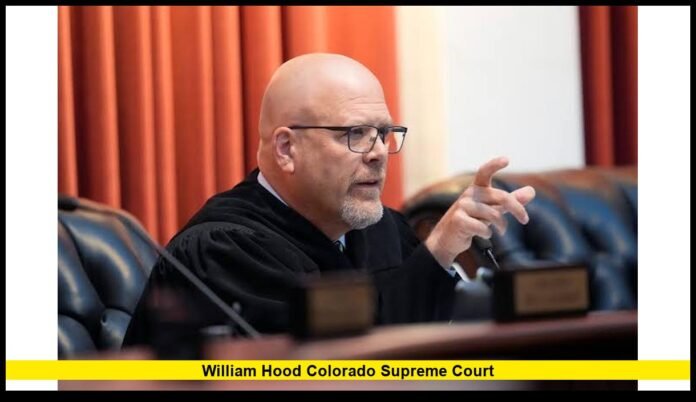

The william hood colorado supreme court story centers on a significant leadership change in Colorado’s judiciary, as Justice William W. Hood III prepares for a potential new term and an expected promotion to chief justice in August 2027. His fellow justices selected him for the leadership position in August 2026, while Colorado voters are scheduled to decide his judicial retention on November 3, 2026. These developments place Hood’s professional record, judicial performance, and future responsibilities in the spotlight.
Hood has served on Colorado’s highest court since January 2014. Before joining the Supreme Court, he spent seven years as a Denver District Court judge and worked in both private litigation and criminal prosecution. His experience across different areas of law has shaped a judicial career that now stands at an important turning point.
As of October 24, 2026, Hood remains a sitting justice, and Chief Justice Monica M. Márquez continues to lead the court. Hood’s planned succession and his retention election are separate matters, making both essential to understanding his current position.
Who Is William W. Hood III?
William W. Hood III is a Colorado Supreme Court justice whose legal career includes work as a prosecutor, private attorney, trial judge, and appellate judge. His professional experience spans criminal law, civil litigation, judicial administration, and legal education.
Hood joined the Colorado Supreme Court after serving on the Denver District Court for seven years. His appointment to the state’s highest court came in October 2013, and he formally took office on January 13, 2014.
During his district court service, Hood handled criminal, civil, and domestic relations matters. This experience exposed him to disputes involving different legal issues and courtroom procedures before he moved into the appellate system.
The Supreme Court occupies a distinct position within Colorado’s judiciary. It serves as the state’s court of last resort, and its decisions bind other Colorado state courts. Its work includes resolving significant legal questions and reviewing cases that raise issues of statewide importance.
Hood’s long service on the court has made him one of its experienced members. His selection as the next chief justice signals that his responsibilities may soon extend beyond deciding cases to leading the judicial branch’s administration.
William Hood’s Selection as the Next Chief Justice
The most significant recent development in Hood’s career came on August 21, 2026, when the Colorado Judicial Branch announced that the justices had selected him to become the next chief justice.
He is scheduled to assume the position in August 2027, when Márquez’s current chief justice term concludes. Until then, Márquez remains the court’s leader, and Hood continues his regular work as a justice.
The selection reflects a decision by Hood’s fellow justices rather than a statewide election for the chief justice position. Colorado’s system gives the members of the Supreme Court responsibility for choosing their administrative leader.
The court adopted a rotating three-year term for the chief justice in 2020. That change replaced the previous practice under which a chief justice could remain in the position indefinitely while retaining the support of colleagues.
Hood’s selection therefore represents the next stage of an established leadership rotation. It also creates a transition period in which he can prepare for the responsibilities associated with managing the state’s judicial system.
Why the Chief Justice Position Matter
The Colorado chief justice holds responsibilities that reach beyond the Supreme Court’s courtroom. The position serves as the executive leadership role for the Colorado Judicial Department, which includes the Supreme Court, Court of Appeals, district courts, county courts, and probation services.
Colorado’s judicial system operates through 23 judicial districts. The chief justice has authority to appoint chief judges for those districts and the Court of Appeals. The role also includes authority to assign active or retired judges to perform judicial duties.
These responsibilities affect the administration of courts throughout the state. Judicial leadership requires attention to staffing, operations, court access, and the systems that support judges, court employees, attorneys, and the public.
The chief justice also remains a member of the seven-justice Supreme Court. Hood would therefore continue participating in the court’s judicial work while assuming broader administrative duties.
The planned transition is particularly important because the chief justice helps guide the institution that interprets Colorado law at its highest level. The position combines legal judgment with leadership and organizational responsibilities.
A One-Year Transition Before Taking Office
Hood’s move toward the chief justice position includes a yearlong onboarding process under Márquez. The Colorado Judicial Branch established this transition to help incoming leaders learn the administrative duties of the role before formally assuming office.
During the transition, Hood will receive guidance from the current chief justice while continuing his responsibilities as a sitting justice. This arrangement is intended to support continuity across the judicial branch.
The chief justice oversees an extensive organization with courts and probation operations across Colorado. Preparing for the role requires familiarity with the administrative decisions that affect the system beyond individual cases.
The transition also gives the outgoing and incoming leaders an opportunity to coordinate responsibilities before the formal change in August 2027.
Hood has expressed appreciation for Márquez’s leadership and willingness to guide him through the process. Márquez has also expressed confidence in his experience and ability to take on the position.
However, the planned succession should not be confused with an already completed appointment to the chief justice role. Hood is the designated successor, while Márquez remains chief justice until the scheduled transition.
William Hood’s 2026 Judicial Retention Election
Another major issue in Hood’s career is his retention election, scheduled for November 3, 2026.
Colorado’s judicial selection system differs from conventional elections in which several candidates compete for the same office. Once appointed and after meeting the applicable initial-term requirements, judges face a yes-or-no retention vote.
Voters decide whether a sitting judge should remain in office. A successful retention vote allows the judge to continue serving under the applicable term rules.
Hood’s current Supreme Court term is scheduled to expire in January 2027. His appearance on the November 2026 ballot gives voters the opportunity to determine whether he should continue serving beyond that term.
The election has additional significance because Hood is already scheduled to become chief justice in August 2027. That future leadership role depends on the relevant judicial office and retention arrangements remaining in place.
The two processes serve different purposes. His fellow justices selected him for future leadership, while voters will decide whether to retain him as a Supreme Court justice.
As of October 24, 2026, the retention election has not occurred. Its final outcome cannot yet be stated.
What Judicial Evaluators Say About Hood
Colorado’s judicial performance evaluation system helps voters assess judges before retention elections. Citizen-led commissions examine judicial performance and provide recommendations for voters to consider.
Hood’s 2026 evaluation found that he meets performance standards. The Colorado State Commission on Judicial Performance reached that conclusion through a unanimous 9–0 vote.
Judicial evaluations consider several aspects of a judge’s work. These can include legal knowledge, analytical ability, integrity, professional conduct, communication, courtroom temperament, and administrative performance.
Evaluators may also examine how judges manage proceedings, interact with attorneys, and prepare written decisions. Such assessments offer voters a structured way to consider professional performance rather than relying only on a judge’s public profile.
Hood’s favorable evaluation is an important part of his retention-election profile. It represents the commission’s assessment, not a prediction of how voters will cast their ballots.
The final retention decision remains with Colorado’s electorate. Voters may consider the evaluation alongside a justice’s experience, record, and approach to judicial responsibilities.
Education and Early Legal Career
Hood’s academic background began at Syracuse University, where he earned a bachelor’s degree in international relations in 1985. He graduated magna cum laude, received academic honors, and was inducted into Phi Beta Kappa.
He later attended the University of Virginia School of Law, graduating in 1990. During law school, he was a member of the Virginia Law Review.
After completing his legal education, Hood developed experience in criminal prosecution and private legal practice. He spent ten years as a prosecutor in Colorado’s 18th Judicial District, which at the time encompassed Arapahoe, Douglas, Lincoln, and Elbert counties.
His prosecutorial responsibilities included leadership positions as chief trial deputy and chief appellate deputy. These roles involved different stages of criminal litigation, giving him experience with trial proceedings and appellate issues.
Hood subsequently became a litigation partner at Isaacson Rosenbaum P.C. in Denver. His work in private practice added experience representing clients in legal disputes before he moved into judicial service.
This combination of professional roles established a foundation for his later work as a district court judge and Supreme Court justice.
Awards and Contributions to Colorado’s Legal Community
Hood has received professional recognition for his judicial service. In 2011, the Denver Bar Association presented him with its Judicial Excellence Award.
In 2014, the Colorado Chapter of the American Academy of Matrimonial Lawyers awarded him its Distinguished Jurist Award.
His involvement in the legal profession has extended beyond courtroom duties. Hood has been a member of the American Bar Association, Colorado Bar Association, and Denver Bar Association.
He has also served on the Colorado Bar Association’s Executive Council and the Denver Bar Association’s Board of Trustees. In 2007, he graduated from the inaugural class of the Colorado Bar Association’s Leadership Training program, known as COBALT.
Hood has contributed to legal education as well. He taught advocacy-related courses as an adjunct faculty member at the University of Denver’s Sturm College of Law.
These activities demonstrate involvement in professional development, legal education, and bar association service alongside his judicial career.
What Happens After the November Election?
The November 3 retention election is the next major milestone in Hood’s career. Its outcome will determine whether he continues serving on the Colorado Supreme Court beyond his current term.
If voters retain him, the planned transition to chief justice in August 2027 can proceed under the established arrangements. He would continue serving as a justice while preparing to assume the additional administrative responsibilities.
If voters do not retain him, his continued service would be affected, and the court would need to address the consequences for the expected leadership transition under applicable procedures.
The election result is therefore important both for Hood’s judicial future and for the court’s leadership plans. Nevertheless, the vote should be viewed separately from the peer selection that designated him as the next chief justice.
For Colorado voters, reviewing the official judicial performance evaluation and understanding the retention process can help clarify what the ballot decision means.
Latest Outlook for William Hood and Colorado’s Supreme Court
Hood enters the final weeks before the November election with a long record of legal and judicial service. His career has included a decade as a prosecutor, private litigation work, seven years on Denver District Court, and service on the Colorado Supreme Court since January 2014.
His selection as the next chief justice creates a clear leadership transition scheduled for August 2027. Meanwhile, his 2026 retention election remains unresolved as of October 24, 2026.
The coming vote will determine whether he continues on the state’s highest court and remains positioned to take on the planned leadership role. The judicial performance commission’s unanimous finding that he meets performance standards provides one established measure for voters to consider.
As Colorado approaches this election and the next chief justice transition, Hood’s judicial record and future responsibilities will remain important subjects for people following the state’s legal system.
Share your perspective on William Hood’s judicial career and Colorado’s upcoming Supreme Court leadership change in the comments, and follow future confirmed developments.