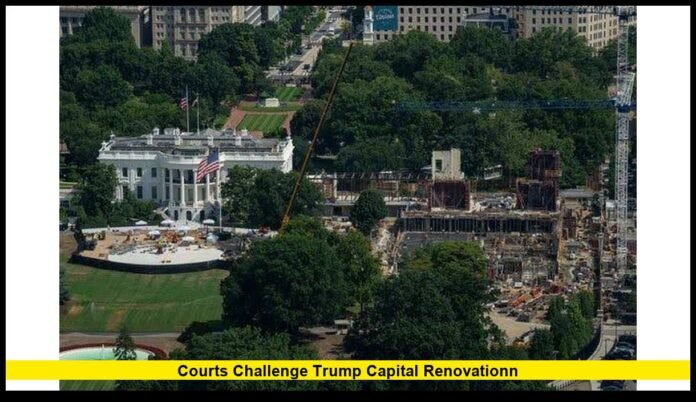

The courts challenge trump capital renovation dispute has intensified in Washington, D.C., as a federal judge questions the Trump administration’s handling of a controversial redevelopment plan for East Potomac Golf Links. The legal battle centers on the removal of hundreds of trees from the historic public property, concerns about environmental and preservation requirements, and conflicting explanations about whether the government has already begun implementing President Donald Trump’s proposed transformation of the golf course. The latest proceedings have placed federal officials under increased scrutiny as the court considers whether additional restrictions are necessary to prevent irreversible changes while the lawsuit continues.
The controversy extends beyond the physical renovation of a golf course. It raises broader questions about presidential authority, the management of federally controlled recreational land, public access, and the legal responsibilities of agencies overseeing historic sites. With the administration announcing plans for a substantial redevelopment and a temporary court order restricting further tree removal through October 26, the coming days could determine how quickly the project advances.
Latest Update on the East Potomac Golf Course Lawsuit
The latest developments center on a series of hearings before U.S. District Judge Ana C. Reyes, who is examining the administration’s actions at East Potomac Golf Links.
During an October 19 hearing, Reyes questioned government officials about the relationship between recent tree removal and Trump’s publicly announced plans to reconstruct the golf course. The hearing followed the removal of more than 400 trees from the property, an action that prompted strong criticism from preservation advocates and the judge overseeing the litigation.
The administration has argued that the tree removal was connected to an existing landscape-management plan developed before Trump announced his redevelopment proposal. Government representatives have maintained that the work was intended to restore aspects of the course’s historic design rather than initiate the president’s larger project.
However, the judge has questioned whether that explanation adequately accounts for the timing and scale of the operation.
The court has temporarily prohibited additional tree removal through October 26. The administration must also provide advance written notice before making irreversible modifications to permanent features of the golf course during the period covered by the order.
No final judgment resolving the entire lawsuit had been announced as of October 20, 2026.
Why Trump Wants to Renovate East Potomac Golf Links
East Potomac Golf Links is located on East Potomac Park, a historic recreational area along the Potomac River near central Washington, D.C. The property has served golfers and other visitors for generations, making it an established part of the capital’s public recreation system.
Trump has proposed a major redevelopment intended to transform the existing facility into a championship-level golf destination.
The proposed project would replace the current 36-hole layout with a single 18-hole championship course designed by golf course architect Tom Fazio. Trump has presented the redevelopment as an opportunity to improve the facility and create a venue capable of hosting prominent professional golf tournaments.
The president has discussed the possibility of attracting events such as the U.S. Open, the PGA Championship, the Ryder Cup, and the Presidents Cup.
He has also announced plans for a closure lasting approximately 15 months, with work scheduled to begin on November 15, 2026.
Those announcements have created uncertainty because the government’s statements in court have not consistently matched the president’s public descriptions of the project.
Officials have indicated that the redevelopment plan remains under review, while Trump has publicly described the renovation as an immediate undertaking. This difference has become a central issue in the proceedings.
The court must determine what actions have actually been authorized, which decisions remain under consideration, and whether the administration can proceed without completing the reviews required by law.
More Than 400 Trees Removed From the Historic Property
Tree removal has emerged as the most immediate source of controversy.
In October, National Park Service crews removed more than 400 trees from East Potomac Golf Links. The operation drew attention because it occurred while a lawsuit challenging the redevelopment was already pending.
The scale of the work raised questions about whether the government was making substantial changes before the court could fully examine the plaintiffs’ arguments.
The administration has pointed to a 2019 cultural landscape report that recommended managing vegetation to restore the course’s historic links-style appearance. Such landscapes typically feature open fairways, fewer trees separating playing areas, and broad views across the surrounding grounds.
Government representatives have argued that the recent work was consistent with those earlier recommendations and was not necessarily the beginning of Trump’s proposed reconstruction.
The plaintiffs dispute that characterization. They argue that the timing and scale of the removal suggest a connection to the president’s broader redevelopment plans.
Government records have also referred to a larger potential tree-removal effort involving approximately 729 trees, although the ultimate scope of any work remains subject to the applicable process and court orders.
Judge Reyes has expressed concern that the administration moved too quickly without adequately addressing the legal implications. Her temporary order is designed to prevent further tree removal while the court evaluates the dispute.
The immediate legal question is not simply whether trees may be removed from a golf course. It is whether the government followed the appropriate procedures and whether the work constitutes part of a broader project requiring additional review.
Judge Ana Reyes Demands Clear Answers From Federal Officials
Judge Reyes has become central to the dispute because she must evaluate whether the government’s actions comply with applicable legal requirements.
During the October 19 hearing, she questioned senior officials about when they learned of the proposed closure, whether the renovation had been finalized, and how the recent tree-cutting operation related to the president’s announcement.
Interior Department official Gregory Wischer indicated that he learned about the planned November closure through Trump’s public social media announcement. Acting National Park Service Director Jessica Bowron also indicated that she had not been informed of a finalized decision establishing that closure date.
Their testimony raised questions about coordination within the administration and the status of the redevelopment.
If the project had not been finalized, the court wanted to understand why substantial work had already taken place. If the tree removal was unrelated to the renovation, officials needed to explain the relationship between the two activities and the timing of the operation.
The government has continued to defend its position, arguing that the landscape-management work had an independent justification.
Reyes has not yet issued a final ruling on the overall project. Instead, she is examining the evidence and considering whether additional safeguards are needed to preserve the property while the case proceeds.
Her scrutiny also reflects the importance of accurate representations to a federal court. Government lawyers and agency officials must provide clear, consistent information when judicial orders govern activities on disputed property.
Trump Administration Seeks to Remove the Judge From the Case
The legal confrontation has developed into a separate dispute over whether Reyes should continue overseeing the lawsuit.
The Justice Department filed a motion seeking her recusal, arguing that her conduct demonstrated bias against the administration. The motion followed earlier hearings in which Reyes strongly criticized government lawyers over the tree removal and the administration’s compliance with previous instructions.
Reyes rejected the recusal request, allowing her to remain assigned to the case.
The disagreement has intensified tensions between the executive branch and the judiciary. Trump has also publicly criticized the judge while defending the proposed renovation.
However, the recusal dispute and the underlying redevelopment lawsuit are separate legal matters.
A request to disqualify a judge does not automatically invalidate an existing order or determine whether a government project is lawful. The court must assess the relevant standards for judicial disqualification independently of the claims concerning the golf course.
The central dispute therefore remains unresolved: whether the administration has complied with the laws and procedures governing changes to the historic property.
The administration continues to defend its authority to manage federal land, while the plaintiffs are seeking to prevent additional changes before the legal issues have been resolved.
Environmental and Historic Preservation Laws Under Review
The lawsuit raises important questions about federal environmental review and the protection of historic properties.
One relevant statute is the National Environmental Policy Act, commonly known as NEPA. It establishes procedures for federal agencies to evaluate the environmental consequences of qualifying proposed actions.
The type and extent of review required depend on the nature of the federal action and the applicable legal standards. Not every maintenance activity requires the same level of environmental analysis, but a substantial redevelopment may raise different considerations.
The National Historic Preservation Act is also relevant to the dispute because East Potomac Park is a historic landscape. Federal agencies may have obligations to consider potential effects on historic properties and follow appropriate consultation procedures before undertaking certain projects.
The plaintiffs argue that the administration must comply with applicable requirements before making significant changes to the site.
They are particularly concerned that dividing work into smaller activities or describing substantial changes as routine maintenance could prevent a comprehensive assessment of the project’s effects.
The government, meanwhile, has cited the earlier landscape report as justification for the tree removal.
The court must determine whether that report adequately supports the actions taken and whether additional procedures apply to the proposed reconstruction.
Neither the existence of an earlier report nor the administration’s authority over federal property automatically resolves those questions.
The outcome will depend on the relevant statutes, the administrative record, the evidence presented, and the judge’s assessment of the government’s legal obligations.
Public Access and the Future of East Potomac Park
The controversy has also drawn attention to the public role of East Potomac Park.
The recreational area is used by golfers, walkers, cyclists, families, and visitors seeking outdoor space near Washington’s major landmarks. East Potomac Golf Links is one part of that larger public landscape.
A closure lasting approximately 15 months could disrupt regular golfers and affect people who rely on the facility for accessible recreation.
Critics have questioned whether a championship-focused redesign would preserve the course’s existing character and maintain reasonable public access. They have also raised concerns about the effects of removing mature trees and altering the historic landscape.
Supporters of the proposal may see the renovation as an opportunity to modernize the facility, improve playing conditions, and attract nationally significant events.
However, the potential benefits and drawbacks remain subjects of debate. The court has not established that the proposed project would necessarily eliminate public access or make the facility unaffordable.
Those questions will depend partly on the final design, operating arrangements, and decisions made by the responsible agencies.
The legal case could influence how the government balances improvements to a public recreational facility with its obligations to protect historic resources and follow established procedures.
What Happens Before the Planned November Closure?
The next immediate milestone is October 26, when the current temporary restriction on tree removal is scheduled to reach its stated endpoint unless the court modifies or extends it.
The judge has indicated that she is considering further safeguards to prevent irreversible changes while the litigation continues.
Several issues could shape the next stage of the proceedings.
Further court restrictions: Reyes could extend the existing tree-removal prohibition or establish additional conditions governing changes to the property.
Additional government disclosures: The court may seek further information about who authorized the tree removal, how the work was funded, and whether it was connected to the larger renovation proposal.
Environmental and preservation reviews: The status of required agency reviews could become increasingly important as the court examines whether the project can lawfully proceed.
Possible changes to the proposal: The administration could revise its plans or adjust the proposed timeline as legal and administrative questions are addressed.
Further litigation: The plaintiffs and government may continue presenting arguments about federal authority, procedural compliance, and the appropriate scope of judicial relief.
Trump’s announced November 15 start date does not itself establish that every element of the renovation has received the necessary approvals.
The legal status of the project will depend on the court’s orders and the requirements governing the specific actions the administration intends to take.
Why the Legal Battle Matters Beyond Washington
The courts challenge trump capital renovation controversy illustrates the tensions that can arise when a president seeks to make substantial changes to federally controlled property.
Presidents have significant authority over executive agencies and federal facilities, but that authority operates within a framework of laws, regulations, and judicial oversight.
When a proposed project affects historic landscapes or public recreational resources, questions about environmental review, preservation, transparency, and public access can become especially important.
The dispute also highlights the consequences of taking irreversible action while litigation is pending. Once mature trees have been removed or a historic landscape has been substantially altered, restoring the original conditions may be difficult.
For preservation advocates, the case is about ensuring that government agencies follow the required process before changing a historic public resource.
For the administration, it raises questions about how federal property can be improved and how much flexibility agencies have when implementing a president’s priorities.
The court’s decisions could influence the timeline and scope of the East Potomac redevelopment. They may also provide guidance on the responsibilities of federal officials when proposed improvements overlap with active litigation.
Importantly, the temporary restrictions should not be confused with a final determination that the entire renovation is unlawful. The judge is managing the immediate risks while considering the legal claims, and the ultimate outcome remains undecided.
Latest Outlook: Will Trump’s Golf Course Renovation Proceed?
As of October 20, 2026, Trump’s East Potomac Golf Links redevelopment remains under legal scrutiny. The removal of hundreds of trees, the proposed 15-month closure, and inconsistent accounts about the project’s status have made the dispute increasingly contentious.
Judge Reyes has temporarily halted further tree removal through October 26 and required advance notice before irreversible modifications to the property. The administration continues to defend its actions, while preservation advocates and local golfers are seeking stronger protections.
The immediate question is whether the court will extend its restrictions or impose additional safeguards before further work can occur. The broader issue is whether the proposed championship course can proceed while satisfying the environmental, historic-preservation, and other legal requirements that apply.
The next court decisions will be particularly important as the administration approaches its announced November 15 start date. Until the legal questions are resolved, the proposed schedule should be understood as the administration’s stated plan rather than a guarantee that construction will proceed as announced.
What do you think about Trump’s plans for East Potomac Park and the court’s intervention? Share your opinion in the comments and stay informed as new developments emerge.