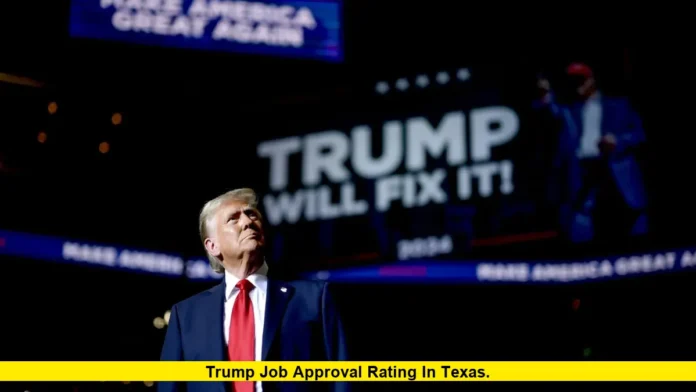

The Trump job approval rating in Texas remains underwater in the latest October polling, with more Texas voters disapproving than approving of President Donald Trump’s performance. A survey of likely voters conducted October 5–8, 2026, found that 45% approved of Trump’s job performance, while 54% disapproved. Another recent Texas poll reported approval at 47% and disapproval at 53%, showing that his standing varies by survey.
These results offer an important snapshot of Trump’s political position in a traditionally Republican state as Texas voters prepare for the November 2026 midterm elections. Although Trump retains substantial support among Republican voters, his overall approval numbers suggest that economic concerns, national policy decisions, and the political environment are important factors shaping public opinion.
Latest Trump Approval Rating in Texas
The latest available polling shows a consistent pattern: Trump’s disapproval rating exceeds his approval rating in Texas, although the size of the gap differs among surveys.
| Poll and survey period | Approve | Disapprove |
|---|---|---|
| ReconMR Texas Poll, October 5–8, 2026 | 45% | 54% |
| UMass Lowell/YouGov, September 18–28, 2026 | 47% | 53% |
| Marist Poll, September 17–20, 2026 | 43% | 55% |
The ReconMR survey interviewed 617 likely Texas voters. The UMass Lowell/YouGov survey included 850 likely voters, while the Marist survey interviewed 1,139 registered voters.
These figures should not be treated as interchangeable measurements. The surveys used different field dates, sample populations, and methodologies. Nevertheless, all three found that more respondents disapproved of Trump’s job performance than approved of it.
The October ReconMR results provide the most recent direct statewide measurement identified in this research. They suggest that Trump’s political standing in Texas deserves attention as the midterm elections approach, but one poll cannot establish a long-term trend by itself.
Why Trump’s Approval Rating Matters in Texas
Texas has long been an important stronghold for Republican presidential candidates. Trump won the state in the 2024 presidential election, and Republican candidates continue to compete from a position of considerable strength in many parts of Texas.
However, a state’s presidential voting history does not guarantee that every voter approves of the president’s performance. Some Texans may support Republican candidates while disagreeing with particular presidential policies. Others may approve of Trump personally but express dissatisfaction with economic conditions or decisions made by his administration.
This distinction matters because job approval and election preference measure different things. A voter who disapproves of Trump is not automatically a Democratic voter, just as someone who approves of him is not guaranteed to vote Republican in every race.
The latest polling indicates that Trump’s overall approval is below 50% in the surveys reviewed. Whether that translates into significant changes in the 2026 election results will depend on candidate quality, turnout, local issues, and the preferences of voters who remain undecided.
What the October 2026 Poll Reveals About Texas Voters
The October ReconMR survey offers a useful snapshot of the political environment shortly before Election Day.
Its results put Trump’s approval at 45%, compared with 54% disapproval. The difference between those figures is nine percentage points in favor of disapproval.
The survey also found a closely contested political environment in Texas. In the U.S. Senate race, Democrat James Talarico received 48% support compared with 44% for Republican Ken Paxton. In the gubernatorial contest, Republican incumbent Greg Abbott received 48%, while Democrat Gina Hinojosa received 47%.
These are candidate preference figures, not measurements of presidential approval. They nevertheless help explain why Trump’s standing has attracted attention in discussions about the midterms.
The same survey found that 50% of respondents believed Texas was heading in the wrong direction, compared with 39% who said the state was on the right track. Nationally, 58% viewed the country’s direction negatively, while 37% viewed it positively.
These findings point to broader dissatisfaction with political conditions among the surveyed voters. They do not, on their own, prove that dissatisfaction with Trump caused the competitive candidate results.
Economic Concerns and the Cost of Living
Economic conditions are an important part of the political environment surrounding Trump’s approval rating in Texas.
Household expenses, fuel prices, housing costs, and the affordability of everyday necessities can influence how voters evaluate the president. Even when employment or other economic indicators appear favorable, families may remain dissatisfied if their purchasing power feels constrained.
A September UMass Lowell/YouGov survey found that 47% of likely Texas voters approved of Trump’s job performance, while 53% disapproved. The poll also examined concerns about energy prices and the effects of national policies on household finances.
Among respondents, 72% identified the war in Iran as the leading factor behind rising energy costs. Another 11% identified tariffs, while smaller percentages selected gas taxes, environmental regulations, or artificial intelligence data centers.
These responses describe voters’ perceptions of energy prices, rather than establishing the precise economic contribution of each factor.
The distinction is important when evaluating presidential approval. Polling can show what respondents believe is affecting their lives, but it cannot independently determine the economic effects of individual government policies.
For Trump, the political challenge is that voters may evaluate his performance partly through their personal experience of inflation and household expenses. If affordability remains a major concern, it could continue to influence public opinion ahead of the midterms.
How Trump’s Approval Rating Has Changed
Comparisons with earlier surveys offer additional context, but they require care.
The September UMass Lowell/YouGov poll reported 47% approval for Trump in Texas. The same institution’s October 2020 Texas poll recorded 50% approval. That comparison suggests that his approval was three percentage points lower in the newer survey than in that earlier measurement.
However, the two surveys were conducted six years apart under different political and economic conditions. The comparison should not be interpreted as a continuous trend or as evidence that approval declined steadily over that period.
The September Marist survey produced a lower approval figure of 43%, with 55% disapproving. The October ReconMR survey subsequently recorded 45% approval and 54% disapproval.
The two surveys differ in their timing and methodology, so the small numerical difference does not conclusively demonstrate that Trump’s standing improved between September and October.
The most reliable way to assess a genuine change is to examine repeated surveys using comparable questions, populations, and methods. At present, the available results establish that disapproval exceeded approval across the three surveys, rather than proving a precise statewide increase or decline over the last several weeks.
Differences Between Texas Voters and National Voters
Trump’s approval in Texas should also be distinguished from his national approval rating.
Texas has a different political composition from the United States as a whole. Its electorate includes large urban populations, suburban communities, rural voters, and a wide range of demographic and economic groups. These differences can produce state-level results that diverge from national polling.
A national survey measures opinion across a broader electorate. A Texas-specific survey measures opinion among the population selected for that particular state poll. Differences in sampling, field dates, and respondent demographics can affect the results.
Consequently, national approval figures should not be substituted for Texas figures when reporting the president’s standing in the state.
The national political environment can still provide context. Debates about inflation, immigration, foreign policy, and government spending may affect voters across the country, including Texans. However, the strength of those effects can vary considerably by region and demographic group.
The available Texas surveys demonstrate why local polling remains necessary for understanding the state’s political climate.
What the Approval Numbers Could Mean for the 2026 Midterms
The November 2026 midterm elections will determine control of the U.S. House and Senate, making Texas an important state to watch.
Trump’s approval rating may influence the political environment for Republican candidates, particularly when voters view congressional elections as a judgment on the president’s performance. Strong presidential approval can help unify a party’s supporters, while widespread disapproval may create additional challenges for candidates associated with the administration.
However, presidential approval is only one factor in an election. Texas voters will also consider candidates’ records, campaign messages, state and local concerns, party loyalty, and the issues they consider most important.
The current Senate and gubernatorial polling suggests competitive contests, but presidential approval figures cannot independently predict their outcomes. Candidate surveys measure intended voting preferences at a particular moment, and those preferences can change before Election Day.
Turnout is another major consideration. A poll of likely voters attempts to account for who may actually vote, but its estimate depends on the survey’s methodology. The eventual electorate may differ from the population anticipated by pollsters.
For that reason, Trump’s approval numbers are best viewed as one indicator of the political climate rather than a forecast of which party will win.
How to Interpret the Latest Polls Correctly
Readers tracking Trump’s approval rating in Texas should pay attention to several details when new surveys are released.
- Survey dates: The field period indicates when respondents expressed their views. A poll published today may contain interviews conducted weeks earlier.
- Sample population: Registered voters, likely voters, and all adults represent different groups. Their approval estimates may differ.
- Margin of error: Sampling uncertainty means that small differences between poll results may not represent meaningful changes in public opinion.
- Question wording: A question about job approval is not the same as one about personal favorability or voting preference.
- Repeated measurements: Several comparable surveys are generally more informative about trends than one isolated result.
These considerations are especially important when polls produce approval estimates of 43%, 45%, and 47%. The figures indicate different survey results, not necessarily a precise ranking of the president’s popularity at one identical moment.
The October ReconMR survey is the newest direct Texas approval measurement identified here. Its findings provide a timely snapshot, while the September surveys offer useful supporting context.
Final Thoughts on Trump’s Job Approval in Texas
The latest available polling shows that President Donald Trump’s approval rating in Texas remains below his disapproval rating. The October ReconMR survey recorded 45% approval and 54% disapproval, while two September surveys also found that disapproval was higher.
These results highlight a challenging political environment for the president as the 2026 midterms approach. Economic concerns and national policy debates form part of that environment, but the available polling does not establish that any single issue is responsible for the approval gap.
Future surveys will help determine whether these figures represent a sustained pattern or a temporary snapshot of voter sentiment. For now, the clearest takeaway is that Texas remains an important state to watch, and Trump’s approval numbers provide one useful measure of the political climate ahead of November’s elections.
What do you think is shaping Trump’s approval rating in Texas? Share your thoughts in the comments and stay updated for the latest polling developments.