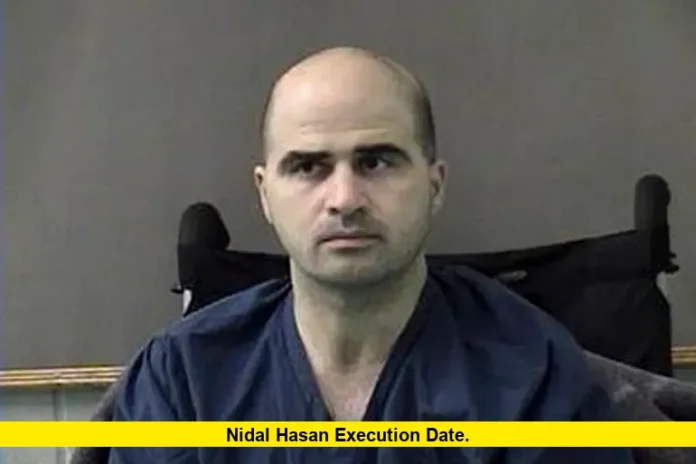

The Nidal Hasan execution date is scheduled for December 3, 2026, at 1 p.m. Central Standard Time at Fort Hood, Texas. The U.S. Army announced the date after President Donald Trump approved the death sentence on October 2, 2026. Acting Army Secretary Adam Telle subsequently directed that Hasan be executed by firing squad. The planned execution would mark the first U.S. military execution since 1961 and the first execution by a military firing squad since 1945. However, the scheduled date remains subject to any legal proceedings that could delay its implementation.
The announcement represents a major development in the long-running military capital punishment case involving Nidal Malik Hasan, the former Army major convicted of killing 13 people during the November 5, 2009, shooting at Fort Hood. His death sentence was imposed in 2013, but the military appeals process and subsequent legal proceedings delayed the case for years.
What Is Nidal Hasan’s Execution Date?
The U.S. Army has officially scheduled Hasan’s execution for December 3, 2026. The announcement identifies Fort Hood, Texas, as the location and specifies 1 p.m. Central Standard Time as the planned time.
The principal confirmed details are:
- Scheduled execution date: December 3, 2026
- Scheduled time: 1 p.m. Central Standard Time
- Location: Fort Hood, Texas
- Planned execution method: Firing squad
- Death sentence: Imposed on August 28, 2013
- Presidential approval: October 2, 2026
- Execution directive: Issued by Acting Army Secretary Adam Telle on October 6, 2026
The Army’s October 7 announcement confirmed the date and location. The directive followed the president’s authorization and the completion of the military appellate process.
As of the latest available information on October 9, 2026, December 3 remains the scheduled date. It is important to distinguish an official execution schedule from a completed execution. Hasan has not yet been executed, and subsequent legal action could affect the timetable.
Why Was Nidal Hasan Sentenced to Death?
Hasan received the death penalty for his role in the mass shooting at Fort Hood, a major U.S. Army installation in Texas now known as Fort Cavazos.
On November 5, 2009, Hasan opened fire inside the Soldier Readiness Processing Center, where military personnel were completing preparations connected with their service assignments and deployments.
The attack killed 13 people and wounded 32 others. The victims included 12 active-duty soldiers and one retired service member. The shooting devastated military families and prompted widespread questions about security, personnel screening, and the Army’s handling of warning signs before the attack.
Hasan was an Army psychiatrist who had served in the military before the shooting. Investigators established his responsibility for the attack, and he was subsequently tried by a military court-martial.
During the proceedings, Hasan represented himself. He acknowledged that he was the shooter and presented a defense that reflected his opposition to U.S. military operations in Muslim-majority countries. His statements and actions became significant parts of the trial.
The military jury found him guilty on August 23, 2013, of 13 counts of premeditated murder and 32 counts of attempted premeditated murder. Five days later, on August 28, the jury unanimously imposed the death penalty.
The sentence also included dismissal from military service and forfeiture of his military pay and allowances. The verdict established the legal basis for the capital punishment proceedings that have now reached the scheduled execution stage.
When Was Nidal Hasan’s Death Sentence Approved?
President Donald Trump approved Hasan’s death sentence on October 2, 2026. The decision followed a recommendation from Defense Secretary Pete Hegseth.
Under the military justice system, the president has the authority to approve a death sentence for a military prisoner. The Army then follows established procedures to determine the execution date and carry out the sentence.
Acting Army Secretary Adam Telle issued the execution directive on October 6, setting December 3 as the planned date. The Army published its formal announcement the following day.
The timing is significant because the case had remained unresolved for more than a decade after Hasan’s conviction. Although the military jury imposed the death penalty in 2013, the sentence could not proceed directly to execution without the required legal reviews and executive authorization.
The Army’s announcement stated that the appellate process had upheld the conviction and death sentence. It also confirmed that the Supreme Court denied Hasan’s request for review of his court-martial conviction on March 31, 2025.
The presidential approval and subsequent execution directive therefore represent the latest major steps in the case.
Why Will Nidal Hasan Be Executed by Firing Squad?
The Army has scheduled Hasan’s execution by firing squad, an exceptionally rare method of capital punishment in the United States.
Military executions have historically used different methods, including hanging and lethal injection. The military’s most recent execution occurred on April 13, 1961, when Army Private John A. Bennett was hanged at Fort Leavenworth, Kansas.
The last U.S. military execution by firing squad occurred in 1945. If Hasan’s execution proceeds as scheduled, it would mark the first military firing squad execution in more than eight decades.
The choice of method follows the recommendation made by Defense Secretary Hegseth and approved by President Trump. The Army’s October announcement confirmed that the planned method would be a firing squad.
However, the public announcement of the method does not mean that every operational detail has been disclosed. Questions about implementation, the applicable procedures, and possible legal challenges remain relevant to the execution timetable.
The case is unusual because military death sentences are rare, and executions within the military justice system are rarer still. Hasan’s scheduled execution would end a gap of more than 65 years since the last execution under the U.S. military justice system.
Where Will Nidal Hasan’s Execution Take Place?
The scheduled execution location is Fort Hood, Texas, the same installation where the 2009 shooting occurred.
The location connects the execution proceedings directly to the military post where Hasan committed the crimes for which he was convicted. The Army has specified Fort Hood in its announcement, along with the December 3 date and 1 p.m. Central time.
Hasan has been held on military death row at the United States Disciplinary Barracks at Fort Leavenworth, Kansas. His imprisonment there followed his conviction and death sentence.
The planned execution would therefore involve a change from his long-term place of confinement to the designated execution location in Texas. The Army has not publicly detailed every aspect of the arrangements.
For readers tracking the case, the official date and location are the most important confirmed details. Reports about other logistical matters should be treated separately unless the Army formally confirms them.
Will Nidal Hasan’s Execution Be Livestreamed?
Reports published on October 8, 2026, said the Defense Department planned to livestream Hasan’s execution. The reported plan has drawn attention because a publicly livestreamed U.S. military execution would be unprecedented in modern American practice.
Defense Secretary Hegseth has publicly supported making the execution visible, presenting it as a demonstration of the consequences of severe crimes. The proposal has also prompted debate about government transparency, the dignity of the condemned prisoner, and the treatment of execution as a public event.
Legal and procedural questions remain important. Public reporting has raised concerns about the rules governing a military execution broadcast and whether existing regulations provide a clear framework for such a livestream.
The reported broadcast plan should not be confused with the confirmed execution schedule. The Army has officially announced the date, time, location, and method. The livestream details have been reported separately and may involve additional procedural decisions.
As of October 9, the reported plan is a notable development, but it does not establish that the execution will necessarily take place on schedule or that all broadcast arrangements are final.
Can Nidal Hasan Appeal and Delay the Execution?
Although the military appellate process has upheld Hasan’s conviction and sentence, further legal proceedings could still affect the execution date.
One potential avenue involves seeking relief through the civilian federal court system. A petition for a writ of habeas corpus can challenge the legality of detention or raise certain constitutional issues, subject to the applicable legal standards and procedural requirements.
Such a petition does not automatically mean an execution will be postponed. The outcome depends on the claims raised, the court’s jurisdiction, the applicable deadlines, and whether a court grants relief or issues a stay.
Nevertheless, legal experts have noted that civilian court proceedings could delay the scheduled execution if Hasan pursues an available challenge and obtains the necessary judicial intervention.
The distinction matters because presidential approval and an official execution date do not eliminate every possible legal question. The military justice system has completed the appellate process described in the Army’s announcement, but that does not necessarily prevent all subsequent litigation.
Readers should therefore treat December 3, 2026, as the official scheduled date rather than an unconditional guarantee that the execution will occur on that day.
What Happens Next in the Nidal Hasan Case?
The next stage centers on preparations for the scheduled execution and any legal developments that could affect it.
The Army has established the date, time, location, and method. Officials must follow the applicable military regulations and execution procedures while addressing any outstanding legal requirements.
The case also remains significant for the families of the 13 people killed and the 32 people injured in the 2009 attack. For those families, the execution announcement marks a major development after years of court proceedings and uncertainty over when the sentence might be carried out.
Several developments could determine the final timetable:
- Whether Hasan initiates further legal proceedings.
- Whether a court considers any new petition or request for a stay.
- Whether the Army maintains the December 3 schedule.
- Whether officials issue additional confirmed information about the execution arrangements.
These are procedural factors, not predictions about what Hasan or the courts will do. The available confirmed information establishes the current schedule but does not settle every possible legal development before December.
How the Nidal Hasan Execution Date Was Established
The timeline explains why the execution date has attracted significant attention.
| Date | Confirmed development |
|---|---|
| November 5, 2009 | The Fort Hood shooting killed 13 people and injured 32. |
| August 23, 2013 | A military jury found Hasan guilty of 13 counts of premeditated murder and 32 counts of attempted premeditated murder. |
| August 28, 2013 | The jury imposed the death penalty. |
| March 31, 2025 | The Supreme Court denied Hasan’s request to review his court-martial conviction. |
| October 2, 2026 | President Trump approved the death sentence. |
| October 6, 2026 | Acting Army Secretary Adam Telle directed the execution and set the date. |
| October 7, 2026 | The Army publicly announced the execution schedule. |
| December 3, 2026 | The currently scheduled execution date. |
The timeline shows the lengthy process between conviction and the current execution schedule. The death sentence was imposed in 2013, but the military’s legal review and the required presidential approval preceded the formal execution directive.
What the Scheduled Execution Means for the U.S. Military Justice System
Hasan’s case stands out because of the extraordinary time between the original crime, the court-martial, and the planned execution.
The military justice system includes capital punishment for certain serious offenses, but death sentences require extensive legal review. The president also has a formal role in approving a military prisoner’s death sentence.
The planned execution would be the first carried out by the U.S. military since 1961. It would also revive the use of a military firing squad, a method last used by the U.S. military in 1945.
Those historical circumstances make the case significant beyond the scheduled date itself. It raises questions about military execution procedures, constitutional protections, and the administration of capital punishment within a separate system of military justice.
For now, the central facts remain clear: Hasan was convicted in 2013, his death sentence received presidential approval in October 2026, and the Army has scheduled his execution for December 3 at Fort Hood.
Final Update on the Nidal Hasan Execution Date
As of October 9, 2026, Nidal Malik Hasan is scheduled to be executed by firing squad on December 3, 2026, at 1 p.m. Central Standard Time at Fort Hood, Texas. President Trump’s approval and Acting Army Secretary Adam Telle’s directive have moved the case to the execution-planning stage, although further legal proceedings could still affect the schedule. The reported livestream proposal has added another dimension to an already historic military death penalty case.
What do you think about the latest developments in the Nidal Hasan case? Share your thoughts in the comments and stay informed as confirmed updates emerge.