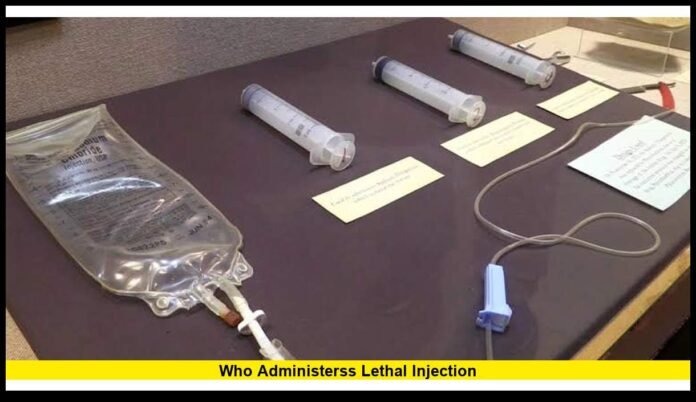

Who administers lethal injection depends on the state, but the person delivering the drugs is generally part of a specially selected execution team rather than a judge, prison warden, or ordinary hospital physician. State laws and correctional policies determine who prepares the procedure, establishes intravenous access, administers the chemicals, monitors the prisoner and confirms the completion of the execution.
The issue has received renewed national attention after Tennessee’s failed execution attempt involving Christa Pike on September 30, 2026. Pike survived after two doses of pentobarbital were administered during the procedure and was taken to an outside medical facility. She later regained consciousness and was reported to be speaking with her attorneys while receiving medical treatment.
The Tennessee Department of Correction has maintained that officials followed the state’s established execution protocol. Governor Bill Lee ordered an independent review and paused the state’s remaining scheduled executions for 2026. The incident has intensified scrutiny of the personnel who carry out lethal injections and the safeguards governing their work.
The Person Who Administers the Drugs
There is no single nationwide position called the “executioner” in the United States.
Each jurisdiction creates its own procedures. Some states specifically use the term executioner, while others refer to an execution team or designated correctional personnel.
The individual who physically administers lethal chemicals may therefore have a different professional background depending on the state.
In many cases, the person works within the corrections system. Some jurisdictions also use medically trained personnel for particular portions of the procedure. However, medical involvement does not automatically mean that a physician administers the final drug.
Execution teams can contain several people with separate responsibilities. One person may establish intravenous access, another may operate the equipment used to deliver the chemicals, and another may monitor the process.
The identities of these individuals are frequently protected by state confidentiality laws.
Why There Is No National Executioner
Capital punishment in the United States is primarily administered by individual states, which means execution procedures are not standardized nationwide.
A state legislature can establish statutory requirements, while a corrections department may develop detailed procedures for carrying out an execution.
That creates substantial differences between jurisdictions.
For example, one state may specify that a particular corrections official administers lethal chemicals. Another may create a larger team with multiple people responsible for different stages. A third may require medical personnel to assist with intravenous access or monitoring.
The federal government also has its own execution procedures.
Consequently, a person searching for the identity of the person who administers an execution cannot rely on one national answer. The answer depends on the government conducting the execution and the protocol in effect at that time.
What Does an Execution Team Do?
An execution team is responsible for carrying out the operational aspects of a death sentence.
Its duties can include several distinct functions:
- Preparing the execution chamber
- Preparing equipment
- Establishing intravenous access
- Preparing or handling authorized chemicals
- Administering the chemicals
- Monitoring the prisoner during the procedure
- Communicating with prison officials
- Responding to procedural problems
- Assisting with the formal completion of the execution
Not every member performs every task.
The division of duties is designed to create a controlled process in which individuals have clearly defined responsibilities.
Some members may work outside the execution chamber. Others may have direct contact with the prisoner.
In jurisdictions where execution personnel are protected by confidentiality laws, the public may never learn which individual performed a particular task.
Do Doctors Administer Lethal Injections?
A doctor may participate in an execution in some states, but that does not mean the doctor necessarily administers the lethal drugs.
This distinction is important because lethal injection resembles a medical procedure in some respects. It can involve IV equipment, needles and medical terminology, but an execution is a legal punishment rather than medical treatment.
Some states use medical professionals for technical assistance. A physician or nurse may help establish intravenous access, while another trained person administers the chemicals.
Georgia’s execution procedures illustrate this separation of duties. Its established framework provides for physician involvement and trained personnel responsible for intravenous access, while designated staff administer the solutions.
Other states have different arrangements.
The result is that the person who inserts an IV line may not be the same person who administers the lethal substance. Likewise, a physician present during an execution may have a role that does not involve delivering the final drug.
Who Establishes the IV Line?
Establishing intravenous access can be one of the most important technical steps in a lethal injection procedure.
The task is not necessarily assigned to the person who administers the drugs.
Depending on state requirements, IV access may be established by a physician, nurse, paramedic or another specially trained member of the execution team.
The procedure can involve more than one IV line or backup arrangements, depending on the jurisdiction’s protocol.
The importance of this step became particularly visible after the failed Tennessee execution of Christa Pike.
Pike received two doses of pentobarbital but survived the attempt. Her attorneys have raised questions about the execution process, while medical experts and observers have examined whether problems involving intravenous delivery could have contributed to what happened.
Tennessee officials have said the state’s protocol was followed and that the state does not permit additional procedures outside its established process.
The independent review ordered after the incident is expected to provide greater information about what occurred.
Who Pushes the Injection?
The final administration of lethal chemicals is generally performed by designated execution personnel.
The person may be identified in law as an executioner or may simply be one of several trained members of an execution team.
Some states use multiple people to administer different syringes or substances.
This arrangement can make it difficult for the public to identify one individual as “the executioner.”
Mississippi law, for example, establishes an execution team and assigns responsibilities involving the administration of lethal chemicals. Missouri also provides for an execution team selected by correctional authorities, with medical personnel included in the broader process.
Other states use different terminology and structures.
The central point is that the person physically delivering the drug is normally acting under a state-approved execution protocol.
What Does the Prison Warden Do?
The prison warden usually has a supervisory role rather than personally administering the lethal injection.
Correctional leadership is responsible for coordinating the execution and ensuring that required legal and administrative procedures are followed.
The warden or another senior corrections official can communicate instructions to the execution team and oversee the institution’s preparations.
That does not necessarily mean the warden enters the execution chamber to administer the drugs.
The exact responsibilities vary by state.
In some systems, the warden can serve as the primary official overseeing the execution. In others, a department commissioner, director or specially designated official may carry the ultimate administrative responsibility.
Who Determines When the Execution Is Complete?
The completion of an execution involves another distinction.
The person administering the lethal substance may not be the person who determines or certifies death.
State law establishes the requirements for declaring an inmate dead. Depending on the jurisdiction, a physician, medical professional, coroner or another authorized official may have a role.
This separation exists because administering the chemicals and formally establishing death are different responsibilities.
An execution team can therefore complete its assigned procedure while another authorized person handles the legal or medical certification that follows.
The precise rules depend on state law.
Why Executioners’ Identities Are Often Confidential
The identities of execution personnel are protected in many jurisdictions.
States have generally cited safety concerns as a major reason for keeping names confidential. People associated with executions can face threats, harassment, unwanted publicity or professional consequences.
Confidentiality laws can cover a wide range of participants.
Protected information may include:
- Names of execution-team members
- Medical personnel
- Correctional employees
- Contractors
- Pharmacists
- Drug suppliers
- People involved in preparing chemicals
- Professional qualifications
- Business contact information
South Carolina, for example, defines its execution team broadly. Its law covers people or entities involved in planning or administering an execution, including those involved with execution drugs, equipment and medical supplies.
As a result, even when the public knows that an execution team was present, it may not know the identities or precise professional backgrounds of the people involved.
How Tennessee’s 2026 Failure Changed the Conversation
Tennessee’s September 2026 execution attempt has become a major current example of why execution personnel and procedures receive scrutiny.
Christa Pike was scheduled to be executed at Riverbend Maximum Security Institution in Nashville. The U.S. Supreme Court allowed the execution to proceed after a lower federal court had temporarily halted it.
The state then attempted to carry out the sentence by lethal injection.
Pike received two doses of pentobarbital but did not die. She was eventually transported to an outside medical facility.
The Tennessee Department of Correction said that officials followed every step of the established execution protocol.
Pike’s attorneys subsequently sought information about the procedure and preservation of evidence. They have also challenged the circumstances surrounding the execution attempt.
By October 7, Pike had regained consciousness and was communicating with her lawyers, although she remained seriously injured and under medical care.
Governor Bill Lee ordered an independent investigation and suspended the state’s remaining executions for 2026. Tennessee Correction Commissioner Frank Strada also resigned following the incident.
The developments have placed renewed attention on the people responsible for administering and supervising executions.
What the Tennessee Case Reveals About Execution Roles
The Pike case demonstrates why it can be misleading to describe lethal injection as something performed by one person.
Several stages must occur before and during the procedure.
Correctional officials coordinate the execution. Trained personnel prepare the equipment and establish access to the prisoner. Designated personnel administer the chemicals. Other officials monitor the procedure and manage communication.
Medical professionals may have separate responsibilities depending on the state’s rules.
When something goes wrong, responsibility can therefore involve multiple layers rather than one individual.
The independent investigation in Tennessee is particularly important because it can help determine what happened during the procedure and whether the established protocol was properly followed.
How Execution Personnel Are Selected
Selection procedures vary by jurisdiction.
Some states give correctional department officials authority to choose members of the execution team. The people selected may already work within the prison system or may have specialized training relevant to their assigned duties.
The selection process is generally not comparable to applying for a conventional public-facing job.
Because executions involve confidentiality and security concerns, states can limit information about team members.
Training can cover equipment, communication procedures, emergency contingencies and the specific execution protocol adopted by the jurisdiction.
The person responsible for administering lethal chemicals therefore receives instructions and preparation that are specific to the state’s system.
Are Executioners Medical Professionals?
Not necessarily.
A person can participate in an execution without being a doctor, nurse or other healthcare professional.
That distinction reflects the legal nature of capital punishment.
Medical licensing rules and execution laws do not always operate in the same way. Some states have enacted specific provisions governing the participation of medical professionals and other personnel in executions.
The result is a system in which someone performing an execution-related medical task may not be acting as a healthcare provider in the ordinary clinical sense.
This issue has generated legal disputes in several states, particularly where professional medical organizations oppose participation in executions.
Who Is Legally Responsible for Carrying Out an Execution?
Responsibility generally follows the government structure established by state law.
Courts determine whether a death sentence may legally be carried out. Once the legal barriers have been cleared, corrections officials implement the sentence.
The governor may have clemency authority, depending on state law, while courts retain authority over constitutional and procedural challenges.
The corrections department then coordinates the actual execution.
Within that system, the execution team performs the physical tasks required by the protocol.
This creates a chain of responsibility rather than placing the entire process on one person.
The Difference Between the Executioner and the Execution Team
The word “executioner” can create the impression that one person performs every part of a lethal injection.
Modern execution procedures are generally more complicated.
An execution team can include personnel assigned to different stages of the process. One person may handle intravenous access, another may administer the drugs, another may supervise communications, and medical personnel may have separate responsibilities.
The identities of those people can also be legally protected.
That is why the most accurate answer to the question of who administers lethal injection is that the procedure is carried out by designated personnel under the authority of the jurisdiction conducting the execution.
What Happens When a Lethal Injection Fails?
A failed execution can raise difficult legal and procedural questions.
The Tennessee case involving Pike is especially significant because the state administered two doses of its lethal injection drug but did not complete the execution.
The state has said its protocol did not authorize additional procedures beyond those already performed.
Pike’s survival has led to questions about what happens when a death sentence is not successfully carried out and whether another execution attempt can legally be scheduled.
Those questions are now part of an evolving legal process.
The independent review ordered by Governor Lee is also expected to examine the circumstances surrounding the failed procedure.
Until those investigations and legal proceedings produce additional confirmed findings, claims about the precise cause of the failure should be treated cautiously.
Why the Answer Varies From State to State
The United States does not operate a single national lethal injection system.
State legislatures establish different rules. Corrections departments adopt different protocols. Medical participation differs. Confidentiality protections differ. Even terminology can vary.
One jurisdiction may identify a State Executioner. Another may rely on a confidential group of corrections employees. Another may specify medical personnel for certain tasks while assigning drug administration to trained staff.
The differences mean that a statement about one state’s execution process cannot automatically be applied to every other state.
For readers trying to understand a particular execution, the relevant state’s current statute and execution protocol are the most important starting points.
What the Latest Developments Mean
The failed Tennessee execution has placed unprecedented attention on the mechanics and personnel involved in lethal injection.
It has also demonstrated why execution procedures cannot be understood simply as a doctor administering a drug to a prisoner.
Behind every lethal injection is a structured system involving corrections officials, designated execution personnel and, in some jurisdictions, medical professionals.
The exact people involved may remain unknown because of confidentiality laws.
As of October 7, 2026, Tennessee’s response remains one of the most significant recent developments. Governor Bill Lee has paused the state’s remaining executions for the year while an independent investigation examines the failed attempt involving Pike.
The investigation may provide additional information about the procedure, the execution team and the circumstances that allowed Pike to survive.
The Bottom Line
The person who physically administers lethal injection is generally a specially selected member of an execution team, not necessarily a physician or prison warden. The precise role depends on state law and the execution protocol adopted by the jurisdiction.
Medical professionals may participate in some states, particularly in tasks involving intravenous access or medical assessment. Other jurisdictions rely primarily on trained corrections personnel.
Confidentiality laws also mean that the public often cannot identify the individual who actually delivers the lethal chemicals.
Tennessee’s failed execution of Christa Pike has made these distinctions especially important in 2026. The state’s investigation could reveal more about how its execution team operated and whether its established procedures were properly followed.
As the national debate over capital punishment continues, understanding who performs each part of an execution remains essential to understanding how the death penalty is actually carried out in the United States.