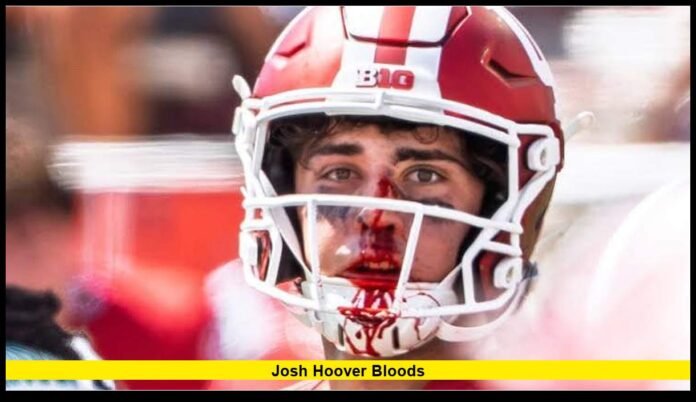

Josh Hoover blood became a trending search topic after the Indiana quarterback was left with a visibly bleeding nose during the Hoosiers’ season-opening game against North Texas. The incident looked alarming on television, but Hoover stayed on the field, continued leading Indiana’s offense and went on to produce an impressive debut for his new team.
The moment occurred during Indiana’s September 5 matchup with North Texas. Hoover was involved in a play in which his facemask was pulled, causing his helmet to twist around his head. The contact resulted in an injury around his nose, and blood quickly became visible on his face.
Despite the dramatic appearance of the injury, Hoover did not allow the incident to define his first appearance for Indiana. He continued playing and eventually helped the Hoosiers secure a convincing victory.
What Happened to Josh Hoover?
Hoover’s injury happened during a physical play against North Texas. As the quarterback was brought down, a defender grabbed his facemask. The contact caused Hoover’s helmet to move significantly and appeared to result in a cut or injury around his nose.
Blood soon became visible across his face and chinstrap.
Because the incident occurred during a nationally watched college football game, television cameras captured the aftermath in detail. Images of Hoover playing with blood on his face quickly circulated among fans and generated considerable online interest.
The quarterback, however, remained involved in the game.
Rather than becoming sidelined for the remainder of the contest, Hoover continued operating Indiana’s offense. He eventually connected with Charlie Becker for a 9-yard touchdown, adding an especially memorable moment to his Indiana debut.
The sequence demonstrated that the visible bleeding did not prevent him from continuing to compete.
Did Josh Hoover Break His Nose?
One of the biggest questions surrounding the incident was whether Hoover had suffered another broken nose.
Hoover has previously discussed breaking his nose multiple times, but the North Texas incident was not publicly established as a new major fracture.
After the game, Hoover indicated that the injury looked worse than it actually felt. His comments helped put the television images into perspective.
A bloody nose can look particularly severe because the nose contains a large number of blood vessels. Even relatively limited trauma can produce significant bleeding, especially during a contact sport such as football.
The amount of blood visible on Hoover’s face therefore does not, by itself, establish the seriousness of an injury.
Most importantly, Hoover remained in the contest and subsequently continued playing for Indiana.
Why Was Hoover Able to Keep Playing?
Football players routinely undergo evaluation after contact, particularly when an injury involves the head or face. The fact that Hoover remained on the field indicates that the situation did not prevent him from continuing at that time.
The quarterback was able to communicate with teammates, operate the offense and make throws after the incident.
Indiana’s medical and coaching staff were also in a position to monitor him during the game.
For fans who saw only photographs of the bloodied quarterback, the images could suggest a much more serious situation than what actually occurred. Hoover’s continued participation provided additional context.
He completed the game and did not immediately disappear from Indiana’s lineup in the weeks that followed.
Hoover Turned the Moment Into a Strong Debut
The injury became memorable because it happened during an otherwise excellent first game for Hoover in an Indiana uniform.
He completed 13 of 16 passes against North Texas for 231 yards and four touchdowns. Indiana won the game 52-16.
That performance gave fans an early look at what the transfer quarterback could bring to the program.
The bloody-nose incident therefore became a footnote to a much larger story: Hoover had successfully begun his Indiana career with a highly productive passing performance.
His ability to remain composed after taking a hard hit was also noticeable.
Rather than allowing the interruption to disrupt the offense, Indiana continued moving the football.
Hoover’s Move From TCU to Indiana
The interest surrounding Hoover is partly connected to the circumstances of his arrival in Bloomington.
Hoover transferred to Indiana after spending several seasons at TCU. During his time with the Horned Frogs, he developed extensive experience as a starting quarterback and became one of the more established passers available in the transfer market.
He entered Indiana with a substantial college résumé.
During his TCU career, Hoover appeared in 35 games and made 31 starts. He accumulated 9,629 passing yards and 71 touchdown passes.
His final season at TCU was particularly productive, with 3,472 passing yards and 29 touchdowns.
Those numbers made Hoover an attractive option for Indiana as the program prepared for life after Fernando Mendoza.
Why Indiana Needed a New Quarterback
Indiana entered the 2026 season facing the difficult task of replacing Mendoza, who had become one of the biggest stories in college football during the previous campaign.
Mendoza helped Indiana achieve an undefeated championship season before becoming the first overall selection in the 2026 NFL Draft.
That meant Hoover did not arrive in Bloomington under ordinary circumstances.
He was taking over the offense of a program that had just experienced an extraordinary season.
The expectations surrounding the position were therefore substantial from the beginning.
Hoover’s experience at TCU gave Indiana an experienced player capable of stepping into a high-profile role.
His first game showed why the coaching staff had confidence in him.
Strong Numbers After the Opening Game
The North Texas game was not an isolated performance.
Through Indiana’s first three games of the 2026 season, Hoover completed 37 of 51 attempts for 649 yards. He had thrown 10 touchdown passes without an interception during that opening stretch.
His completion percentage during those games was 72.5 percent.
Indiana also won all three contests.
Against Western Kentucky, Hoover completed 18 of 24 passes for 273 yards and two touchdowns in Indiana’s 38-0 victory.
Those performances helped shift attention away from the earlier injury and toward his performance as Indiana’s starting quarterback.
What Does the Blood Incident Mean for His Season?
For now, the nose injury does not appear to have changed Hoover’s role.
He remained Indiana’s starting quarterback as the team moved into Big Ten competition.
There has been no indication that the injury from the North Texas game developed into a season-ending or extended absence.
That is important for fans searching for updates because social media posts can sometimes make a sports injury appear more serious than it is.
The most visible part of Hoover’s injury was the blood on his face. His subsequent participation provides the more important context.
The Physical Demands of Playing Quarterback
Quarterbacks are often protected from some forms of contact, but they remain vulnerable to facial injuries.
A quarterback can be struck while throwing, hit during a sack or pulled down by equipment such as the facemask.
Even when a play does not produce a major injury, facial contact can lead to bleeding.
Hoover’s incident is a good example of why visual severity and medical severity are not always the same thing.
The sight of a player covered in blood naturally attracts attention, but the underlying injury has to be assessed independently.
In Hoover’s case, his ability to continue playing became a key part of the story.
Josh Hoover’s Playing Style
Hoover entered Indiana with the reputation of a quarterback capable of handling a significant passing workload.
His production at TCU showed his experience in a high-volume offense, while his early Indiana performances demonstrated accuracy and touchdown production.
The transition also required him to learn a new offensive system, build chemistry with new receivers and take responsibility for a program with championship expectations.
His first three games provided encouraging statistical signs, particularly his touchdown-to-interception ratio.
However, the Big Ten schedule represented a different challenge from the opening portion of the season.
Conference opponents would provide a tougher test of how Hoover and the Indiana offense performed over an extended schedule.
Why Fans Continue Searching for the Injury
The unusual circumstances surrounding the incident explain much of the continued interest.
Hoover was a new quarterback playing his first game for a nationally prominent program. He was then shown on television with blood running down his face after a facemask-related play.
Within moments, the image became one of the most recognizable scenes from Indiana’s season opener.
The fact that he continued playing made the incident even more memorable.
Sports fans frequently search for injury updates when a player visibly suffers an injury, particularly when there is uncertainty about whether the athlete will return.
In Hoover’s case, the answer became clear during the game itself: he continued competing.
What Hoover Said About the Injury
Hoover’s own comments were significant because they indicated that the injury was not as painful or serious as the visual evidence might have suggested.
He acknowledged that the situation looked worse than it felt.
He also referenced having broken his nose in the past, providing additional context for his experience with similar injuries.
Those comments helped explain why he was able to maintain his focus after the incident.
Instead of allowing the injury to dominate his attention, Hoover returned to the task of running Indiana’s offense.
Indiana’s Expectations for Hoover
Indiana’s decision to bring in Hoover was about much more than finding a temporary replacement at quarterback.
The Hoosiers needed a player with experience who could take control of the offense after Mendoza’s departure.
Hoover’s background provided that experience.
He had already played extensively in a major college football program, dealt with pressure as a starting quarterback and produced significant passing numbers.
His early results at Indiana suggested that he was comfortable with the responsibility.
The season, however, was still developing, making every Big Ten game important for assessing how the new quarterback performs against conference competition.
Latest Status of Josh Hoover
The available information indicates that Hoover remained active after the bloody-nose incident and continued his role as Indiana’s starting quarterback.
Indiana began the 2026 season with victories over North Texas, Howard and Western Kentucky before moving into Big Ten play.
The nose injury from the opening game did not keep Hoover out of subsequent contests.
For readers specifically following Josh Hoover blood, the key takeaway is that the visible bleeding came after contact involving his facemask during Indiana’s game against North Texas. The incident looked dramatic, but Hoover remained in the game, threw a touchdown and continued playing in the following weeks.
His larger 2026 storyline is his attempt to establish himself as Indiana’s starting quarterback after transferring from TCU and following a national championship season that ended with Mendoza entering the NFL.
The early portion of his Indiana career has already included strong passing statistics, a memorable debut and one particularly striking moment that fans are unlikely to forget.
As the season progresses, Hoover’s performances on the field will remain the primary measure of his first year in Bloomington. The bloody-nose incident, meanwhile, stands as one of the more recognizable moments from his introduction to Indiana football.