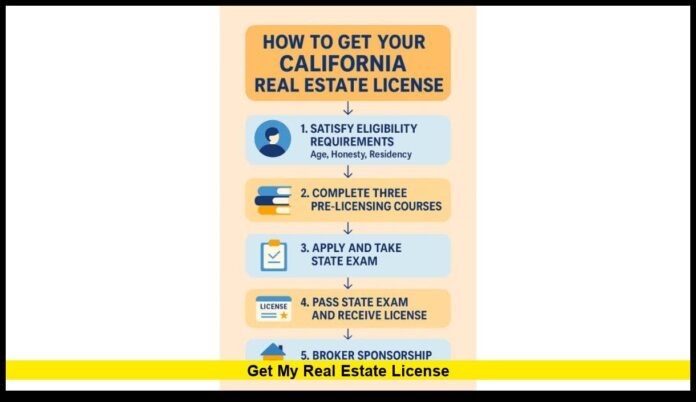

Get my real estate license is a common search for people looking to enter the U.S. real estate industry, and the basic path remains state-specific in 2026: complete required education, meet eligibility rules, pass the licensing exam, submit the application, and satisfy any state-specific background or sponsorship requirements.
Every U.S. state requires real estate sales agents and brokers to hold a license. However, there is no single national real estate license. State real estate commissions and licensing agencies establish the education, examination, application, renewal, and continuing-education rules for their jurisdictions.
The process can look similar across the country, but important details differ. Education hours, exam structure, application fees, fingerprint requirements, broker sponsorship, renewal periods, and reciprocity rules can all vary by state.
For anyone researching how to enter the industry in 2026, understanding that state-by-state structure is the first step.
What It Means to Get a Real Estate License
A real estate license authorizes an individual to perform regulated real estate activities under the laws of the state that issued the license.
Real estate sales agents generally help clients buy, sell, or rent property. They may market homes, arrange showings, communicate with clients, prepare transaction documents, and assist with negotiations.
Sales agents normally work under the supervision of a licensed broker. A broker has additional authority and can generally operate or manage a real estate brokerage business, subject to state law.
The U.S. Bureau of Labor Statistics reports that all states require real estate brokers and sales agents to be licensed. It also reports that a high school diploma or equivalent is typically the entry-level education requirement, although each state establishes its own licensing conditions.
That means someone interested in becoming an agent does not generally need a four-year college degree just to begin the licensing process.
The Basic Steps to Get My Real Estate License
Although requirements differ by jurisdiction, the licensing journey usually follows a recognizable sequence.
1. Choose the State Where You Want to Work
The first decision is the state in which you intend to practice.
Licenses are issued by individual states and territories rather than by the federal government. A license issued in one state does not automatically authorize someone to practice in every other state.
Before paying for a course, applicants should check the current requirements published by their state real estate commission or licensing agency.
This matters because education requirements can differ substantially between states.
2. Check the Eligibility Requirements
Most states establish basic eligibility requirements before an applicant can receive a real estate license.
Common requirements include:
- Meeting a minimum age
- Having a high school diploma or equivalent
- Completing approved prelicensing education
- Passing a state licensing examination
- Completing an application
- Paying required fees
- Completing a background check or fingerprinting when required
- Meeting character or other statutory requirements
The exact requirements are controlled by state law.
Applicants should not assume that satisfying the rules in one state automatically satisfies another state’s requirements.
Prelicensing Education Is a Major Part of the Process
Most states require prospective agents to complete approved real estate education before taking or completing the licensing process.
The courses introduce applicants to the legal and practical foundations of real estate.
Typical subjects can include:
- Real estate principles
- Contracts
- Agency relationships
- Property ownership
- Financing
- Real estate mathematics
- Fair housing
- Property management
- State real estate law
- Licensing rules
- Ethics and professional responsibilities
The number of required education hours varies by state.
Some jurisdictions allow approved online education, while others impose specific attendance, testing, or course-delivery requirements. Applicants should make sure the school and course are approved for the particular state.
Distance learning is also regulated differently across jurisdictions. Some states have specific requirements concerning approved providers and course delivery.
The Real Estate Licensing Exam
After completing the required education, applicants generally must pass a state licensing examination.
Many state exams contain questions covering both general real estate principles and state-specific law.
The examination process can therefore require preparation beyond simply memorizing definitions.
Applicants should understand topics such as contracts, property rights, agency relationships, financing, fair housing, disclosures, mathematics, and applicable state rules.
Exam procedures also vary.
Some states use separate national and state portions. Others administer examinations under different structures. Testing providers can also vary by jurisdiction.
The Association of Real Estate License Law Officials maintains information on regulatory agencies and examination-related programs across U.S. jurisdictions, but the state licensing authority remains the controlling source for an applicant’s actual requirements.
Background Checks and Fingerprinting
Background checks are another important part of the licensing process in many states.
The requirements are not identical nationwide.
Some states require fingerprints and criminal-history checks as part of an initial application. Others have additional procedures involving license renewals or specific categories of applicants.
A criminal record does not automatically mean an applicant cannot become licensed in every jurisdiction. State laws determine how criminal history is considered and what disclosures may be required.
Applicants should answer licensing questions honestly and provide documentation when requested.
For example, Oregon currently requires unlicensed applicants to complete a criminal-record background check and submit fingerprints. Washington also has fingerprint requirements for certain first-time real estate license applicants.
These examples demonstrate why applicants should use their own state’s current rules rather than relying on a general national checklist.
Do You Need a College Degree?
In most states, a bachelor’s degree is not required to become a real estate sales agent.
The typical entry-level education listed by the U.S. Bureau of Labor Statistics is a high school diploma or equivalent.
That does not mean college education has no value in real estate.
Courses in business, finance, economics, accounting, marketing, communications, or law can provide useful knowledge. However, those subjects generally are not a substitute for whatever state-approved licensing education the jurisdiction requires.
The key distinction is between education that may help an individual’s career and education legally required for licensure.
Applicants should focus first on the education requirements imposed by the licensing authority in their state.
How Long Does It Take to Get a Real Estate License?
There is no single nationwide timeline.
The total time depends on several factors, including:
- Required education hours
- Course availability
- Study schedule
- Exam scheduling
- Exam results
- Fingerprinting or background checks
- Application processing
- Broker sponsorship requirements
- State licensing procedures
Someone studying full time may complete the education requirement relatively quickly in one state, while another applicant may take considerably longer.
The examination can also affect the timeline. If an applicant does not pass on the first attempt, additional preparation and another examination may be required under state rules.
Applicants should therefore treat the licensing process as a series of state-controlled steps rather than a fixed national program.
What Happens After Passing the Exam?
Passing the exam does not always mean the applicant can immediately begin working independently.
Depending on the state, additional steps may include submitting the license application, completing a background check, providing fingerprints, paying fees, submitting documentation, or associating with a sponsoring broker.
The terminology also differs.
Some states use the term “salesperson,” while others use terms such as “sales agent” or “broker.”
The legal role attached to the license matters more than the terminology.
A newly licensed sales agent generally cannot simply open an independent brokerage and operate as a broker. Broker licenses typically involve additional education and experience requirements.
Finding a Sponsoring Broker
In states that require sponsorship or broker affiliation, a newly licensed sales agent must work under an eligible broker.
Choosing a brokerage can affect the practical experience of a new agent.
Applicants commonly examine factors such as:
- Training programs
- Commission structures
- Mentorship
- Technology
- Transaction support
- Office resources
- Marketing assistance
- Brokerage fees
- Local market presence
The specific arrangement varies between companies and states.
A person who has completed the licensing process should understand the brokerage agreement before beginning business activities.
Real Estate License vs. REALTOR® Status
A real estate license and REALTOR® membership are not the same thing.
A state government issues the real estate license. The National Association of REALTORS® does not issue state real estate licenses.
A licensed agent can practice real estate without automatically becoming a REALTOR®.
REALTOR® is a membership designation associated with membership in the National Association of REALTORS® and its applicable local and state associations.
This distinction is important for people researching how to enter the industry because obtaining a license is a government licensing process, while REALTOR® membership is a separate professional association matter.
License Reciprocity Can Matter If You Move
Real estate licenses generally do not transfer automatically from one state to another.
However, some states have reciprocity or other recognition arrangements that can simplify licensing for professionals who already hold a license elsewhere.
The rules vary.
A state may recognize certain education or examination results, require a state-specific exam, or impose additional application requirements.
Reciprocity also does not necessarily mean an applicant can immediately practice every type of real estate activity in the new state.
Anyone moving across state lines should check the licensing authority in the destination state before assuming that an existing license will be accepted.
Continuing Education Does Not End With the License
Getting licensed is only the beginning of the regulatory process.
Most states require licensed real estate professionals to complete continuing education to renew their licenses.
The number of hours, deadlines, subject requirements, and renewal cycles vary.
Some states require specific courses covering areas such as fair housing, ethics, agency law, legal updates, or other subjects.
State rules can also change over time.
For example, Oregon introduced significant real estate licensing changes beginning in 2026, including updated continuing-education requirements. Other states have made their own changes to licensing and renewal rules.
The practical lesson is straightforward: agents need to monitor their state licensing authority after receiving a license, not just before getting one.
Important Real Estate Licensing Changes in 2026
Real estate licensing remains a state-regulated field, and several jurisdictions have introduced or implemented changes during 2026.
North Carolina changed several licensing-related rules effective April 1, 2026. Among the changes were a new original broker license application fee of $105 and a $50 renewal fee. The state also created a permanent voluntary license-cancellation process under specified conditions.
North Carolina also changed rules concerning synchronous distance learning. Beginning July 1, 2026, certain students taking synchronous distance-learning courses must remain visible on camera to satisfy attendance requirements.
Texas implemented changes affecting real estate license holders beginning January 1, 2026. Among the changes, brokers must complete the Broker Responsibility Course under specified renewal and application circumstances.
Oregon also implemented significant licensing-law changes in 2026, including a new timeshare sales-agent license category and revised continuing-education provisions.
These examples show why older online licensing guides can become inaccurate.
A course provider, blog post, social-media video, or discussion forum may describe requirements that have since changed.
Current Licensing Rules Remain State-Specific
There is no universal national checklist that guarantees approval for every applicant.
The Association of Real Estate License Law Officials maintains a directory of real estate regulatory agencies across U.S. jurisdictions. State agencies remain the appropriate place to confirm current requirements.
Applicants should verify:
- Minimum age
- Education requirements
- Approved course providers
- Examination rules
- Application procedures
- Application fees
- Fingerprinting requirements
- Background-check rules
- Sponsoring broker requirements
- License activation procedures
- Renewal deadlines
- Continuing-education requirements
- Reciprocity rules
Checking these items before beginning the process can prevent unnecessary delays and expenses.
How Much Do Real Estate Agents Make?
Income varies significantly in real estate.
The U.S. Bureau of Labor Statistics reports that the median annual wage for real estate sales agents was $52,830 in May 2025. The median annual wage for real estate brokers was $73,220 during the same period.
These figures should not be interpreted as guaranteed earnings for new licensees.
Real estate professionals often earn income through commissions, and individual earnings can vary with transactions, property values, market conditions, experience, and business activity.
The BLS also reports that earnings can be irregular, particularly for people who are new to the occupation.
For people considering licensing, this is an important practical consideration. Obtaining a license provides authorization to practice. It does not guarantee a specific level of income.
Employment Outlook for Real Estate Professionals
The latest BLS projections show that employment for real estate brokers and sales agents is projected to grow by 2% from 2025 through 2035.
The agency projects approximately 40,400 openings for real estate brokers and sales agents each year, on average, during that period.
Many of those openings are expected to result from workers leaving the occupation or transferring to other occupations rather than from rapid employment expansion.
The figures describe the occupation nationally and do not predict an individual’s earnings or career results.
Local housing markets can differ considerably from national conditions.
What New Applicants Should Prepare Before Starting
Before enrolling in a course, a prospective applicant can organize the licensing process around a few practical questions.
First, identify the state. Licensing is jurisdiction-specific.
Second, check the current education requirement. Confirm that the course is approved for the intended license.
Third, review the examination rules. Understand whether the state uses separate portions, specific testing providers, or other procedures.
Fourth, determine whether fingerprints or a background check are required.
Fifth, review the application process and fees.
Sixth, understand whether a sponsoring or supervising broker is required.
Finally, review renewal and continuing-education requirements.
Following those steps helps applicants understand the complete process instead of focusing only on the licensing exam.
The Path After Licensing
A newly licensed agent can build experience through actual transactions, brokerage training, mentoring, and continued education.
Real estate professionals often specialize over time.
Possible areas include residential sales, commercial property, leasing, investment property, new construction, luxury homes, or other segments permitted by state law and the agent’s qualifications.
A sales agent may eventually pursue a broker license after meeting the state’s experience, education, and examination requirements.
Broker requirements are generally more demanding than initial sales-agent licensing.
The BLS notes that states typically require licensed sales-agent experience before someone can obtain a broker license, although the precise requirements vary.
Why State Verification Matters in 2026
The biggest issue for someone trying to get a real estate license is not simply finding a course or passing an exam.
It is making sure every step matches the rules currently in effect where the person intends to practice.
Real estate licensing laws can change through legislation, regulatory rulemaking, fee adjustments, education changes, examination policies, and renewal requirements.
Recent 2026 changes in states such as North Carolina, Texas, Oregon, Colorado, and Washington demonstrate that licensing and professional practice rules continue to evolve.
For that reason, applicants should treat current state licensing information as the final authority.
A national guide can explain the process, but only the applicable state regulator can establish whether an applicant currently satisfies the legal requirements for a particular license.
For readers researching a career in real estate, our guides on how to get a real estate license and real estate license courses provide useful information about the education and licensing steps involved.
If you are planning your real estate career, check your state’s current licensing requirements before taking the first step and stay informed as the rules continue to change.
Curious about Berkshire Hathaway Real Estate and the services it offers across the U.S.? Take a closer look at its brokerage network, real estate professionals, and the resources available to people buying or selling a home.