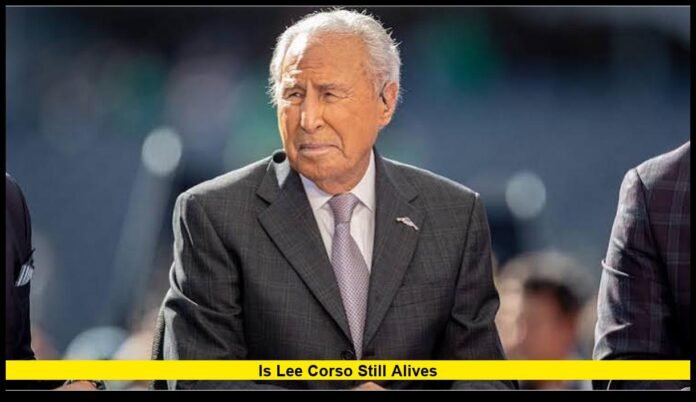

For fans wondering is lee corso still alive, the answer is yes. Lee Corso remains alive at 91 and has continued to make occasional appearances away from his former role on college football television. The legendary broadcaster celebrated his 91st birthday in August 2026, and a recent reunion with longtime colleague Kirk Herbstreit offered fans a fresh glimpse into his life after College GameDay.
Corso’s absence from ESPN’s Saturday pregame show has understandably prompted questions about his current status. He retired from College GameDay in August 2025 after a television run that stretched across nearly four decades. His retirement, however, did not mark the end of his public connection to college football.
Lee Corso Is 91 Years Old
Born August 7, 1935, Corso reached his 91st birthday on August 7, 2026.
His age has become an important part of the conversation surrounding his life after television. Corso spent decades appearing in front of millions of college football fans, making his disappearance from the weekly broadcast particularly noticeable.
Recent reports indicate that he continues to follow college football closely despite no longer appearing regularly on television.
A recent meeting with Herbstreit in Orlando provided one of the clearest recent public updates involving Corso. The two longtime colleagues reunited shortly before the 2026 college football season, giving Herbstreit an opportunity to spend time with the coach he worked alongside for many years.
A Recent Reunion Drew Attention
Corso’s connection with Herbstreit remains strong even though their regular television partnership has ended.
In August, Herbstreit shared a photo from his meeting with Corso in Orlando. According to the account surrounding the reunion, Corso made the effort to see Herbstreit after learning that his former colleague was in the area.
The encounter quickly attracted attention from college football fans who had not seen Corso in his familiar College GameDay role for some time.
The reunion also demonstrated that Corso remains connected to people from his broadcasting career. Herbstreit has frequently spoken warmly about his former colleague, particularly since Corso’s retirement.
Health Has Been Part of Recent Discussions
Corso’s health has also received attention as he has entered his 90s.
In September 2026, Herbstreit discussed Corso during an interview and said the former analyst is dealing with several physical ailments. At the same time, Herbstreit emphasized that Corso remains mentally engaged and continues to follow the sport.
Those comments provide useful context for fans who may have noticed that Corso’s public appearances have become less frequent.
Corso previously suffered a stroke in 2009 and eventually returned to his broadcasting duties. His career continued for many years afterward, although his responsibilities and travel schedule changed as he grew older.
His retirement from College GameDay came after years of adapting his role to accommodate the realities of working at an advanced age.
Why Did Lee Corso Retire From College GameDay?
Corso announced his retirement from College GameDay in 2025, bringing his long association with the program to an end.
His final appearance occurred on August 30, 2025, in Columbus, Ohio, before the Texas-Ohio State matchup.
That broadcast became a celebration of Corso’s career and his contribution to college football television. It also gave fans an opportunity to see him perform one final headgear selection, a tradition that had become inseparable from his television persona.
Rather than disappearing because of an announced death or sudden event, Corso stepped away after an extraordinary stretch of television work.
His retirement explains why viewers do not see him on the program during the 2026 season.
The End of an Iconic Television Tradition
For many viewers, Corso’s most recognizable contribution was the headgear pick.
Near the end of major College GameDay broadcasts, Corso would select the team he believed would win and then place a mascot head on his own head.
The segment became a defining part of the program.
His first famous mascot-head appearance came in 1996, when he selected Ohio State. Nearly three decades later, Ohio State again provided the setting for his final broadcast.
The symbolism was difficult to miss. Corso’s television career had come full circle in Columbus, where one of the show’s most enduring traditions had begun.
Corso’s Career Started Long Before ESPN
Corso was not simply a television personality who became famous through College GameDay.
His football career began as a player at Florida State, where he played quarterback and defensive back.
After college, he entered coaching and worked his way through various positions before eventually becoming a head coach.
His coaching résumé included Louisville, Indiana and Northern Illinois. He also worked in professional football.
That experience gave him a perspective that became valuable during his broadcasting career. Corso could discuss football from the standpoint of someone who had spent decades inside college athletics.
When he joined College GameDay, that combination of football knowledge and entertainment helped establish a television personality unlike most traditional analysts.
The Phrase Fans Still Remember
Corso’s television identity was built around more than football predictions.
His enthusiastic personality, playful arguments and distinctive catchphrases made him a recognizable figure outside the traditional sports-analysis audience.
His most famous expression, “Not so fast, my friend,” became closely associated with his appearances on College GameDay.
The phrase was typically used when Corso challenged another analyst’s prediction or argument.
His willingness to turn football analysis into entertainment helped make him one of the show’s defining personalities.
Life Away From the Saturday Broadcast
Corso’s retirement has changed his relationship with college football television, but it has not erased his connection to the sport.
The recent meeting with Herbstreit showed that he remains interested in college football and continues to maintain relationships with people from his ESPN years.
Herbstreit has also continued to speak publicly about the importance of his relationship with Corso.
For fans, these occasional updates have become a way to keep track of a broadcaster who was once a weekly fixture on television.
Instead of appearing every Saturday, Corso is now enjoying life away from the demands of a national sports production.
Why Fans Continue to Search for Updates
The continued interest in Corso is understandable given the length of his career.
Someone who appeared regularly on television for almost 40 years becomes part of viewers’ routines. When that person suddenly stops appearing each week, fans naturally want to know what happened.
Corso’s age has also contributed to the attention surrounding his current status.
At 91, he belongs to a generation of sports personalities whose careers span multiple eras of American college football.
The most recent public updates have provided reassurance to fans who simply want to know how he is doing after retirement.
What His Legacy Means to College Football
Corso’s impact is not limited to the number of years he spent on television.
He helped turn a college football pregame segment into a major Saturday-morning tradition. His headgear selections became a recognizable feature of the sport’s television culture, while his coaching background gave his analysis additional depth.
His career also demonstrated how a former coach could become an entertainment personality without completely abandoning the football knowledge that established his reputation.
For viewers who grew up watching College GameDay, Corso became part of the experience of college football Saturdays.
The Latest Answer for Fans
As of September 2026, Lee Corso is alive and 91 years old.
The latest public updates show a retired football broadcaster who remains connected to the sport and maintains relationships with former colleagues. His recent reunion with Herbstreit has been particularly notable because it offered fans a current glimpse of Corso away from the television studio.
His health has become a more significant consideration at his age, and Herbstreit has acknowledged that Corso is dealing with physical difficulties. At the same time, the former College GameDay analyst remains engaged with football and continues to follow the sport he has spent most of his life around.
For longtime viewers, the most important distinction is straightforward: Corso’s absence from College GameDay reflects his retirement from the program, not a death announcement.
His television career may have ended, but the legacy created through decades of coaching, broadcasting and unforgettable Saturday-morning moments remains firmly established in college football history.