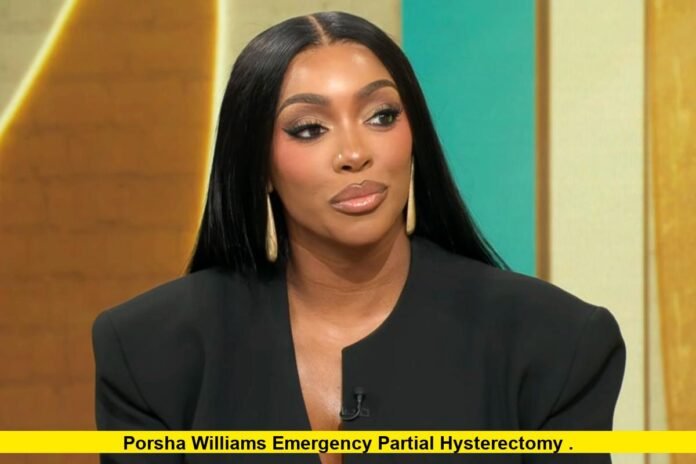

Porsha Williams emergency partial hysterectomy has become the focus of a new health disclosure after the reality television personality revealed that doctors discovered 21 uterine fibroids before performing surgery earlier this year. Williams, 45, discussed the experience publicly on September 18, 2026, explaining that the diagnosis came unexpectedly while she was exploring fertility options and that the surgery ultimately changed her ability to have more biological children.
The former The Real Housewives of Atlanta star said she had lived with fibroids for years and had previously undergone procedures intended to preserve her uterus and fertility. Despite those efforts, the growths returned. By the time doctors evaluated her again, the problem had become extensive.
Williams said doctors ultimately found 21 fibroids during surgery. One was reportedly as large as a cantaloupe. She also said doctors identified endometriosis and another condition involving the uterine lining before the operation.
Porsha Williams Opens Up About the Emergency Surgery
Williams revealed the details in a personal essay for Glamour and discussed the experience during an interview with Gayle King on CBS Mornings. She described the sequence of events as happening extremely quickly.
The surgery took place in May 2026, about two weeks after doctors identified the severity of her condition and determined that a hysterectomy was necessary.
Williams said she initially did not expect to receive such serious news. She had been accompanying a friend to a fertility appointment to learn about egg freezing. During that visit, Williams decided to ask for an examination of her own reproductive health.
That examination changed everything.
The doctor noticed abnormalities and referred Williams to a fertility specialist. The specialist then ordered an MRI after seeing the extent of the fibroids. Williams said she was shocked to learn that the growths had returned despite her earlier treatments.
Doctors Found 21 Uterine Fibroids
The most striking detail from Williams’ disclosure is the number and size of the fibroids discovered during the operation.
Doctors found 21 uterine fibroids in total. One of them had grown to approximately the size of a cantaloupe, according to Williams’ account.
Before surgery, Williams had already learned that she had more than 15 large fibroids. Her specialist also identified endometriosis and another issue involving the uterine lining.
The findings left Williams facing a difficult decision. She had spent years trying to manage fibroids while maintaining the possibility of having another child. A hysterectomy meant that possibility would end.
Williams ultimately underwent a partial hysterectomy. Her ovaries were retained, but her uterus was removed. Because she no longer has a uterus, she cannot carry another pregnancy.
Why the Fibroids Were Especially Significant for Williams
Williams’ history with fibroids stretches back to her early attempts to become a mother.
She said she first learned she had fibroids when she was about 30 and was pregnant with her first child. The fibroid grew during the pregnancy, and Williams experienced a miscarriage at four months.
About a year later, she underwent a myomectomy to remove fibroids while preserving her uterus.
The condition returned during her pregnancy with her daughter, Pilar Jhena McKinley. Williams described that pregnancy as difficult because of the fibroids and said she spent the final month on bed rest as the growths degenerated.
Pilar was born in 2019. Williams has described her daughter as her “rainbow baby” following the earlier pregnancy loss.
After Pilar’s birth, Williams said the fibroids returned again. She subsequently underwent uterine fibroid embolization, a treatment designed to reduce fibroids while preserving the uterus.
At the time, Williams still did not know whether she would want another child. Preserving her fertility therefore remained important to her.
Symptoms Williams Initially Thought Were Related to Age
One reason the recurrence was not immediately obvious to Williams was that some of her symptoms seemed easy to associate with getting older.
She told CBS News that she had been experiencing a longer menstrual cycle, migraines and fatigue. At 45, she initially wondered whether the symptoms could be related to perimenopause.
The subsequent examination revealed that the symptoms had another possible explanation.
Williams said the fibroids were affecting her body in ways she had not fully recognized. After the surgery, she reported improvements in several areas of her health, including migraines and low iron levels. She also said the fibroids had affected her sexual function and placed pressure on her bladder.
The size and location of the growths had become particularly serious. Williams said they had grown large enough to close off more than 60% of her birth canal and put pressure on her bladder.
Porsha Williams Emergency Partial Hysterectomy Changed Her Fertility Plans
The physical recovery was only part of the experience for Williams.
The surgery also forced her to confront the permanent loss of her ability to carry another pregnancy. She had spent years choosing treatments that would preserve her uterus because she wanted to keep the possibility of another child open.
The timing was particularly difficult because she had been considering fertility options when doctors discovered the recurrence.
Williams said she had been exploring egg freezing with the possibility of using a surrogate in the future. The discovery of the extensive fibroids and the need for surgery changed those plans.
Although her ovaries were preserved, removal of the uterus meant she could no longer carry a pregnancy herself.
That loss has been emotionally significant for Williams. She described waking after surgery and realizing that part of her reproductive future was gone. Her public comments have focused not only on the physical effects of the procedure but also on the grief associated with losing a choice she had worked to preserve.
Williams Says the Surgery Improved Her Quality of Life
Despite the emotional consequences, Williams has also described substantial improvements since the procedure.
She said the operation ultimately saved her life and that her quality of life has improved dramatically. She connected the improvement to symptoms she had previously not realized were related to her fibroids.
Migraines, low iron levels and the physical strain caused by the large fibroids had affected her daily life. She also described the impact the growths had on intimacy and bladder function.
For Williams, the experience has therefore involved both loss and relief.
The hysterectomy ended her ability to carry another child, but it also addressed a serious medical problem that had persisted despite several previous treatments.
Her Long History of Trying to Preserve Fertility
Williams’ medical journey demonstrates why the surgery was not an immediate or simple decision for her.
Her earlier treatments included a myomectomy and uterine fibroid embolization. Both reflected her desire to manage the condition without immediately giving up the possibility of future pregnancy.
The recurrence of the fibroids eventually changed the circumstances.
When doctors discovered more than 15 large fibroids before surgery and then found 21 during the operation, the situation was substantially different from her earlier experiences with the condition.
The largest growth was reportedly comparable in size to a cantaloupe. Williams’ account makes clear that the issue was not simply the presence of fibroids but their number, size and impact on her body.
Williams Wants Women to Pay Attention to Their Symptoms
Since revealing her surgery, Williams has emphasized the importance of medical evaluation rather than assuming symptoms have a routine explanation.
She said she initially attributed some of her symptoms to perimenopause. Her experience led her to encourage women to ask questions and seek appropriate medical evaluations when something feels different.
Williams has also spoken about the stigma surrounding fibroids and hysterectomies.
Her story highlights how reproductive health issues can carry both physical and emotional consequences. For her, the uterus was closely connected to fertility plans and the possibility of expanding her family.
She said she wants greater openness around these subjects so women can feel more comfortable discussing symptoms and seeking help.
What Williams Has Said About Her Daughter Pilar
Williams has also placed her experience in the context of motherhood.
She shares Pilar with Dennis McKinley, and her daughter was born in 2019 after Williams’ earlier pregnancy loss and continued struggles with fibroids.
In discussing the surgery, Williams has expressed renewed gratitude for the daughter she already has.
She described Pilar as a miracle and said the experience has made her more present and appreciative of their time together. The loss of the possibility of another pregnancy has therefore been accompanied by a stronger focus on her relationship with her daughter.
That perspective has become an important part of Williams’ public discussion of the surgery.
Latest Update on Porsha Williams’ Health
As of September 18, 2026, Williams has publicly confirmed that she underwent emergency partial hysterectomy surgery in May after doctors discovered extensive uterine fibroids. The operation removed her uterus while preserving her ovaries.
She has described her recovery as a major improvement in her overall quality of life and has spoken openly about symptoms that she now believes were connected to the fibroids.
There is no indication in the current reporting that she is facing another surgery related to the fibroids. Her latest public comments instead center on recovery, fertility loss and raising awareness about women’s health.
The most important confirmed details remain clear:
- Williams underwent surgery in May 2026.
- Doctors discovered 21 uterine fibroids during the procedure.
- The largest fibroid was reportedly about the size of a cantaloupe.
- Doctors had identified more than 15 large fibroids before surgery.
- Williams also said she was diagnosed with endometriosis and another uterine-lining condition.
- Her uterus was removed while her ovaries were retained.
- The surgery ended her ability to carry another pregnancy.
- Williams has reported improvements in migraines, low iron levels and other problems following the procedure.
- She is now publicly discussing her experience to encourage women to take symptoms seriously and seek medical evaluation.
Why Her Story Is Receiving Attention
Williams’ disclosure has drawn attention because it combines a long history of fibroids with an unexpected discovery, emergency surgery and a major change in her fertility plans.
She had already undergone procedures intended to preserve her reproductive options. The recurrence of the fibroids eventually left her with a decision she said she did not feel she had a choice about.
Her story also illustrates how symptoms can be interpreted differently over time. Williams initially considered age-related hormonal changes as one possible explanation for what she was experiencing. A medical examination revealed a much more serious underlying issue.
By sharing the details publicly, Williams is bringing greater attention to the symptoms and personal consequences associated with uterine fibroids.
For Williams, the experience has been both physically demanding and emotionally difficult. Yet she has also said that her health and quality of life have improved since the surgery.
Her latest comments make one point especially clear: the end of her ability to carry another child does not erase her identity as a mother. Instead, she says the experience has deepened her appreciation for the daughter she already has and strengthened her determination to speak openly about women’s reproductive health.
Porsha Williams’ latest health disclosure continues to spark important conversations about fibroids, fertility and the need to listen closely to changes in the body—share your thoughts or stay updated as new confirmed details emerge.