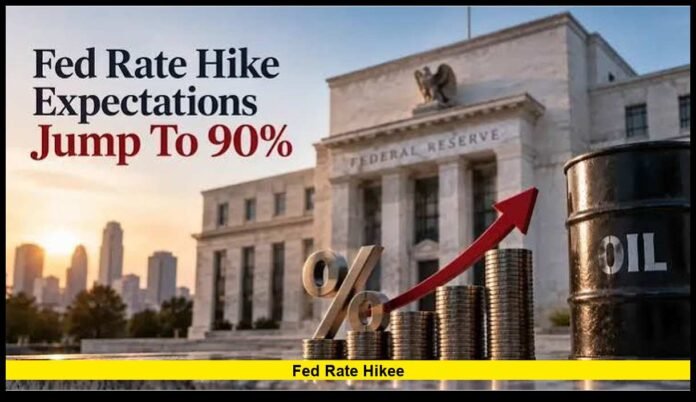

The fed rate hike announced by the Federal Reserve on September 16, 2026, has pushed the U.S. central bank’s benchmark federal funds target range to 3.75%-4%. The quarter-point increase is the first rate hike since July 2023 and comes as policymakers continue to confront inflation that remains above the Federal Reserve’s 2% objective.
The decision gives households, businesses, investors and financial markets a new set of interest-rate conditions to navigate. It also signals that the Federal Reserve is prepared to keep monetary policy restrictive while it watches inflation, employment and economic growth.
Federal Reserve Raises Rates by 25 Basis Points
The Federal Open Market Committee voted unanimously to increase the target range by 0.25 percentage point. The new range of 3.75%-4% represents a meaningful change after a lengthy period in which the Fed had moved away from rate increases.
The Federal Reserve said economic activity has continued to expand at a solid pace. Domestic spending has remained resilient, productivity growth has been strong and capital investment has been robust. The labor market has also shown relative stability, with job gains keeping pace with the workforce and unemployment changing little.
Inflation, however, remains the central concern.
The Fed said the latest action is intended to support a more timely return to its 2% inflation objective. That language is important because it shows that policymakers are placing significant weight on price stability even while the economy continues to grow.
Why the Fed Increased Interest Rates Now
Interest-rate decisions are based on a broad assessment of economic conditions rather than a single inflation report.
The September decision reflects a combination of persistent price pressures, resilient economic activity and a labor market that has not deteriorated sharply enough to force policymakers toward easier policy.
The Fed’s latest economic projections show that officials expect inflation to remain above target during 2026. The median projection for headline personal consumption expenditures inflation is 3.7% for the year, up from the 3.6% estimate published in June.
Core PCE inflation, which excludes food and energy prices, is projected at 3.4% for 2026. That is also higher than the previous 3.3% projection.
Those figures help explain why the central bank is not treating inflation as a problem that has already been solved.
What the September 2026 Economic Projections Show
The Federal Reserve’s updated projections provide a clearer picture of the policy outlook.
Officials’ median projection for the federal funds rate is 4.1% at the end of 2026. Since the current target range has a midpoint of 3.875%, the projection points toward another quarter-point increase if conditions develop in line with the median forecast.
The projections are not a promise of what the Fed will do at its next meeting. They represent policymakers’ individual assessments of the appropriate path for interest rates based on their economic expectations.
For 2027, the median federal funds rate projection is also 4.1%. The median then declines to 3.9% in 2028 and 3.6% in 2029.
That path suggests policymakers currently see restrictive monetary policy remaining in place for an extended period rather than expecting an immediate return to very low interest rates.
Could the Fed Raise Rates Again in 2026?
Another increase remains possible.
The September projections indicate that most policymakers expect the federal funds rate to move higher before the end of 2026. That could occur at either the October or December policy meeting, depending on how inflation and other economic data develop.
The important point for consumers and investors is that the September increase may not represent the final move of the year.
At the same time, future decisions are data-dependent. A forecast is not a commitment. Inflation could move differently from expectations, economic growth could change, financial conditions could tighten or loosen, or the labor market could develop in an unexpected direction.
For that reason, the October and December meetings will receive significant attention.
What the Fed Rate Hike Means for Inflation
Higher interest rates generally work by making borrowing more expensive and reducing the amount of demand circulating through the economy.
When mortgages, credit cards, business loans and other forms of financing become more expensive, households and companies may postpone some purchases or investments. Lower demand can eventually reduce pressure on prices.
However, monetary policy does not immediately change the price of gasoline, groceries, housing or other goods and services. The effects of interest-rate changes typically spread through the economy over time.
This creates a difficult balancing act for policymakers. The Fed wants to bring inflation closer to 2% without unnecessarily weakening economic activity or the labor market.
The latest projections suggest officials believe the economy is currently strong enough to handle tighter financial conditions.
How Borrowers Could Be Affected
The impact of a Federal Reserve rate increase differs from one financial product to another.
Variable-rate borrowing tends to respond more directly to changes in short-term interest rates. Credit cards, home-equity lines and some personal or business loans can therefore become more expensive as lenders adjust their rates.
For someone carrying a large revolving credit-card balance, even a modest increase in the annual percentage rate can add to total interest costs.
Borrowers with fixed-rate loans are generally insulated from an immediate change in their existing interest rate. However, people taking out new loans can encounter different pricing as banks and lenders adjust to market conditions.
What the Rate Increase Means for Mortgage Rates
Mortgage rates deserve special attention because they do not simply move in lockstep with the federal funds rate.
Thirty-year fixed mortgage rates are strongly influenced by longer-term Treasury yields, mortgage-backed securities, inflation expectations and expectations about future monetary policy.
As a result, a 25-basis-point Fed increase does not automatically translate into a 25-basis-point jump in every mortgage rate.
Still, the overall interest-rate environment matters. A central bank that signals a willingness to keep rates elevated can influence market expectations and longer-term borrowing costs.
For homebuyers, that can affect monthly payments, purchasing power and the amount of financing a household can comfortably carry.
Effect on Savings Accounts and CDs
Higher interest rates can be positive for savers, although the benefit depends on how individual banks price deposits.
Savings accounts, money-market accounts and certificates of deposit may offer higher yields when market interest rates are elevated. Banks compete for deposits in different ways, so the amount passed through to customers can vary considerably.
A consumer who keeps substantial cash in a low-yield account may therefore want to compare available annual percentage yields.
Certificates of deposit can also become attractive during periods of elevated rates, particularly for savers who are comfortable locking money away for a defined period.
The trade-off is that longer-term rates depend on market expectations. A high CD rate today does not necessarily mean rates will remain at the same level indefinitely.
Impact on Credit Cards
Credit cards are among the financial products most closely associated with changes in short-term interest rates because many card APRs are variable.
When benchmark rates rise, card issuers can adjust APRs, increasing the cost of carrying a balance.
For consumers who pay their full statement balance each month, the effect may be limited because interest generally is not charged on purchases when the account is paid according to its terms. For borrowers who carry balances, however, a higher APR can materially increase monthly finance charges.
The latest rate increase therefore puts additional importance on reducing expensive revolving debt where possible.
What the Decision Means for Businesses
Businesses also face changing financing conditions.
Companies with variable-rate debt can see borrowing expenses rise when short-term benchmark rates increase. Businesses considering expansion, equipment purchases, acquisitions or new facilities may also reassess projects when financing costs become higher.
The effect is not necessarily negative for every company. Banks and financial institutions can benefit from changes in lending and deposit spreads, although the ultimate effect depends on funding costs, credit demand and loan performance.
Companies with strong cash positions may also earn more interest income on some short-term investments.
Stock Market Reaction
Interest-rate decisions can produce immediate movements in financial markets because investors constantly adjust expectations about corporate earnings, borrowing costs and future economic growth.
Following the September 16 announcement, major U.S. stock indexes finished lower. The S&P 500 declined 0.4%, the Dow Jones Industrial Average fell 1.2% and the Nasdaq Composite edged down less than 0.1%.
A rate increase can affect different sectors differently. Growth-oriented companies may be sensitive to higher discount rates, while financial companies can respond to changes in lending conditions and yield levels.
Market reactions can also change rapidly as investors digest the Fed’s statement, economic projections and comments from policymakers.
What Happens to Bond Markets?
Bond prices and yields generally move in opposite directions.
When investors expect interest rates to remain high, yields on Treasury securities and other bonds can rise. Higher yields can put downward pressure on existing bond prices because newly issued securities may offer more attractive returns.
For investors, the changing rate environment can therefore create both risks and opportunities.
People holding individual bonds to maturity may experience a different practical outcome from investors trading bond funds, where changes in market prices can affect portfolio values immediately.
The Economic Outlook for 2026 and Beyond
The September projections show that Federal Reserve officials still expect continued economic growth.
The median projection for real GDP growth is 2.3% in 2026, 2.4% in 2027 and 2.2% in 2028. The unemployment-rate projection is 4.1% for each of those years.
Inflation is expected to gradually decline after 2026. The median PCE inflation projection falls to 2.3% in 2027, 2.1% in 2028 and 2% in 2029.
That forecast represents a gradual path toward price stability rather than an expectation that inflation will return immediately to target.
The Fed’s projections can change with incoming economic data, particularly if energy prices, geopolitical conditions, consumer spending or labor-market trends develop differently from current expectations.
Why the Next Fed Meeting Matters
The Federal Reserve’s next scheduled FOMC meeting is October 27-28, 2026.
That meeting will give policymakers another opportunity to evaluate inflation and economic activity after the September increase. Investors and consumers will be watching inflation readings, employment data, economic growth figures and financial-market conditions leading into the decision.
The December meeting on December 8-9 will provide another major opportunity for the Fed to determine whether the policy rate needs to move again.
Because policymakers have indicated that another increase is possible, every major economic report between meetings could influence expectations.
What Consumers Should Watch Now
Americans do not need to react to a Federal Reserve announcement in exactly the same way.
Borrowers should pay attention to variable-rate debt and compare refinancing or consolidation options carefully. Homebuyers should focus on the actual mortgage rates and monthly payments available to them rather than assuming the Fed’s decision determines their exact rate.
Savers can compare deposit yields and CD offers because institutions do not necessarily pass changes through at the same speed.
Investors should remember that markets often move based on expectations rather than simply reacting to the headline rate decision.
The broader financial picture matters more than one quarter-point move.
What Could Change the Fed’s Policy Path?
Several factors could alter the direction of monetary policy.
A faster-than-expected decline in inflation could reduce the need for additional tightening. Conversely, persistent inflation could lead policymakers to keep rates high or raise them again.
Economic growth is another important variable. If activity remains strong, the Fed may have more room to prioritize inflation control. If growth slows sharply or unemployment rises, policymakers could face a different balance of risks.
Energy prices are also important because sudden increases can push headline inflation higher, even though monetary policy cannot directly produce more oil or eliminate geopolitical disruptions.
The Federal Reserve will therefore continue weighing multiple indicators rather than relying on a single economic report.
Bottom Line
The September 2026 decision places the federal funds target range at 3.75%-4% and reinforces the Federal Reserve’s focus on bringing inflation back toward its 2% goal.
The updated projections point to the possibility of another increase before the end of 2026, while also showing a gradual decline in the policy rate later in the decade. For households, the immediate consequences will depend heavily on whether they borrow, save, invest or own assets affected by changing market rates.
The key issue now is what happens next. Inflation data, employment conditions, economic growth and financial-market developments will determine whether the Fed follows through with another increase or changes course.
For consumers, businesses and investors, the September decision means interest rates remain an important part of financial planning as the U.S. economy moves through the final months of 2026.
Key Points Summary
╔════════════════════════════════════════════════════════════════════╗
║ – The Federal Reserve raised its benchmark federal funds target range to 3.75%-4% in September 2026. ║
║ – The quarter-point increase was the first Fed rate hike since July 2023. ║
║ – Inflation remains above the Federal Reserve’s 2% target, keeping price stability at the center of monetary policy. ║
║ – Fed projections show a 4.1% median federal funds rate at the end of 2026, leaving room for another increase. ║
║ – Higher rates can raise costs for variable-rate borrowers while creating opportunities for some savers. ║
║ – The next scheduled FOMC meetings are October 27-28 and December 8-9, 2026. ║
╚════════════════════════════════════════════════════════════════════╝