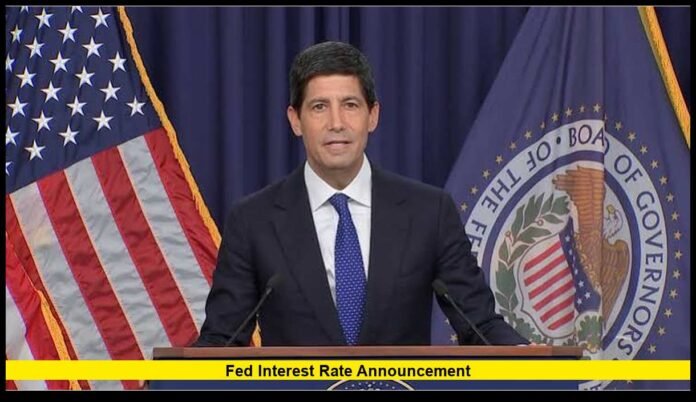

The latest Fed interest rate announcement delivered a 25-basis-point increase on September 16, 2026, moving the federal funds target range to 3.75%–4%. The Federal Open Market Committee approved the decision unanimously as policymakers responded to inflation that remains above the Federal Reserve’s 2% objective.
The move marked the first increase in the federal funds target range since July 2023. The decision followed five consecutive meetings in which the Fed kept its benchmark rate unchanged. The latest action also came with updated economic projections showing higher expected interest rates and inflation than officials had projected earlier in the year.
The September decision gives Americans, businesses and financial markets a new reference point for borrowing costs. It also provides important information about where policymakers currently see interest rates heading through the remainder of 2026 and beyond.
Federal Reserve Raises Its Benchmark Rate
The Federal Reserve raised its target range by one-quarter percentage point at its September meeting.
The new federal funds target range is:
- Previous range: 3.50%–3.75%
- New range: 3.75%–4.00%
- Rate increase: 0.25 percentage point
- FOMC vote: 12-0
- Effective date: September 17, 2026
The unanimous vote shows that all participating FOMC policymakers supported the September increase.
The decision represents a change from the Fed’s approach earlier this year. Policymakers had maintained the benchmark range through their first five meetings of 2026 before raising rates in September.
The central bank said economic activity continues to expand at a solid pace. Domestic spending remains resilient, productivity growth is strong, and capital investment remains robust.
At the same time, inflation remains elevated.
That combination is central to the latest decision. The Fed is dealing with continued price pressure while economic activity remains strong enough to support a higher policy rate.
Why the Fed Increased Interest Rates
Inflation remains the main issue highlighted in the latest policy decision.
The Federal Reserve aims for 2% inflation over the longer run. Recent price data remains above that level, creating pressure for policymakers to maintain tighter monetary conditions.
The latest Consumer Price Index data showed consumer prices increased 0.4% in August from the previous month. Prices were 3.4% higher than a year earlier.
Core consumer prices, which exclude food and energy, increased 0.3% in August and were up 2.4% over the previous year.
Producer prices also showed continuing price pressure. The Producer Price Index for final demand increased 0.4% in August and was 5.4% higher than a year earlier.
These numbers provide the backdrop for the September decision.
The Fed’s latest statement specifically said inflation remains elevated. Policymakers said the latest action is intended to support a more timely return to the central bank’s 2% inflation goal.
The Latest Rate Is Now Between 3.75% and 4%
The federal funds rate is a key short-term interest rate used by the Federal Reserve to influence financial conditions.
After the September increase, the target range now stands between 3.75% and 4%.
The Fed also adjusted several rates used to implement monetary policy.
The interest rate paid on reserve balances was raised to 3.90%. The primary credit rate increased by one-quarter percentage point to 4%.
The changes took effect September 17.
The Federal Reserve Bank of New York’s trading desk was also directed to conduct operations needed to keep the federal funds rate inside the new target range.
These technical measures allow the central bank to implement its policy decision throughout the financial system.
Federal Reserve’s New Economic Projections
The September meeting included updated economic projections covering 2026 through 2029.
The projections show that officials now expect inflation to remain above 2% for several more years.
The median forecast for personal consumption expenditures inflation is:
| Year | Median PCE Inflation |
|---|---|
| 2026 | 3.7% |
| 2027 | 2.3% |
| 2028 | 2.1% |
| 2029 | 2.0% |
The figures show a gradual decline in inflation rather than an immediate return to the Federal Reserve’s target.
The 2026 forecast is higher than the 3.6% projection released in June.
The median forecast for core PCE inflation is 3.4% for 2026, 2.5% for 2027 and 2.2% for 2028. Officials see core inflation reaching 2% in 2029.
These projections help explain why policymakers continue to expect relatively high interest rates.
Fed Officials See Higher Rates Through 2027
The September projections also changed the outlook for the federal funds rate.
The median projection places the federal funds rate at 4.1% at the end of 2026.
The median remains at 4.1% for 2027 before declining to 3.9% in 2028 and 3.6% in 2029.
That outlook represents a significant change from the June projections.
In June, officials had placed the median federal funds rate at 3.8% for the end of 2026, 3.6% for 2027 and 3.4% for 2028.
The latest projections therefore show policymakers expecting interest rates to remain higher for longer than they had anticipated earlier in the summer.
These projections are not fixed commitments. Each official’s projection reflects an assessment of appropriate monetary policy based on available economic information.
Future decisions can change as inflation, employment and economic growth data develop.
One More Rate Increase Is Reflected in the Outlook
The new rate projections point to another quarter-point increase before the end of 2026.
The current target range is 3.75%–4%. A further 25-basis-point increase would place the target range at 4%–4.25%.
The median year-end projection of 4.1% falls within that range.
This does not mean the Federal Reserve has already committed to another increase. Monetary policy decisions remain dependent on incoming economic information.
Still, the latest projections show that a higher year-end policy rate is the central tendency among officials.
The September outlook also shows rates staying elevated during 2027 before gradually declining later.
Economic Growth Remains Positive
The Federal Reserve is raising rates while maintaining a positive outlook for economic growth.
The September projections show median real GDP growth of 2.3% for 2026.
The median growth projection increases to 2.4% in 2027 before moving to 2.2% in 2028 and 2.1% in 2029.
The figures indicate that policymakers continue to expect the U.S. economy to expand.
The Fed’s latest statement also described domestic spending as resilient.
Productivity growth remains strong, while capital investment is robust.
These conditions differ from an economy experiencing a broad contraction. They also give policymakers more room to focus on inflation.
Unemployment Forecast Improves
The September projections also contain a lower unemployment outlook than the June forecast.
The median unemployment-rate projection is 4.1% for 2026, 2027, 2028 and 2029.
The June projection had placed the 2026 unemployment rate at 4.3%.
The latest Fed statement said job gains have kept pace with the workforce and that the unemployment rate has changed little.
Employment remains an important part of monetary policy because the Federal Reserve has a dual mandate covering maximum employment and price stability.
The latest figures indicate that policymakers are not currently describing the labor market as rapidly deteriorating.
Instead, inflation remains the more prominent concern in the September policy statement.
How the September Decision Differs From July
The contrast between the July and September meetings is significant.
In July, the Federal Reserve left the target range at 3.50%–3.75%.
That decision passed by a 9-3 vote.
Three policymakers preferred a quarter-point increase at that meeting.
Two months later, the FOMC unanimously approved a quarter-point increase.
The September decision therefore represents a clear change in the policy rate after the Fed had held it steady during the first part of the year.
The change came as inflation remained elevated and economic activity continued to expand.
What the Latest Inflation Numbers Show
The most recent inflation readings available before the September decision remained above the Fed’s target.
The August CPI report showed a 3.4% annual increase in consumer prices.
Gasoline prices were an important contributor to the monthly increase. The gasoline index rose 3.9% during August.
Food prices also increased during the month.
Core inflation remained above 2%, although it was considerably lower than the headline CPI rate.
The combination of headline and core inflation readings means policymakers continue to face price pressures across the economy.
The Federal Reserve’s latest projections reinforce that point by placing 2026 PCE inflation at 3.7%.
What the Latest Decision Means for Borrowing Costs
The federal funds rate does not directly determine every consumer interest rate.
However, changes in the Fed’s benchmark rate influence broader financial conditions.
Short-term borrowing rates can respond quickly to changes in monetary policy. Credit card rates, certain personal loans and other variable-rate products can therefore be affected by changes in the federal funds rate.
Long-term borrowing costs do not always move by the same amount because they also respond to Treasury yields, market expectations, lender conditions and other financial factors.
The September increase therefore does not mean every U.S. loan rate will rise by exactly 0.25 percentage point.
The impact depends on the type of financial product and its underlying pricing structure.
When Is the Next Fed Meeting?
The next scheduled Federal Open Market Committee meeting is October 27–28, 2026.
That meeting will give policymakers another opportunity to evaluate inflation, employment and economic activity.
The next major inflation reports and employment data will provide additional information before officials meet again.
The Federal Reserve’s December meeting is scheduled for December 8–9, 2026.
The December meeting will also include another round of economic projections.
As a result, the September projections should not be treated as a permanent forecast for the remainder of the year.
Key Numbers From the Latest Fed Decision
The most important figures from the September decision include:
- Federal funds target range: 3.75%–4%
- Rate increase: 25 basis points
- FOMC vote: 12-0
- Interest on reserve balances: 3.90%
- Primary credit rate: 4%
- 2026 median PCE inflation forecast: 3.7%
- 2027 median PCE inflation forecast: 2.3%
- 2028 median PCE inflation forecast: 2.1%
- 2029 median PCE inflation forecast: 2%
- 2026 median federal funds rate forecast: 4.1%
- 2027 median federal funds rate forecast: 4.1%
- 2028 median federal funds rate forecast: 3.9%
- 2029 median federal funds rate forecast: 3.6%
- 2026 median GDP growth forecast: 2.3%
- 2026 median unemployment forecast: 4.1%
Together, these figures show the current direction of Federal Reserve policy.
What to Watch After the Fed Decision
The next stage will center on incoming economic data.
Inflation remains particularly important because the Fed has explicitly identified elevated prices as a concern.
The September projections show officials expect inflation to decline, but the median forecast does not reach the 2% target until 2029.
Employment data will also remain important.
The central bank continues to monitor whether job gains remain consistent with a healthy labor market.
Economic growth will be another factor.
The latest projections show continued expansion, with real GDP growth expected to remain above 2% through 2029 in the median forecast.
These indicators will help shape future policy decisions.
Bottom Line on the Latest Fed Decision
The Federal Reserve raised its benchmark interest-rate target by 25 basis points on September 16, bringing the federal funds range to 3.75%–4%. The unanimous 12-0 decision was the first rate increase since July 2023.
Inflation remains above the Federal Reserve’s 2% goal, while economic activity continues to expand at a solid pace. The new projections show a 3.7% median PCE inflation forecast for 2026 and a 4.1% median federal funds rate projection for the end of the year.
The latest outlook also keeps the median federal funds rate at 4.1% for 2027 before showing gradual declines in 2028 and 2029.
The next scheduled FOMC meeting will take place October 27–28, with policymakers expected to assess the latest inflation, employment and economic data available at that time.
What are your thoughts on the latest Federal Reserve decision? Share your view in the comments and stay updated as new U.S. interest-rate developments emerge.