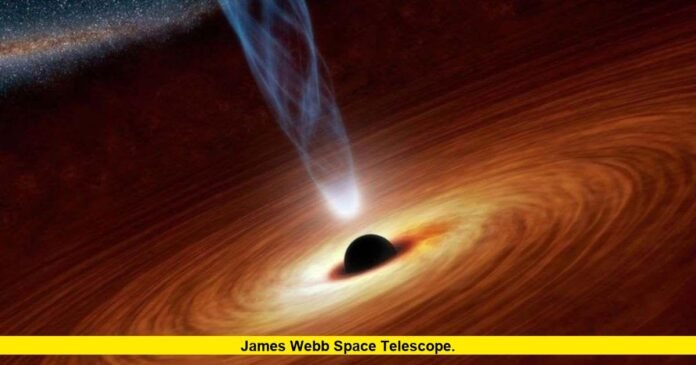

The James Webb Space Telescope (JWST) remains one of the most important observatories in modern astronomy, and its latest observations continue to reveal surprising details about distant galaxies, exoplanets, black holes and objects much closer to home. As of the latest update, one of the newest Webb-related findings involves the changing rings of the small outer-Solar-System body Chariklo, while other recent research is reshaping scientists’ understanding of the early universe.
What Is the James Webb Space Telescope?
The James Webb Space Telescope, commonly called Webb or JWST, is a large infrared space observatory operated through an international partnership between NASA, the European Space Agency (ESA) and the Canadian Space Agency (CSA).
Webb launched on December 25, 2021, aboard an Ariane 5 rocket from French Guiana and reached its operating region near the Sun-Earth L2 point in January 2022. Unlike the Hubble Space Telescope, Webb does not orbit Earth. It travels around the Sun near L2, approximately 1.5 million kilometers (about 1 million miles) from Earth.
NASA describes Webb as its premier space science observatory for studying different stages of cosmic history, from the earliest galaxies to the formation of stars, planets and planetary systems.
Why Is the James Webb Space Telescope So Important?
Webb was designed primarily to observe infrared light. This is especially useful because infrared wavelengths can pass through clouds of cosmic dust that block visible light.
The telescope can therefore investigate objects and environments that earlier observatories could not study in the same detail.
Its major scientific goals include:
- Studying the first galaxies that formed after the Big Bang
- Understanding how galaxies evolved
- Examining the birth of stars
- Studying the formation of planetary systems
- Investigating exoplanet atmospheres
- Observing planets, moons, asteroids and comets in our Solar System
- Examining black holes and the environments around them
- Searching for clues about the chemical ingredients associated with potentially habitable worlds
Webb’s primary mirror measures about 6.5 meters (21.3 feet) across and consists of 18 hexagonal segments coated with gold. Its instruments cover wavelengths from roughly 0.6 to 28.5 microns, extending from visible red light through near-infrared and mid-infrared wavelengths.
How Does the James Webb Space Telescope Work?
Webb’s enormous mirror collects extremely faint light from distant astronomical objects and directs it toward its scientific instruments.
Because infrared observations are sensitive to heat, the telescope needs to remain extremely cold. A giant, five-layer sunshield approximately the size of a tennis court protects Webb’s instruments from the heat and light of the Sun, Earth and Moon.
Webb’s location near L2 also helps keep its observing environment stable. The telescope follows a halo orbit around L2 while traveling around the Sun with Earth.
What Instruments Does Webb Have?
The James Webb Space Telescope has four primary scientific instruments:
NIRCam
The Near Infrared Camera (NIRCam) is Webb’s main near-infrared imaging instrument. It is used to capture detailed images of galaxies, stars, nebulae and other objects and also plays an important role in studying exoplanets.
NIRSpec
The Near Infrared Spectrograph (NIRSpec) separates infrared light into spectra. Scientists can use those spectra to determine the chemical composition, temperature and other characteristics of astronomical objects.
NIRSpec can observe multiple objects at once and supports several spectroscopy techniques across approximately 0.6 to 5.3 microns.
MIRI
The Mid-Infrared Instrument (MIRI) observes longer infrared wavelengths than Webb’s near-infrared instruments. It is particularly useful for studying cool objects, dust, star formation and distant galaxies.
NIRISS
The Near Infrared Imager and Slitless Spectrograph (NIRISS) provides imaging and spectroscopy capabilities and can be used for several specialized observing techniques.
Together, the four instruments cover a broad range of infrared observations.
Latest James Webb Space Telescope Discovery: Chariklo’s Rings Are Changing
One of the newest Webb-related developments as of the latest update concerns 10199 Chariklo, a small body located between the orbits of Saturn and Uranus.
Chariklo is only about 250 kilometers (155 miles) across, yet it has two narrow rings. Scientists discovered those rings in 2013.
A new study published in Science Advances in September 2026 reports that the two rings appear to have changed in different ways. Observations made with Webb in 2022 were compared with previous stellar-occultation observations.
The inner ring showed higher opacity, while the outer ring showed lower opacity. In other words, the two rings appear to be evolving in opposite directions.
The observation is particularly significant because the rings are too small and distant to be directly photographed, even with Webb. Instead, astronomers used a stellar occultation, measuring tiny changes in a background star’s light as Chariklo’s rings passed in front of it.
Scientists say the physical reason for the changes is not yet settled. Possible explanations include genuine changes in the ring material, wavelength-dependent effects or a combination of factors.
Webb and the Mystery of the Little Red Dots
Another major area of Webb research involves mysterious objects known as little red dots.
Webb first revealed large numbers of these compact red sources in the early universe. Their nature has puzzled astronomers because they do not always behave like familiar active galactic nuclei.
Recent research has strengthened the possibility that at least some little red dots represent highly active supermassive black holes surrounded by dense gas.
In June 2026, NASA reported particularly strong evidence from the object GLIMPSE-17775. Webb obtained what NASA described as the deepest spectrum yet of a little red dot, with more than 40 spectral lines identified. Multiple features supported a model in which the object contains a supermassive black hole surrounded by a dense cocoon of partially ionized gas.
Scientists are still investigating whether this explanation applies broadly to the entire little-red-dot population.
Webb Is Helping Explain What Happens to Little Red Dots
Research published in July 2026 offered another possible piece of the puzzle.
Astronomers studied a lower-redshift spiral galaxy nicknamed the Saguaro. Its compact red center resembles the little red dots Webb sees in the distant universe.
The researchers proposed that little red dots could represent a temporary stage in the development of highly active supermassive black holes rather than being an entirely separate type of galaxy. However, NASA emphasizes that the Saguaro is not necessarily representative of every little red dot, so additional observations are needed.
This work illustrates one of Webb’s major strengths: it can study very distant objects and compare them with closer examples that may represent later stages of cosmic evolution.
Webb Finds a Hidden Planet in the Beta Pictoris System
Webb has also been making important advances in exoplanet research.
In 2026, astronomers using Webb identified Beta Pictoris d, a previously hidden giant planet in the young Beta Pictoris planetary system.
The system was already known to contain Beta Pictoris b and Beta Pictoris c. The new planet makes Beta Pictoris one of only a small number of planetary systems with at least three directly imaged planets.
What makes the discovery especially interesting is that Beta Pictoris d was identified through the chemical fingerprint of its atmosphere, rather than simply being recognized as a bright point of light. Webb’s NIRSpec instrument played a key role in mapping the system’s chemical characteristics.
Webb and the Most Distant Parts of the Solar System
Webb is not only a telescope for studying the early universe.
In September 2026, NASA reported that researchers combined Hubble and Webb observations to study trans-Neptunian objects, small and faint bodies orbiting beyond Neptune.
These objects preserve clues about the early stages of planet formation because they are remnants from a region where the process of building large planets did not proceed to completion. Webb’s infrared capabilities help researchers investigate these extremely faint targets.
The research demonstrates how Webb can contribute to both cosmology and relatively nearby Solar System science.
Webb’s Other Recent Scientific Highlights
The telescope’s recent science program has produced discoveries across a remarkably broad range of subjects.
ESA’s 2026 Webb archive includes research involving:
- Dust and water surviving surprisingly close to the Milky Way’s central supermassive black hole
- The Lion Nebula and its detailed structures
- The unusual history of the stellar system Terzan 5
- Early black holes and their host galaxies
- Little red dots in the young universe
- Exoplanets and planetary atmospheres
One particularly important result concerns a black hole in the distant galaxy Abell2744-QSO1. Webb observations provided a mass measurement suggesting that the roughly 50-million-solar-mass black hole may have formed before its host galaxy, adding important evidence to the debate over how the earliest supermassive black holes developed.
How Far Back Can the James Webb Space Telescope See?
Webb is designed to observe light that has traveled for more than 13 billion years.
Because light takes time to travel, looking at extremely distant galaxies effectively means looking into the universe’s past. Webb’s sensitivity to infrared wavelengths is particularly valuable for observing ancient galaxies whose light has been stretched toward longer wavelengths by the expansion of the universe.
NASA says Webb is designed to investigate the first galaxies and the earliest luminous structures that formed after the Big Bang.
It is important to understand that Webb does not literally see the Big Bang itself. Instead, it observes increasingly ancient light from objects that formed relatively soon after the universe began.
Does James Webb Replace Hubble?
No. Webb and Hubble are complementary observatories.
Hubble primarily observes ultraviolet, visible and some infrared wavelengths, while Webb is optimized for infrared astronomy. Their different capabilities allow scientists to combine observations and obtain a more complete picture of astronomical objects.
Recent research on distant trans-Neptunian objects and little red dots demonstrates how combining Webb data with Hubble observations can reveal information that would be difficult to obtain from either telescope alone.
Is the James Webb Space Telescope Still Operating?
Yes. The James Webb Space Telescope remains an active mission and continues to serve astronomers worldwide.
NASA’s current mission information lists Webb as an active observatory and says it is serving thousands of astronomers while studying everything from the early universe to nearby planetary systems.
The mission was initially designed around a nominal operating lifetime of approximately five to 10 years. Actual mission longevity depends on factors including propellant consumption, spacecraft health and operating conditions.
Why Webb’s Latest Discoveries Matter
The significance of the James Webb Space Telescope goes beyond spectacular space images.
Its observations are changing scientific understanding in several areas simultaneously. Webb is helping astronomers investigate how the first galaxies formed, how black holes grew, how planetary systems evolved and how atmospheres behave on worlds outside our Solar System.
The latest Chariklo findings are a good example. A telescope designed to study the earliest galaxies can also detect subtle changes in a tiny ring system billions of kilometers away. That versatility is one reason Webb has become such an important astronomical facility.
At the same time, scientists are careful not to treat every intriguing Webb observation as a final answer. Many discoveries raise new questions, and several of the telescope’s most interesting targets remain under active investigation.
What Can We Expect From the James Webb Space Telescope Next?
Webb’s scientific program is expected to continue exploring distant galaxies, black holes, stars, exoplanets and objects within the Solar System.
Future observations will be particularly valuable for testing competing explanations for mysterious early-universe objects such as little red dots, improving measurements of exoplanet atmospheres and examining how planetary systems form and evolve.
As more Webb observations accumulate, astronomers can also revisit earlier targets and compare them with newer measurements. The changing Chariklo rings demonstrate the value of this long-term approach: repeated observations can reveal evolution that a single snapshot would never show.
James Webb Space Telescope: Latest Update
As of the latest update, Webb remains fully engaged in scientific research, with recent results ranging from the changing rings of Chariklo to new insights into early black holes, little red dots, exoplanets and distant Solar System objects.
The newest Chariklo research is particularly notable because it shows that even a small and distant ring system can change on relatively short timescales. Meanwhile, Webb’s continuing observations of the early universe are helping scientists refine their understanding of how galaxies and black holes developed during cosmic dawn.
What do you think the James Webb Space Telescope will reveal next? Share your thoughts in the comments and stay tuned for the latest Webb discoveries.